
Why Data Center Developers Need One Coordinated Power Equipment Supplier
Interface risk, not unit price, is what delays data center power rooms—and most of it lives in the gaps between suppliers
Introduction
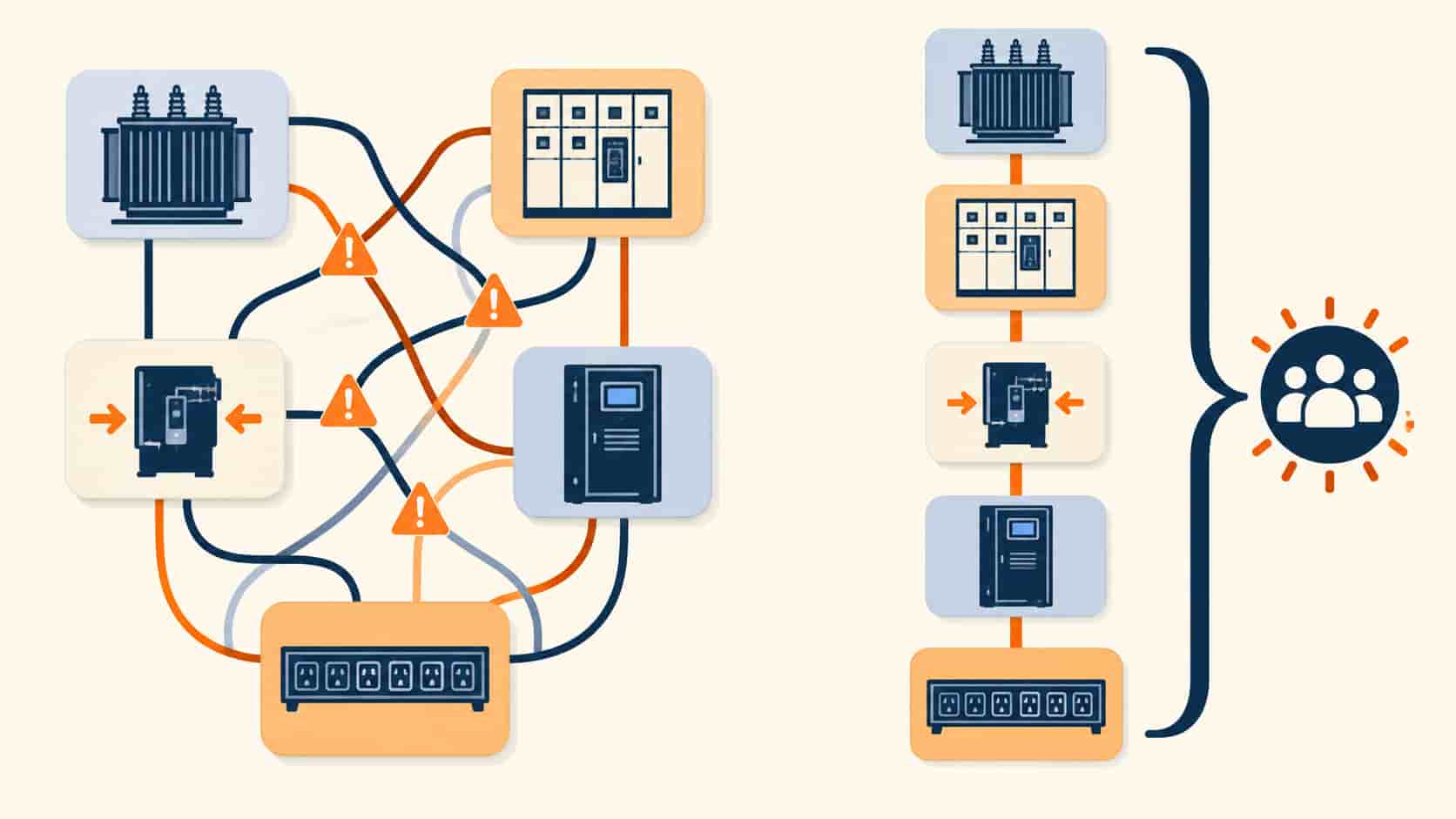
Data center power rooms are assembled from a short list of major items: transformers, medium-voltage and low-voltage switchgear, automatic and static transfer switches, UPS systems with their battery banks, power distribution units, busway, cabling and the protection and monitoring that sits across all of them. Each of those items is available from specialist manufacturers, and each specialist will tell you—correctly—that they make the best version of their own product. The problem is not the quality of any single item. It is what happens where they meet.
Every interface between two pieces of electrical equipment is a place where two data sheets must agree, two protection philosophies must coordinate, two sets of physical dimensions and cable entry positions must line up, and two delivery schedules must be reconciled. Multiply that by the number of suppliers and the number of interfaces grows faster than the number of items. That is the arithmetic that makes a data center power package hard, and it is the reason an increasing number of developers buy the package as a coordinated set rather than as a shopping list.
This article works through where multi-vendor procurement actually costs money, what “one coordinated supplier” realistically means, where the model does and does not suit a project, and how to structure the package so the coordination is real rather than a marketing claim. For the equipment context, see our data center and critical power range.
The Real Cost of Multi-Vendor Procurement
The costs of a fragmented power package are almost entirely invisible at the purchase-order stage, which is precisely why they persist. They appear later, as follows.
Interface engineering. Someone has to check that the UPS input breaker matches the switchgear feeder, that the transformer impedance suits the downstream protection, that the ATS rating covers the actual fault level, that cable sizes match both ends’ terminations. With one supplier this is an internal check; with five it is a set of meetings, and the meetings happen on the developer’s schedule and at the developer’s cost. The same problem appears in cable scope, where terminations, joints and trays must match equipment specified by someone else.
Protection coordination across ownership boundaries. Discriminating correctly between upstream and downstream devices requires seeing the whole single-line diagram and the actual device curves. Each specialist can optimize their own zone; nobody owns the boundary. The technique itself is documented in our guide to reading a switchgear single line diagram, and it becomes materially harder when each board arrives from a different supplier. Miscoordination shows up as nuisance tripping, or worse, as a failure to clear a fault—discovered during commissioning, when remediation means replacing devices and re-testing.
Schedule divergence. Five suppliers, five production schedules, five shipping dates, five customs clearances. A single late item—often a minor one like a control module or a specific cable drum—holds up the energisation of a complete power train. With one supplier, internal sequencing absorbs part of that risk; across five, the risk is entirely the developer’s.
Documentation and compliance scatter. Test certificates, type approvals, as-built drawings and warranty terms arrive in five formats, five languages and five documentation conventions, and someone has to assemble them into one submission. That assembly is a real cost, and it recurs at every project.
Warranty blame allocation. When a failure occurs at an interface, the failure investigation becomes a negotiation. Each vendor has a defensible reason why their equipment was within specification. The developer pays for the downtime while the discussion proceeds. This is precisely the pattern the certification evidence in our switchgear manufacturer verification checklist is designed to prevent, by fixing the standard each device is tested to before delivery rather than after a failure.
What "One Coordinated Supplier" Actually Means
The phrase is used loosely by vendors, so it is worth being precise. It does not require that every item be manufactured under one roof—few suppliers globally can claim that across a full data center electrical scope. What it requires is that a single party takes contractual and engineering responsibility for the interfaces, which in practice means four things.
One engineering authority. A single technical contact who owns the whole single-line diagram, who can answer questions about how the pieces interact, and who can produce a coordination study covering the complete system rather than one zone of it. This is the single most valuable element of the model, and the one most often missing from vendors who merely resell.
Ratings agreed as a set. Transformers, switchgear, transfer switches, UPS and distribution specified against one load schedule and one fault level calculation, so that no item is quietly undersized relative to its neighbours or oversized to cover an unknown.
Coordinated delivery. A delivery plan that sequences items to the site’s actual build order, with the supplier holding responsibility for the sequencing rather than shipping everything to a date that suits production.
One documentation and support commitment. A single documentation set, a single warranty framework, a single commissioning and service interface.
Where a supplier genuinely combines manufacturing breadth with engineering capability, the model becomes quite strong: they can design the package, build most of it, and take responsibility for the interfaces with the few items they source. That is the configuration worth looking for.
Where the Interfaces Actually Bite
| Interface | What Must Agree | Typical Failure | Who Pays When It Does |
|---|---|---|---|
| Transformer to LV switchgear | Impedance, fault level, termination layout, protection settings | Nuisance tripping or miscoordinated clearing | Developerâvia remediation and delay |
| Switchgear to ATS/STS | Rating against fault level, control wiring, transfer logic and interlocks | Transfer sequence faults found at commissioning | Developerâvia rework and retest |
| ATS/STS to UPS | Transfer timing, input window, bypass arrangement, control interface | Unintended UPS transfers or failed bypass | Negotiated between two vendors; time lost |
| UPS to PDU and busway | Neutral and earthing arrangements, rating, physical connection | Site-fit problems and derating disputes | Developerâvia site modification |
| Power cabling throughout | Size, insulation, routing, termination compatibility at both ends | Wrong drum lengths and mismatched lugs | Developerâvia expedited reorder |
| Monitoring and controls | Protocols, alarm taxonomy, data points, integration scope | Islands of data no NOC can read together | Developerâvia integration project |
None of these failures is exotic, and none indicates poor equipment. They are the predictable consequence of each supplier optimizing their own boundary. The important observation is the last column: in every case the cost lands on the developer. There is no mechanism by which the interface risk self-corrects across independent vendors, which is the whole argument for consolidating it deliberately.
When One Supplier Is Not the Right Answer
The coordinated model is strong but not universal, and pretending otherwise undermines the case. There are situations where multi-vendor procurement is genuinely better.
Genuine single-source specialization. Where an item has no credible alternative—a particular switchgear family the utility mandates, a PDU form factor the tenant’s IT standard requires—you buy that item from its maker and manage the interface around it. Consolidation should not mean accepting an inferior product to keep the supplier count down.
Local content and regulatory requirements. Some jurisdictions require locally manufactured or locally certified equipment for parts of the scope. A single coordinated supplier must be able to work with those constraints rather than pretend they do not exist—and a supplier who has done it before is worth more than one who has not.
Very large or highly unusual scopes. At a certain scale, a developer may have the in-house engineering depth to own the interfaces themselves and may prefer to buy each item at its most competitive price. That is a legitimate strategy—it simply requires acknowledging that the coordination work has moved in-house and staffing it accordingly.
Existing standardized estate. An operator with an established equipment standard and in-house maintenance capability may prefer to keep buying the same items. In that case the interfaces are already solved, and re-solving them through a new supplier adds risk rather than removing it.
Equipment Breadth and the Limits of Scope
When evaluating whether a supplier can genuinely coordinate a data center power package, scope breadth matters—but so does honesty about the edges. The useful questions are concrete: can they supply the transformer and the low-voltage switchgear that connects to it? Can they provide the transfer switches and the UPS together, with one coordination study covering the sequence between them? Do their PDUs and busway match their own UPS output characteristics? And where an item falls outside their manufacturing scope, do they take responsibility for specifying and integrating it, or do they simply pass it through?
Interface responsibility is the thing to test. A supplier who manufactures switchgear, transfer switches and UPS can eliminate the three most failure-prone interfaces in the package—the ones between protection, transfer and continuity—because those all live inside their own engineering documentation. That is a meaningful advantage, and it is checkable by asking to see the coordination study for a completed project rather than a capability statement. Our guide to choosing switchgear for a substation project sets out the selection questions that sit underneath those interfaces.
Where the package extends beyond the supplier’s own range—cabling, for instance, or particular busway systems—the question is whether they specify and warrant the interface or merely quote someone else’s product. Both models exist; only one removes the risk from the developer.
Structuring the Package So Coordination Is Real
Whatever the supplier mix, coordination has to be written into the contract rather than assumed from the sales conversation.
Make one party responsible for the single-line diagram. The coordinating supplier should own the complete electrical single-line diagram and the protection coordination study, with a defined review and approval cycle. If that responsibility is not assigned, it defaults to the developer’s engineering team—which may be the right answer, but it should be a decision, not a gap.
Define the interface matrix in the contract. A simple table listing every interface, which party specifies it, which party warrants it and what evidence is required. This is a one-page document that prevents most interface disputes.
Require a combined FAT where interfaces can be tested. Testing the switchgear, transfer switch and UPS as a set at the factory—even a partial integration test—catches control and timing issues before they arrive on site. This is one of the highest-value provisions in a consolidated package and is difficult to arrange across independent vendors.
Specify one documentation set and one language. As-built drawings, test certificates, O&M manuals and warranty terms in a single format and language, delivered as one package. This is a small clause with a large effect on the commissioning phase.
Align payment to commissioning milestones, not shipment. A delivery-based payment schedule rewards shipping; a commissioning-based one rewards working systems. For a coordinated package, the latter is a stronger alignment of interests.
What to Ask Before Appointing a Coordinating Supplier
| Interface | What Must Agree | Typical Failure | Who Pays When It Does |
|---|---|---|---|
| Transformer to LV switchgear | Impedance, fault level, termination layout, protection settings | Nuisance tripping or miscoordinated clearing | Developerâvia remediation and delay |
| Switchgear to ATS/STS | Rating against fault level, control wiring, transfer logic and interlocks | Transfer sequence faults found at commissioning | Developerâvia rework and retest |
| ATS/STS to UPS | Transfer timing, input window, bypass arrangement, control interface | Unintended UPS transfers or failed bypass | Negotiated between two vendors; time lost |
| UPS to PDU and busway | Neutral and earthing arrangements, rating, physical connection | Site-fit problems and derating disputes | Developerâvia site modification |
| Power cabling throughout | Size, insulation, routing, termination compatibility at both ends | Wrong drum lengths and mismatched lugs | Developerâvia expedited reorder |
| Monitoring and controls | Protocols, alarm taxonomy, data points, integration scope | Islands of data no NOC can read together | Developerâvia integration project |
- Engineering depth: who owns the single-line diagram and the coordination study, and can you see a completed example?
- Manufacturing breadth: which items are made in-house, and for items that are not, who specifies and warrants the interface?
- Reference projects: a delivered data center power package of comparable scope, with contactable references rather than a logo list.
- Schedule capability: committed production slots against your build sequence, not a single aggregate delivery date.
- Integration testing: willingness to perform combined factory testing of the transfer and UPS sequence, with witness provision.
- Documentation: a single as-built set, test reports and O&M in the project language, delivered as one package.
- Service and spares: commissioning support, training, and a spares strategy covering the installed base after handover.
Conclusion
The case for a coordinated power equipment supplier is not that one company makes every item better than every specialist. It is that the interfaces between items—where protection must coordinate, timing must agree, dimensions must fit and documentation must reconcile—are where data center power projects actually lose money and schedule. Consolidating those interfaces under one responsible party converts a set of negotiations into an engineering task, and that conversion is the value.
The right approach for most developers is neither purist: consolidate the high-interface items—switchgear, transfer switches, UPS and distribution—under one supplier who can own the coordination study and the combined test, and source genuinely specialized or locally mandated items separately with the interface explicitly specified. What matters is that the interface matrix exists and has an owner. KXY E-Power Group manufactures and supplies the core data center power package—switchgear, transformers, transfer switches, UPS and distribution—and takes responsibility for the interfaces between them; send us your single-line diagram and load schedule and we will respond with a coordinated package rather than a parts list.
Frequently Asked Questions
Recent Posts

Voltage Stabilizers vs UPS: Do You Need Both?
Voltage Stabilizers vs UPS: Do You Need Both? One device fixes how high or low the voltage is; the other fixes whether there is voltage

Energy Storage for Data Centers: A Growing Backup Power Option
Energy Storage for Data Centers: A Growing Backup Power Option Batteries have always backed up data centers in the form of UPS strings. Grid-scale BESS
Thermal Runaway in Lithium Batteries: What BESS Buyers Should Understand
Thermal Runaway in Lithium Batteries: What BESS Buyers Should Understand How thermal runaway starts, how it propagates, and which evidence buyers should require before approving