
Cable Drum Packaging for Export: Specs, Marking and Transit Protection
Quick Answer: Export packaging is a technical specification: drum size for weight and bend radius, ISPM 15 timber, transit-proof lagging, and marking keyed to the test report. Between the end of the extrusion line and the trench at your site sits the least glamorous component in the cable system: the drum. It's also the one most often treated as an afterthought, and the one whose failures get photographed most bitterly on receiving day. Crushed flanges from forklift blades, lagging gone, cable buried under a collapsed crate, drum ends soaked by a month of salt air. Packaging failures don't just dent wood. They impose bends, kinks and moisture on a product that stores mechanical memory. This guide treats the drum as what it is: the factory's last quality gate and your site's first one.
Introduction
Cable is a long, elastic product with a minimum bend radius, a maximum pulling tension and a total dislike of being crushed. The drum’s job is to hold those limits through weeks of ocean transit, multiple crane cycles and unknown handling at every intermediate yard, conditions the factory neither controls nor witnesses. That’s why packaging belongs in the technical specification rather than the freight annex: the same discipline that fixes the cable’s construction should fix what carries it. Buyers who treat packaging as a spec line get drums that survive. Buyers who leave it to “standard export packing” find out what that phrase means when a claim is being disputed. Packaging decisions also interlock with the shipping terms themselves. The responsibility handoffs described in FOB vs CIF for power equipment determine who owns the cable during exactly the transit stages where drum failures happen. And when drums arrive late or damaged, they’re rarely late alone. Packaging is one of the quiet contributors cataloged in cable sourcing delays and EPC timelines.
Why Packaging Is a Technical Spec, Not Logistics
The engineering reason is simple: cable has mechanical memory. A cable bent too tightly on an overloaded drum doesn’t forget the bend. The conductor work-hardens at the curve, the insulation carries a stress point, and the defect may surface years later as a termination failure nobody connects to a transit event. Overfilling a drum to save freight money packs the turns too tightly and exceeds the flange rating. Under-specifying the drum for the cable’s weight lets the barrel sag and the lower turns crush. A properly sized drum leaves clearance for the bend radius, spreads the weight through barrel and flanges, and seals the cable from water and dust with lagging and battens. None of this is visible on a quotation, which is why the specification must be written down: drum type, construction, treatment, protection and marking, with the same seriousness as the voltage rating. A factory that sizes drums correctly is also signaling something about its overall discipline. The plant that respects the bend radius in transit usually respects it everywhere.
The Drum Itself: Types, Construction and Sizing
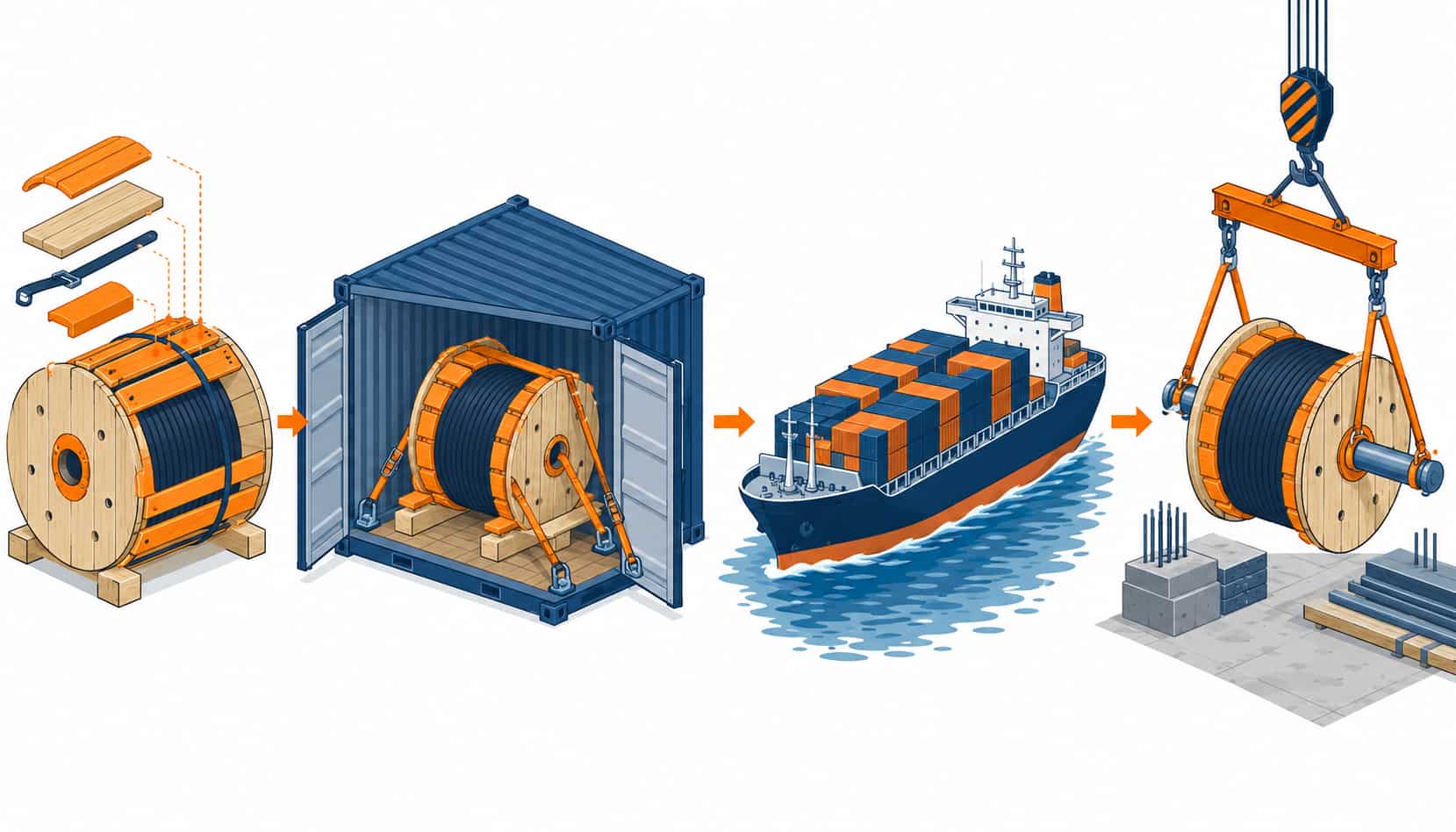
Export practice uses three drum families. Wooden drums are the export default for power cable: flanges and barrel of seasoned timber, battens sealing the cable surface, and the non-negotiable line, heat treatment to ISPM 15 for phytosanitary compliance, stamped on the drum. Steel drums and steel-reinforced designs serve the heavy end: large MV and HV lengths where a wooden flange would deform under tonnes of cable, and where the drum will be reclaimed and reused. Steel or plastic reels serve small control and building wire, often packed in cartons for the last mile. Sizing is the part buyers should check rather than delegate. The drum diameter must respect the cable’s minimum bend radius, the drum width must fit the cable length without over-packing, and the flange strength must match the total weight. A loaded drum of large-section MV cable can exceed a tonne, and the arithmetic is the factory’s but the verification is yours. For ocean freight, drums are typically crated or shrink-wrapped and restrained on the pallet footprint. Loose drums rolling in a container are a claim waiting to be photographed.
| Spec Line | What It Controls | Buyer Check |
|---|---|---|
| Drum type and material | Wooden export drum, steel for heavy lengths, reels for small cable | Type matched to cable weight and length, not to freight convenience |
| ISPM 15 treatment | Phytosanitary compliance for wooden packaging | HT stamp visible on flange; missing stamp can stop customs clearance |
| Drum sizing | Bend radius clearance, length capacity without over-packing | Diameter vs cable's minimum bend radius; fill not exceeding flange |
| Flange and barrel strength | Stacking, crane cycles, transit shock | Rated for loaded weight; steel reinforcement for heavy MV lengths |
| Lagging and sealing | Water, dust and UV protection of the cable surface | Full lagging plus shrink-wrap; cable ends sealed against moisture |
| Marking and traceability | Drum ID, meter marks, specification, test report keying | Markings match shipping documents and the batch report's IDs |
Marking and Traceability on the Drum
A drum is a document, and the marking is where the paper trail touches the physical product. Every export drum should carry, permanently and legibly: the drum ID that the batch test report keys to, the printed meter marks on the cable itself as it winds, the specification line as ordered, gross and net weight, the manufacturer’s name, and the direction-of-rolling arrow that tells the next handler how to pay out without kinking. The drum ID is the hinge of the whole evidence chain. It turns a generic report into proof about the drums on the truck, and it’s the first thing to photograph on receiving day before anything is unwrapped. Missing or illegible marking isn’t a cosmetic defect. It breaks the chain connecting your drums to the tests that qualified them, and it turns any future claim into an argument instead of a lookup. Marking discipline is one of the small, checkable habits that separate a manufacturer from an assembler, the same habit layer verified during the site visit in the power cable manufacturer checklist.
How Cable Gets Damaged in Transit
The damage modes are few, repetitive and preventable. Crushing comes first: forklift blades through flanges, drums stacked above their rating, container loads restrained so the drums carry the load of shifting cargo. Moisture follows. Cable ends left unsealed wick water into the conductor interstices during weeks of humid transit, and water inside a drum migrates along the cable; the long-term consequence, moisture-driven insulation degradation, is one of the slow failure modes in common cable failure causes. Impact and rolling come from unrestrained drums in containers and from drops at intermediate yards where nobody knows the drum’s weight. Abrasion comes from loose lagging: battens that fall off in transit leave cable turns rubbing on flange edges for thousands of kilometers. Every mode maps to a protection line, whether restraint plans, sealed ends, rated stacking or fixed lagging, and that mapping is the specification. When a drum arrives damaged, the receiving protocol matters as much as the cause: photograph everything before moving it, note exceptions on the delivery document, and notify within the claim window the shipping terms define.
| Damage Mode | How It Happens | Prevention in the Spec |
|---|---|---|
| Flange crushing | Forklift blades, stacking above rating | Rated flanges, stacking limits marked, handling instructions on drum |
| Water ingress | Unsealed ends, missing lagging, condensation cycles | Sealed cable ends, full lagging, shrink-wrap; end-cap check on arrival |
| Rolling and impact | Unrestrained drums in container, drops at yards | Chocks and restraint plan, crating for small drums, weight marked |
| Over-bend memory | Over-packed drums, payout against the rolling arrow | Sizing for bend radius, direction arrow marked, payout guidance in documents |
| Abrasion of turns | Loose battens and lagging lost in transit | Fixed battens, banded lagging, banding tension checked before loading |
| Marking loss | Painted-on labels on the exposed face only | Marking on multiple faces plus attached weatherproof tag |
Packing for the Last Mile: Site Handling and Storage
Most transit protection is wasted if the last kilometer undoes it. The delivery documents should carry the handling rules: lift drums with a spindle through the barrel or a forklift with blades wider than the flange footprint, never on the flange edge; roll only in the marked direction; leave drums on firm ground with the cable end sealed until pulling day. Storage rules matter for projects with gaps between delivery and installation. Drums go on sleepers rather than soil, ends get resealed after any sampling, and outdoor storage is acceptable for most constructions as long as UV-sensitive jackets are shaded. The unloading plan is part of the packaging scope, not the installer’s improvisation. A drum that survived six weeks of ocean freight can be destroyed by one careless crane cycle at the gate. Factories that ship as part of a coordinated package, the model described in one coordinated power equipment supplier, extend their packaging and handling documentation to the site boundary, because the claim conversation always happens where the damage is discovered, not where it occurred.
When Packaging Is Not the Answer
Packaging protects cable from transit, but it can’t protect cable from everything, and three limits are worth naming. It doesn’t survive bad installation: a drum delivered flawless and paid out against a capstan sized wrong, or bent around a corner sheave below the radius, absorbs damage no specification can prevent. The pulling-tension and bend-radius disciplines belong to the installation side. It doesn’t substitute for inspection either. Drums should be examined and photographed at receiving regardless of how well they’re packed, because the claim window closes and the evidence leaves with the truck. And it doesn’t fix documentation gaps: a perfectly packed drum with no drum ID on the report is still an unprovable drum. Packaging is the last quality gate, not the quality system. The system is what the audit in the EPC sourcing guide verifies, and the packaging spec is one of its outputs.
RFQ Checklist: Specifying Export Packaging
Write the drum into the contract with the same care as the cable:
- Drum type and construction stated per cable size and length
- ISPM 15 heat treatment required, stamp visible on every wooden drum
- Drum sizing respects the cable’s minimum bend radius; no over-packing
- Flange rating matched to loaded weight; stacking limits marked
- Cable ends sealed against moisture; lagging and shrink-wrap complete
- Drum ID, meter marks and specification marked on multiple faces
- Container restraint and chocking plan stated before loading
- Handling and payout instructions attached to each drum
- Receiving inspection and photographic protocol agreed, with claim windows
Conclusion
The drum is the cable’s exoskeleton for the worst month of its life. Specified properly, sized for the bend radius, built for the weight, treated for customs, marked for traceability and restrained for transit, it delivers the tested product to the trench with its evidence chain intact.
Kexingyu Cable Group (KXYE) treats export packaging as part of the specification: ISPM 15 timber, drums sized to the cable, sealed ends, drum IDs that match the batch reports, and handling documentation that follows the delivery to your site gate.
Recent Posts

Power Cable Warranty Terms: What to Demand and What to Watch For
Power Cable Warranty Terms: What to Demand and What to Watch For Quick Answer: A usable warranty names its scope, duration, evidence standard, exclusions and

The Cable Sample Approval Process: What to Test Before Mass Production
The Cable Sample Approval Process: What to Test Before Mass Production Quick Answer: Sample approval tests the supplier’s claims while changes are still cheap —

Copper Purity in Cable Conductors: Grades, Risks and How to Verify Them
Copper Purity in Cable Conductors: Grades, Risks and How to Verify Them Quick Answer: Cable conductors use electrolytic tough pitch copper at about 99.9 percent