UAE Cable Imports: ECAS and Civil Defence Fire System Approvals
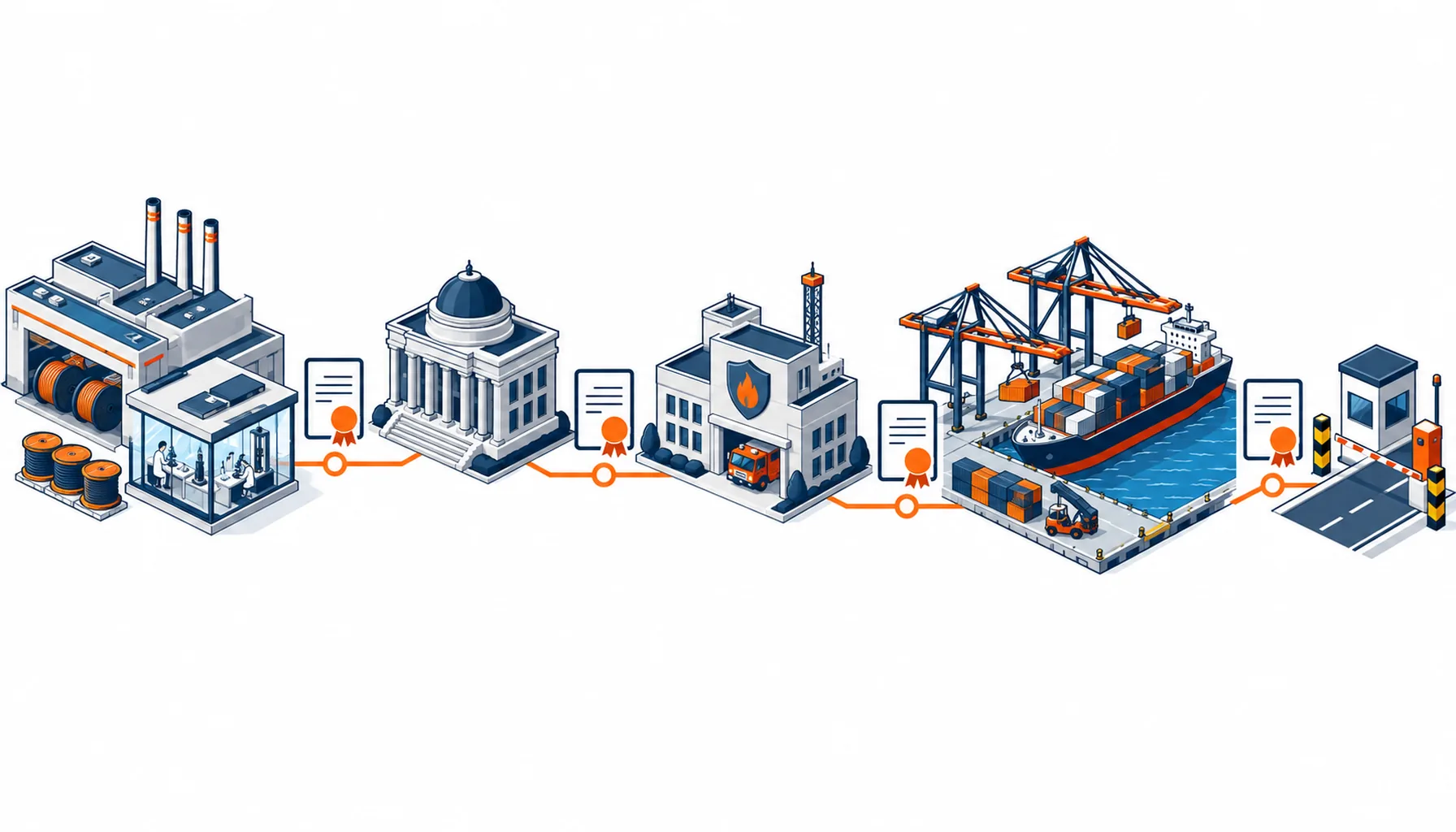
Quick Answer: Cable into the UAE passes two gates: federal ECAS certification of the product, and — for fire and life-safety circuits — civil-defence approval of the listed product.
The UAE imports cable at the scale of a permanent construction boom, and its authorities read cable labels with the seriousness that kind of skyline demands. Two approval names come up in every UAE cable conversation: ECAS at the federal level, and Civil Defence wherever fire safety is involved. Buyers who understand how the two fit together move shipments through. Buyers who lump them together as one bureaucratic blur lose weeks at the border. This guide pulls the layers apart and lays out the documents and workflow for each.
Introduction
The UAE’s market access model mirrors its geography. It’s a federation of emirates, with a federal standards infrastructure and emirate-level enforcement where life safety is concerned. The federal layer, a conformity assessment for electrical products under the national standards body, proves the product meets the applicable UAE standards. The emirate layer, most prominently Dubai Civil Defence for fire and life-safety systems, proves that the specific products installed in fire-related systems are approved for that duty. A power feeder to a chiller plant and a fire alarm loop in a high-rise can come from the same factory, yet they enter the market through different doors. For sourcing, the consequence is procedural: the destination’s use case decides the approval path, the approvals decide the lead times, and those lead times belong in the order schedule. The Gulf logistics reality described in Middle East power equipment sourcing bites twice as hard when approvals stack. This guide covers the federal layer, the fire layer, and the workflow that threads both.
The Federal Layer: ECAS for Electrical Products
ECAS, the Emirates Conformity Assessment Scheme, is the UAE’s federal mechanism for registering regulated electrical products before they enter the market. For cable, the logic will feel familiar from other mandatory schemes. The applicable UAE standards define the technical requirements, largely aligned with IEC plus local amendments. Test reports from accredited laboratories prove conformity. The manufacturer or its local representative registers the product and obtains the certificate of conformity that customs and market surveillance recognize. Three details deserve a buyer’s attention. First, the registration names a holder, either the factory or its UAE-authorized representative, and identity matters here just as it does in every scheme in this cluster. Second, the certificate is construction-specific: a registration for one voltage class or cable family doesn’t cover another. Third, ECAS is a product-level gate. It qualifies the construction for the market, not the individual shipment; shipment-level checks ride on top of it. The verification habits are the cluster’s standard four — holder, coverage, currency, marking — as detailed in the power cable certifications checklist.
The Fire Layer: Civil Defence Approvals
Where cable forms part of fire and life-safety systems — fire alarm circuits, emergency lighting, fire pumps, smoke control — the UAE’s civil defence authorities add their own approval gate. In Dubai, the authority’s approval list is a working document that consultants and contractors check by name. The fire layer asks a different question from ECAS. It isn’t “does this cable meet its standard” but “may this cable carry a life-safety circuit in an approved system”. The answers are product-specific: fire-resistance performance for circuits that must survive a fire, listed approval for the exact product family, and documentation that consultants can submit with the fire system design. Two consequences follow for the buyer. The specification must name the fire duty — which circuits, which endurance requirements — because the approval is sought per duty, not generically. And the approval lead time belongs in the project schedule, because consultants approve submittals against the authority’s list, and a cable that is electrically perfect but unlisted for fire duty stops a project at design review. The circuit-integrity properties behind fire-survival performance are the engineering half of this story; they’re covered in the fire-performance guides of the standards cluster such as LSZH vs fire-retardant cable.
| Layer | Question It Answers | Planning Note |
|---|---|---|
| ECAS (federal) | Does the construction meet the applicable UAE standards? | Product registration with a lead time; belongs in supplier selection |
| Civil Defence (emirate) | May this product serve fire and life-safety circuits? | Listed per product family; consultant submittals check the list by name |
| Customs clearance | Does this shipment match its certificates and documents? | Shipment-level document match at arrival |
| Project submittal | Do the approvals satisfy the consultant's specification? | Assemble certificate file before design review, not after |
How the Layers Interact
The two layers are separate approvals with separate owners, and their interaction is where imports either run smoothly or stall. An ordinary power cable may need the federal registration and nothing more. The same factory’s fire-alarm cable needs the registration plus the authority listing, and the two processes run on different calendars with different bodies. Three coordination rules work in practice. Specify the duty first: the fire-related circuits decide whether the second layer exists for your order at all, so the use-case conversation belongs at RFQ, not at customs. Verify both certificates for the exact construction: a factory that holds federal registration for its building wire may or may not hold the fire-system listing for its fire-rated family, so never assume one implies the other. And sequence the submittal file: consultants on UAE projects approve cable against the approval documents, so the certificate file — federal registration, fire listing, test reports — should be assembled before the project’s design review, per the EPC sourcing discipline in sourcing power equipment for China EPC projects.
The Import Workflow: From Registration to Clearance
Planned properly, the workflow reads as a straight line. At RFQ, name the destination emirate and the cable’s duties, and ask the supplier which registrations and listings it holds for the offered constructions. At supplier selection, verify the certificates — holder, coverage, currency — and budget application lead times for anything missing. At contract, allocate who registers, who pays, and who holds the certificate: the factory, its UAE representative, or the importer. Customs decides against the certificate holder, not the invoice. At shipment, assemble the document set from one source — invoice, packing list, certificates, test reports — so the clearance match is automatic. At arrival, the receiving protocol checks the drums against the documents, the same photographic drum-ID habit that anchors every destination in this cluster. The step most often underestimated is the dependency on a local representative: federal registration runs through a UAE-authorized entity, so early agreement with the importer or distributor is a scheduling task, not a courtesy. It’s the same ownership pattern seen in Saudi Arabia’s importer-registered workflow.
| Stage | Action | Classic Trap |
|---|---|---|
| RFQ | Name emirate and cable duty; ask for held registrations and listings | "UAE standards" treated as one generic requirement |
| Supplier selection | Verify holder, coverage and currency of both layers' certificates | Assuming federal registration covers fire-duty listing |
| Contract | Allocate registration owner, cost and certificate holder | Customs meets a certificate holder nobody contracted with |
| Shipment | Document set from one source, consistent descriptions | Invoice quantities disagreeing with certificate coverage |
| Arrival | Drum-to-document match per the receiving protocol | Mixed loads where one family is listed and another is not |
Where UAE Imports Fail — and the Fixes
The failure modes repeat across projects, and each has a known fix. Duty ambiguity: a cable ordered for “power” turns out to feed an emergency system, and the missing fire listing surfaces at design review. The fix is the use-case conversation at RFQ. Certificate drift: the shipped construction differs from the registered one by a size or voltage class. The fix is the construction-identity chain — certificate, datasheet, drums, one line. Holder confusion: the registration belongs to a previous distributor and the new import stalls. The fix is checking the holder at supplier selection, the same discipline as every mandatory scheme. Submittal timing: approvals discovered after the consultant’s review deadline. The fix is treating the certificate file as a submittal deliverable with a date, not a customs formality. Each fix is cheap at the start of an order and expensive after sailing, which is the recurring economics of market access cataloged in international power equipment sourcing mistakes. The scheduling insurance is simple: put the approvals in the delivery schedule, and verify them per the current-status habit of the China certification checklist on the origin side.
When ECAS and Civil Defence Are Not the Answer
Two limits keep the scheme in frame. These are gates, not specifications: conformity and listing prove minimums, while the project’s ampacity, derating, redundancy and fire strategy remain the engineer’s specification, verified through the project’s own evidence regime. And they’re UAE-specific. Gulf neighbors run their own federal and civil-protection schemes, and a UAE approval has no force in any neighboring port. Multi-Gulf orders need the market-by-market matrix from the cluster’s overview page, not one approval hoped across a border. Use the gates for what they do; keep the project verification where it belongs, with the drums.
RFQ Checklist: UAE Access Lines for the RFQ
Write the Emirates’ requirements into the order:
- Destination emirate and cable duties (power vs fire/life-safety circuits) named
- ECAS registration held for the offered constructions, holder and number stated
- Civil Defence listing confirmed for any fire-duty cable families, per emirate
- Test reports from accredited laboratories against the applicable UAE standards
- Registration owner, cost bearing and certificate holder allocated in the contract
- Certificate file assembled as a submittal deliverable before design review
- Document set generated from one source for clearance
- Drum marking consistent with registered constructions, per the receiving protocol
Conclusion
The UAE gates cable the way it builds: federally at the border, precisely where life safety is at stake. ECAS qualifies the construction for the market. Civil Defence approves the fire duty. Customs matches the shipment to both. Get all three specified early, verified by holder and coverage, and scheduled against the project’s review calendar, and the two layers become routine. Improvise them at the port and they cost you weeks.
Kexingyu Cable Group (KXYE) supports UAE-bound orders with accredited test reports, registration documentation and fire-duty product files keyed to the exact constructions that ship, so the drums clear the gate as cleanly as they left the line.