Cable Manufacturer vs Trading Company: 6 Ways to Tell the Difference
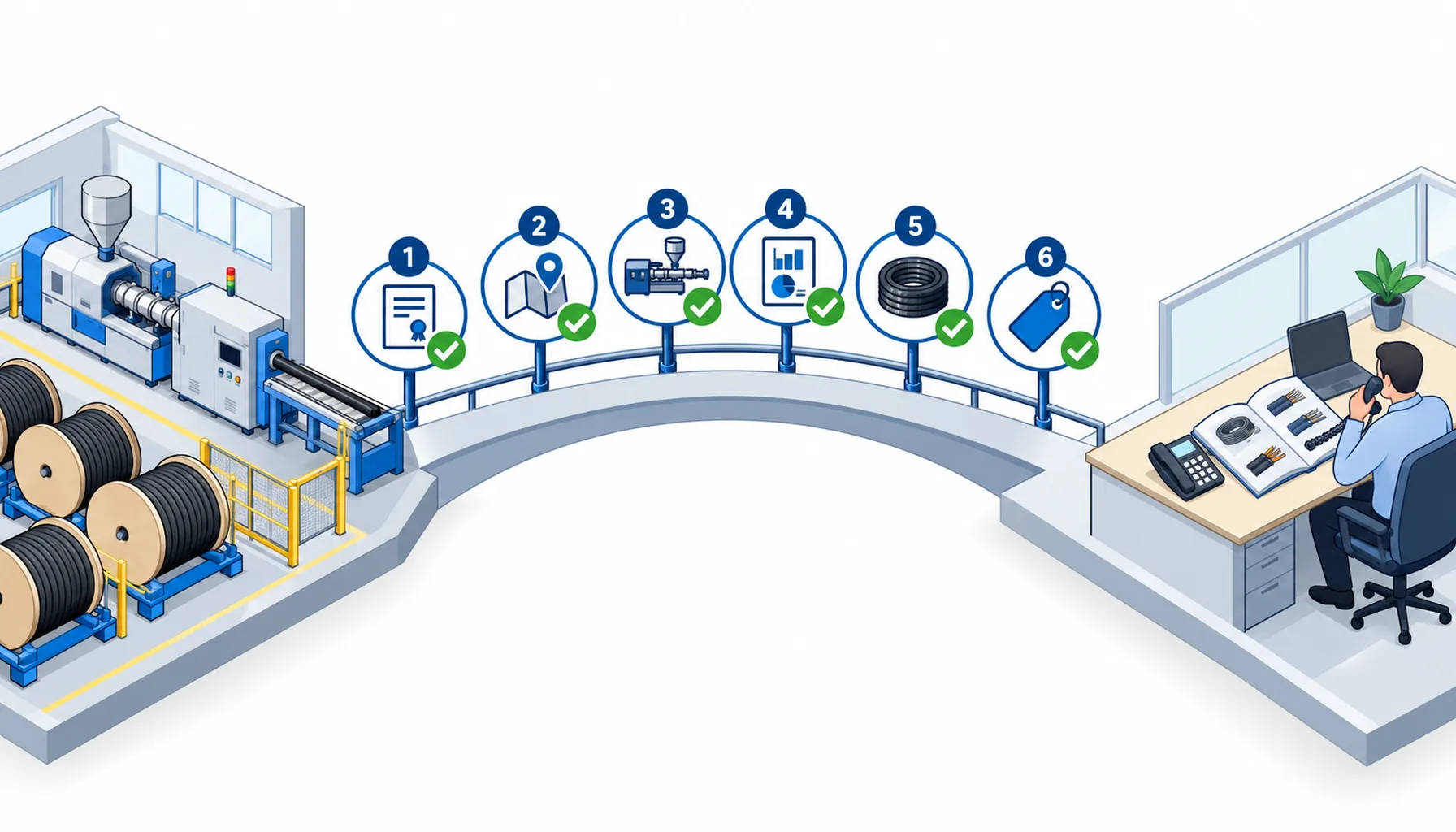
Quick Answer: Trading companies resell factories’ cable with a margin and a filter between you and the machines. Six checks — license, location, equipment, reports, samples and pricing — reveal which one you are talking to.
Ask a Chinese cable supplier whether it is a factory, and the answer is always yes. Sometimes it is true. Sometimes the “factory” is a trading company — a desk with a catalog, a margin and relationships with real plants — and the difference changes everything about the deal: who controls the production schedule, who owns quality when a batch fails, who answers at two in the morning when a container is held, and how much of your money pays for cable versus paying for a middleman. Neither model is illegitimate; traders exist because they are useful for mixed, small or urgent orders. But the model should be something you choose, not something you discover afterward — few positions are worse than believing you bought from a machine when the deal was actually made at a desk. Six practical checks separate them, none requiring a factory visit on day one, all requiring about a week of attention.
Introduction
The checks below work because manufacturing leaves physical evidence that a trading operation cannot fully fake: machines that appear on camera, test reports that name a plant, samples that arrive with production-line consistency. They also work because the stakes are documented — the failure patterns of international power equipment sourcing mistakes trace back, more often than buyers expect, to an intermediary that nobody audited. For buyers assembling a full power scope, the same logic applies one level up: one coordinated power equipment supplier only works if the coordinator actually controls factories, not just relationships. Run the six checks in order; each one is cheap, and together they cost less than a single wrong drum of cable would.
Checks 1–3: License, Location, Machines
Check 1 — the business license. Chinese business licenses state the registered business scope. A manufacturer’s scope names production and manufacturing of wire and cable with registered capital sized to a plant; a trader’s scope reads trading, import and export, or sales of electrical products. The document is public, askable in a day, and honest — it is the single fastest signal. Check 2 — the address and the neighborhood. Factories live in industrial zones with freight access; trading desks live in office towers. Match the registered address to the map and to what video calls show behind the people you talk to. Check 3 — the machines. Ask for the production equipment list relevant to your construction, then verify it on a live video walk through the workshops — not a promotional film. A factory that makes XLPE power cable has a crosslinking (catenary or vertical) line; a factory that claims mineral-insulated cable has the drawing and compaction lines to show. If the “factory” proposes a video call that always shows offices, you have your answer before check four.
| Check | Manufacturer Shows | Trader Shows |
|---|---|---|
| 1. Business license | Production scope, plant-scale capital | Trading or sales scope |
| 2. Address and setting | Industrial zone, freight access | Office tower, meeting rooms |
| 3. Machines | Named production lines on live video | Catalogs, promotional films, delays |
| 4. Test reports | Third-party reports naming the factory | Reports naming someone else |
| 5. Sample behavior | Line samples, consistent, customizable | Sourced samples, slow, fixed menu |
| 6. Price structure | Copper-linked, drawing-based quotes | Flat quotes, thin technical depth |
Checks 4–6: Reports, Samples, Pricing
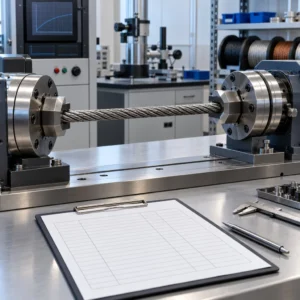
Check 4 — test report traceability. Every serious supplier shows test reports. Read the fine print: a manufacturer’s third-party reports name the manufacturing entity and the tested construction, and the names match the license; a trader’s reports name the plant it buys from — different name, same file. Reports that name nobody you can test against are little more than wallpaper. Check 5 — sample behavior. Ask for a sample from the production line with the construction customized to your drawing. A factory cuts it, tests it and ships it on its own schedule; a trader requests it from a plant, and the delays, the “not available in that size” answers and the fixed menu of constructions reveal the supply chain. The datasheet literacy to read what arrives — conductor class, compound type, markings — comes from reading an electrical equipment datasheet properly. Check 6 — price structure. Factories quote from drawings with a copper basis they can explain, per the cable size selection guide; traders quote round numbers that flex with your budget and cannot name the copper content of the cable they are selling. The pricing conversation works like a technical exam without saying so — whoever can explain the copper credibly has answered the credibility question.
When a Trading Company Is Actually Fine
The checks are a map, not a verdict — and honesty requires the reverse reading. A good trader is legitimately useful: for mixed small orders a single factory cannot fill, for urgent spot buys where the trader knows which plant has slot capacity this week, for markets whose language and paperwork the trader handles well. The problem is never the model; it is the mismatch — a buyer who needs engineering support, construction customization and batch traceability, buying through a layer that can supply none of the three. Match the model to the need: deep, customized, documented programs belong with factories vetted per the power cable manufacturer China checklist; mixed commodity orders can run through a trader who names his plants and lets you audit them anyway. The one non-negotiable in every case is knowing which model you are in, because every downstream promise — lead times, quality control, customization — inherits it.
| Your Need | Better Fit | Why |
|---|---|---|
| Custom construction, program volume | Direct manufacturer | Engineering, schedule control, traceability |
| Mixed small orders across types | Trader with named plants | One order, many sources, one invoice |
| Urgent spot requirement | Trader with slot knowledge | Knows who has capacity this week |
| Certified, auditable project supply | Direct manufacturer | Reports and batch files name the maker |
| New market entry, paperwork-heavy | Either, with audit rights | Export competence matters most |
When the Checks Disagree
Real suppliers are not always clean signals, so weigh the pattern rather than any single check. Some factories hold a trading license alongside the production one for historical reasons; some large traders keep a token plant; some small plants outsource one construction they advertise. When signals conflict, the machines and the reports outrank the license and the website — production evidence is expensive to fake, registered scope is cheap to broaden. Escalate on disagreement: ask directly, request the specific production floor on video, and treat a nervous answer as data. A supplier that evades questions a real factory would answer casually has already told you something important, whichever model it turns out to be. The vetting protocol that resolves these cases in full lives in our manufacturer vetting guide, and the certification layer in the power cable certifications checklist.
RFQ Checklist: Questions That Sort Factories from Desks
Put the market’s questions in writing:
- Business license and registered scope shared on request
- Production equipment list for the specified construction
- Live video walk through the relevant workshop, not a film
- Third-party test reports naming the manufacturing entity
- Production-line sample customized to the drawing
- Copper pricing basis explained with the quote
- Named plant disclosed if any part of the scope is outsourced
Conclusion
Manufacturer and trader are different products, and buying the wrong one by accident is the error the six checks exist to prevent. License, address, machines, reports, samples and pricing structure — each is a week’s worth of questions, and together they tell you whose factory, whose quality system and whose schedule your cable actually depends on.
Kexingyu Cable Group (KXYE) invites the full six checks: production scope on the license, machines on live video from drawing to drum, third-party reports naming the manufacturing entity, production-line samples built to your drawing, and copper-based quotes the technical team can defend line by line — cable supply that settles the factory question before it ever comes up.