The AGV and AMR Boom: From $7.6 Billion to $23.4 Billion and What Moves Inside
Quick Answer: PW Consulting projects warehouse AMR demand growing from about USD 7.6 billion to USD 23.4 billion by 2032, and every one of those mobile robots runs, charges and senses through cable.
Of all the automation curves published this decade, few bend like the autonomous mobile robot’s. PW Consulting’s 2026 market review projects warehouse AMR demand growing from roughly USD 7.6 billion to USD 23.4 billion by 2032, a compound rate near 17.5 per cent that compounds its way past every category it used to be compared with. The robots themselves are the visible part: flat shuttles sliding under shelves, forklift-shaped machines stacking pallets, sorting fleets weaving between human pickers. The part this catalogue cares about is underneath and inside: the cable that carries their power, their data and their charging current, flexing and coiling through the hardest duty cycle in mobile machinery.
Introduction
The boom has a simple economic engine. E-commerce taught warehouses that throughput is a competitive weapon, labour markets taught them that flexibility is scarcer than capital, and mobile robots happened to arrive as the answer to both. Unlike fixed automation, a fleet of AMRs scales by adding units, redeploys overnight and survives a layout change that would strand a conveyor. IFR’s World Robotics 2026 counts global industrial robot installations at roughly 600,000 units for 2025, but the mobile fleet sits largely outside those statistics, which is exactly why its cable demand gets underestimated: the machines are counted as logistics equipment, not robots, until something inside them fails.
This article sizes the market honestly, then goes inside the machine, because the cable story of an AMR is not one story but four, and each has its own duty cycle. The battery and charging systems that power these fleets are treated further in the comparisons of LiFePO4 and other battery chemistries and BMS versus EMS roles.
Why the Market Curve Bends So Hard
Three properties give mobile robots their growth profile. They deploy without construction: a warehouse adds robots over a weekend instead of shutting down for a conveyor project, so the adoption decision is reversible and therefore easy. They flex with demand: seasonal peaks are handled by renting units, a business model fixed automation cannot offer, which pulls fleet sizes up and smooths the customer’s capital risk. And they improve with software: every navigation update makes the existing fleet more productive, so the installed base appreciates rather than depreciates in capability. Together these turn the AMR market into something closer to a device market than a construction market, and device markets grow faster.
The cable consequence hides in the deployment model. Rapid fleet growth means rapid cable production growth, and the redeployment model means cable endures more connect-disconnect cycles, more door-dent abuse and more improvisation than fixed machinery ever sees. A machine designed to be moved is a machine whose wiring is handled by everyone, and the harness quality that survives that handling is a different engineering conversation than the one inside a bolted-down cell.
The Four Cable Stories Inside a Mobile Robot
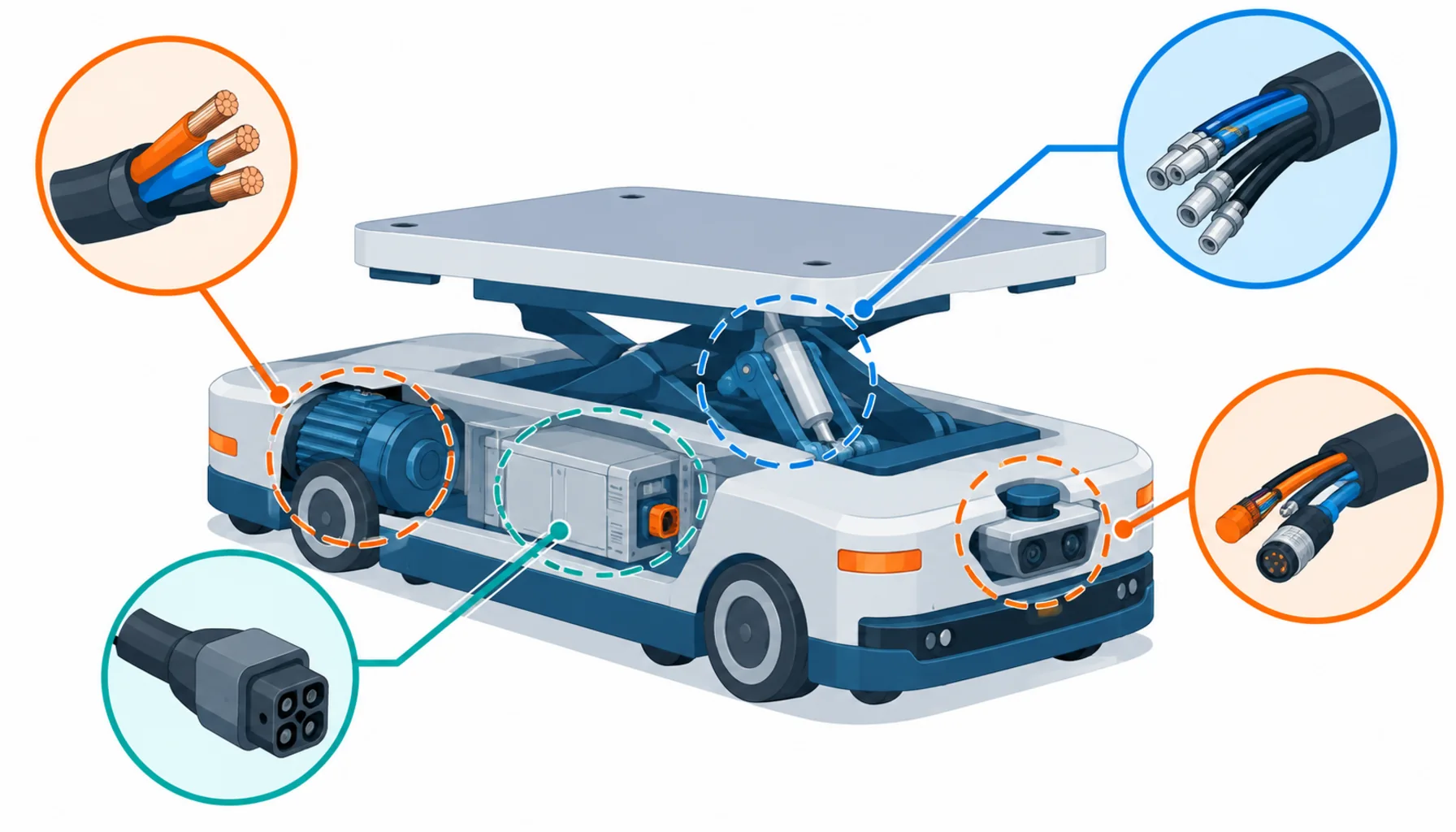
Open an AMR and the cable sorts into four duties. The drive power loop runs battery to controller to motor, carrying high current with the voltage sag and heat that high current brings, sized by the same logic the guide to cable size selection applies anywhere. The charging interface connects machine to dock hundreds of times a month, flexing at the same strain relief every cycle, and it fails by fatigue at the connector long before the conductor gives up. The lift and actuation wiring serves the mast, forks or lifting deck, cycling continuously through the machine’s work. And the sensing harness carries LiDAR, cameras, safety sensors and navigation data, where signal integrity matters more than mass and where the machine’s own drives create the interference the shields must defeat.
The four duties share one environmental feature: vibration. A mobile robot shakes continuously at frequencies a static machine never experiences, and every crimp, clamp and jacket compound is judged by its performance under that shaking. The failure patterns that result, from chafed jackets at clamp points to work-hardened conductors, are the standard mobile-machinery catalogue, explained in the analysis of why cables fail on machines, and the signal-side discipline they demand mirrors the compact high-integrity requirements described in the guide to control versus instrumentation cabling.
| Cable duty | Where it runs | Duty profile | What fails first if underspecified |
|---|---|---|---|
| Drive power loop | Battery to controller to motor | High current, heat, continuous vibration | Terminations and insulation at hot spots |
| Charging interface | Machine to dock, hundreds of cycles monthly | Flex at the same strain relief every cycle | Strain relief and connector fatigue |
| Lift and actuation | Mast, forks, lifting deck | Continuous cycling through the working day | Conductor fatigue at moving sections |
| Sensing harness | LiDAR, cameras, safety and navigation sensors | Low current, interference-rich, mass-critical | Signal integrity under drive noise and shake |
What the Growth Curve Means for Cable Supply
The table explains why AMR cable is a portfolio purchase even inside one machine. A single shuttle needs high-current power cable, high-cycle charging leads, motion-rated actuation wiring and shielded sensor harnesses, each specified against its own duty. Fleet builders buy all four at volume, which makes them the market’s anchor customers, and their supplier choices reward evidence and consistency over price alone, because a recall across a thousand-unit fleet costs more than any cable saving. The battery-side systems those power loops serve are compared in the analysis of battery systems in standby power, whose failure logic rhymes with the mobile case.
When the Market Curve Is Not the Answer
A market tripling by 2032 does not merely need more cable; it needs cable availability that tracks deployment calendars. Fleet builders commission by the quarter, their cable needs arrive in tranches, and a supplier who cannot hold construction stability across those tranches becomes the bottleneck their customer reports to its board. The opportunity therefore concentrates on suppliers who combine mobile-duty constructions, vibration-proof terminations, high-cycle charging leads and shielded sensor harnesses, with the capacity planning discipline to grow alongside a customer whose own curve is steep. Where fleets integrate into wider facility systems, the power infrastructure behind the docks follows the planning logic in the industrial power distribution checklist.
| Decision | Why it matters for AMRs | Practical handling |
|---|---|---|
| Portfolio over single product | One machine needs four different cable duties | Offer the full set: power, charging, actuation and sensing |
| Vibration-proof terminations | Continuous shaking judges every crimp and clamp | Specify mobile-machinery crimps, clamps and strain reliefs |
| Charging lead cycle rating | Failure concentrates at the strain relief | Rate and test the lead for hundreds of dock cycles monthly |
| Construction stability | Fleets deploy in tranches across quarters | Lock constructions with change control across the ramp |
| Tranche capacity planning | Customer demand arrives on deployment calendars | Plan capacity against the customer's fleet commissioning plan |
RFQ Checklist: Cable for AMR and AGV Fleets
Three cautions. First, market projections describe the category, not any supplier’s order book; a cable maker who plans capacity on the 23.4 billion figure without a customer list will learn the difference between a market and a customer. Second, the AMR fleet is young, and its failure data is immature; the honest duty profiles are still being learned, so overmargining critical circuits is cheap wisdom in this market. Third, growth does not change the physics: flex life, vibration fatigue and shield integrity follow the same science as every moving cable, and suppliers who mastered them in industrial robotics adapt fastest to the mobile case.
Conclusion
Send these so the quote covers all four duties:
- Machine class and duty: shuttle, forklift-style, sortation or mixed fleet
- Drive power requirements: current, voltage band and thermal environment
- Charging pattern: dock cycles per day and the strain relief geometry at the machine
- Actuation duty: lift strokes, cycles per shift and moving-section lengths
- Sensing harness: signal set, drive proximity and shield requirements
- Vibration and impact environment, including redeployment handling expectations
- Fleet deployment plan by quarter, so production can track commissioning
- Test evidence requested: flex cycles, vibration endurance and shield continuity