Firestop Cable Penetration Systems: What to Specify, Test and Inspect
Quick Answer: A firestop is not a product you can price on its own. It is approved as a combination of the penetrating items, the substrate and the seal at a maximum fill, and the approval only applies while all three stay as tested. Three questions therefore belong in the enquiry rather than in a site discussion: what the tested configuration covers, whether the seal can be re-entered when the next cable arrives, and who is approved to install it. Get those wrong and the cost does not land on the firestop budget, it lands on the compartmentation inspection, where it is much harder to absorb.
Fire stopping has an unusual cost profile. The material is cheap, the labour is unremarkable, and the consequence of getting it wrong is disproportionate, because a penetration seal is part of the building’s compartmentation rather than part of the electrical installation. That means it is inspected by someone outside the electrical scope, judged against a design that predates the installation, and very often repaired by a different trade at a later date, after the cable schedule has changed.
Introduction
Ask for a price for fire stopping a hundred penetrations and you will receive a number per penetration. That number is almost meaningless, because the work involved depends on four things that the enquiry probably did not state: the fire resistance required at each location, the substrate the cable passes through, the number and type of penetrating items, and whether the seal has to be re-enterable. Two penetrations that look identical on a drawing can differ by several times in installed cost on those four variables alone.
There is also a compliance trap that catches projects more often than a bad installation does. The seal is approved as a system, which means the certificate at the top is not the relevant document. The relevant document is the tested configuration, and it usually includes a maximum fill, a defined range of cable types, and a defined substrate. Where the installation differs from that configuration in any of those respects, the seal is unapproved even though it was installed exactly as the manufacturer intended. Our note on procuring data center riser cable looks at the same interface from the vertical route side.
Six Seal Families and Where Each One Belongs
The families below cover most of what a data center project buys, and the choice is usually decided by whether the penetration will ever change.
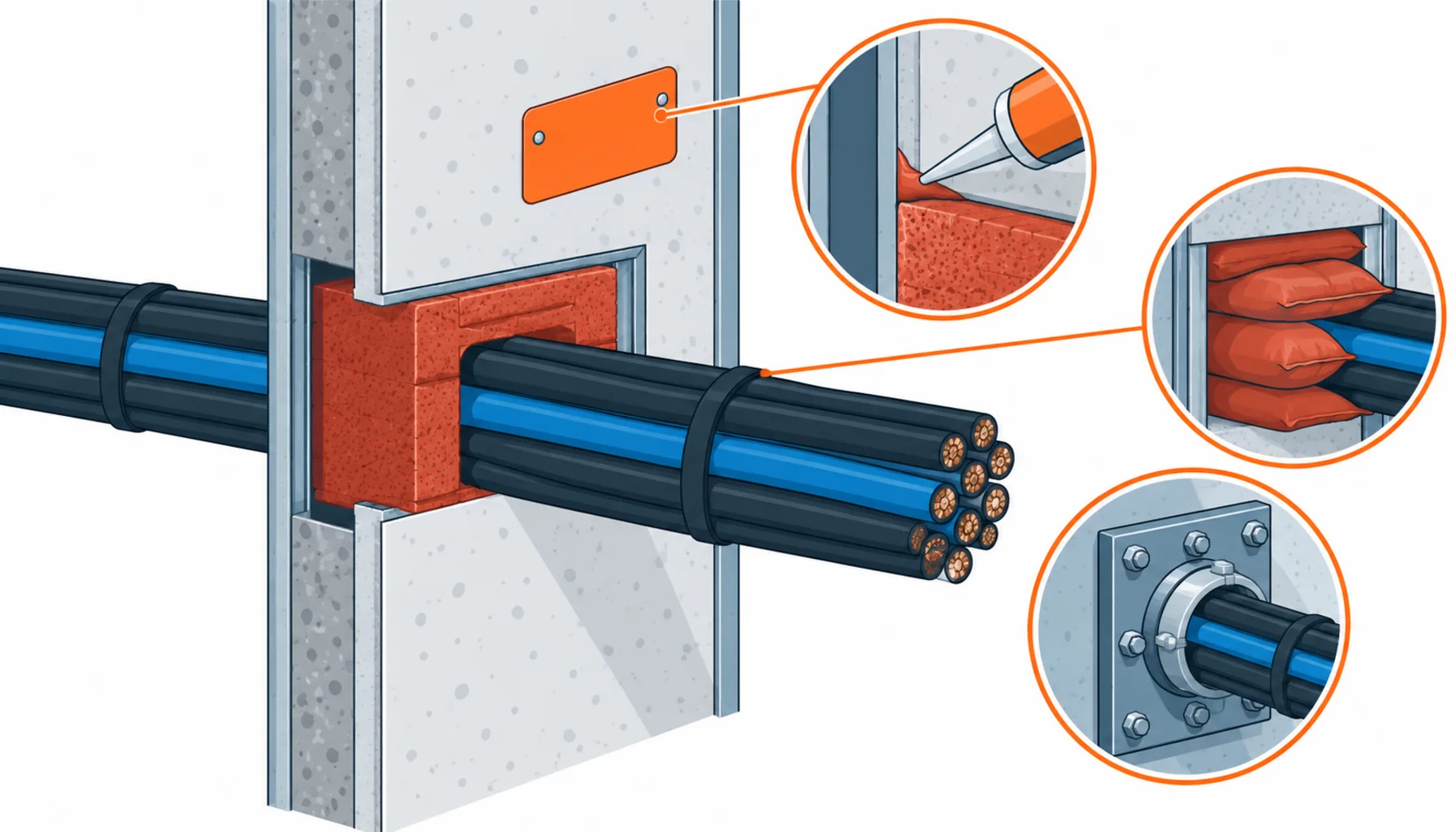
Sealant and mastic. A flexible compound applied around and between cables, sometimes over a backing material. Fast, cheap, and suitable for small penetrations with a settled cable count. On its own it is not re-enterable without cutting it out, and it depends heavily on the depth of application being achieved.
Cementitious mortar. A rigid seal around the penetrating items. Robust, inexpensive, and often chosen where the substrate is masonry or concrete and the penetration is small. Rigid seals are a poor match for cable that moves thermally or is expected to be added to, because the seal cracks rather than accommodating the change.
Intumescent pillows. Bags of intumescent material packed into the opening. The reason they dominate in data centers is that they can be removed and replaced around a new cable, which makes them the practical answer where the cable population keeps growing. The trade-off is that the fill has to stay within the tested limit and the pillows have to be correctly compressed, which means the installation inspection matters more than the material.
Blocks or bricks. Pre-formed modules fitted into a grid, typically with a sealant coating on the surface. Re-enterable in the same way as pillows, more dimensionally stable, and better suited to larger openings and where the penetration is in a wall that gets inspected visually.
Composite sheets and boards. Panels cut to the opening and sealed at the edges. Used for large openings and where the penetration is a duct or a tray rather than a cable bundle. Re-entry means cutting a panel and replacing it, so the sheet has to be kept in stock on site.
Mechanical seals and gland plates. A frame with individual cable inserts. The most expensive option per cable and the most serviceable, because a single cable can be added or removed without touching the rest. Used where the penetration is designed to carry a defined circuit at a time and where the room’s cleanliness or pressure regime matters.
The Decision Table: Seal Options Compared
The table is written for a buyer rather than a designer. The cost column carries re-enterability with it, because that is where the lifetime difference actually appears.
| Seal Family | What to Declare | Evidence to Demand | Installed Cost and Re-Entry | Failure Mode If Chosen Wrong |
|---|---|---|---|---|
| Sealant or mastic | Required fire resistance, substrate, cable count, and the applied depth per the tested detail | Test report for that configuration, depth record and photographs | Lowest installed cost; not re-enterable without cutting out and losing the seal | Shallow application that satisfies nobody, and a seal renewed on every cable addition |
| Cementitious mortar | The same, plus whether the cables can move thermally or will be added to | Test report, mixing and cure record, thickness verification | Low material cost, moderate labour; effectively permanent | Cracking where cable movement or later additions stress a rigid seal |
| Intumescent pillows | The tested maximum fill, pillow compression, and the restraint method at the opening edge | Test report showing maximum fill, compression record, photographic register | Moderate cost; re-enterable, so the marginal cost of a future cable is small | Fill exceeded or pillows loose, and a seal that looks right and performs as decorative |
| Blocks or bricks | Opening dimensions, module grid, surface coating method | Test report for the grid, module dimensions, coating record | Moderate to high cost, very re-enterable and visually inspectable | Modules cut to fit gaps that were never in the tested arrangement |
| Composite sheets | Opening size, penetrating item type, and the edge sealing detail | Test report, edge seal detail, spare panel stock on site | Moderate material cost, low labour; re-entry needs panel stock and a clean cut | No spare panels, so a later penetration is sealed with something else entirely |
| Mechanical gland plates | Frame size, insert type per cable diameter, and the future circuit plan | Frame test report, insert specification, per-cable installation record | Highest cost per cable; the most serviceable option available | Bought for a fixed circuit count and filled before the hall is half populated |
Re-Enterability: The Question That Decides Lifetime Cost
The firestop budget on a data center project is rarely the final number, because a hall adds cable throughout its life. Each addition that crosses a compartment boundary creates a penetration, and each penetration needs a compliant seal.
Where the seal is permanently installed, every future cable means cutting out and rebuilding a seal. That work is done in an operating building, on a cable that may be live, and the rebuilt seal has to be documented again. Where the seal is re-enterable, the same work is a short maintenance task by a trained person, followed by a photograph in the register.
The arithmetic is easy to do at enquiry stage. Take the number of penetrations, estimate how many will be re-entered over the life of the hall, and compare the premium for a re-enterable system against the cost of rebuilding a permanent one each time. On a hall that expects to grow, the re-enterable system usually wins on the first or second re-entry, and after that the comparison is not close. Where the cable population is genuinely fixed, for example in a plant room with a defined switchboard layout, the cheaper permanent seal is the right purchase.
There is a second, less obvious benefit. A re-enterable seal gets re-entered properly, because doing so is easy. A permanent seal that is difficult to reinstate tends to be modified informally, and an informally modified penetration is the one that fails an inspection years later.
Who Installs It, and What the Approval Actually Requires
Firestop approvals come with conditions, and the conditions are part of what you are buying.
Installer competence. Several approval routes expect the work to be carried out by trained personnel, and some require the installer to hold a manufacturer’s or scheme’s certification for that specific system. Where that is the case, the person who seals the penetration is a named resource, and the programme depends on their availability. It is worth confirming before the package is awarded, because the alternative is discovering that the sealing work cannot start until a certified person is on site.
Third-party surveillance. Some approval routes include an element of external surveillance of the installation. Where that applies, the evidence trail is not optional; it is the mechanism by which the approval stays valid. That changes the documentation scope from nice-to-have to a contractual deliverable.
Identification. In many jurisdictions a firestop has to be identifiable, usually by a label carrying the system reference, applied at the penetration. This is a trivial cost item and a large inspection benefit, because it lets an inspector verify the seal against the tested configuration without opening it. Requiring labels in the purchase order costs almost nothing and it pre-empts a whole class of finding.
One more interface to name. The cable’s own fire performance and the seal’s performance are separate requirements, and confusing them leads to a specification that no product can meet. The cable requirement governs flame propagation along the cable; the seal requirement governs the compartment boundary. The relevant cable constructions sit in our special wire and cable range, and the standards landscape around them sits under standards explained.
What to Freeze Before Releasing the Firestop Package
| Item | What to State | Evidence to Attach | Cost of Leaving It Open |
|---|---|---|---|
| Fire resistance per location | The required classification at each penetration, taken from the compartmentation plan rather than assumed | Compartmentation drawing keyed to the penetration register | Uniform low rating everywhere, or a mixture that fails the inspection |
| Tested configuration | The penetrating items, maximum fill and substrate the seal is approved for | Test report or assessment showing that configuration | Approved product installed outside its approval, which is not a compliant seal |
| Re-enterability decision | Which penetrations will be re-entered, and the system chosen for each | Written basis for the choice, with the expected re-entry count | Permanent seals rebuilt at every future cable addition, in a live hall |
| Installer competence | Who installs each system, and the certification or training that applies | Certification in date, named against the system and the project | Sealing held up until a certified person is available, or work outside the approval |
| Surveillance and witness | Whether external surveillance applies and what evidence it requires | Agreed inspection schedule and the record format | A valid approval that cannot be evidenced, and a remediation claim at handover |
| Identification and register | Label format carrying the system reference, and the penetration register structure | Labels supplied and applied, register delivered in editable form | Penetrations that cannot be verified without opening them, and unbounded inspection time |
| Photographic record | Photographs per penetration before the seal closes, showing fill and items | Image set indexed to the register, handed over | No evidence of what was sealed, and a visual guess at inspection |
| Future modification procedure | How a seal is to be re-opened and reinstated, and who is authorised to do it | Written procedure issued with the handover documentation | Informal modification by other trades, and a penetration that quietly stops being compliant |
When a Rigid Seal Is Not the Answer
Cementitious and sealant systems are the right answer in a lot of places, and there are conditions where buying them is a mistake.
Where the cable count will grow. Any hall that expects to add circuits over its life should not be sealed with a permanent system at the majority of its penetrations. The cost appears not as a bad seal but as repeated rebuild work inside an operating space.
Where the cables move thermally. A rigid seal around cable that expands and contracts with load cycles cracks over time. Flexible or modular systems accommodate that movement; mortar does not.
Where the opening is large. Above a certain size a single sealant or mortar detail stops being the economical answer, and a modular system with a defined grid is faster, more inspectable and easier to reinstate.
Where nobody will maintain the register. A seal that depends on a record has a failure mode in the record rather than the seal. If the project has no mechanism for keeping a penetration register current, then a system whose compliance depends on labelling and documentation is being bought without the support it needs. In that case, choosing a system that is verifiable by visual inspection alone is the more robust purchase. The wider handover documentation picture is covered in our note on cable labeling and documentation, and the inspection side is set out under third-party commissioning agents.
RFQ Checklist
- Compartmentation drawing, with the required fire resistance stated per penetration rather than as a single figure
- The tested configuration for each proposed system: penetrating items, maximum fill, substrate
- Re-enterability requirement per location, with the expected number of future re-entries
- Installer name and the certification or training that applies to each system
- Whether external surveillance is part of the approval, and the evidence format it expects
- Label format carrying the system reference, and who supplies and applies it
- Penetration register structure, delivered in editable form, keyed to the drawing
- Photographic requirement per penetration, with the index convention stated
- Spare materials held on site for re-entry, with the quantity and the storage location
- Written reinstatement procedure for each system, issued at handover
- Lead time per system, and which items are made to order rather than stocked
- Price per penetration broken into material and labour, so the re-entry cost can be compared honestly
Conclusion
Fire stopping is a small budget line with a building-level consequence, and it is decided by three questions that a buyer can ask before anything is ordered: what the tested configuration covers, whether the seal can be re-entered, and who is approved to install it. Answer those and the package has a predictable cost. Leave them to site and the money moves into the inspection stage, where the options are all expensive.
Kexingyu Cable Group (KXYE) supplies the cable that passes through these penetrations, including the WDZ-YJY, WDZN-YJY, BTTZ, BBTRZ, NG-A (BTLY), KVV and YJV ranges and the fire resistant cable constructions used where the route itself has to resist flame propagation, together with the GGD power distribution cabinet and KYN28 medium voltage switchgear that feed these circuits, all from one factory group with copper price linkage available on project-scale orders. Send your compartmentation plan with the cable schedule per penetration and we will return the cable data the seal approval needs, item by item; the fastest route is a request for quotation.