Buying Prefabricated Power Skids: What to Freeze Before Manufacture and How to Receive Them
Quick Answer: A power skid is bought as a boundary before it is bought as equipment. What decides whether the purchase works is not the assembly itself but the interface definition, the transport and lifting constraints, the factory test scope, and the change cut-off date. Freeze those four and prefabrication compresses the programme the way it is supposed to. Leave them open and the saving in site labour is consumed by site modification, which is the one activity prefabrication exists to remove.
Prefabricated distribution is usually introduced to a data center project on schedule grounds. The site labour is constrained, the trades are competing for the same space, and moving work into a factory where it can be done in parallel appears to be free time. That reasoning is sound, and it comes with a condition: the factory has to be able to finish the work, which means everything it needs has to be decided before it starts.
Introduction
The commercial case for prefabrication is often presented as a cost comparison, and the cost comparison usually disappoints. A skid bought as a unit typically costs more than the same equipment assembled on site, because the frame, the factory labour, the testing and the transport are all real costs that the site version does not carry in the same way. The saving is in programme and in risk: fewer site hours, a shorter critical path for the electrical fit-out, factory conditions instead of a dusty shell, and a tested assembly arriving instead of a set of components.
That is the honest frame for the decision. Where the project is programme constrained, prefabrication buys time. Where the project is purely cost constrained and has site labour available, the comparison is much closer and the answer may be to assemble on site. What it is never worth doing is buying a skid for the cost saving and then discovering that the interfaces were left open, because the on-site modification that follows costs more than the difference ever was.
What You Are Actually Buying: A Boundary, Not a Box
The most important document in a skid purchase is the one that defines where the skid ends.
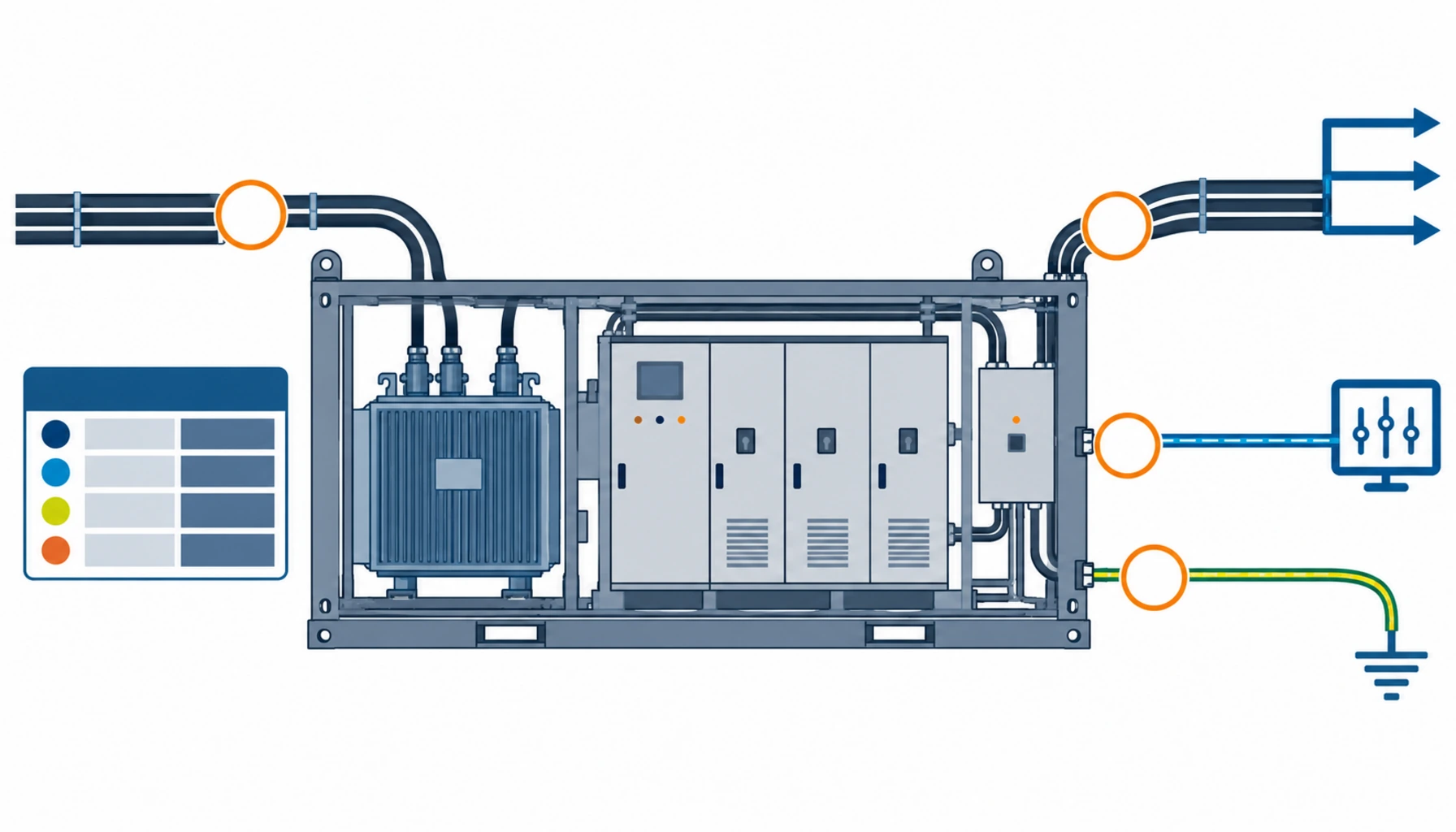
Every interface that crosses the boundary has to be named, dimensioned and owned. On the incoming side that means the point at which the site cable or busway terminates, the cable entry position and direction, the spare cable length needed to make the termination, and the earthing connection point. On the outgoing side it means the same in reverse, plus the number, size and position of every outgoing way. Around the assembly it means the control and monitoring interface: which signals leave the skid, in what form, into what protocol, and who provides the terminal block.
Two interfaces are routinely left out of enquiries and both produce site work. The first is the mechanical path: the route the skid takes from the delivery vehicle to its final position, including the door it passes through and the corner it turns. The second is the earthing and bonding arrangement between the skid frame and the building’s earthing system, which is a single item until it is discovered that nobody supplied the conductor or the connection detail.
A boundary definition does not need to be elaborate. A marked-up drawing showing the skid outline with every interface annotated, a table listing who supplies and who installs each one, and a signed acceptance of both by the suppliers on each side is enough. What matters is that it exists before manufacture, because the cost of changing a boundary after the frame is welded is entirely different from changing it on paper. The coordination around modular and prefabricated cable systems is covered in our note on prefabricated modular cabling, which makes the same argument at the cable level.
The Decision Table: Delivery Formats Compared
The table compares how an electrical distribution assembly can be delivered. The last two columns are the commercial ones: the shape of the cost and the way each option fails.
| Format | What to Freeze | Evidence You Receive | Cost and Programme Shape | Failure Mode If Chosen Wrong |
|---|---|---|---|---|
| Site assembled from components | The component list, the assembly drawing and the site test scope | Component routine test records plus site assembly inspection | Lowest unit cost, longest site duration, most trades competing for the same room | Site hours expand beyond plan, and the electrical fit-out becomes the critical path |
| Skid with factory test only | The factory test scope, the routine test report, and the transport and lifting plan | Routine test report per assembly, packing list, lifting drawing | Moderate premium, large site time saving, one interface to manage | Interfaces defined late, so the skid needs modification on arrival |
| Skid with witnessed factory test | The witness points, the test schedule, and the acceptance criteria before shipping | Signed witness record plus full test report | Small additional cost and a date the buyer must attend | Defects found on site that the factory would have corrected for free |
| Modular substation or prefabricated room | The building interface: foundations, cable routes, cooling, fire rating and access | Module test records plus the building interface drawing | Highest unit cost, largest programme compression, longest lead time | Civil works late, and a delivered module that cannot be set down |
| Hybrid: primary on site, secondary prefabricated | The split point, and which party owns the interface at that split | Two record sets with a defined boundary between them | Balanced cost and programme; works where the primary plant is late | The split point left ambiguous, so both parties assume the other has covered it |
Interfaces: Where Prefabrication Fails
Almost every failed skid purchase fails at an interface, and the failures fall into three groups.
Dimensional. The skid that will not pass through the opening is a recurring story and it is entirely preventable, because the constraint is known in advance. The data needed is the transport envelope, the weight, the lifting points and the load distribution, checked against the delivery route, the site access, the opening dimensions and the crane capacity at the radius it will actually work at. That crane question is worth doing properly: capacity at a given radius falls quickly, and a lift plan based on the crane’s headline capacity rather than its chart is optimistic. Where the assembly cannot be delivered in one piece, the frame should be designed to split before manufacture, not cut on site. Our note on cable pulling tension and sidewall pressure covers the cable side of the same access problem.
Electrical. The cable or busway arriving at a skid has to land on a terminal that exists, at a position the cable can reach, with enough length to make the termination. Where the skid’s incoming terminals were positioned from the design drawing and the site route was built around an obstruction, the mismatch is discovered during connection. The fix is a dimensional survey of the actual incoming route before the skid is released for manufacture, with the terminal positions confirmed against it. This is a small step and it is the single most effective one available.
Control and monitoring. Signals that leave the skid have to arrive somewhere, in a form that the receiving system can read. Protocol mismatches, missing terminal blocks, and signals specified by one party and assumed by another are common, and they are found at commissioning when the schedule pressure is highest. The control interface schedule belongs in the boundary definition, item by item, with the supply responsibility marked for each line. The verification of these interfaces after installation is covered in our note on third-party commissioning agents.
Transport Damage and the Records That Save You
A skid is a tested assembly that then experiences a road journey, a crane lift and a set-down on a site. That sequence is the largest mechanical event the equipment will experience before it is energised, and it is entirely unmonitored unless the purchase makes it monitored.
Three measures belong in the order, and they cost very little.
Shock and tilt indicators. Devices fixed to the frame that change irreversibly if the assembly experiences an impact or an inclination beyond a threshold. Read on arrival and photographed before unpacking, they convert an argument about whether damage happened in transit into a record. Where an indicator has triggered, the correct response is a documented inspection rather than a decision to proceed and see.
Transport bracing and re-torquing. Internal components braced for transport, with a defined procedure for removing the bracing and re-checking the torque on bolted connections afterwards. A bolted busbar joint that was correct in the factory may not be correct after a road journey, and the re-torque record is the evidence that it was checked. That record is also what the thermal scan at commissioning is compared against, as our note on infrared thermography explains.
Receiving inspection with the packing list. A defined inspection at arrival, before the unit is moved into position, checking the frame, the enclosures, the internal components, the indicators and the preservation condition. Photographs taken at that point are the only evidence that will exist of the condition on delivery, and they are what a warranty claim rests on. Once the skid is inside the building and powered, the question of when the damage occurred becomes unanswerable.
The factory test itself is the other half of this evidence, and it is worth distinguishing the two test types clearly. A factory acceptance test demonstrates that the assembly works as designed before it leaves. A site acceptance test demonstrates that it still works after installation and connection, which is a different question because the journey and the interfaces sit between them. The division of scope between the two is covered in our note on factory and site acceptance testing, and the routine test records that accompany a low voltage assembly are the ones to ask for specifically, since an assembly tested as a unit carries evidence that site-assembled equipment never has.
What to Freeze Before Manufacture Release
| Item | What to State | Evidence to Attach | Cost of Leaving It Open |
|---|---|---|---|
| Interface boundary | Every crossing point, with supply and install responsibility marked against each one | Marked-up boundary drawing plus a responsibility table, signed by both sides | Site modification of a finished assembly, which is the cost prefabrication was meant to remove |
| Incoming terminal positions | Terminal positions confirmed against a dimensional survey of the actual route | Survey record plus the confirmed position drawing | Cables that cannot reach their terminals, and short extensions made under pressure |
| Control and monitoring schedule | Every signal, its form, its protocol, and the terminal it lands on | Interface schedule agreed with the receiving system supplier | Commissioning delays while two suppliers establish who should have provided a signal |
| Transport envelope and lift plan | Dimensions, weight, lifting points, and the crane capacity at the working radius | Lift plan checked against the crane chart and the site access route | An assembly on a low loader that cannot be delivered to its position |
| Factory test scope | What is tested before shipping, at what values, and whether the buyer witnesses it | Routine and functional test report per assembly, plus witness record if applicable | Defects discovered on site, where correction costs more and the schedule absorbs it |
| Shipment monitoring | Shock and tilt indicators fitted, with thresholds and the read procedure on arrival | Indicator readings recorded and photographed before unpacking | Concealed transport damage with no evidence of when it occurred |
| Re-torque procedure | Which connections are re-torqued after transport, at what values, and who records it | Torque record per connection, signed after installation | Bolted joints that passed in the factory and are loose on site |
| Change cut-off date | The date after which changes are treated as variations rather than absorbed | Written cut-off in the contract, with the cost basis for post-cut-off changes | Late changes absorbed silently into the programme, with no basis to argue cost or delay |
When Prefabrication Is Not the Answer
Skids suit projects with limited site labour and accessible lifting, and there are conditions where they are the wrong purchase.
Where the site cannot accept the lift. A restricted site with no crane access to the final position turns the whole argument around, because the assembly then has to be broken down for movement, which is the site assembly it was meant to avoid, with the additional cost of having built it in a factory first.
Where the design is still moving. Prefabrication requires decisions to be final earlier than site assembly does. A project whose requirements are still changing will spend more on variations than it saves in site time, and the honest answer is to keep the assembly conventional until the design stops moving.
Small and repetitive installations. Where the same small assembly is repeated many times, the fixed engineering cost of prefabrication per unit is harder to justify, and standard catalogue equipment assembled on site is usually competitive.
Where the primary equipment is the constraint, not the assembly. Prefabricating the assembly around equipment that is late does not compress the programme; it moves the waiting to a different location. Where the transformers or switchgear are the long poles, the schedule problem is a supply problem, and the position on switchgear lead times is set out in our 2026 switchgear lead time guide.
RFQ Checklist
- Interface boundary drawing with a responsibility table, signed by both the supplying and installing parties
- Incoming and outgoing terminal positions confirmed against a dimensional survey, not against the design drawing
- Control and monitoring interface schedule, item by item, with the receiving system supplier’s acceptance
- Transport envelope, weights and lifting points, with a lift plan checked against the actual crane chart
- Factory test scope named, including the routine test report to be supplied per assembly
- Witness points stated, with the date the buyer must attend before shipping
- Shock and tilt indicators fitted, with the thresholds stated and the read procedure agreed
- Preservation and packing specification, including the conditions the assembly can be stored in on site
- Re-torque procedure after transport, with the values and the record format
- Earthing and bonding connection detail between the frame and the building earthing system
- Spare cable length at each incoming termination, and who provides it
- Change cut-off date written into the contract, with the cost basis for anything after it
Conclusion
A prefabricated power skid compresses a programme by moving work into a factory, and it only does that if the factory can finish. The four things that decide the outcome are the interface boundary, the dimensional survey that confirms the connections will fit, the factory test scope with a witness date, and a change cut-off the project is willing to hold. Add shipment monitoring and a re-torque procedure, and the assembly arrives as a tested unit rather than as a claim waiting to be argued.
Kexingyu Cable Group (KXYE) supplies the equipment inside these assemblies and the cable that connects them: the dual power ATS cabinet and GGD power distribution cabinet, the MC8000 containerized data center for prefabricated capacity, and the WDZ-YJY, WDZN-YJY, BTTZ, BBTRZ, NG-A (BTLY), KVV and YJV cable ranges, all from one factory group with copper price linkage available on project-scale orders. Send your boundary drawing with the terminal positions you intend to land on and we will return equipment and cable data that matches it before manufacture; the fastest route is a request for quotation.