Buying Maintenance Windows in 24/7 Data Centers: Planning Cable Work Without Impact
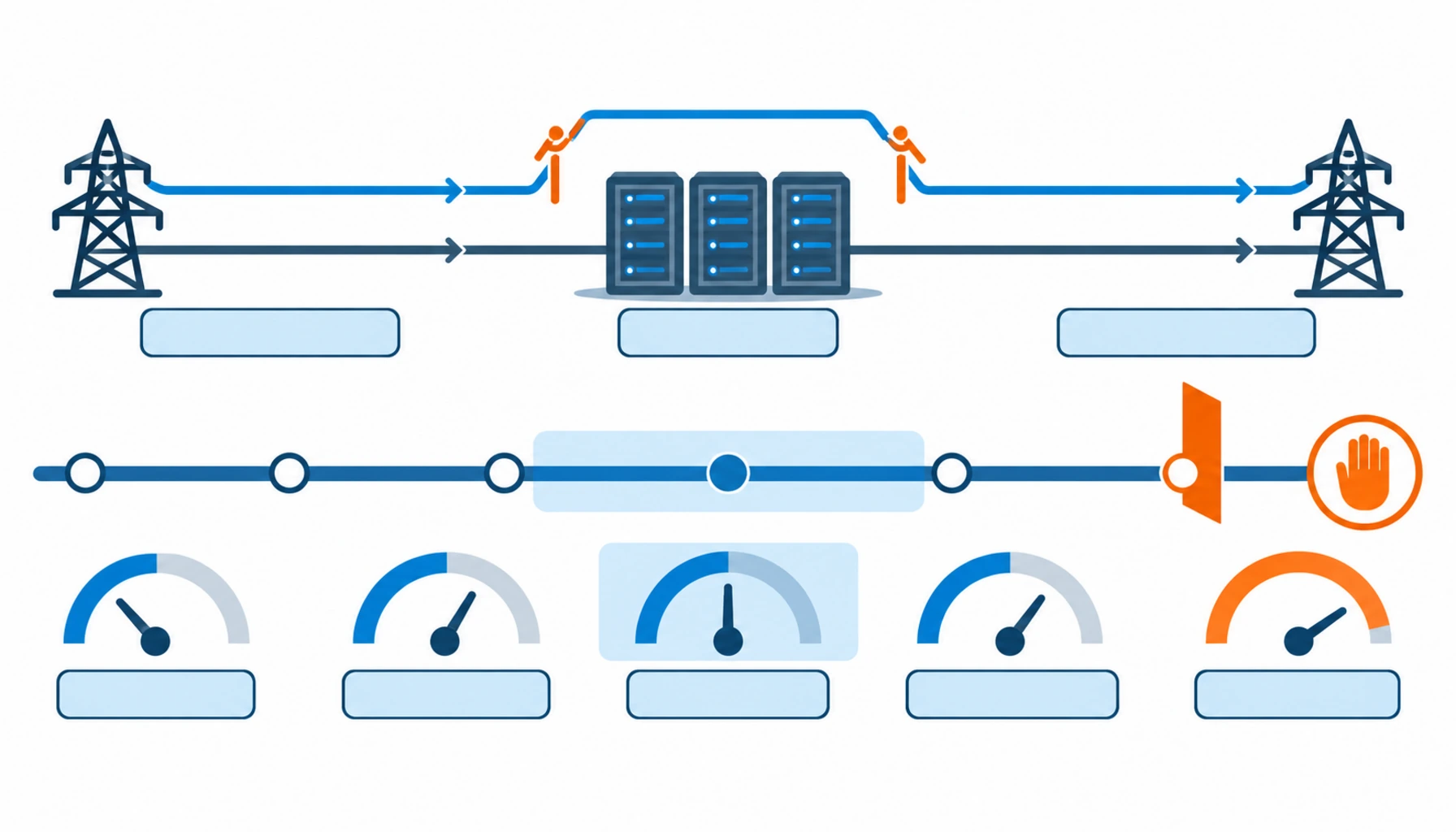
Quick Answer: A maintenance window is an agreement, and the work is only as safe as the agreement behind it. Classify each window by the impact the facility is allowed to carry, write the duration, the reduced state, the overrun rule and the authority to abort into the plan, and buy the work against that plan rather than against a calendar date. Most overruns are decided before the first cable is touched, by a window that was scoped too tightly and had no agreed way to end.
In a facility that never stops, maintenance is a negotiation with the load. The window is the document that records what was agreed.
Introduction
Cable work in a live hall is scheduled in a way that other maintenance is not, because the work tends to be physically extensive, to require access above and below the racks, and to have a duration that is genuinely hard to predict. A tray run that looks like four hours of work becomes ten when a section of the route is not where the drawing says it is.
The remedy is not a better estimate. It is a window design that assumes the work will take longer than planned, that defines the state the facility will be in while it happens, and that has an agreed endpoint. Our note on planned cable replacement covers the sequencing of the work itself, and our note on fault isolation and bypass strategies covers the equipment that determines what can be isolated while the hall runs.
Four Window Types and What Each One Costs
Windows are usually described by duration. They are better described by impact, because impact is what has to be agreed with the tenant and with the load owner.
Zero impact. The work is done on equipment whose redundant partner is fully available and proven. Nothing is interrupted, no load is at risk, and the window is a scheduling courtesy rather than an agreement. Most routine inspection and metering work belongs here.
Redundancy reduced. One path is taken out, the remaining path carries the full load, and the facility is knowingly running without a second chance. This is where most cable work sits. It requires a load cap, a derated capacity check on the surviving path, and tenant notification.
Planned partial outage. Defined circuits go down, and a defined part of the hall is affected. This needs a tenant agreement with a specified duration and an escalation path if the work runs long.
Full facility outage. Rarely used for cable work and expensive when it is, because the cost is not the electricity but the load. Where a full outage is being considered for cable work, the design question should be asked again first.
The Decision Table: Window Types Compared
The table sets out what each window type commits you to.
| Window Type | What to Specify | Evidence You Should Receive | Cost and Notice Shape | Failure Mode If Chosen Wrong |
|---|---|---|---|---|
| Zero impact | Which redundant partner is in service, and confirmation that it is proven | A redundancy check record and the current load on the surviving path | Lowest cost; short notice and no tenant agreement needed | Work done on equipment whose partner turns out to be degraded, with no second chance |
| Redundancy reduced | The load cap during the window, the derated capacity of the surviving path, and notification | A derated capacity calculation and a written notification record | Moderate administrative cost; notice period set by the tenant agreement | A surviving path overloaded mid-window, converting maintenance into an outage |
| Planned partial outage | The circuits affected, the duration, the escalation path and the compensation terms if any | A signed outage agreement with defined duration and overrun handling | Highest administrative and commercial cost; longest notice | A window that overruns into a tenant service level event with no agreed position |
| Full facility outage | Everything above, plus a cold start procedure and a rollback plan | A full method statement, a tested start up sequence, and a rehearsal record | Rarely justified for cable work; the cost is the load, not the labour | A facility that does not restart cleanly, which is the event the whole design exists to prevent |
Writing the Window Plan
Five elements turn a time slot into a plan that can be executed and audited.
The reduced state, stated explicitly. What will be out of service, what will be carrying the load, and what the facility is not protected against during the window. The last part is the one most often left unwritten, and it is the one that decides how much extra work is acceptable mid-window.
The load cap and who enforces it. A cap without an owner is a suggestion. Where the window runs during business hours, the cap has to be visible to whoever is deploying equipment, which usually means a temporary read on the monitoring platform rather than a note in a document.
The overrun rule. Decide in advance what happens at the planned end time. The usual options are to complete the current step and stop, to extend within a stated maximum, or to restore the facility to its pre-window state. The rule has to be decided before the window, because at the end of a long night everyone is motivated to finish rather than to stop.
The abort condition and the authority. Conditions that stop the work, and the named individual who can call it. Where the authority is assumed to sit with the most senior person present, it is usually assumed by whoever is most committed to finishing.
The records. Every window should close with an updated state, a test record for anything energised, and an entry in the maintenance log. Where the window was a partial outage, the record set includes the tenant notification and the restored state confirmation.
What to Freeze Before the Window Is Booked
| Item | What to State | Evidence to Attach | Cost of Leaving It Open |
|---|---|---|---|
| Window classification | Which of the four types applies, and the impact the facility will carry | A classification note in the work request | Work treated as routine that actually removes the only second path |
| Reduced state | What is out, what carries the load, and what protection is lost | A state diagram for the window, not just a task list | An unlisted risk discovered during the window, with no compensating measure |
| Load cap and owner | The cap during the window, and who enforces it | A derated capacity figure and a named owner | A surviving feed loaded beyond its derated capacity while its partner is out |
| Duration and contingency | Planned duration, plus the agreed contingency allowance and how it is used | A duration breakdown by task, with the contingency shown separately | A window that is too short by design and overruns as a matter of course |
| Overrun rule | What happens at the planned end time, and who decides | A written rule agreed before the work starts | An improvised decision at 4am, usually to finish rather than to stop |
| Abort criteria and authority | The conditions that stop work and the named individual who can call a stop | Named in the permit and acknowledged by the person | Work continued past a condition that should have stopped it |
| Notification and access | Who is notified, how far in advance, and how access to the work area is arranged | A notification record and an access plan agreed with operations | A tenant discovering the work from their monitoring rather than from you |
| Close out records | The state confirmation, test records and log entries required to close the window | A close out checklist signed before the permit is closed | A window that ends in fact but not on paper, and a facility whose condition is uncertain |
What Makes a Window Fail
Overruns have a small number of causes, and most are visible before the work begins.
Scope discovered on site. The drawing did not match the installation, and the work expanded. This is why survey work and record correction belong before the window, not inside it.
Access taken by another trade. In a busy retrofit, the same ceiling void is wanted by several contractors. Without a single owner for the space during the window, the access is shared and the duration doubles.
Testing after the work, not during it. A circuit that is tested only once the window has closed cannot be corrected inside the window. Building a test step after each circuit, rather than one test phase at the end, converts a late failure into a localised fix.
A window with no contingency. Where the duration is the estimate with no allowance, the plan has accepted that any unforeseen item causes an overrun. A contingency allowance that is stated separately is easier to defend than a padded estimate.
Records that were already wrong. Being unable to identify circuits during the window is the most common delay in cable work, and it is a documentation problem rather than a technical one. Our note on certification testing and evidence covers the record standard that avoids it.
When a Window Is Not the Answer
Where the impact classification is zero. Work with no impact does not need a window. Treating routine inspection as a window consumes the approval capacity that the work which genuinely needs one depends on.
Where the work can be done during construction. Cable work completed before a hall is loaded is not a maintenance activity at all, and moving it earlier is almost always cheaper than engineering a window later. The design decisions that make later work easy are covered in our note on zero downtime power tie-ins.
Where the constraint is access, not power. Some work appears to need an electrical window and actually needs a physical access arrangement. Separating the two requirements often removes the electrical window entirely.
Where the window would be used to avoid a design decision. A hall that needs frequent windows because its redundancy is fragile is a hall carrying a design problem. Windows manage that problem; they do not solve it.
RFQ Checklist
- Window classified by impact, not by duration, in the work request
- Reduced state described, including what protection is lost during the window
- Load cap stated numerically, with the derated capacity basis attached and an owner named
- Duration broken down by task, with contingency shown separately
- Overrun rule written and agreed before the work starts
- Abort criteria stated and a named individual given the authority to call a stop
- Notification period and recipients agreed, including any tenant agreement
- Access plan agreed with other trades working in the same area
- Test step built into the sequence after each circuit, not held to the end
- Survey and record correction completed before the window, not within it
- Close out records defined, including state confirmation and the maintenance log entry
- Post-window review scheduled to record actual versus planned duration for the next window
Conclusion
Every window in R3 depends on the same discipline that the rest of this group describes. The isolation equipment from the fault isolation purchase decides what can be taken out. The sequencing from the replacement programme decides in what order. The tie-in design decides how much work is needed in the first place in a hall that has grown. What the window adds is the agreement that governs the time in between, and the discipline of deciding how it ends before it starts.
Kexingyu Cable Group (KXYE) supplies the cable and distribution equipment that this work is performed on, including the WDZ-YJY, WDZN-YJY, BTTZ, NG-A (BTLY), KVV and YJV ranges, the data center cable range used on submain and riser routes, and the dual power ATS cabinet that makes a reduced redundancy window a defined state rather than an improvised one, from one factory group with copper price linkage on project-scale orders. Send your window plan and the reduced state you intend to run in, and we will return the equipment ratings and records that let it be confirmed before the work starts; the fastest route is a request for quotation.