Procuring GIS Switchgear and the Main Transformer Interface for Data Center Substations: What to Specify and What to Witness
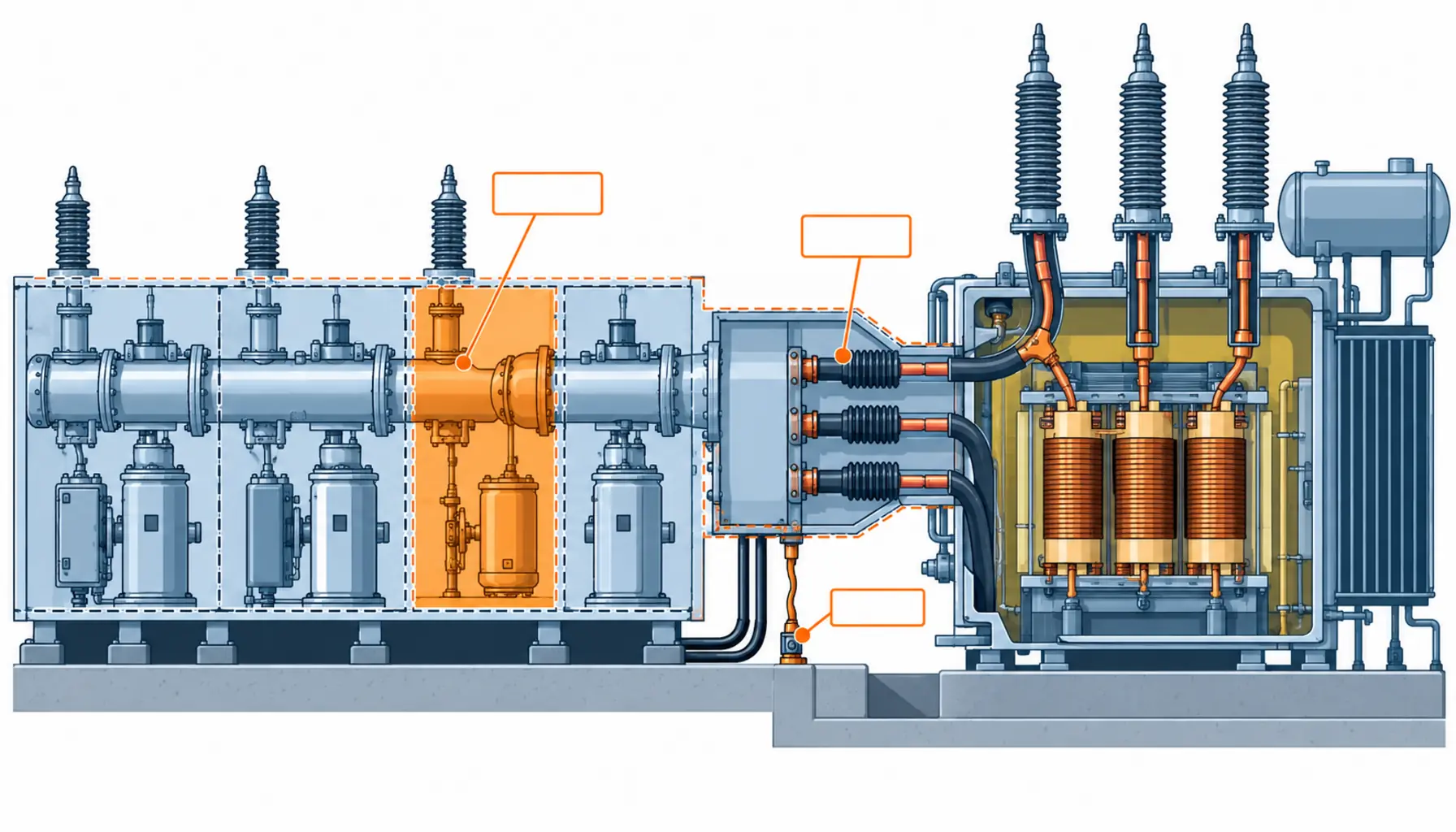
Quick Answer: Gas insulated switchgear is bought for two reasons, floor space and reliability, and both are paid for later in building cost and maintenance constraints. The purchase itself turns on four things: how the gas zones are divided, how the switchgear connects to the main transformer, what partial discharge measurement is specified in the factory test, and whether space is reserved for a future bay. The transformer interface is where most problems appear, because two suppliers meet there and neither treats the boundary as its own.
Introduction
A data center substation is a small installation with very little tolerance for failure and, in most sites, very little land. That combination is what pushes buyers toward gas insulated switchgear, usually without a formal comparison against the air insulated alternative. The comparison is worth doing, because the two products fail in different ways and are maintained by different skills.
The second half of the purchase is the interface to the main transformer, which is rarely described precisely enough in the enquiry. Our note on the switchgear and transformer shortage explains why both items now arrive on long clocks, and our note on the IEC 62271 switchgear standard covers the test framework the specification should reference.
Why GIS Is Chosen, and What That Costs
GIS is compact, it is largely immune to pollution and humidity, and its live parts are enclosed, so it can be installed close to occupied buildings. Those are real advantages on a constrained site.
What they cost is visible in three places. The building has to be gas tight, ventilated and provided with gas detection, which is a civil and services cost that does not appear on the switchgear quotation. Maintenance requires trained staff and gas handling equipment, and it cannot be improvised during an incident. And expansion is possible only where the busbar and the gas zones were designed for it, so a future bay has to be bought as an option long before it is needed.
Where the site has room and the pollution level is low, air insulated switchgear does the same job with simpler maintenance and easier condition assessment. Our note on low voltage and medium voltage switchgear covers where each class belongs in the chain, and the choice at the high voltage level follows the same logic of buying the simplest equipment the site will allow.
The Interface With the Main Transformer
The interface is a physical boundary and a contractual one, and the two should match. Four details decide whether they do.
Connection type. A transformer can be connected to GIS by a cable box, by an oil to gas bushing arrangement, or by direct connection where the transformer is close enough. Each has a different site work content, a different dielectric test and a different party responsible for the terminations.
Phase identification and core arrangement. The phase order and the position of the core, the tank and the neutral have to be fixed before either item is manufactured. A transformer delivered with the wrong phase rotation is not a transport problem, it is a rebuild.
Protection current transformers. Where the CTs sit, on which side of the interface, and who supplies them. A duplicated protection scheme needs both sets, and the location determines whether a fault in the cable box is inside or outside the protected zone.
Earthing and surge protection. The earthing arrangement at the transformer, the surge arrester location and the screen treatment of any cable connection. These are small items that decide how the installation behaves under a lightning or switching impulse, and they are cheapest when they are in the switchgear and transformer scopes at the same time.
The Decision Table: GIS, AIS and Hybrid Compared
The three arrangements below cover most data center substation enquiries.
| Arrangement | What You Are Buying | What to Specify | Evidence You Should Receive | Cost and Maintenance Shape |
|---|---|---|---|---|
| Full GIS | Enclosed bays with gas insulated busbars, a building with gas detection, and a maintenance regime built around gas handling | Gas zone division, rated gas pressure and leak rate, partial discharge measurement method, spare bay provision | Type tests to IEC 62271-203, gas leak test per bay, partial discharge records, as built gas zone diagram | Highest equipment cost plus a specialist building; maintenance needs trained staff and spares that cannot be improvised |
| Air insulated | Open or metal enclosed bays, larger clearances, and a simpler building with normal ventilation | Clearances for the pollution level, busbar arrangement, interlocking, and the condition monitoring to be fitted | Type tests for the rated fault level, dielectric tests, mechanical operation records, interlocking test certificate | Lower equipment and building cost where land allows; easier visual inspection and thermographic survey |
| Hybrid | Gas insulated busbars and circuit breakers with air insulated connections and outgoing feeders | Which sections are gas insulated and which are open, and the boundary where a gas zone ends | Drawings showing each gas zone boundary, plus the test records for both technologies | Middle cost; footprint reduced without a fully gas tight building, but two maintenance regimes to run |
What to Specify in the GIS Package
Six items separate an enquiry that can be quoted accurately from one that produces a heavily qualified offer.
Rated values and their basis. Rated voltage, normal current, short time withstand current and duration, and the peak withstand value. These follow from the system study rather than from preference, and they should be stated with the study attached.
Gas zone division. Which bays share a gas compartment, and where the sectionalisers sit. Zone division decides how much of the installation is lost when one compartment is opened for work, which is a redundancy question as much as a maintenance one.
Bay schedule. The number and function of each bay, including incomers, bus couplers, outgoing feeders and voltage transformers, plus the positions reserved for future use. A bay schedule that changes after manufacture is a change order.
Partial discharge requirement. The measurement method to be used at the factory test and the acceptance level. This is the single most valuable test on a GIS, because internal defects are invisible and expensive to reach later.
Monitoring and interface. Gas density monitoring, trip coil monitoring, and the protocols and point lists for connection to the site control system. Interface point lists are where commissioning delays are created.
Spares and training. The recommended spare parts list, the gas handling equipment, and the training that the operations team will need. These are cheaper in the original order than in a later variation, and they are often the first items cut.
What to Witness at the Factory
The factory acceptance test is the last point at which a defect is cheap to correct. Three parts of it deserve attendance.
Dielectric and partial discharge tests. The measurement described above, performed bay by bay, with the results recorded against the limits in the specification rather than against a general pass.
Gas tightness. A leak test per compartment, with the measured rate recorded. The figure matters over the life of the installation, not on the day of the test.
Scheme and interlocking checks. Verification that the protection and interlocking scheme matches the approved drawings, and that each bay responds as intended. Our note on why factory acceptance testing matters covers what the witness should be looking at rather than merely signing.
What to Freeze Before the Order
| Item | What to State | Evidence to Attach | Cost of Leaving It Open |
|---|---|---|---|
| Rated values | Voltage, normal current, short time withstand current and its duration | The system study the values came from, labelled provisional if it is | Equipment ordered with a rating that fails coordination, or a rebuild of the busbar |
| Gas zone division | Which bays share a compartment, and where sectionalisers sit | An as designed gas zone diagram with each boundary marked | A single fault taking out more of the installation than the redundancy case allows |
| Bay schedule | Every bay with its function, and the positions reserved for future use | A single line diagram with future bays shown as options | Expansion that requires an outage because the busbar was not extended at build |
| Transformer connection | Cable box or bushing arrangement, phase order, core and tank position | A joint interface drawing signed by both equipment parties | Site work nobody priced, or an interface that cannot be assembled as delivered |
| Protection CT ownership | Which side of the interface the CTs sit on, and who supplies and wires them | A protection zone diagram with the interface marked | A fault inside or outside the protected zone by accident, discovered in a coordination study |
| Partial discharge test | Measurement method and the acceptance level for the factory test | A test schedule including the method and the limits | An internal defect accepted at the factory and found on site after installation |
| Earthing and surge protection | The earthing arrangement, arrester location and cable screen treatment | An earthing drawing covering both scopes | Impulse performance nobody can predict, and an argument about the cause after a failure |
| Spares and training | The spare parts list, gas handling equipment and operator training | A list priced into the order rather than quoted as an option | A first maintenance event delayed by a part that had to be ordered after the fact |
When GIS Is Not the Answer
Where the site has land and clean air. GIS earns its premium on constrained or polluted sites. Where the switchyard can be built outdoors with normal clearances, air insulated equipment is easier to inspect, easier to repair and cheaper to expand.
Where the maintenance skill set does not exist and will not be bought. A GIS installation that the operating team cannot maintain is a single source dependency. If the training and the gas handling equipment are not in the budget, the equipment choice should be revisited.
Where the future bay is being bought as a promise. A spare bay that is not extended at build usually costs an outage to add. If expansion is likely, the busbar and the zone arrangement are better bought now than described as future provision.
Where the interface is being left to the two suppliers. The transformer and switchgear boundary is the most common source of unclaimed scope on a substation project. Where neither purchase order names the interface details, the items are either duplicated, omitted, or added as a change. Our note on compact substations for data centers describes what a fully scoped package looks like.
RFQ Checklist
- Rated voltage, normal current and short time withstand current stated with the study behind them
- Gas zone diagram supplied with the enquiry, showing every compartment boundary
- Bay schedule complete, with future positions shown as priced options
- Transformer connection type, phase order and core position fixed in a joint interface drawing
- Protection CT location and ownership stated on both purchase orders
- Partial discharge measurement method and acceptance level written into the test schedule
- Earthing arrangement and surge arrester scope shown on one drawing covering both packages
- Gas tightness test records required per compartment, with the measured leak rate
- Interlocking and protection scheme checked against approved drawings before shipment
- Gas detection, ventilation and building interface requirements issued to the civils package
- Spare parts, gas handling equipment and operator training priced into the order
- Witness points named before manufacture begins, not requested after the tests are done
Conclusion
A GIS substation is a purchase of space and certainty, and both are easy to overbuy. The parts that repay attention are unglamorous: the gas zone diagram, the bay schedule, the joint interface drawing with the transformer and the partial discharge test that proves the enclosure is sound before it leaves the factory. Everything else can be negotiated later at a price.
Kexingyu Cable Group (KXYE) supplies the equipment either side of this boundary, including the KYN28 medium voltage switchgear that takes the transformer output down to the distribution level, the oil immersed and dry type transformers used on data center campuses, and the medium voltage cable and terminations for the interface routes, from one factory group with copper price linkage on project-scale orders. Send the single line diagram and the gas zone arrangement you intend to use, and we will return the ratings, the interface details and the test records that close the boundary; the fastest route is a request for quotation.