Procuring On-Site Gas Turbines for AI Campuses: Capacity, Fuel and What to Freeze Before the Order
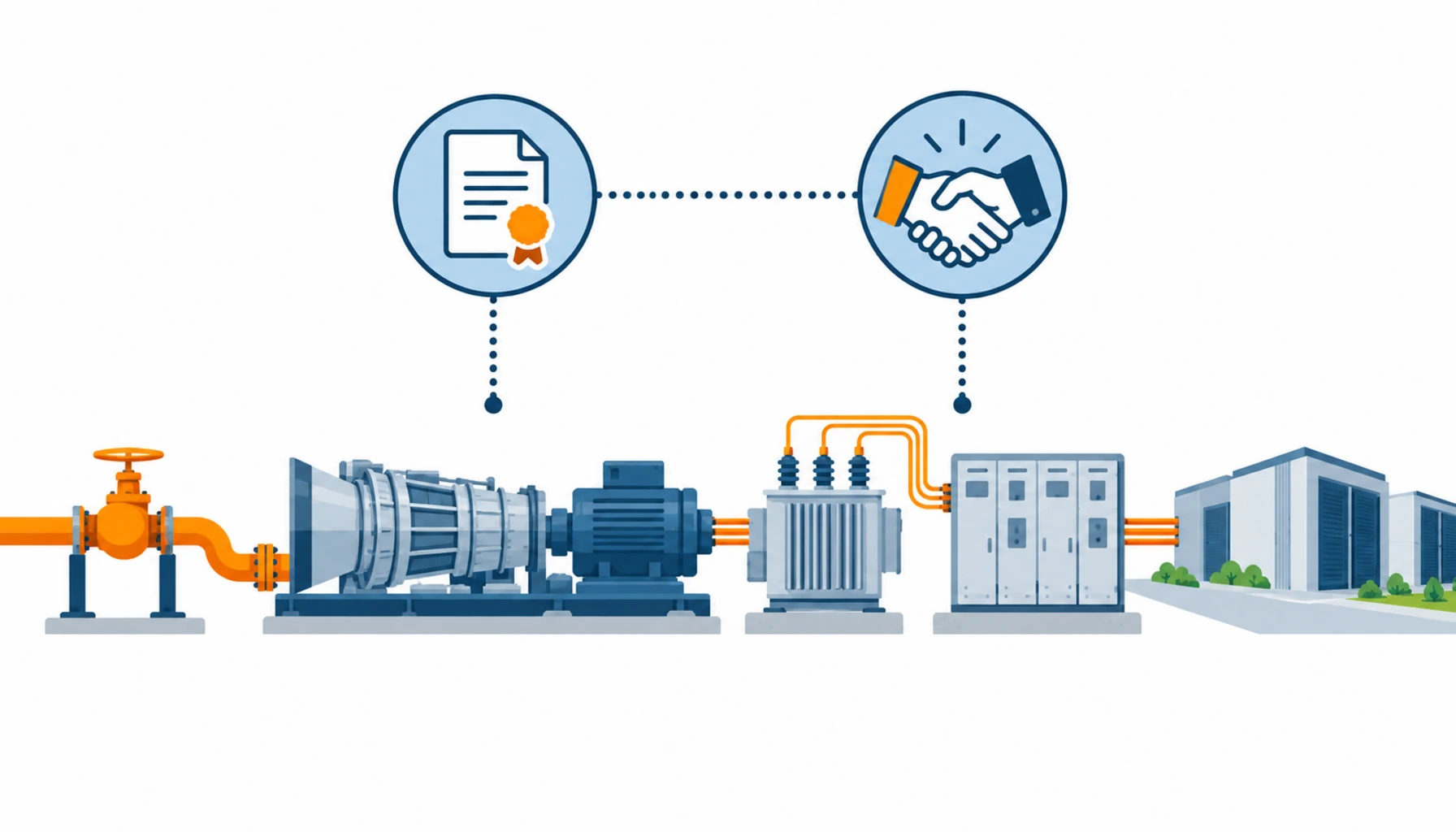
Quick Answer: A gas turbine is now bought as primary capacity rather than as backup, and the constraint is no longer the machine but the slot, the fuel and the permit. Confirm the fuel supply and the emissions position before the turbine is ordered, because those two items decide whether the plant can run at the rating you are paying for. Specification should fix the site conditions, the fuel quality, the performance guarantees and the service agreement, and the service agreement should be priced with the machine rather than negotiated after it arrives.
Introduction
Three years ago, on-site generation at a data center meant diesel engines that ran during an outage. The load growth described in our note on data center power demand growth has changed that, because in many regions the grid cannot deliver the capacity in the time the campus needs it. The result is a purchase that looks like a power station rather than a backup system.
That shift changes what the buyer has to secure. A diesel standby set is bought as equipment and stored. A gas turbine is bought as a slot in a production line, a fuel supply, a permit and a long term service relationship, and the equipment is the easiest part of it. Our note on utility grid expansion explains why the grid queue is the reason this purchase exists.
What the Purchase Actually Contains
A gas turbine plant for a data center is four purchases, and only one of them is the turbine.
The machine and its balance of plant. The turbine package, gearbox, generator, inlet and exhaust systems, control system and the cooling arrangement. The balance of plant often carries more cost uncertainty than the machine, because it is designed for the site rather than built to a catalogue.
The delivery slot. Turbine production capacity has been sold forward. Analysts tracking the sector have reported order books extending into 2028, and some suppliers sell reservation agreements for future slots rather than firm delivery dates. A buyer who needs generation in 2027 is negotiating for a slot that was committed years earlier.
Fuel. A gas supply agreement, a pipeline connection or a delivered fuel arrangement, with the pressure, quality and interruption terms that the machine needs. Fuel is the item most often secured late and the one that can prevent operation entirely.
The permit and the service agreement. Emissions limits, noise limits, water use where evaporative cooling is used, and a long term service agreement covering maintenance intervals, parts and performance guarantees.
The Decision Table: On-Site Generation Options Compared
The three configurations below cover most campus enquiries. Each one changes the fuel, permit and service position.
| Configuration | What You Are Buying | What to Specify | Evidence You Should Receive | Lead Time and Operating Shape |
|---|---|---|---|---|
| Aeroderivative turbines | Lightweight machines in the 30 to 50 MW class, supplied as packages that can be shipped and installed relatively quickly | Site conditions, fuel quality and pressure, emission limits, start reliability and time to full load | Performance guarantee at site conditions, emission test results, factory and site test records | Shorter build time than heavy duty; lower efficiency and a higher maintenance burden per megawatt |
| Heavy duty combined cycle | A large frame machine with heat recovery and a steam turbine, producing power at the highest efficiency available | Fuel specification, water availability for cooling, emission limits, and the part load behaviour the campus will actually see | Guaranteed output and heat rate at site conditions, emission guarantees, commissioning test data | Longest lead time and the largest footprint; highest efficiency but inflexible at low load |
| Multiple smaller units | Several reciprocating engines or small turbines arranged in an N+1 group | Unit count and the redundancy step, start sequence, load following, and the emission limit at each unit | Individual unit performance tests, group control scheme, and a documented N+1 case | Better part load efficiency and easier maintenance rotation; more units to permit, fuel and service |
Specifying the Machine
Turbine specifications fail for predictable reasons, and most of them are site conditions.
Performance at site conditions. Output and heat rate at the actual altitude, ambient temperature and fuel composition, not at ISO reference conditions. A machine quoted at ISO conditions in a hot climate will not deliver the rating that was used to size the campus.
Fuel specification and range. The composition, heating value, pressure and the variation the machine must tolerate. Gas quality changes with the network and the season, and a machine that only runs on the reference gas is a machine with an operating constraint.
Emissions and the permit basis. The limit that applies, at what load and with what measurement method. Where dry low emission combustion is specified, the part load range over which the limit is held becomes an operating restriction that should be defined rather than discovered.
Starting and islanding capability. Whether the plant can start without a grid supply, and whether it can run as an island. These two functions decide what the campus can do during a wide area event, and they are covered in our note on islanding and grid transfer.
Noise and water. The noise limit at the site boundary and the water consumption where evaporative cooling is used. Both are permit conditions, and both are cheaper to design in than to add later.
Control and synchronising. How the plant synchronises with the grid and with other sources, and what protection is shared. Our note on generator synchronisation systems covers the equipment that carries this function.
Fuel, Permits and the Items Nobody Buys Early
The fuel agreement. Capacity, pressure at the delivery point, interruption terms and the price basis. A firm fuel supply is a separate negotiation from the pipeline or the delivered fuel contract, and it should be secured before the machine is ordered rather than alongside commissioning.
The emissions permit. The application takes longer than most buyers expect, and it fixes the operating envelope. A permit written for a lower annual run hour limit than the campus needs is an expensive correction.
The grid interaction. Whether the plant exports, and what the connection agreement allows. Export capability is an option with a price, and it is often assumed to be free. Our note on behind the meter generation covers the approval side in detail.
The service agreement. Maintenance intervals, spare parts availability, performance guarantees over time and the penalties if availability is missed. Signing it with the machine order usually costs less than negotiating it later, and it is where long term operating cost is decided.
What to Freeze Before the Order
| Item | What to State | Evidence to Attach | Cost of Leaving It Open |
|---|---|---|---|
| Firm capacity and role | How much load the plant carries, whether it is prime or standby, and the N-1 step | A load and generation balance for the full build, with the grid contribution shown | A plant sized on an assumed grid contribution that the utility later reduces |
| Performance basis | Output and heat rate at site conditions, with the ambient and altitude declared | A performance guarantee table with the correction method stated | A shortfall in output discovered at commissioning, with penalties disputed |
| Fuel supply | Composition, pressure, volume, interruption terms and who holds the firm capacity | A supply agreement or a letter of intent attached to the order | A machine installed with no firm fuel, and a campus relying on the grid it was bought to replace |
| Emission limit basis | The limit, the load range over which it applies and the measurement method | The permit application and the expected conditions in it | A plant that cannot run at the required output within its permit |
| Part load behaviour | The load range the campus will operate in, and the efficiency and emissions at that range | A load duration curve for the site, not a single design point | Poor efficiency and permit breaches during the operating pattern the site actually has |
| Starting and islanding | Black start capability, islanding mode and the transfer sequence to and from the grid | A switching and protection scheme covering both modes | An unusable plant during the event it was purchased to cover |
| Service agreement | Maintenance intervals, parts, performance guarantees over time and availability penalties | A long term service agreement signed with the order | Unplanned outages on a machine with no spare parts pipeline and no committed response |
| Delivery and site readiness | Delivery window, foundation and building readiness dates, and heavy lift arrangements | A programme showing the site interface dates against the delivery slot | A reservation slot lost because the foundation was not ready when the machine arrived |
When On-Site Generation Is Not the Answer
Where the grid will deliver in time. An on-site plant is a permanent operating cost and a permit obligation. Where the utility can provide the capacity within the programme, buying generation is buying a solution to a problem that will not exist.
Where fuel cannot be firm. A turbine without a firm fuel supply is a machine with an availability figure that depends on someone else’s network. Where firm supply cannot be contracted, the honest configuration includes stored fuel or storage capacity rather than a promise.
Where the permit will not carry the run hours. Some jurisdictions cap annual operating hours for on-site plant. A plant limited to a few hundred hours a year cannot be the primary capacity of a campus, and that has to be established before the order rather than after.
Where the service agreement is treated as a later negotiation. Maintenance cost over a twenty year life can exceed the capital cost of the machine. A purchase that does not address it is a purchase with a hidden liability. Where a hybrid arrangement is being considered, our note on generator and storage hybrid systems describes how the combination changes both the permit case and the fuel position.
RFQ Checklist
- Firm capacity, prime or standby role, and the N-1 step stated
- Output and heat rate guaranteed at site ambient, altitude and fuel composition
- Fuel composition, pressure and tolerated variation specified
- Firm fuel capacity secured, with the interruption terms and the holder named
- Emissions limit, the load range it applies over and the measurement method defined
- Part load efficiency and emissions stated across the operating range the site will use
- Black start and islanding capability specified with the transfer sequence
- Synchronising and protection interface covered in one scheme
- Long term service agreement priced with the order, including parts and availability terms
- Delivery slot confirmed in writing, with site readiness dates against it
- Noise and water use limits included as specification values, not as permit conditions to be met later
- Witness points and performance test methods agreed before manufacture
Conclusion
A gas turbine for a data center is a procurement of time as much as of power. The slot, the fuel and the permit each take longer to arrange than the machine takes to build, and none of them can be recovered by paying a premium at the end. The buyers who do this well treat the turbine as the last item in the sequence rather than the first, and they place the order once the fuel and the permit position are firm enough to be written into it.
Kexingyu Cable Group (KXYE) supplies the equipment that connects generation to the campus, including the medium voltage switchgear and busbar systems for the generator incomers, the cable and terminations for the station and interconnector routes, and the high voltage backup battery system used where bridging and fast response sit alongside the turbines, all from one factory group with copper price linkage on project-scale orders. Send the generation capacity and the operating modes you intend to run, and we will return the ratings and the interface records that make the connection work in both grid parallel and island mode; the fastest route is a request for quotation.