Procuring Flood-Resilient Cable Routes for Data Centers: Submersion, Ingress and What to Specify
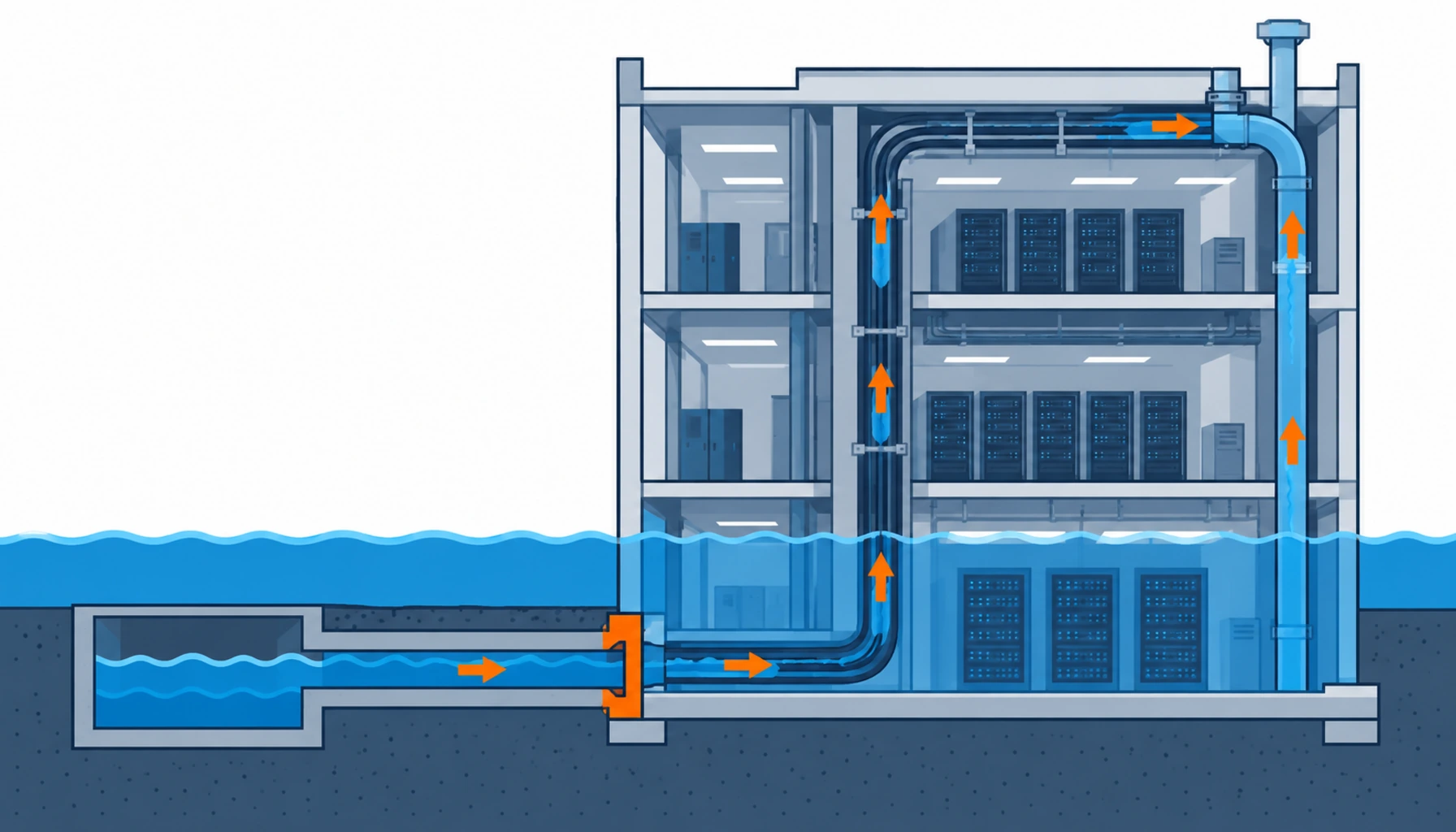
Quick Answer: Flood resilience in a data center is bought as a route design, not as a pump. The water that matters rarely arrives through the wall; it arrives through a duct, a cable trench or a riser, and it travels along the cable itself. That makes the specification a question of levels, seals and blocking rather than of equipment ratings alone.
Introduction
A flood study usually produces a level, and a level usually produces a decision about how high to build. What it does not produce is a description of how water will get in anyway, which is through the services. Cable ducts, trenches and risers are continuous paths from outside the building to the equipment inside it.
This is a procurement problem before it is an engineering one, because the items that stop water are bought: the sealing system at each penetration, the blocking construction inside each cable, the drainage and the backflow prevention. Our notes on firestop cable penetrations and on riser cable in shafts cover the same openings from the fire and vertical distribution sides; this note covers what has to be specified so that water stops at the boundary rather than at the servers.
How Water Actually Gets In
Four pathways account for most water damage in data centers, and each one has a different answer.
Penetrations in the envelope. Every cable, pipe and duct crossing the building line is a hole. A penetration sealed for fire is not automatically sealed for water, because firestopping materials are often porous and can be penetrated by water under a small head. The two requirements have to be met by the same detail or by two details that coexist.
Ducts and trenches that run below the flood level. An underground duct bank entering a basement cable room is a pipe filled with cables and air. Where the outside end is above the water and the inside end is below it, the duct becomes the route, and the water arrives without any visible breach.
Travel along the cable itself. An unblocked cable core carries water between the strands, and the water emerges at the far end, which may be a floor above the entry point. This is the pathway that surprises operators, because the equipment that fails is not the equipment that got wet.
Rising groundwater and backflow. Where the drainage system is connected to a municipal sewer, a flood event can push water back up the drain. A sump pump without a backflow prevention device is a pump fighting an open pipe.
The Decision Table: Four Flood Strategies and What Each One Requires
The strategies below are usually combined. The last column is where the money goes if the strategy is chosen without the detail that makes it work.
| Strategy | What You Are Buying | What to Specify | Evidence You Should Receive | Failure Mode If Simplified |
|---|---|---|---|---|
| Raise the route above the flood level | Trays, busway and equipment mounted above a stated level, with entries arranged to suit | The design flood level, the freeboard added, and the entry levels of every duct and trench | Route drawings with levels marked, against the flood study | One duct left below the level, on the assumption that the rest of the route is safe |
| Dry floodproofing the envelope | Water resistant seals at every penetration, plus membranes, doors and backflow prevention | Sealing system for each penetration type, with the head of water it is rated against | Product certification for the water head, and installation records per penetration | Firestop materials used as water seals, porous and untested for water |
| Water blocked cable as the last barrier | Cable with longitudinal blocking and sealed ends, so water cannot travel along the core | Blocking construction named, with the end sealing system matched to it | Type test data for the blocking construction, plus sealing procedure records | Standard cable on the assumption that the seals will keep water out of the duct |
| Drain and pump the water out | Sump, pumps, level detection and backflow prevention, with a power supply that survives | Pump duty, standby arrangement, detection levels and the backflow device | Pump duty calculations, backflow device certification, alarm test records | A pump installed without backflow prevention, discharging into a flooded sewer |
What Each Strategy Changes in the Order
Four items convert from design intent into purchase requirements.
Levels have to appear in the cable schedule. Every duct, trench and tray crossing a boundary needs an entry level recorded against the flood level. Where levels are not on the drawings, the installer sets them to suit the steelwork, and the flood study becomes a document rather than a constraint. Our note on data center cable selection covers how these route conditions feed into the cable choice.
Sealing becomes a system per penetration type. A duct with cables is not the same penetration as a duct without, and a wall is not the same as a floor. The sealing product should be qualified for the water head it will see, and the installation should be recorded per penetration so that a later cable pull does not silently void the seal. Where the range includes purpose-built blocking constructions, they are described in our note on longitudinal water blocking cable.
Cable blocking moves from optional to specified. On any route whose ends are at different levels, longitudinal blocking is what prevents water arriving somewhere it was never expected. For routes that may be submerged, the construction has to be assessed for continuous immersion rather than for damp conditions, and the ranges built for submerged duty are described in our note on deep well waterproof cable.
Drainage equipment becomes part of the power scope. Pumps, level detection and backflow prevention need power, and they need it during a flood event when the main supply may be lost. The supply arrangement and the alarm route belong in the specification, and the enclosure that houses them belongs in the same corrosion and ingress class as the rest of the installation. Our note on GGD power distribution cabinets covers the enclosure side, and the earthing consequences of a wet environment are covered in our note on data center grounding cable.
Where Flood Programmes Fail
The flood level applied to structures and not to services. The building is raised, the doors are specified, and the duct bank still enters below the level with no seal. The route is the part of the design that crosses the boundary, and it is the part that gets least attention.
Fire sealing assumed to be water sealing. The penetration was inspected and approved against the fire requirement, and no one asked about water. Unless the detail satisfies both requirements, which live in different documents, the inspection gives false confidence.
Recovery not planned as part of the purchase. After a flood, the decision about which equipment can be dried and reused and which must be replaced is made under time pressure, by whoever is holding a drying fan.
Pumps specified without a power source that survives the event. A sump pump on the critical supply is useful only if the critical supply is above the water. The same logic applies to the level detection and the alarm.
What to Freeze Before the Order
| Item | What to State | Evidence to Attach | Cost of Leaving It Open |
|---|---|---|---|
| Design flood level | The level for the site, the source study and the freeboard applied on top of it | The flood study with the level and return period stated | Route levels set to suit steelwork, and a constraint that exists only on paper |
| Entry levels | Duct, trench and tray levels at every envelope crossing, checked against the flood level | Route drawings with levels marked at each crossing | One duct left below the level, and a path for water into the building |
| Penetration sealing | The sealing system for each penetration type, qualified to a stated water head | Certification for the water head, plus installation records per penetration | Firestop material used as a water seal, and water arriving through an approved detail |
| Cable blocking construction | Longitudinal blocking on any route with ends at different levels; immersion rated where submersion is possible | Type test data for the blocking construction and for immersion where required | Water emerging inside equipment that was never near the flood |
| End sealing | The sealing system matched to the cable construction, with the procedure specified | A sealing procedure and the accessories qualified with the cable | Unsealed cores acting as water pipes from a flooded duct to a dry floor |
| Backflow prevention | The device, its location and the head it is rated against | Device certification and a test record after installation | Drainage that reverses and delivers flood water into the building |
| Pump and detection power | The supply arrangement for pumps, detection and alarms, and what happens when the main supply fails | A power and alarm diagram with the supply source marked | Pumping equipment that stops working at the start of the event |
| Recovery criteria | Which equipment is rated to survive immersion, and the test that decides reuse | Manufacturer statements and an agreed post-flood test procedure | Decisions made under time pressure about equipment nobody is sure of |
When Hardened Cable Routes Are Not the Answer
Where the site is genuinely outside the floodplain and the freeboard is generous. Not every site needs immersion rated cable. The level study is what decides, and over-specifying everywhere is a way of avoiding the study rather than an answer to it.
Where the routes are already above the level and sealed. On many sites the answer is already in the layout. What is missing is the verification: the levels marked on drawings, the seals recorded per penetration and the test after installation. Verification is cheaper than additional protection.
Where a pump is being bought instead of a seal. Pumping removes water that has already arrived. It is a legitimate second line of defence and a bad first one, and where the specification relies on it, water reaches the equipment before the pump finishes its first cycle.
Where the design assumes a single event. Flooding often arrives as a sequence, with a first event saturating the ground and a second one exceeding the drainage. Equipment specified for one submersion may see two in a month, and the recovery criteria should reflect that.
RFQ Checklist
- Design flood level stated, with the source study and the freeboard recorded
- Entry level recorded for every duct, trench and tray crossing the building envelope
- Penetration sealing systems named per penetration type, with the water head they are rated to
- Sealing installation recorded per penetration and re-checked after later cable pulls
- Longitudinal water blocking specified for every route whose ends are at different levels
- Immersion rated construction required where submersion during an event is possible
- End sealing procedure specified and matched to the cable construction supplied
- Backflow prevention device specified, located and tested
- Pump, detection and alarm supplies confirmed to survive the loss of the main supply
- Earthing and bonding arrangements checked for the wet condition
- Recovery criteria stated, including the test that decides whether equipment is reused
- Drainage capacity stated against the event the design assumes, not against a typical rainfall
Conclusion
Flood resilience is one of the few areas where the cheapest items carry the most weight. A level marked on a drawing, a seal recorded per penetration and a cable with blocking along its length together prevent most of the damage that a flood causes in a data center, and none of them is expensive. The mistake to avoid is buying the visible protection, the pumps and the barriers, and leaving the routes to be detailed on site.
Kexingyu Cable Group (KXYE) supplies cable and distribution equipment for installations where water ingress is a design case, including the WDZ-YJY, WDZN-YJY, BTTZ, NG-A (BTLY), KVV and YJV ranges, the water blocking cable range used on routes crossing a flood level, and the busbar tap-off box used where a busway run is tapped along its length, all from one factory group with copper price linkage available on project-scale orders. Send the flood level, the route levels and the ingress class you are working to, and we will return the constructions, the sealing options and the test records that support them; the fastest route is a request for quotation.