Buying Construction Robot Cable for Demolition and Site Duty: Dust, Impact and Vibration
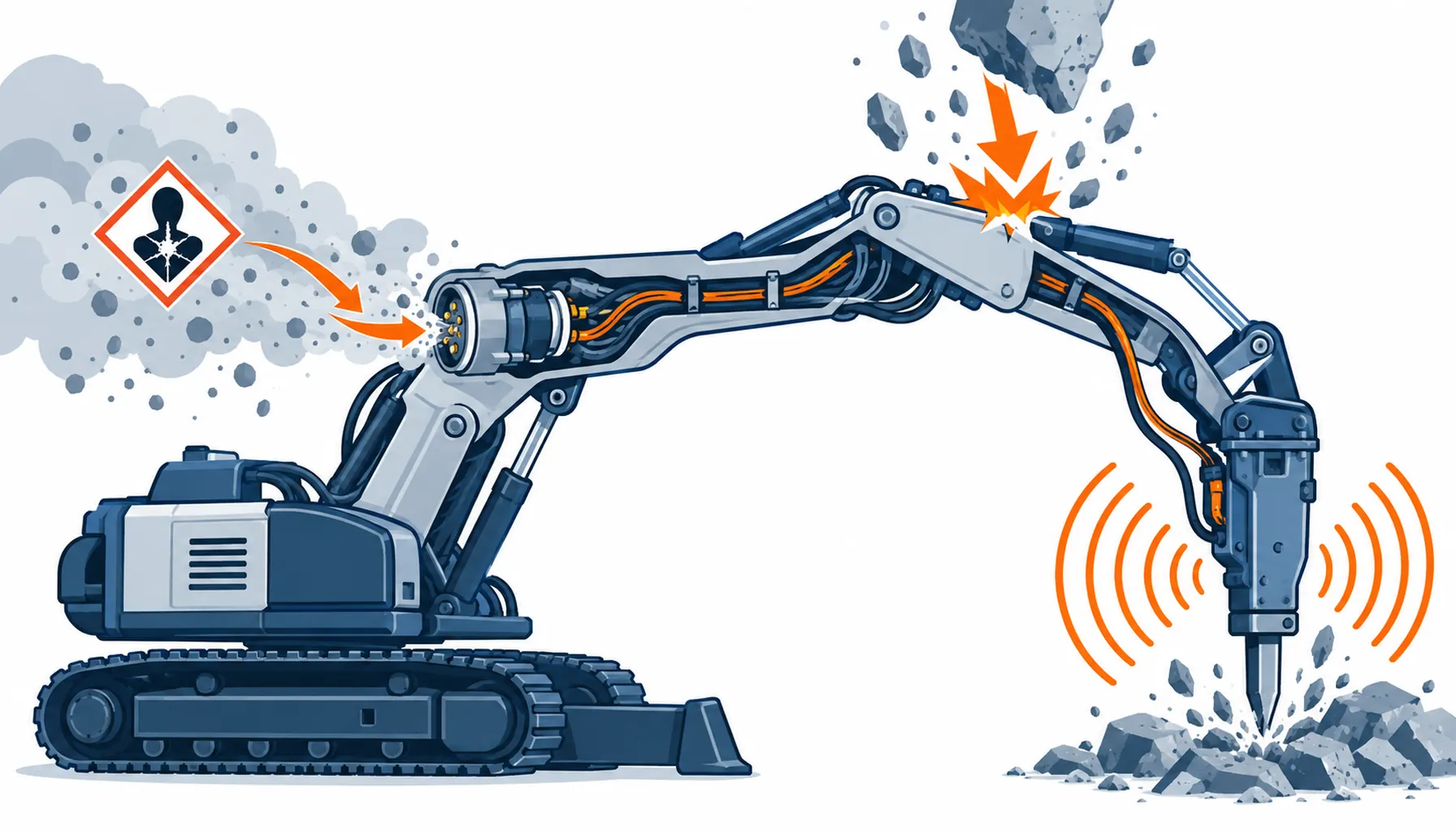
Quick Answer: A site robot is destroyed from the outside in. Concrete dust is alkaline and abrasive, debris arrives as impact rather than as wear, and the breaker on the end of the arm puts continuous vibration into every termination in the harness. Cable bought on flex life alone will pass every bench test and still fail at the first connector. The specification that matters names the dust, the impact, the vibration and the route.
Introduction
Demolition and site robots have become common on refurbishment and infrastructure work, and their cabling follows none of the assumptions that hold in a factory. There is no defined route, no clean power, no controlled temperature, and nobody to notice a chafed jacket until something stops working.
Some of the outdoor rules are shared with other field machines, and our note on agricultural robot cable covers ultraviolet and soil exposure. What follows is specific to a site: concrete dust, impact, vibration and a power supply that moves every week.
Dust That Is Not Just Dust
Concrete and masonry dust is alkaline, and it is abrasive in a way that sand is not. It also hardens when it takes on water, which means dust that collects in a connector shell can set like weak mortar and then hold moisture against the contacts. That is a slow failure that looks like a random electrical fault and is usually blamed on the connector.
The practical fix has two parts. Keep dust out of the places it can set, and keep the places it does collect accessible for cleaning. Sealing a connector properly is worth more than sealing the whole harness, because the connector is where the dust actually causes damage. Where the machine works in a wet demolition environment with dust suppression, the same dust arrives as a slurry, which is worse.
Declare the dust and the suppression method in the RFQ, including whether water is sprayed continuously. A cable bought for dry dust and then run under a water spray is a different product with a different sheath requirement, and this is the single most common mismatch on these machines.
Vibration Is a Termination Problem
A breaker or a crusher jaw puts a continuous, high-frequency load into the structure, and every cable termination inherits it. The failure that follows is fretting: tiny relative movement between contact surfaces that wears through plating, exposes base metal and raises contact resistance. It is not a conductor problem and no amount of extra copper will fix it.
Two purchasing decisions address it. The first is contact plating, because a thicker and harder contact surface survives movement far longer than a thin one. What each plating option buys and what it costs is set out in our note on connector contact plating. The second is the termination method itself, because a crimp with the correct tool and verification survives vibration better than a hand-made joint.
The failure signature is worth knowing, because it is routinely misdiagnosed. A connection that tests fine at rest and misbehaves once the machine starts is a fretting problem, not an insulation problem. The pattern is described in our note on why robot connectors fail, and it is the main reason a site machine should not be bought with the cheapest connector family available.
Impact, Debris and the Route Nobody Draws
On a site the route is improvised by the operator, and the cable is the part that suffers for it. Falls of rubble, dropped tools, tracked machines running over the harness and dragging the cable across a broken slab are all normal events rather than accidents. None of them is addressed by a flex figure.
Two things help. The first is armour on the sections that touch the ground, specified as a replaceable sleeve rather than as part of the cable, so a damaged section can be renewed without rebuilding the harness. The second is a route drawing that the operator can actually follow, because a cable that is dragged rather than carried wears at a predictable place.
The abrasion standard behind the sleeve matters more than the sleeve’s appearance. Ask what test was used and at what load, because abrasion figures are only comparable when the method is the same. The methods and how to read them are set out in our note on cable abrasion test standards, and the visible patterns that identify impact rather than abrasion are in our note on cable damage wear patterns.
The Site Supply Is Part of the Cable Specification
Site power is rarely what the machine was designed for. A generator supplying a demolition robot also feeds lighting, grinders and pumps, and the voltage at the far end of a long temporary run can swing well outside the nominal value while the machine starts under load. That does not change the cable electrically, but it changes what the buyer should ask about conductor size and voltage drop over the temporary run.
Earthing is the second half. Temporary distribution boards are bonded in ways that are legal and messy, and a machine whose frame is bonded through a long, thin run can pick up differences in potential that appear as noise on feedback and control lines. Where the machine has screened signal, the screen should be bonded where the drawing says and not wherever an installer finds a convenient bolt. The rules for that on a moving machine are set out in our note on EMC and grounding for moving cable.
Ask for the temporary feed length and the voltage drop calculated at the machine’s starting current. It takes a few minutes and it prevents the most common site complaint, which is a machine that behaves perfectly on the bench and oddly on hire.
The Decision Table: Four Cable Strategies for Site Machines
| Strategy | What to specify | Evidence to demand | Cost and lead time | Where it fails |
|---|---|---|---|---|
| Exposed flexible run on the arm | Sheath compound, bend radius and the contact points | A flex figure at the real arc and cycle count | Lowest cost, shortest lead time | Impacts and dragging that a flex figure never covered |
| Armoured or sleeved low sections | Sleeve type, coverage and the replacement interval | An abrasion test at the stated load and method | Add-on cost at assembly | Dust and grit trapped under a sleeve against the sheath |
| Umbilical to the hydraulic power pack | Oil resistance, crush rating and the strain relief at both ends | An oil resistance statement plus a crush figure | Higher unit cost, longer lead time | A hose-grade cable used where an oil-resistant one was needed |
| Temporary site feed with quick connectors | Connector family, ingress level and mating cycles | A mating cycle and ingress test at the mated joint | Moderate cost, standard lead time | A connector chosen for convenience rather than for cycles |
| Relocation assembly with handles and coiling | Coiling radius, handles and a reeling-rated core | A coiling life figure at the real storage radius | Higher hardware cost, longest lead time | Paying for reeling hardware where a fixed loop was enough |
What to Freeze Before the Order
| Item | What to state | Evidence to attach | Cost of leaving it open |
|---|---|---|---|
| Dust type and suppression | Concrete, masonry or mixed, and whether water is sprayed | A slurry and chemical statement for the sheath | Dust setting inside a connector shell and holding moisture |
| Ingress at the joint | Where dust and water reach the connector, and the mated state | An ingress test at the mated joint, not on a loose plug | A sealed-looking connector that passes dust when open |
| Vibration level | The source, frequency range and where it enters the arm | A vibration endurance figure for the termination | Fretting that reads as an intermittent electrical fault |
| Contact plating | Plating material and thickness for the vibration duty | A plating specification, not a description | Contact resistance rising within a season |
| Impact exposure | Where debris can fall and where machines can run over the run | An impact figure plus a protected route drawing | A crushed or severed run that stops the job |
| Abrasion contact points | The points that touch slab, rubble or a track | An abrasion figure with the method and load stated | A sleeve worn through where nobody looked |
| Oil and hydraulic exposure | Where hydraulic oil or fuel can reach the harness | An oil resistance statement for the compound | A swollen jacket at the power pack end |
| Bend radius | The figure for the assembled harness at each pivot | A flex figure at the tightest point of travel | Core damage hidden inside the harness |
| Grounding and bonding | How the arm and the frame are bonded, and where | A bonding drawing with the conductor sizes stated | Noise, shock risk and a fault that is hard to trace |
| Relocation routine | How often the machine moves and how the cable is coiled | A coiling radius and a handling procedure | A harness damaged by the way it is stored, not used |
When a Construction Robot Cable Specification Is Not the Answer
When the machine is on a short contract. A robot working a three-month strip-out does not need a five-year specification. Buy a proven industrial flexible cable, armour the low sections, keep the route short, and put the money into spare assemblies that can be fitted on site. The specification should harden when the machine is going to a second job.
When the failures are in the connector rather than the cable. If contacts are the recurring problem and the insulation tests are clean, vibration and dust are the causes and the cable is the wrong place to spend money. Move the budget into plating, termination quality and a connector with a proper seal.
When the site has a permanent power route. Some refurbishment machines work from a fixed distribution board for the whole project. In that case the temporary feed and the quick-connect hardware disappear from the specification, and the money is better spent on the arm-side harness and its spares.
When nobody owns the route on site. A specification cannot compensate for a cable that is dragged across rubble by whoever is nearest. If the machine will be moved by site staff rather than by the buyer’s own operators, a protected route, a coiling procedure and a pre-use check matter more than the compound. What to check after each relocation is set out in our note on robot cable field diagnostics, and the wider inspection routine in our note on robot cable inspection standards.
RFQ Checklist
- Dust type named, with the suppression method and whether water is sprayed continuously
- Ingress level stated at the mated joint, with a test report at that joint
- Vibration source, frequency range and the point it enters the arm
- Contact plating material and thickness specified for the vibration duty
- Impact exposure shown on a route drawing, with protected sections identified
- Abrasion figure requested with the test method and load stated
- Oil and hydraulic exposure named, with a compound resistance statement
- Bend radius given as a harness figure at each pivot, not for a single core
- Grounding and bonding shown on a drawing, with conductor sizes stated
- Relocation routine, coiling radius and spare assembly level agreed with the operator
Conclusion
Construction robot cable is bought on four things the factory assumptions never cover: alkaline dust, impact instead of wear, continuous vibration at the terminations, and a route that changes with the job. Put those four in the RFQ and the arguments about sheath hardness resolve themselves. Leave them out and the failures will arrive at the connector first, where they will be blamed on the wrong part.
Kexingyu Cable Group (KXYE) has supplied abrasion-rated, oil-resistant and armoured special cable since 1996, and can build harnesses with the plating, sealing and strain relief a site machine needs. Send us the dust and suppression details, the vibration source and the route drawing, and we will return constructions, sleeve options and sample assemblies for a site trial; the fastest route is a request for quotation.