Buying Educational Robot Cable: Why Laboratory Duty Cycles Mislead Buyers
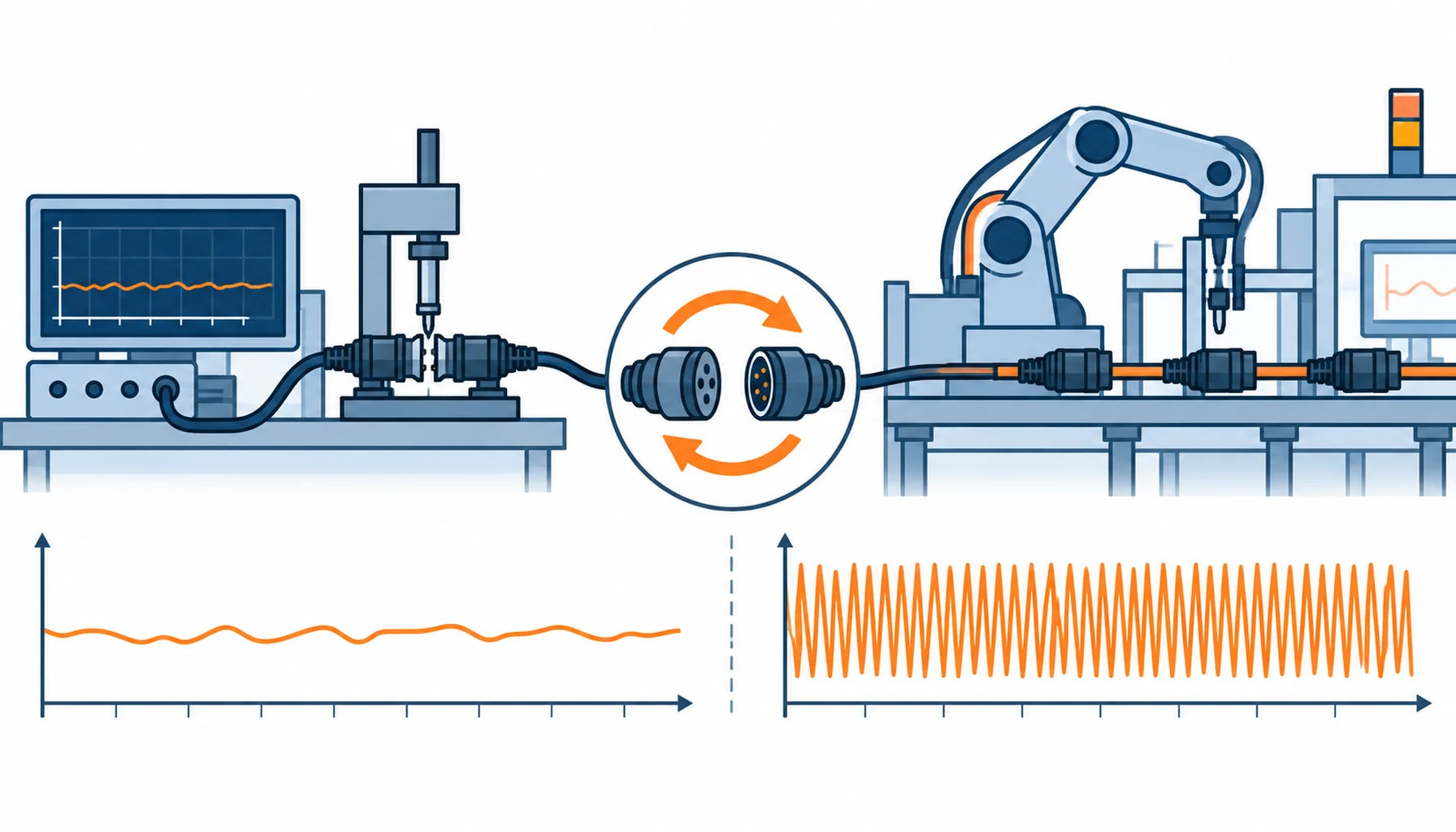
Quick Answer: A robot that has run happily in a laboratory for three years has proved almost nothing about how its cable will behave in production. Laboratory duty is low-cycle, supervised, temperature-controlled and constantly reconfigured, and it wears a cable through handling rather than through motion. The trap is that the laboratory result is then quoted as evidence for a factory or a fleet, where the same cable meets an entirely different duty. Buying for the lab is a different decision, and it should be made on purpose.
Introduction
Education and research account for a large share of robot unit sales. Industry data on the segment consistently shows entertainment, education and service applications taking well over half of the units shipped in some years, and the reason is simple: teaching institutions buy many small machines and industry buys fewer large ones. That statistic matters to a cable buyer, because it means most robots in service are working in exactly the duty that misleads.
The physical rules do not change in a laboratory, and the comparison between continuous flex and drag chain duty in our note on flex versus drag chain cable still applies. What changes is which of those rules actually governs the failure.
Why a Laboratory Duty Cycle Is Not a Production Duty Cycle
A laboratory arm runs a few hours a day, in a controlled room, at moderate speed, on a known program. A production arm runs shifts, in a warm enclosure, at higher speed, on a cycle that never varies. The flex cycles may be lower in the lab by an order of magnitude or more, and the thermal load is usually much lower as well.
That gap is invisible in a laboratory report. A harness that completed a year of laboratory work has demonstrated a low-cycle, low-temperature duty, and a specification written from that result will be wrong in the direction that matters, because production failures come from cycles and heat, not from time.
The second gap is supervision. Nothing in a laboratory is handled carelessly, and almost everything in production is handled under time pressure. A connector that is mated a few times a week in a lab may be mated dozens of times a week in a factory, and mating cycles are a finite resource. The reasoning about what happens to contacts under repeated mating is set out in our note on M8 and M12 connectors for automation, and it applies to every connector family.
What Actually Wears Out in a Teaching Cell
Not the flex life. In a teaching cell the cable fails from handling. Students reconfigure the arm, move it between benches, unplug the harness to route it differently, coil it around the frame and take it home in a bag. The cable is dragged, kinked, stood on and occasionally used to lift the machine.
The second cause is re-termination. A teaching cell is a place where somebody rewires the end of a cable to try an idea, and the cable has to survive that. A harness built with sealed, moulded terminations cannot be modified at all, which is fine for a product and wrong for a laboratory.
The third cause is wrong power. A bench with a variable supply and several students will eventually put the wrong voltage onto a circuit, and the resulting damage is concentrated at the terminations and the first few centimetres of the cable rather than along its length. Buying a cable with a generous temperature and current margin at the terminations is more useful here than buying a high flex rating nobody will reach.
The fourth is the collaborative arm itself. Where a cobot shares a bench with people, its own safety requirements shape what can be routed where, and those requirements come from the machine standard rather than from the cable. The relevant documents are set out in our note on ISO 10218 robot safety, with the collaborative case in our note on ISO TS 15066 for cobot safety, and a cable choice cannot substitute for either.
Buy for Re-Termination, Not for Flex Life
The single most useful decision in a laboratory or teaching purchase is field-serviceable termination. A connector that can be re-terminated on a bench, with a documented process and a tool that the institution already owns, turns a broken cable into an hour of student work instead of a purchase order. That is worth more than any rating on a datasheet.
It also changes the spares model. Instead of holding finished harnesses for each experiment, the laboratory holds connectors, contacts and a length of approved cable, and builds to the length the experiment needs. The process and the evidence behind a good termination are set out in our note on terminating robot harnesses, and the same method that a factory uses at scale can be taught and repeated on a bench.
Where a project is expected to become a product, the calculation changes. In that case the laboratory is the first unit of a production programme, and the connector family chosen on day one sets a constraint that is expensive to remove later. Buying a general-purpose connector for the prototype and a production connector for the product means qualifying both, re-writing the drawings and re-testing the harness, which is exactly the cost the laboratory was supposed to avoid.
Teaching Cells and Research Rigs Need Different Buying
A teaching laboratory is a repetitive environment. The same cell is bought in tens, runs the same exercises every term, and every unit sees almost the same duty. That makes it a volume purchase: one specification, one connector family, one documented termination process, and a stock of contacts that covers a whole department. Buying them together is cheaper and, more importantly, keeps every cell repairable with the same tooling.
A research rig is the opposite. It is one machine, its configuration changes with the project, and the cable has to accommodate an idea that did not exist when the order was placed. Buying for research means buying slack: extra length, spare ways, connectors that can be re-made, and a supplier who can deliver a short length of the same cable next month rather than next quarter.
Mixing the two in one order is where departments waste money. The volume purchase ends up with a specification that is too loose for a teaching cell, and the research rig gets a sealed assembly it cannot open. Split the requirement, and let the numbers follow each case.
Four Ways to Buy for a Laboratory or Teaching Cell
| Strategy | What to specify | Evidence to demand | Cost and lead time | Where it fails |
|---|---|---|---|---|
| Field-serviceable harness | Connector family, contacts and a documented re-termination | A re-termination done on site during handover | Moderate cost, standard lead time | A connector family nobody can buy contacts for locally |
| Sealed moulded assembly | Flex rating, sealing and the replacement part number | A flex figure at your duty plus a spare part number | Higher unit cost, tooling lead time | An assembly that cannot be modified when the rig changes |
| Cable and connectors as loose items | Approved cable, mating cycle count and tooling | A sample termination with a pull-off record | Lowest unit cost, highest labour | Untrained terminations that fail during the experiment |
| Prototype built on production parts | Production connector, contacts and cable from day one | A harness drawing that can go into production unchanged | Highest unit cost, longest lead time | Paying production prices for a rig that never ships |
| Disposable bench extension | Short length, cheap connector and an inspection interval | An abrasion and handling statement | Very low cost, off the shelf | A cheap extension used as a permanent installation |
What to Freeze Before the Order
| Item | What to state | Evidence to attach | Cost of leaving it open |
|---|---|---|---|
| Real duty | Hours, cycles and amplitude per week, not per year | A short measurement on the actual rig | A rating written from a laboratory impression |
| Handling | Who moves it, how often and by what part | A note on the routes that get handled most | A cable that fails from being picked up, not from moving |
| Re-termination | Whether the end can be re-made on site, and with what | A documented process and the tools required | A one-hour repair turned into a two-week order |
| Mating cycles | Plugs and unplugs per week for each connector | A cycle count against the connector's rating | A connector at its limit before the term ends |
| Connector lock-in | Whether this rig will become a product | A drawing that can survive into production | Two connector qualifications instead of one |
| Termination margin | Voltage and current margin at the ends | A temperature rise record at the highest load used | Damage concentrated at the terminations |
| Bend radius | The figure for the assembled harness on the rig | A flex figure at the tightest point used | Kinks from coiling that nobody connects to a fault |
| Labelling | How each harness is identified when it is off the machine | A label sample that survives handling | Two harnesses confused and both rebuilt |
| Safety routing | Where the cable may run on a collaborative rig | The machine's own safety documentation | A routing choice that conflicts with the machine standard |
| Spares and warranty | What is held, and what the warranty covers in a teaching use | Written terms that mention the actual duty | A claim refused because the use was never declared |
When an Educational Duty Specification Is Not the Answer
When the rig is genuinely going to production. If the machine on the bench is the first unit of a product, stop buying laboratory cable. The connector, the terminations and the drawings should all be the ones the product will use, and the extra cost now is smaller than the qualification work later. The laboratory is a cheaper place to find out that a connector cannot be re-terminated reliably.
When the institution wants a high flex rating it will never use. A continuous flex construction bought for a bench rig is money spent on cycles the machine will not reach, and it usually arrives stiffer than the simple build it replaced. Measure the rig for a week, then buy to that figure with a margin, rather than buying the highest rating in the catalogue.
When the cables keep disappearing. If harnesses are being lost rather than broken, the answer is labelling and a storage system, not a different cable. A lab that cannot find its harnesses will lose expensive ones at the same rate as cheap ones, and our note on robot cable RFQ covers how to write an order that makes identification part of the delivery.
When nobody reads the warranty terms. Teaching use is not always covered by a standard industrial warranty, and a claim refused after a student connects the wrong supply is a common and avoidable argument. Have the terms confirmed for the actual duty before ordering. Where the machine is a collaborative arm used in a service or educational setting, the reasoning in our note on service robot cable applies to the handling side, and the general terms question is set out in our note on robot cable warranty.
RFQ Checklist
- Measured duty stated per week, in hours, cycles and amplitude, rather than assumed
- Handling described, including who moves the machine and by which part
- Re-termination capability stated, with the process and the tools required
- Mating cycle count per connector given against the connector’s own rating
- Whether the rig becomes a product, and a connector chosen accordingly
- Current and voltage margin at the terminations, with a temperature rise record
- Bend radius given as a harness figure for the rig as it is actually used
- Label scheme specified so that a harness can be identified off the machine
- Routing checked against the machine’s own safety documentation
- Warranty terms confirmed for educational use, in writing, before the order
Conclusion
An educational robot cable is bought on four things a laboratory report will not tell you: the measured duty, the handling it will receive, whether it can be re-terminated on site, and whether the rig is really a prototype of a product. Answer those four and the specification becomes simple, and you stop paying for flex cycles the machine will never reach or discovering a connector limit at the end of term.
Kexingyu Cable Group (KXYE) has supplied flexible and special cable since 1996, and can supply both field-serviceable assemblies and sealed production harnesses, with termination processes documented well enough to be repeated on a bench. Send us the measured duty, the connector preference and the expected life of the rig, and we will return suitable constructions and sample assemblies; the fastest route is a request for quotation.