Robot Repair Harnesses and Field Kits: What to Stock Before Cable Failure Stops the Line
Quick Answer: A cable failure costs what the response takes, and the response is decided by the shelf. A stocked robot repair harness for each critical axis plus a compact field kit of connectors, crimp tooling and consumables turns most cable events into a shift of work; the same event without them becomes a procurement exercise at panic freight.
Introduction
Our note on spare cable programmes covers what whole cable to stock and why. This one covers the other half of the recovery story: the pre-terminated repair harnesses that replace a damaged section, and the field kits that carry a recovery from diagnosis to running production without a single purchase order raised mid-crisis. The two overlap deliberately, and the boundary between them is the first thing a stocking plan should draw.
The economics are blunt. A robot cell bills its downtime by the hour, a repair harness on a shelf costs a fraction of one lost shift, and a field kit is a tooling investment that serves every recovery for years. Yet most plants stock none of it, because cable fails rarely enough that the shelf looks like dead money right up until the night it looks like the cheapest purchase of the year.
Repair Harnesses: What to Hold, and for Which Axes
A repair harness is a pre-terminated drop for the section that actually fails, the flex loop at the wrist, the carrier run to the base, the dress pack segment, built to the machine’s drawing and tested before it goes on the shelf. It replaces a two-week lead time with a two-hour swap. Which axes earn one follows the same triage as any spare: the highest downtime cost per hour, the longest supplier lead time and the failure history from your trend sheets. A fleet of twenty robots usually needs repair harnesses for two or three axis types, not twenty, and the fleet’s own records decide which, as our note on in-service cable testing explains how to read.
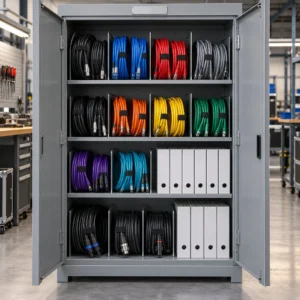
Storage conditions matter more than buyers expect. Pre-terminated harnesses age on the shelf, jackets take a set in hot or compressed storage, connectors corrode in damp ones, and a spare that fails its first continuity test on the night it is needed is worse than no spare, because the diagnosis now includes the rescue plan. Cool, dark, coiled at the designed radius, with a continuity check on a calendar, is the whole specification for the shelf itself.
The Field Kit: What Goes in the Box
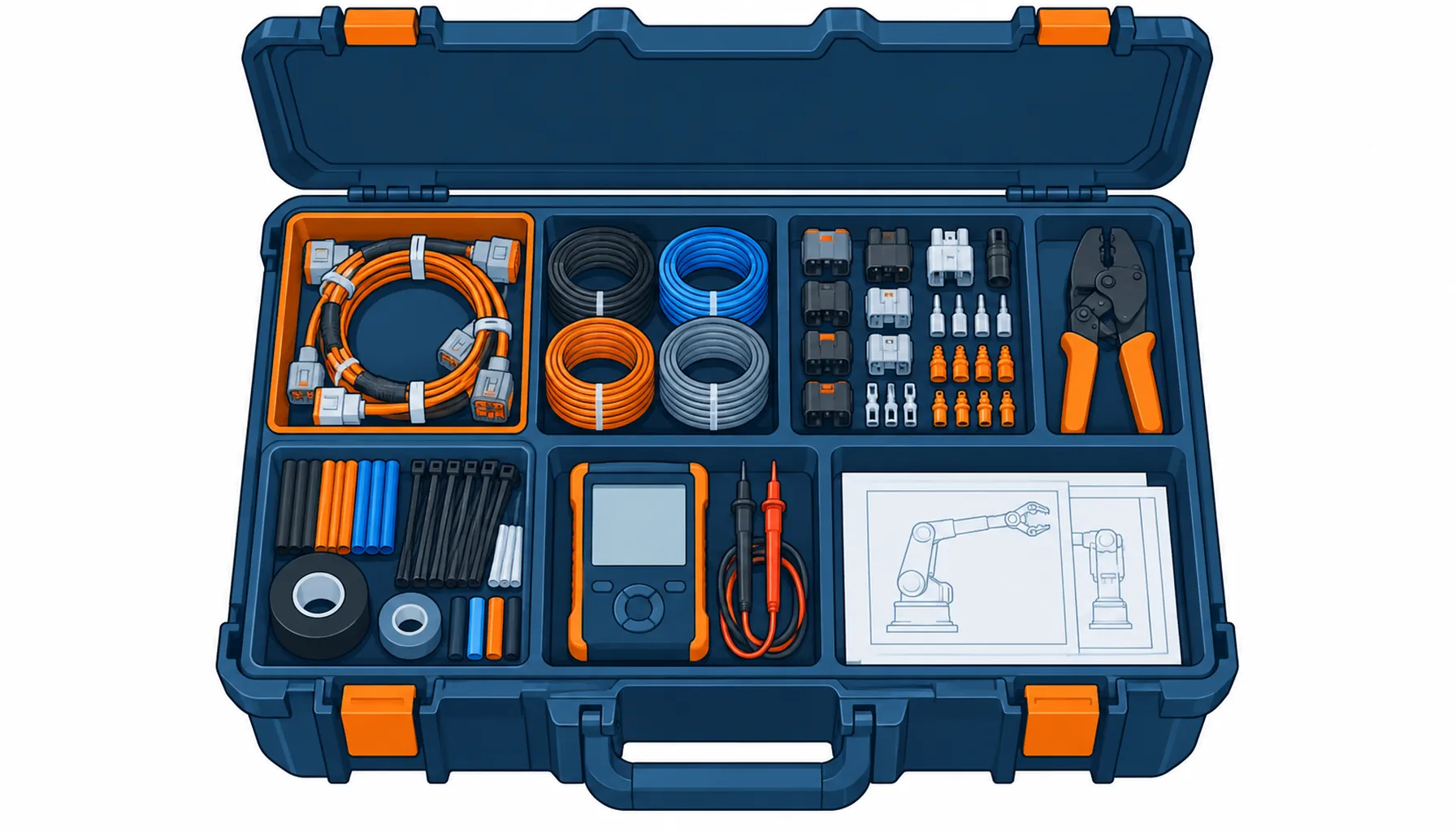
The kit serves the repairs a harness cannot, and its contents follow the failure patterns your fleet actually produces. The electrical core is a quality crimper with the die set matched to your terminals, spare connectors for every type in service, a wire-stripping tool that handles fine strand without nicking, heat-shrink and adhesive-lined sleeves, and the multimeter and insulation tester the diagnostic sequence in our note on robot cable troubleshooting assumes you own. The mechanical layer is zip ties, dress-pack clips, spiral wrap, chafe protection and the small hardware that a repair always seems to lack one piece of.
Two items earn special mention. A small stock of the actual cable used in your flex sections, five or ten metres of each critical type, lets a technician rebuild a damaged segment rather than improvise with whatever is at hand; the construction differences that make substitution risky in production are explained in our note on continuous flex versus drag chain cable. And a printed set of termination drawings, crimp heights, torque values and pinouts per harness, converts three hours of archaeology into thirty minutes of following instructions, as our note on terminating robot harnesses sets out.
Size the box itself honestly. A kit that fits one shelf location gets maintained; a kit spread across three cabinets gets mined and never restocked. If the contents outgrow one location, that is a signal to trim to what your fleet’s failure history actually uses, not to buy a second cabinet.
The Decision Table: Kit Contents and What Each Line Buys
| Item | What to stock | Why it is there | Cost to hold | Downtime saved |
|---|---|---|---|---|
| Repair harness | Pre-terminated drop per critical axis type | Replaces the section that actually fails | Shelf space and a continuity check | Weeks of lead time per event |
| Flex cable stock | 5-10 m of each critical type | Rebuilds segments without improvisation | Minor, with rotation | Hours of sourcing per repair |
| Connector set | Spares of every type in service | Connectors fail more than cables | Small | The failure mode most repairs meet |
| Crimp tooling | Quality crimper plus matched dies | Terminations decide repair quality | One-time tooling cost | Repairs that survive the year |
| Consumables | Heat-shrink, sleeves, ties, wrap | The missing piece at 2 a.m. | Trivial | Minutes to hours per repair |
| Test gear | Multimeter, insulation tester, leads | Diagnosis before disassembly | Already owned in most shops | The wrong-part swap |
| Documents | Termination drawings and pinouts | Turns archaeology into instructions | Paper | Hours per unfamiliar harness |
Sizing the Stock to the Fleet
Price the whole kit against one lost shift on your most expensive cell and the case closes itself. The kit is not a cost centre that occasionally helps; it is the physical half of the recovery plan, and the plants that hold one recover in hours what the plants without it recover in weeks.
Building the Kit With the Supplier, Not Against the Clock
The stocking formula has three inputs: the failure rate from your own records, the supplier lead time for each part, and the cost of downtime per cell. One spare per critical harness type covers a fleet whose failures arrive months apart with a two-week lead time; a fleet that eats a harness a quarter, or that waits eight weeks for an imported replacement, needs two, and the arithmetic that says so is the same one our note on the robot downtime cost runs in full. Resist the temptation to stock everything: a shelf full of spares for axes that never fail is capital that the critical axes’ empty slots need more.
Consolidation helps small fleets. Where several robot models share a cable type, or where the supplier can build one harness design that serves a family of cells with minor pinout differences, the stock count drops without the coverage dropping, and the consolidation conversation belongs in the RFQ rather than in the maintenance office, as our note on the robot cable RFQ suggests structuring. A one-cell plant can play the same game by matching its kit to a neighbouring plant’s, sharing the slow-moving items and halving both shelves.
Before the Kit Exists: What to Freeze
The right time to build the kit is with a purchase order, not with a failure. Bundle the repair harnesses, the cable stock and the connector sets into one quotation against the harness drawings, and the supplier prices the package as a programme rather than as a scramble. The conversation also surfaces facts a plant cannot get mid-crisis: which constructions the supplier recommends holding, what shelf life they warrant on stocked harnesses, and what the repeat lead time for a second spare looks like. Those answers become the min-max levels the shelf runs on.
Ask for the harnesses to arrive bench-tested with their termination packs, and say so in the RFQ. A spare that arrives with its own continuity record, crimp data and pinout drawing goes on the shelf ready; one that arrives as an untested coil goes on the shelf as a question. The delta in price is small and the delta in the first real recovery is large, as our note on robot cable sample testing explains for first articles and as the shelf inherits unchanged.
Keep the arrangement standing rather than transactional. A supplier who holds your harness drawings, knows your fleet and ships a repeat spare in a week is worth more than a cheaper supplier discovered during the failure, and the standing arrangement costs nothing beyond remembering to send the trend sheets that keep their file current.
When Stocking More Is Not the Answer
| Item | What to state | Evidence to attach | Cost of leaving it open |
|---|---|---|---|
| Covered axes | Which axis types earn a repair harness | Failure and downtime records | Stock where nothing fails |
| Kit contents | The line-item list, owned and budgeted | A written inventory | Kits that grow by accident |
| Storage conditions | Cool, dark, coiled, logged | A shelf standard | Spares that fail their first test |
| Shelf inspection | Continuity and condition calendar | A CMMS entry | A dead spare found mid-crisis |
| Drawings pack | Termination data per harness type | Printed, in the kit | Repairs by memory |
| Repair policy | What is field-repairable, what is swap-only | A one-page rule | Repairs that fail worse than faults |
| Tool calibration | Crimper die condition and check date | A tool register | Crims that pass the bench, fail the year |
| Replenishment trigger | What a used spare orders automatically | A min-max rule | A second failure with an empty slot |
| Supplier link | Who builds the spares, at what lead time | A standing arrangement | Spares sourced after the failure |
| Post-event review | Each recovery updates the kit | A review habit | The kit missing what the last event needed |
RFQ Checklist
When the failures are specification failures. A shelf that empties on the same axis every quarter is not a stocking problem, it is a construction problem, and each replacement should carry the evidence-driven specification change from our note on cable wear patterns. Spares manage the transition; they do not cure the design.
When repair policy has no floor. Some repairs are not worth making. A harness repaired three times has consumed more labour than a new one costs, and a written repair limit, per harness type, stops the drift from economics to habit, as our note on robot cabling serviceability argues.
When nobody has practised. An unopened kit and an unread drawing pack fail their first live test. One training hour per maintenance shift, a staged mock recovery on a scheduled window, pays for itself the first real night, and it usually shortens the recovery enough to fund itself in the same quarter.
When the kit replaces the supplier conversation. The kit buys hours, not constructions. A plant that recovers brilliantly and reorders the same harness blind has optimised the wrong half; the recovery file belongs in the reorder, every time.
Conclusion
- Repair harness designs quoted per critical axis, pre-terminated and bench-tested
- Shelf-life and storage guidance requested for stocked harnesses
- Five to ten metre cable lengths of each critical type priced with the harnesses
- Connector and consumable lists specified from the harness drawings
- Termination drawing pack supplied with each harness design
- Lead times for repeat spare orders stated, so min-max levels can be set
- Consolidation across robot models explored where cable types allow
- Kit replenishment linked to a standing supplier arrangement
- Shelf continuity checks written into the maintenance calendar
- Post-event review updates folded into the next order cycle