Open-Pit or Underground: Matching Mining Cable to the Duty Cycle
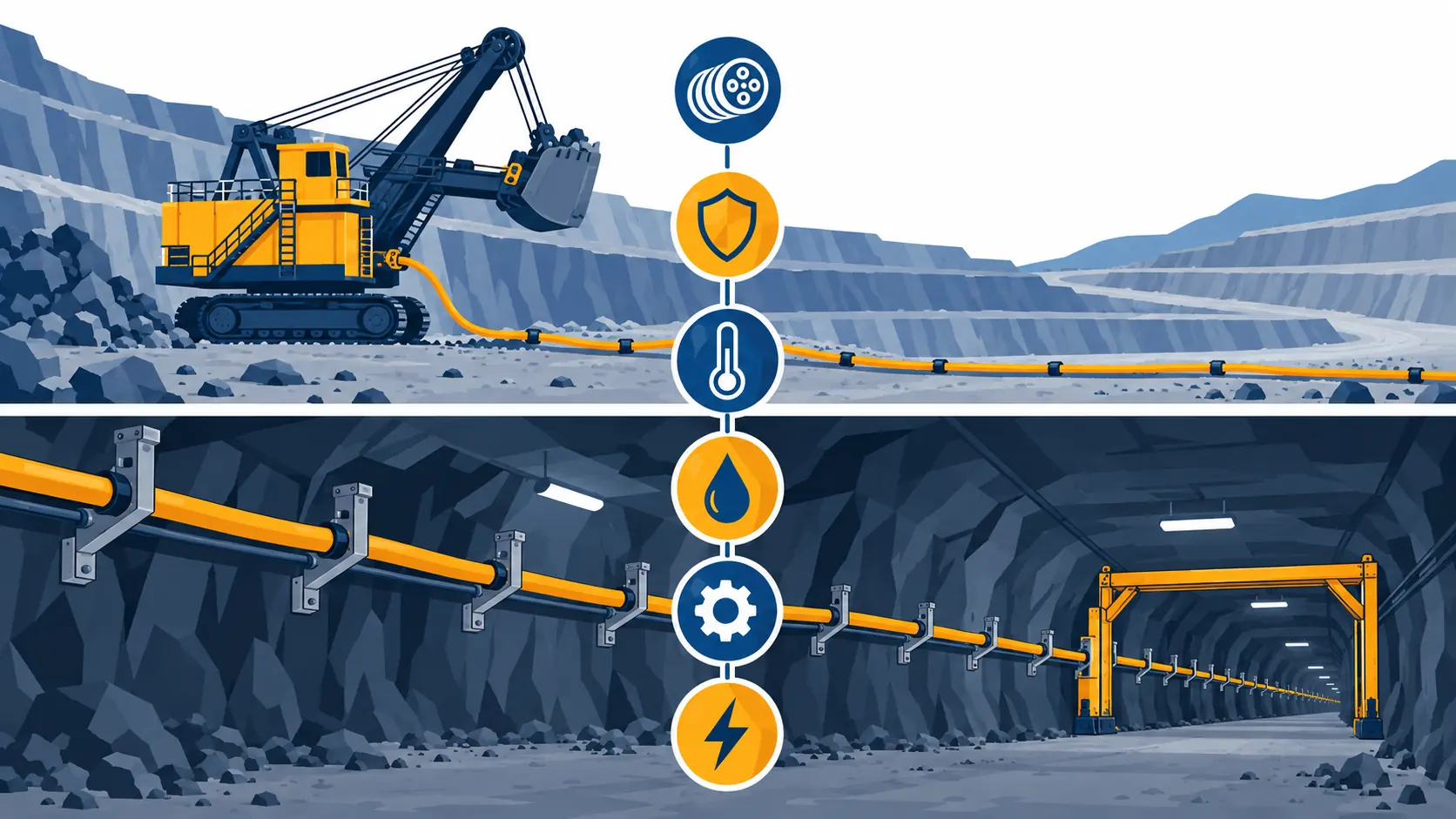
Quick Answer: Most mines buy two cable populations, and the fastest way to lose a delivery is to write one specification and apply it to both. Open-pit cable is dragged, run over and reeled; underground cable is fixed in congested roadways and accepted or rejected on flammability and antistatic evidence. This guide splits the two duty cycles line by line, shows what a shared construction costs in service, and lists the decisions to freeze per line before the RFQ goes out.
Introduction
On a mine, cable is bought against movement. Ask a plant buyer how a cable will be installed and the answer is a tray or a duct. Ask a mine buyer and the answer is a machine that will drag it, a roadway that will flood it, or a reel that will wind it four times a shift. The same copper is asked to do three different jobs, and the specification has to say which job it is.
The mistake has a shape. A buyer writes one mining cable specification, awards it, and discovers at the first shut down that the fixed feeder and the trailing cable were never the same product. Sites that also buy switchgear and skid distribution alongside the cable will find that the equipment side is covered in our note on the mining power equipment package.
What a Duty Cycle Actually Measures
The term means more than hours of operation. Cable duty is how often the conductor moves relative to the ground, how tight the bend gets at the worst point, how much axial pull it carries, and how much of the time it sits in water or dust.
Three numbers describe most mining runs: the working cycle length, the tightest bend radius on the route, and whether the cable is pulled or merely laid. Open-pit machines produce high cycle counts on short lengths, with bends that tighten at the machine entry. Underground feeders produce almost no motion but a lot of environment, and the constraint is the roadway rather than the machine.
Open-Pit: Drag, Crush and Reel
Open-pit cable lives on the ground and is moved with the bench. Loaders, drill rigs, shovels, draglines and face conveyors all take power down a cable that will be driven over, spooled and dragged across gravel.
Drag. The sheath carries the load. Once the outer layer is cut through to the screen, water finds the conductor and the run fails as an earth fault rather than as a visible break, usually weeks after the damage was done.
Crush and impact. A haul truck crossing a trailing cable does not always cut it. The more common result is a flattened core that resists current in one strand bundle, and the fault appears as a hot spot at a termination months later.
Reel duty. Bench conveyors and some drills wind and unwind under tension. Wind-on geometry decides whether the cable rolls or flattens, and a spiral-wound drum twists the cable every revolution. A straight construction corkscrews within a few thousand cycles and starts failing at the drum entry.
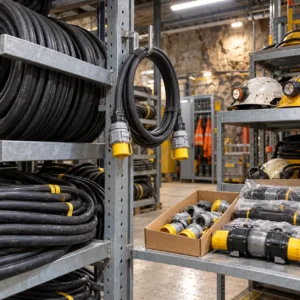
Lengths move with the pit, so open-pit cable is ordered in working lengths with factory-fitted ends. Armour is an option here rather than a default; the trade-off is set out in our note on armoured versus unarmoured cable.
Underground: Fixed, Congested and Regulated
Underground runs barely move and are far harder to replace. Feeders sit on brackets or in trays along roadways, semi-mobile cable serves continuous miners and shuttle cars, and services reach pumps, fans and lighting.
Space shapes the order. Bend radius in a low roadway, termination space in a junction box, and pulling tension through a confined drift all fix drum lengths before price is discussed. A construction that meets the electrical requirement but cannot be pulled around the last corner is not a candidate.
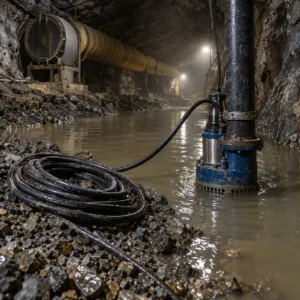
Environment shapes the order. Acidic seepage corrodes armour, and a corroded armour layer stops being an earth path. Where a roadway floods twice a year, the joint becomes the weak point rather than the cable.
Approval decides acceptance. In gassy workings, cable is accepted on flammability and antistatic test evidence against the national mining standard, with a mark issued for a named construction. That is an inspection-in requirement, not a brochure claim, and it changes which suppliers can bid at all.
Where a run has outgrown what the feeder can carry economically, the answer is often a prefabricated substation for mining set closer to the load.
Where the Two Specifications Diverge
Six clauses separate the two lines, and each one changes what the supplier quotes and what the site inspects.
| Clause | Open-Pit Line | Underground Line | What to Specify | Evidence to Demand | Cost of Getting It Wrong |
|---|---|---|---|---|---|
| Conductor class | Finely stranded for continuous flexing | Standard stranding is usually enough | Class 5 or class 6 for trailing, class 2 for fixed feeders | Conductor class on the construction drawing | A stiff conductor cracks at the machine entry within a season |
| Sheath duty | Cut, crushed, dragged over gravel | Abrasion from rough rock walls only | Reinforced heavy-duty sheath, or armour where crush is severe | Sheath tear and abrasion results at the declared radius | Sheath cut through to the screen, then water ingress and an earth fault |
| Flex and bend | Bent tight daily at the entry and the reel guide | Bent once at installation | Minimum bend radius at the worst point, not the average | Flex test data at the declared radius and cycle count | Early core breakage at the coupler, well before the drum is worn out |
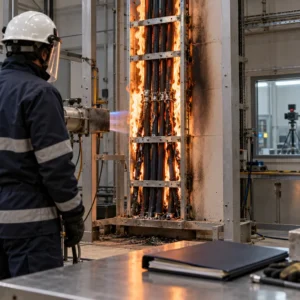
| Flame and antistatic | Surface machinery, rarely regulated | Mandatory in gassy workings | Certified compound and construction with the accepted mark | Flammability and antistatic report to the named standard | A delivery the mine refuses to inspect in, and weeks lost to re-award |
| Water and corrosion | Sump and dewatering exposure on pump runs | Continuous seepage and acidic water | Water-blocked or submersible construction where immersed; corrosion-resistant armour | Immersion test evidence, armour corrosion data | Water treeing in insulation, corroded armour that stops being an earth path |
| Ends and lengths | Working lengths that change as the pit advances | Drum lengths set by the pulling section | Factory-fitted ends for mobile runs, planned joints only where unavoidable | Packing list checked against the cable schedule | Joints where a continuous length was expected, and a stopped machine |
Construction Choices That Follow the Duty
Insulation. Ethylene propylene rubber stays flexible at low temperature and tolerates repeated working, which is why it dominates trailing cable. Cross-linked polyethylene suits fixed feeders and is the wrong choice where the cable bends at the machine entry every day.
Sheath compound. The sheath takes most of the budget and most of the abuse. Our note on cable sheath materials compared works through where each compound earns its price, and the families stocked for mining duty are listed in the special cable range.
Screen and earthing. Mobile machine cable carries a screen or pilot core for earth continuity monitoring, and continuity is a safety function rather than a signal function.
Armour. Underground feeders often benefit from armour against rock fall and drag during installation; open-pit trailing cable usually does not, because armour adds weight and stiffness where flexibility is being bought. Our note on abrasion-resistant cable jackets covers the intermediate option.
Sizing and Approval Differences
Both lines need the electrical calculation, but the inputs differ.
Open-pit sizing. Runs are short relative to the load, so voltage drop is usually manageable and the binding constraint is the starting current of a heavily loaded machine. Give the RFQ the continuous and starting current and how often the machine starts, because a shovel starting loaded puts a duty on the cable that a fan running continuously does not. Cable in sun on a bench and cable grouped in a trench derate differently, so ask for the derated current rather than the table figure; our note on cable derating factors explains where the tables mislead.
Underground sizing. Feeders are long, so voltage drop and earth loop impedance both matter. Earth fault protection is set against the circuit’s earth loop impedance, which makes the calculation a pre-order task rather than a commissioning one. Where the run crosses a large fault level, the cable’s screen or armour arrangement is part of the protection design, not an accessory.
Approval path. For the underground line, name the standard and the mark the destination mine accepts, and confirm it covers the exact construction quoted. Substituting a compound breaks that on paper even when the cable looks identical.
What to Freeze Before the Order Goes Out
These six items are cheap at specification stage and expensive once drums are on a truck.
| Decision | What to State | Evidence to Attach | Cost of Leaving It Open |
|---|---|---|---|
| Duty per run | Trailing, reeling, fixed or immersed, run by run | A cable schedule mapping every run to its machine | One construction bought for two duties |
| Line ownership | Which runs belong to the open-pit order and which to the underground order | Two specifications, two approval conversations, two supplier lists | An over-specified fixed run and an under-specified trailing run |
| Approval basis | The standard and mark the destination mine accepts, per line | Test report and certificate for the exact construction quoted | A delivery that cannot be inspected in |
| Bend radius and tension | Minimum radius at the worst point, plus reel tension where reeling is involved | Flex and reeling cycle data at the declared duty | Core breakage or corkscrewing inside the first year |
| Lengths and drums | Working lengths for mobile runs, pulling sections for feeders | Packing list checked against the cable schedule | Joints where a continuous length was expected |
| Test and spares plan | Which tests are witnessed and what rides on each drum, plus a spare allowance | A written plan with acceptance criteria and dates | Volume accepted on a sample nobody kept, then a stopped machine |
Lead Time and Cost Structure
The two lines do not sit on the same critical path, and confusing them is how a shutdown date slips.
Open-pit cable is normally made to order on the sheath compound, the reinforcement and the working lengths, with factory-fitted ends adding a step at the end of the line. The copper content of a heavy trailing cable is large, so the copper basis and its validity window belong in the comparison of quotations rather than in a footnote.
Underground certified construction is the longer line, because the compound has to be the certified one, the testing follows the standard’s regime, and the paperwork is part of the product. Buyers who discover the approval requirement after award routinely lose four to eight weeks. Where a project runs both lines, place the certified order first and let the open-pit drums follow.
Incoming Inspection: What to Witness
Against the drum, before anything is cut. Count drums against the packing list and photograph the markings. A drum arriving without traceable records cannot be linked back to them afterwards.
Electrical checks. Conductor resistance and continuity, insulation resistance, and screen or pilot core continuity end to end. On the underground line, match the flammability and antistatic reports to the drum references before acceptance rather than after installation.
Dimensional checks. Overall diameter, sheath thickness and actual conductor cross-section on a cut sample. Measuring the copper area settles arguments about what the conductor is, and it is far cheaper to do it with both parties present than to discover the answer on a face.
When One Specification for Both Lines Is Not the Answer
When the failure is routing, not cable. Repeated sheath damage at the same point on a face conveyor is usually a guide, a clamp or a bend radius problem. Our note on cable damage wear patterns is written to separate one from the other before money is spent on a heavier drum.
When the site wants one approved construction for everything. A cable that satisfies a gassy roadway and a drag duty in a pit does not exist at a sensible price. Two specifications cost less over the life of the mine than one compromise.
When the approved supplier list already settles it. If the mine’s engineering standard names a construction and a vendor, the competition moves to delivery, service and spares rather than design, and the specification work is about writing the duty accurately enough to enforce it.
When the protection settings are the real problem. A feeder tripping on earth fault well above its setting is telling you about the earth loop, not the cable. Replacing a drum without doing the calculation repeats the fault with newer copper.
When price is the only variable asked about. A mining cable bought on unit price alone is judged in service rather than in the quotation, and the two lines fail in different currencies: open-pit in maintenance hours, underground in refused deliveries.
RFQ Checklist
- Each run assigned to the open-pit or underground order, in writing
- Duty stated per run: trailing, reeling, fixed, semi-mobile or immersed
- Working cycle length, plus trailing loop and vertical drops
- Minimum bend radius at the machine entry and at the reel or guide
- Reel tension and winding geometry where reeling is involved
- System voltage, insulation level and prospective fault current per feeder
- Continuous and starting current, plus starting frequency per shift
- Ambient and installation conditions, with the derated current required
- Approval basis named for the underground order: standard, test method and mark
- Conductor class, insulation and sheath compound specified per duty
- Screen or pilot core arrangement, plus the monitoring system it supports
- Working lengths or pulling sections, drum sizes and drum marking
- Factory-fitted ends versus field joints, with coupler type and supplier
- Copper basis and its validity window, stated per quotation
Conclusion
Open-pit and underground mining cable are bought against different physics, and the specification should say so. State the duty in numbers a manufacturer can build against, name the approval the destination mine will inspect to, and keep the two orders apart from the first line of the RFQ.
Kexingyu Cable Group (KXYE) has supplied electrical cable from Quanzhou since 1996, including the rubber-sheathed, screened and control constructions that mobile and fixed mining duty calls for, along with the joints, couplers and accessories that go with them. Send us the cable schedule with the duty per run, the run lengths, the approval standard and the site conditions, and we will come back with the constructions, the test evidence that applies to each, and a delivery plan against your shutdown window. The fastest route is a request for quotation.