Welding Cable on Site: Sizing, Duty and Damage Control for Construction Buyers
Quick Answer: Welding cable is the most copper-intensive and most abused cable on any site, and it is bought badly in predictable ways: sized on the welder’s nameplate instead of current, duty cycle and lead length together; bought with an undersized earth return; and replaced for damage that a routing fix would have prevented. Size both leads as one circuit, buy fine-stranded flexible construction, standardise lengths and lugs across the site, and fix the copper basis at quotation.
Introduction
Every construction site welds, and welding cable is the one product in the electrical order that nearly every trade touches. It is also the product where small specification errors cost the most per gram: the copper is expensive, the duty is brutal, and an undersized circuit quietly ruins arc quality every day until someone blames the machine.
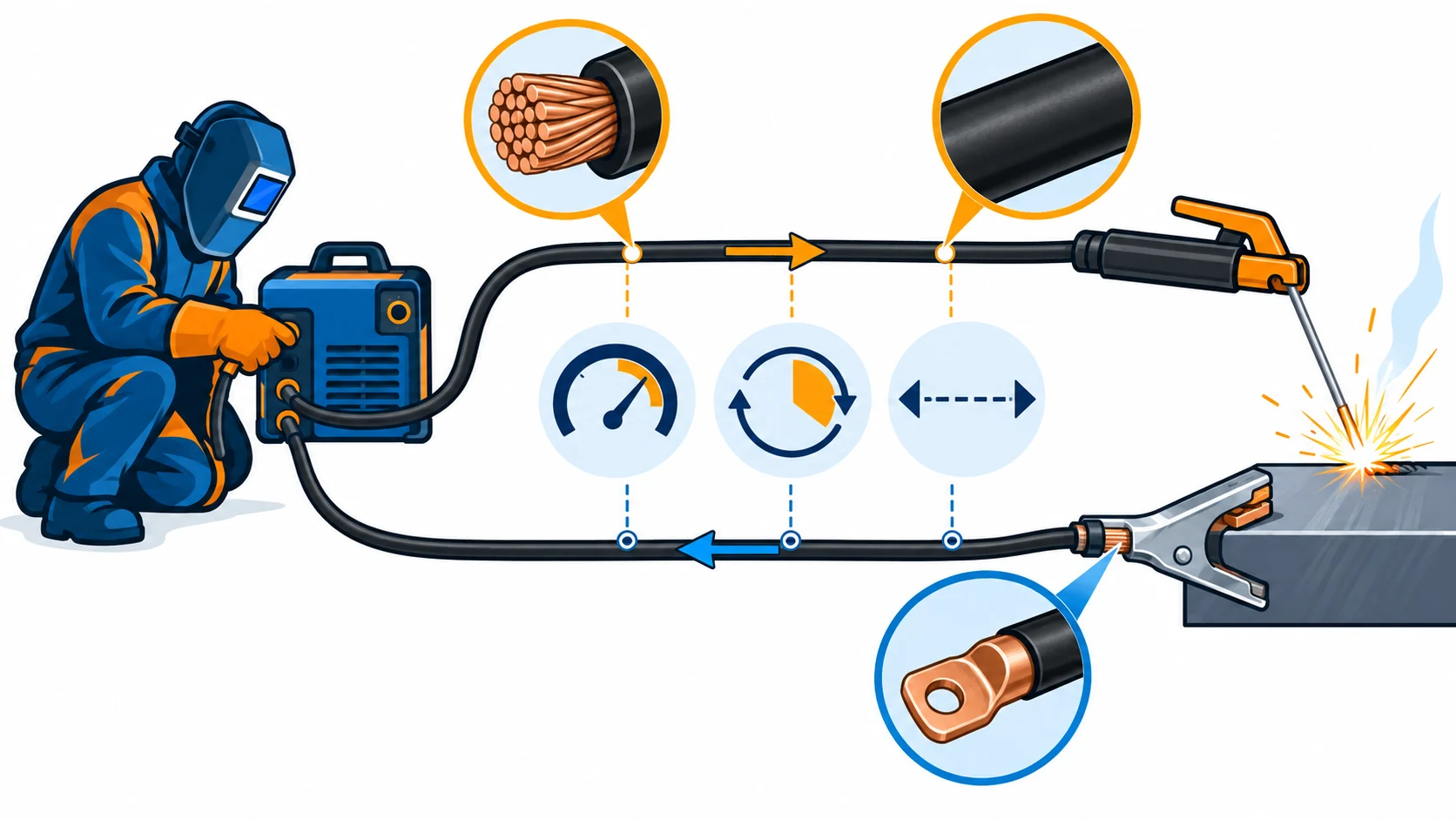
The buying logic is simple once the circuit is understood. A welding circuit is a loop: electrode lead out, earth return back, and both carry the same current. This guide covers sizing that loop, the duty it lives with, damage control, and the commercial terms that matter on a copper-heavy product.
Sizing: Current, Duty Cycle and Length Together
Welding cable sizing takes three inputs, and leaving out any one produces a circuit that underperforms.
Welding current. The electrode or wire process sets the current, not the welder’s maximum output dial. State the processes actually used and their currents: a site running 4 mm electrodes at 250 amps has a different cable than one running MMA at 140.
Duty cycle. Welding is intermittent by nature, and cable ratings assume it. Duty cycle is the fraction of a ten-minute period the cable carries current, and it lets a cable sized on continuous rating shrink considerably. State the real duty: tack welding structural steel is nothing like welding pipe all morning.
Lead length. The loop’s resistance includes every metre of both leads, and voltage lost in the circuit is voltage missing at the arc. Long leads to a high position are the site’s normal condition, and they push the conductor up. Give the supplier the real lead lengths, including the runs to the top of the steelwork, and the return path.
The earth return is half the circuit and gets half the attention. An undersized or damaged return wastes arc voltage, overheats at its clamp, and makes every weld on the site worse. Size it with the same rules as the electrode lead and inspect it with the same care.
| Part | Duty | What to Specify | Evidence to Demand | Cost and Lead-Time Driver | How It Fails |
|---|---|---|---|---|---|
| Electrode holder lead | Dragged to the work, coiled hot, flexed at the holder | Fine-stranded Class 6 conductor, sized on current, duty cycle and length, high-flex rubber sheath, factory-fitted holder or lug schedule | Conductor resistance per metre, flex data, stranding class declaration | Copper content dominates; price tracks the copper market directly | Broken strands at the holder, burned insulation at the work, cuts exposing conductor |
| Earth return lead and clamp | Same current as the electrode lead, clamp contact quality decides everything | Same conductor sizing as the lead, clamp rated to the current with real contact area, length matched to the work area | Conductor resistance records, clamp rating and contact data | Half the circuit for a fraction of the attention | Hot clamps on painted steel, arc voltage lost in the return, intermittent arcs |
| Extension and distribution runs | Long feeds from the welder to the work zone, few joints wanted | Continuous lengths to the real site reach, couplers rated to the circuit, colour-coded ends | Coupler ratings, resistance per assembled circuit | Length discipline saves copper; joints cost quality | Resistance creeping at couplers, mixed sizes joined in series |
| Multi-process and machine leads | Shared sets, changing processes and currents | Sized to the highest process in use, core or connector arrangements for multi-operator sets | Sizing notes per process, machine compatibility schedule | Slightly more copper; far less downtime | Leads sized for the common process burning on the rare big one |
Construction: What Makes Welding Cable Different
Stranding. Welding cable is built on the finest regular stranding, Class 6 territory, because the lead flexes at the holder thousands of times a shift and coarse stranding work-hardens and breaks. The stranding class is the first line of any specification, and our note on Class 6 conductor flex performance covers why it outlasts lighter stranding in handled duty.
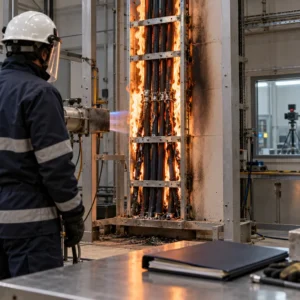
Sheath. The sheath takes sparks, hot spatter, oil and being stood on. High-grade rubber compounds resist all four; cheaper jackets harden with heat cycles and crack where the lead rests on hot work. Our comparison of cable sheath materials and our note on abrasion-resistant jackets cover the options; the standard constructions are exemplified by YH/YHF welding cable.
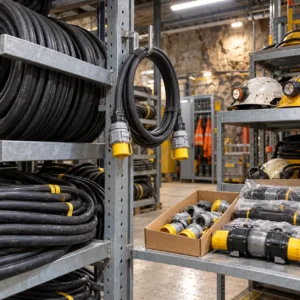
Ends. The failure census on site welding cable is dominated by ends: broken strands at the holder, burned lugs, clamps gone springless. Factory-fitted ends with proper strain relief, or a lug standard with the crimping tool to match, is a procurement decision with a direct downtime return.
Damage Control: The Reality of Site Welding Cable
Welding cable will be cut, burned and run over; the specification question is how it fails and what it costs when it does. Cut insulation on a welding lead is repairable with proper splice kits and heat shrink, and the repair discipline belongs in the site standard: no taped joints, no conductor exposed, and any lead with exposed conductor out of service until repaired. Our note on cable damage and wear patterns helps distinguish repairable damage from the lead that should be retired.
What the specification can actually change is the failure location. Ends fail from bending and heat, and better stranding and strain relief move the failure point outward by months. Sheaths fail from abrasion and spatter, and a better compound buys the same. Leads fail from routing, and no cable survives being the bridge across a walkway.
The Machine End: Supply Cable and Set Positioning
The welding circuit starts at the welder’s supply, and the machine end generates its own small order.
Supply feed. Each set takes a feeder sized on its input rating and the starting behaviour of its fan and electronics. Portable sets on long extension runs are the classic hidden problem: the set performs badly not because the welding lead is short but because the supply cord drops voltage before the arc even starts. Give the supply run the same sizing attention as the secondary circuit.
Set positioning. Sets sited centrally with standard lead lengths serve more of the site with less copper than sets dragged to each job. The positioning decision is a procurement one, because it decides the lead length standard, and the lead length standard decides the copper content of the order.
Multi-operator sets. Where several welders share one set, the output arrangements and per-station leads need a core or connector schedule agreed with the supplier, sized for the highest process any station will run at once.
Storage, Retirement and the Lead Census
Welding leads circulate, and a site that does not manage the circulation ends up with a pile that fits nothing. Three low-cost disciplines keep the stock coherent.
Tag everything. Length, size and test date on every lead, renewed at each inspection. The tag is what makes the standard enforceable at a glance and the census possible at all.
Retire on evidence. A lead with repeated repairs in the same metre, cracked sheath over its whole length, or a failed conductor test retires to the cutting bin, not back to the pile. Retirement criteria in the site standard prevent the oldest leads from becoming the permanent fault source.
Count it quarterly. A simple count of leads by size against the welder fleet tells procurement what the next order actually is. Sites that skip this buy leads in panic quantities at the worst copper moments; sites that run the census buy to a plan and can hold the copper basis with confidence.
What to Freeze Before the Order
| Decision | What to State | Evidence to Attach | Cost of Leaving It Open |
|---|---|---|---|
| Sizing basis | Processes, currents, duty cycle and real lead lengths | A sizing note per welder type on site | Circuits that under-arc daily and get blamed on machines |
| Return path | Return lead sized with the electrode lead, clamp ratings | Clamp specification with contact rating | Half the circuit underperforming for years |
| Stranding and sheath | Class 6 stranding, spatter-resistant compound | Stranding declaration and compound data | Leads that break at the holder within a season |
| Ends standard | Factory-fitted ends or a lug standard with tooling | Lug schedule and crimp specification | The weekly burned-lug repair queue |
| Length standardisation | Standard lead lengths across the site, colour-coded | A one-page site welding standard | Mixed leads joined in series, resistance creeping |
| Copper terms | Copper basis and validity window on bulk orders | Quotation terms naming the basis | A copper-heavy order priced on a stale quote |
Lead Time and Cost Structure
Welding cable is a stock product in standard sizes and ships in days; no welding front on any site should ever wait for it. Bespoke lengths and factory-fitted ends add little for standard constructions, and the bulk order for a large site is worth sequencing with the steelwork programme rather than buying ad hoc per floor.
On cost, welding cable is the most copper-dominated product in the site order: metal is the overwhelming majority of the unit price, and the price moves with the market between quotation and order. That is why the copper terms matter more here than anywhere else on site. Fix the basis and the validity window at quotation, and prefer a supplier who locks the copper element for a stated window against the spot price; our note on copper price lock contracts explains the mechanics. A fleet standardising its leads across projects also spreads the copper position over months, and our note on copper price and cable procurement covers how buyers handle that exposure.
Incoming Inspection
Against the standard. Check conductor size on a cut sample against the order, verify the stranding class by construction, and measure resistance per metre on a sample length. Welding cable is the product where substitution for a lighter conductor is both easiest and most costly, so the sample check earns its keep.
Ends and marking. Verify factory-fitted ends against the lug schedule, and tag each lead with its length and size so the site standard is enforceable at a glance. Leads without tags join the unmanaged pile within a week.
Warranty terms. The warranty on a consumable-duty product should be read for what it excludes; our note on power cable warranty terms lists the clauses that matter on heavy-duty flexible constructions.
When a Welding Cable Specification Is Not the Answer
When the return path is the problem. Poor arcs traced to the machine are often a corroded or undersized earth clamp on painted steel. Clean contact points and a proper clamp fix what a heavier lead will not.
When routing is the killer. Leads laid across walkways and steel edges cut on schedule. Hang or ramp the route, then buy cable.
When the machine is at fault. Welders with failing output regulation get blamed on leads daily. Test the set with a known-good short lead before re-ordering anything.
When the fleet needs automated welding. High-volume repetitive welding is a robotics question, not a heavier lead; our note on welding robot cable covers that entirely different duty.
RFQ Checklist
- Processes and currents per welder type, with duty cycle stated
- Real lead lengths, including work at height, and the return path length
- Conductor class declared, with resistance per metre evidence
- Sheath compound with spatter and abrasion resistance data
- Factory-fitted ends or the lug standard with crimp tooling
- Earth clamp rating and contact specification
- Standard lead lengths and colour coding across the site
- Coupler ratings for extension runs
- Sample-check right: conductor area, stranding and resistance on delivery
- Copper basis with validity window on bulk orders
Conclusion
Welding cable is bought well when the loop is sized as a loop, the ends are treated as the failure point they are, and the copper terms are fixed at quotation. Standardise the leads across the site, enforce the return-path standard, retire damaged leads on recorded evidence, and the arc quality argument disappears from the daily report.
Kexingyu Cable Group (KXYE) has manufactured cable in Quanzhou since 1996, including Class 6 fine-stranded welding constructions with spatter-resistant sheaths and factory-fitted ends, backed by copper basis pricing for bulk orders. Send us the processes, currents and lead lengths in use on your site, and we will come back with the sizing, the constructions and a delivery plan. The fastest route is a request for quotation.