Asphalt Plants and Pavers: Specifying Cable for Heat, Oil and Dust
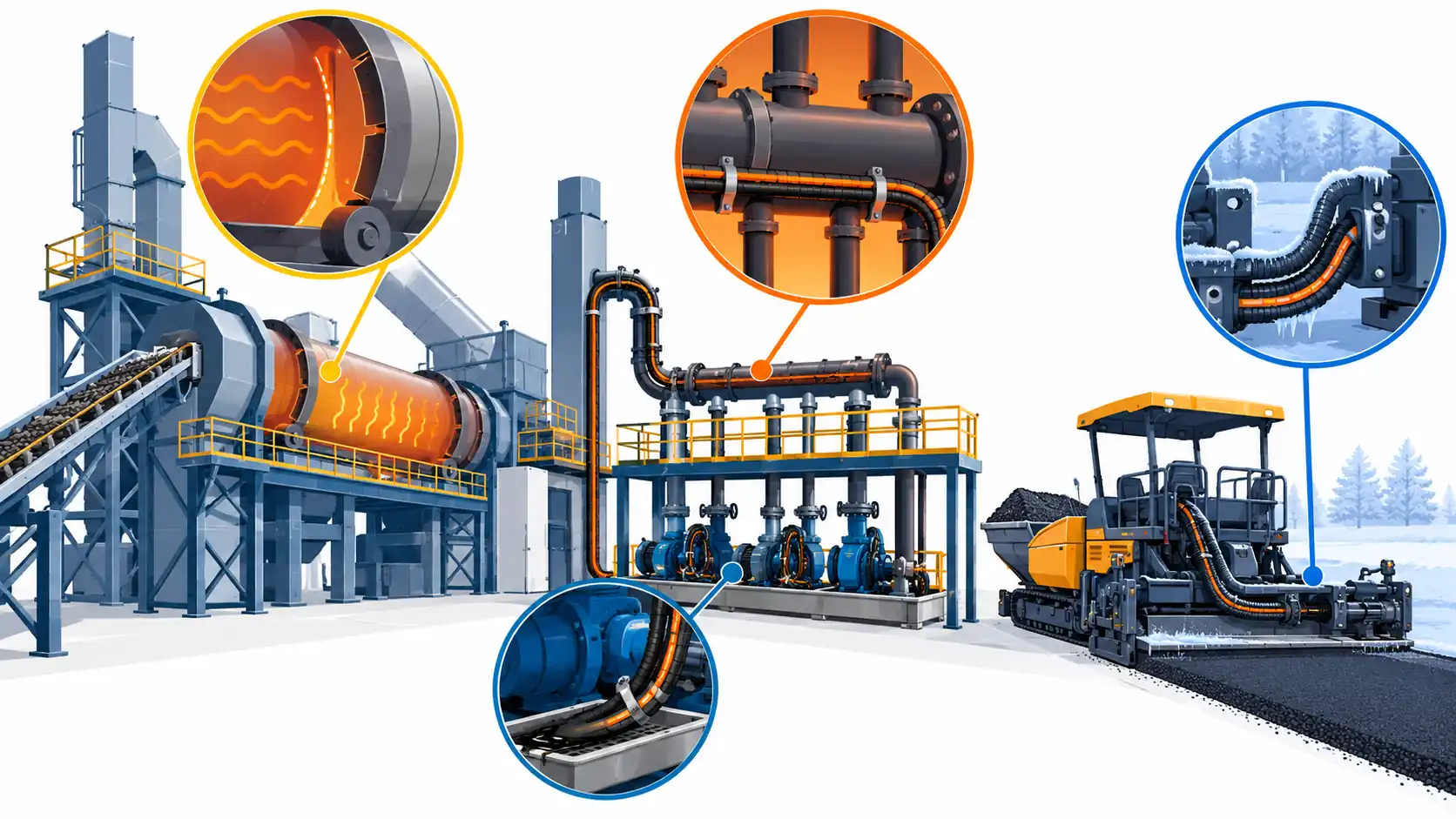
Quick Answer: An asphalt plant attacks cable from two directions at once: radiant heat at the dryers, hot oil lines and silo heaters, and oil-soaked floors everywhere a pump or gearbox leaks. Buy temperature-rated constructions near the heat, oil-resistant sheaths at the pumps, dust-sealed terminations throughout, and a genuinely flexible build for the paver, and check every claim with a certificate rather than a catalogue phrase.
Introduction
Asphalt plants are the only common industrial environment where a cable can be aged by the air around it. The dryer end radiates, the hot oil loop conducts, the bitumen tanks hold temperature for days, and the floors collect a film of oil and fines that softens ordinary PVC jackets within a season.
The paver adds the opposite problem. It sits cold at dawn, flexes its connections over every joint the crew crosses, and works eight metres from a 160-degree mat. The buying task is to split the plant into heat zones and oil zones, specify each zone once, and hold the supplier to evidence. This guide walks the zones in order.
Heat Zones: What Temperature Rating Actually Buys
Near the dryers, hot oil lines and silo heaters, ambient temperature is not a derating footnote; it is the selection criterion. Standard PVC cable rated to 70 degrees conductor temperature fails in this air long before its current rating is reached, because the jacket itself heat-ages, hardens and cracks.
Insulation class. XLPE insulation, rated for 90-degree continuous conductor temperature, is the sensible baseline for power runs through warm areas; our explainer on XLPE cable construction covers why the cross-linked compound holds its properties at temperature. Where the run passes close to hot surfaces or through the dryer deck, silicone rubber constructions rated 180 degrees and beyond keep their flexibility instead of baking brittle; our high temperature silicone control cable is the standard choice for heater and instrument circuits in exactly these positions.
Distance is the cheapest insulation. Routing that keeps cable outside the radiant envelope costs nothing at design time and buys more life than any compound upgrade. The specification should state clearance zones around the dryer, the hot oil header and the silo discharge, and treat cable inside those zones as a special purchase, not a default.
Derating honestly. Warm ambiences also cut current capacity, and plants that ignore the derating tables run their feeders permanently hot. Our note on cable derating factors lists the corrections; the point for procurement is that ambient temperature belongs in the RFQ, because a quote priced without it is sized for a different plant.
Oil Zones: Sheaths That Survive the Floor
At the pumps, gearboxes and bitumen handling areas, the enemy is mineral oil and bitumen splatter. Ordinary PVC and some rubber compounds swell, soften and lose mechanical strength in oil contact, and the failure shows as a jacket that rubs through on its own support bracket.
Compound selection. Oil-resistant sheath compounds, typically nitrile rubber or oil-grade PVC blends, are the specification answer. Our note on oil-resistant machine cable explains the compound families, and the oil-resistant cable range shows the standard constructions. The key procurement step is asking for oil immersion test data rather than the word “oil-resistant” on a datasheet; our note on oil resistance testing explains what the test measures and what a pass looks like.
Housekeeping helps, specification decides. Drip trays and repaired seals reduce exposure, but a plant that runs bitumen will splash. The sheath compound is the permanent answer, and it costs less at specification than the annual jacket replacement it removes.
| Zone | Attack Mechanism | What to Specify | Evidence to Demand | Cost and Lead-Time Driver | How It Fails |
|---|---|---|---|---|---|
| Dryer and burner deck | Radiant heat, cyclic baking | XLPE power runs with clearances stated, silicone rubber for close circuits, dust-sealed glands | Temperature ratings per construction, clearance zone drawings | Silicone constructions cost more and ship shorter; clearance costs nothing | Heat-aged jackets cracking, brittle cores at terminations |
| Hot oil and bitumen areas | Sustained conduction, splatter | High-temperature control and power constructions, heat-reflective routing away from line contact | Continuous temperature rating declarations | Small copper premium; routing labour dominates | Insulation cook-off at line contact points, tracker faults |
| Pump and gearbox floor | Mineral oil and bitumen film | Oil-resistant sheath compounds, drip-leg routing, supported clear of pooled oil | Oil immersion test data, compound declarations | Compound premium small against annual jacket replacement | Swollen soft jackets rubbing through on brackets |
| Paver and mobile equipment | Cold starts, constant flexing, mat heat | Fine-stranded flexible construction, cold-flex rated sheath, factory-fitted strain relief | Flex cycle data, cold bend temperature, stranding class | Flexible constructions carry a copper and build premium | Strand fatigue at the entry glands, morning cracking on cheap jackets |
The Paver: Flexing Duty at Both Temperature Ends
The paver is the hardest single cable duty on the asphalt job. It flexes its power and extension connections continuously over an uneven surface, starts cold before dawn, and works beside material hot enough to soften a standard jacket. The cable that survives is a genuinely flexible construction: fine-stranded conductor, a rubber compound that stays elastic across the full temperature range, and ends with real strain relief.
Cold mornings decide the compound. A sheath that bends at 40 degrees ambient cracks at zero, and the crack is where oil and moisture enter. Cold-flex ratings belong in the RFQ, and our note on low temperature flexible cable explains the rating and the bend test behind it. The same flexibility argument drives conductor class; fine stranding survives the flexing that work-hardens coarse conductors, which our note on Class 6 conductor flex performance covers in detail.
Ends and extension discipline. Most paver cable failures are at the connections, not in the length: broken strands at gland entries, burned plug faces, and taped joints from mixed extension sets. Standardise the extension lengths and connector types across the paving fleet, buy factory-fitted ends where the schedule allows, and retire any set with exposed conductor. A paving crew that waits on a repaired cable every Monday is paying for a missing ends standard.
Dust, Containment and Termination Hygiene
Fines infiltrate everything on an asphalt plant, and cable terminations are the quiet casualty. Dust-packed panels cause tracking, heating and intermittent control faults that no amount of cable quality can prevent.
Specify sealed glands at every panel and motor connection box, keep the containment closed where fines blow, and put the termination inspection into the maintenance routine: gland tightness, enclosure seals, and a look for dust bridges inside frequently opened boxes. Sheath selection interacts here too; a smooth, hard compound sheds dust where a tacky one collects it, which our comparison of cable sheath materials covers alongside the oil and heat properties. None of this is expensive at installation time, and all of it is expensive after the first summer.
Building the Zone Map: A Walk-Through for Buyers
The zone map is the document that turns this guide into an order, and it takes one morning to build. Walk the plant from the cold feed to the silo with three markers: a heat marker for anywhere the back of your hand objects, an oil marker for anywhere the floor film shows, and a dust marker for anywhere fines blow or settle. Note each cable run against the markers, including the runs the last contractor left on the floor, because those are usually the ones failing.
Then write the exceptions down explicitly. Every plant has one run that crosses the hot oil header on a bracket six inches away, one motor connection box that opens monthly in the dust, and one extension set the paving crew made up themselves. These exceptions are the actual order: the standard zones buy catalogue constructions at stock prices, and the exceptions buy the special builds that keep the plant out of trouble.
Attach the map to the RFQ and ask bidders to price it as drawn, with each zone’s construction named and each exception’s evidence attached. The discipline pays twice: quotes become comparable because they are sized against the same zones, and the installation crew receives a drawing instead of a judgment call. Plants that skip the map buy average cable for an above-average environment, and the difference shows up as the two or three runs that fail every summer regardless of what was bought.
What to Freeze Before the Order
| Decision | What to State | Evidence to Attach | Cost of Leaving It Open |
|---|---|---|---|
| Heat zone map | Clearance zones around dryers, hot oil lines and silos | A zone drawing attached to the RFQ | Standard cable baked brittle inside one season |
| Temperature ratings | Continuous ratings per zone, silicone where clearance fails | Rating declarations per construction | Insulation cook-off at the worst contact points |
| Oil resistance | Compound family per zone, immersion-tested | Oil immersion test reports, not datasheet adjectives | Swollen jackets replaced annually at the pump floor |
| Paver flexibility | Fine-stranded conductor, cold-flex sheath, strain relief | Flex cycle and cold bend data | Monday-morning cable repairs across the paving fleet |
| Dust sealing | Gland specification and enclosure discipline | Ingress ratings per termination type | Tracking faults and packed control panels |
| Derating basis | Ambient temperatures per zone in the RFQ | Sizing notes referencing the derating tables | Feeders running hot in a warm plant |
Lead Time and Cost Structure
Standard XLPE power and control constructions ship from stock in days, and the oil-resistant and silicone families are catalogue products with modest premiums. The items that need programme time are long bespoke lengths and factory-fitted ends on the mobile fleet, which should be ordered against the plant construction schedule rather than improvised at commissioning.
On cost, the honest comparison is against replacement cycles, not unit price. A heat-zone cable that lasts three summers beats a standard cable replaced every one, and the oil-resistant compound premium is recovered at the first skipped jacket renewal. Buyers who manage a fleet of plants should also look at the copper terms on bulk orders, and our note on copper price and cable procurement covers how to hold the position while ordering across a season.
Incoming Inspection
Verify the claims. Check sheath markings against the order, and cut a sample on each new construction: conductor area, stranding class, and a bend test on the cold sections. Temperature and oil ratings are exactly the properties a substitution silently removes, and the sample check is the only defence at handover.
Ends and lengths. Confirm factory-fitted ends against the schedule, and drum lengths against the run list, because joints in heat and oil zones are the failure points nobody wants to own.
File the certificates. Temperature, oil and flex test reports belong in the plant file next to the route drawings, where the next buyer and the next inspector can find them.
When an Asphalt Cable Specification Is Not the Answer
When the heat source can be moved. A heat shield or a reroute that takes cable out of the radiant envelope beats any high-temperature compound, and it is free at design time.
When the leak is the problem. A gearbox that coats its feeder weekly will defeat any sheath eventually. Fix the seal, then buy cable.
When the paver fault is the generator. Voltage sag under load is a supply problem, not a cable problem, and heavier cable will not fix a tired set. Test the supply before re-ordering.
When the dust fault is the gland. Control faults from packed fines are termination failures; new cable with the same open glands repeats the fault within a quarter.
RFQ Checklist
- Plant zone map marking heat, oil and dust areas
- Ambient temperatures per zone for honest derating
- Continuous temperature ratings declared per construction
- Oil immersion test data for sheath compounds at the pump floor
- Cold-flex and bend data for paver and mobile constructions
- Stranding class and flex cycle data for the moving fleet
- Factory-fitted ends and standardised extension sets
- Gland and ingress specification for all terminations
- Drum lengths matched to runs to keep joints out of hot zones
- Test certificates filed with the delivery documents
Conclusion
Asphalt cable is bought well when the plant is split into zones and each zone gets the construction it needs: heat ratings where the dryers radiate, tested oil resistance at the pumps, cold-flex flexibility on the paver, and sealed terminations everywhere. Demand the test data behind each claim, put the zone map in the RFQ, and the plant stops buying the same cable twice.
Kexingyu Cable Group (KXYE) has manufactured cable in Quanzhou since 1996, including high-temperature silicone, oil-resistant and cold-flex constructions for asphalt plants and paving fleets, with test documentation supplied against every zone specification. Send us your zone map and the worst spots on your plant, and we will come back with the constructions and the evidence. The fastest route is a request for quotation.