Cable for Rental Equipment: Procurement Rules for Contractors
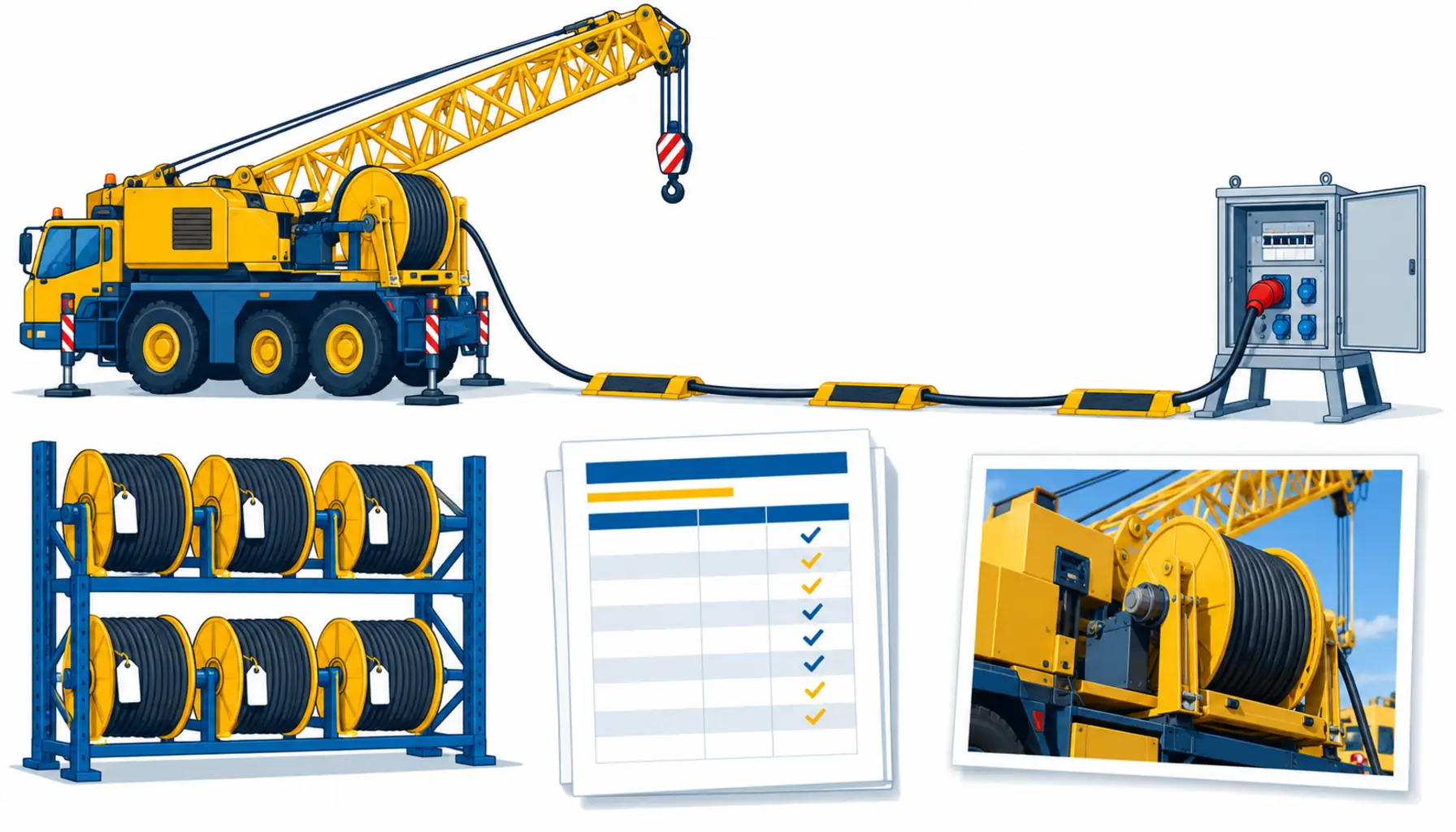
Quick Answer: Hired cranes, generators and hoists arrive with cable that somebody owns, and the hire contract decides who pays when it fails. Map the responsibility before delivery, state cable condition and specifications in the hire agreement, hold a small fleet-wide spare pool instead of per-machine panic buys, and put the failure responsibilities and test evidence into the supplier terms. Rental cable is a commercial problem wearing an electrical costume.
Introduction
Rental is now how most sites get their cranes, hoists, generators and specialist plant, and every unit arrives trailing its own cable question: who owns it, who maintains it, who tests it, and who pays when it stops the job. Most contractors answer these questions by accident, in the middle of the dispute.
The rental cable problem is commercial before it is technical. The constructions are the same ones a purchased fleet would use; the difference is that ownership, maintenance and liability are spread across two or three parties. This guide maps the responsibilities, sets the spare strategy, and puts the contract clauses in order.
Map the Responsibility Before Delivery
The first rule of rental cable is that every metre has an owner, and the second is that nobody writes the owner down. Fix both before the equipment arrives.
The three ownership patterns. Equipment-supplied cable belongs to the rental house and travels with the machine: reel cables on cranes and hoists, umbilicals on generators. Site-supplied cable is the contractor’s: extension runs, distribution links, the connections between the hired unit and the site network. And retrofit or replacement cable is whatever the contract says it is, which is why the contract must say.
What to put in writing. The hire agreement should state the cable’s specification and condition at delivery, the maintenance and inspection responsibility per party, the test records that travel with the unit, and the failure protocol: who supplies the replacement, how fast, and who pays for the downtime. None of this is standard in every rental house’s paper, and the contractor who raises it at booking gets better terms than the one who raises it at breakdown.
The delivery check. Photograph and record the cable’s condition at handover, verify the test tag dates, and note any existing damage on the acceptance sheet. This half hour is what stops the return inspection from becoming a negotiation about damage that predates the hire.
The Spare Strategy: Fleet Pool, Not Panic Buys
Rental equipment fails its cable at the worst times by definition: the crane’s reel cable on the lift day, the generator umbilical during the outage. The spare strategy decides whether that failure costs an hour or a week.
Hold a fleet pool. Instead of hoping each rental house supplies spares, hold a small pool of the common duty cables across the fleet: the reel and trailing constructions that the hired cranes and hoists actually use, in the lengths the sites actually run. Our note on cable reel and crane cable covers the constructions that dominate this duty. The pool is small because the duties are repetitive; three or four standard builds cover most hired plant.
Ownership within the pool. Pool spares used to replace failed equipment cable raise the ownership question again, and the answer is commercial: the pool sells the cable to the rental house at an agreed price, or the rental house pays rental on the machine while its cable is in the pool being replaced. Either clause works; no clause means an argument.
Standardise the interfaces. Where the fleet hires similar plant repeatedly, specify compatible connector standards with the rental houses, so a pooled spare actually plugs in. Standardisation across the hired fleet is the same lever it is on the owned one, and the rental houses will usually adopt the contractor’s standard when the volumes justify it.
| Cable Category | Typical Owner | What to Agree in Writing | Evidence to Hold | Cost and Lead-Time Driver | How the Arrangement Fails |
|---|---|---|---|---|---|
| Equipment-supplied reel and umbilical cable | Rental house | Specification and condition at delivery, maintenance duty, failure protocol | Delivery photographs, test tag dates, acceptance sheet | Replacement speed is the rental house's lead time problem | Undocumented pre-hire damage billed at return |
| Site-supplied extensions and links | Contractor | Specification matched to the hired unit's inputs, connector standards | Site test records, spare pool inventory | Contractor's own stock discipline | Mismatched connectors and undersized links blamed on the hire |
| Replacement and retrofit cable | Whatever the contract says | Purchase-from-pool clause, pricing, ownership at next hire | Pool records, agreed price schedule | Pool size versus machine downtime cost | The clause nobody wrote, argued at the breakdown |
| Long-term and framework hires | Often transfers to contractor | Maintenance transfer, inspection regime, end-of-hire condition | Inspection records shared with the rental house | Becomes an owned-fleet problem with a rental contract | Ageing cable maintained by nobody through a two-year hire |
Vetting the Rental House: The Cable Questions to Ask
Rental houses differ enormously in how they manage cable, and the difference is visible in five questions asked at booking, before the rate is negotiated.
How do you test between hires? The answer should be instrumented testing with recorded results, not a visual check. A rental house that tests records dates and values per unit, and that documentation discipline is the single best predictor of what comes down the truck ramp.
What is your failure response? Not the brochure line; the actual protocol, the spare position, and the response time they will put in writing. A supplier who hesitates to write a number is quoting their number in their hesitation.
What condition will the cable arrive in? Ask for the specification and age of the cable on the specific unit, not the fleet average. Units with original cable at twice its design duty are common, and knowing before delivery is the whole point of the question.
How do you handle replacement cable? Their stock, your pool, or a purchase at failure? The answer decides the spare strategy and the pool clause, and rental houses that already have an answer run more professional fleets.
Can you match our connector standard? For contractors standardising interfaces across the hired fleet, this question sorts the flexible suppliers from the rigid ones in one sentence. The five questions take ten minutes at booking, and they rate the rental house’s cable operation more accurately than any rate card, because the rate card prices the machine while these answers price the days the machine actually works.
Supplier Terms: The Clauses That Matter
Rental cable ends up in commercial documents, and four clauses carry most of the risk.
Failure and downtime. Who supplies the replacement, from where, in what time, and who carries the machine’s standing cost while it is down. A rental house with a documented failure protocol and a local spare position is worth a small premium per week, and the premium is cheap next to a crane standing idle.
Test evidence that travels. Every hired unit should arrive with its cable’s test records, and every return should carry the same. The paperwork discipline costs the rental house little and gives both sides the evidence baseline that prevents most damage disputes. Contractors running framework hires should ask for the same inspection regime they would run on their own fleet, and our note on insulation resistance testing gives the measurement both sides can share.
Condition and fair wear. The return condition clause is where damage disputes live. Define fair wear and tear against the photographs at delivery, and agree the inspection at return happens jointly. The clause is short; the argument it prevents is long.
Payment and risk transfer. On framework agreements covering many hires, the payment terms and the risk transfer points deserve the same scrutiny as any supply contract; our notes on cable payment terms and moving from RFQ to framework agreement cover the mechanics for contractors who buy as well as hire. The same commercial rigour applies to the cable-price components inside hire rates; our note on cable price breakdown helps a contractor see what a hire rate’s cable element actually buys.
What to Freeze Before the Order
| Decision | What to State | Evidence to Attach | Cost of Leaving It Open |
|---|---|---|---|
| Ownership map | Owner named for every cable category in the hire | The responsibility table in the hire agreement | Every failure argued from first principles |
| Delivery condition | Specification, condition and test tags recorded at handover | Photographs and the acceptance sheet | Pre-hire damage billed to the contractor at return |
| Failure protocol | Replacement source, response time, downtime responsibility | The protocol as a contract schedule | A crane standing idle while two firms negotiate |
| Spare pool | Fleet pool scope, pricing and ownership clause | Pool inventory and price schedule | Panic buys at breakdown prices per incident |
| Connector standards | Compatible interfaces specified with the rental houses | Standard named in the framework terms | Pooled spares that do not plug in |
| Return condition | Fair wear defined, joint return inspection agreed | Delivery photographs as the baseline | The return dispute that outlives the project |
Cost Structure: What Rental Cable Really Costs
Rental cable’s costs hide in three places: the downtime a failed cable causes, the disputes that consume management time, and the premium of buying replacements under pressure. There is a fourth that shows up at programme level: the sites that lose a lift day or a pour to a cable fault hire the same equipment again at a rate that quietly includes the risk, while the sites that manage rental cable hire at rates that exclude it. The direct hire rate difference between a rental house with sound cable practices and one without is usually small; the difference shows up in the other places.
The fleet spare pool inverts the economics. Pool cables bought calmly, in planned quantities, at supply prices, replace the panic purchase at the counter, and the pool’s cost per hire falls as the fleet standardises. Contractors running many concurrent hires should treat the pool as a small owned fleet serving the hired one, with the same inspection regime and the same census logic; our note on cable MOQ and lead time covers the order phasing that keeps the pool stocked without overbuying.
Coordination closes the loop. Contractors who hire heavily find that the rental houses, the generator suppliers and the cable maker all touch the same few circuits, and the coordination cost of three parties improvising is real; our note on coordinated power equipment supply covers what one channel changes. Where failures do reach a warranty or damage claim, the records decide it, and our note on power cable warranty terms lists the clauses the records support.
When a Rental Cable Clause Is Not the Answer
When the unit is effectively purchased. A two-year hire with maintenance transferred to the contractor is an owned fleet wearing a rental label; manage the cable as owned, with the inspection and census regime that implies.
When the fault is the site’s infrastructure. A hired generator failing on an undersized site feeder is a contractor problem, and no clause transfers it. Check the site side before blaming the hire.
When the rental house cannot deliver the protocol. A supplier who will not commit to a failure response in writing is telling you the response time. Price the risk or change the supplier.
When the duty is specialised. Highly specialised plant with bespoke cable is sometimes better served by buying the critical spares outright at hire start, because the rental house cannot stock them either and the downtime clause will be tested.
RFQ Checklist
- Responsibility table naming the owner for every cable category
- Delivery condition record with photographs and test tag dates
- Failure protocol: replacement source, response time, downtime cost
- Test evidence travelling with the unit, both directions
- Fair wear and tear defined against the delivery baseline
- Joint return inspection clause
- Fleet spare pool scope, pricing and ownership clause
- Connector standards specified across the hired fleet
- Framework terms covering payment and risk transfer points
- Long-hire maintenance transfer stated explicitly
- Booking-time vetting questions on testing and failure response
Conclusion
Rental cable is managed well when the ownership map is written before delivery, the condition record travels both ways, the failure protocol is a clause rather than a negotiation, and the fleet pool replaces the panic buy. The contractor who puts those four papers in place hires plant that behaves like an owned fleet, at a rental price, with somebody else holding the capital.
Kexingyu Cable Group (KXYE) has manufactured cable in Quanzhou since 1996, supplying the reel, trailing and umbilical constructions that hired plant depends on, with the test documentation and fleet-standard support that rental programmes need. Send us your hired fleet list, and we will come back with the pool specification and the prices that make it work. The fastest route is a request for quotation.