Cable Delivery Length and Tolerance: What to Agree in the Order
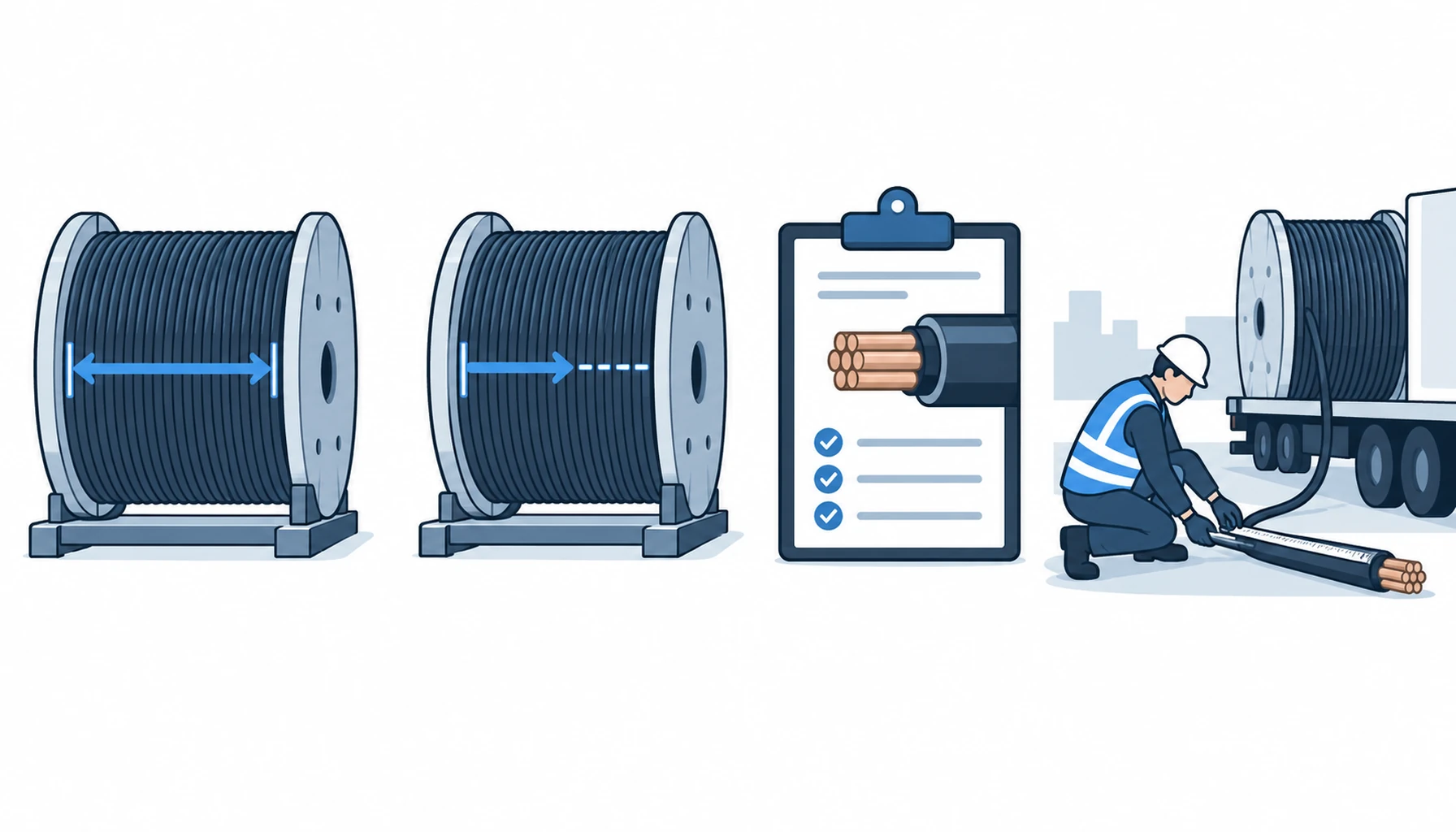
Quick Answer: Cable delivery length is a commercial term, because a drum that arrives a few metres short of the route’s need is a problem the buyer owns unless the order said otherwise. Lengths carry a permitted tolerance, the tolerance runs one way when a route has no slack, and the figure has to be stated, measured and proven rather than assumed from the drum mark. Agree the length, the tolerance and the evidence before the order is placed, not after the first pull.
Introduction
Length is the one cable property that cannot be checked by looking. A drum looks right whether it holds the ordered length or several metres less, and the shortfall only appears when a route is being pulled and the end does not reach.
This guide is written for the buyer who has to put a length clause into a purchase order. It sets out why delivery length is a contract term, the tolerances that apply, how to work out what a route can accept, and what to freeze so the drum that arrives can be proven against the order. The companion question of how long each drum should be in the first place is covered in our note on cable drum packaging for export.
Why Delivery Length Is a Contract Term
The route is a fixed number and the drum is not. A pull is measured on the drawing and the cable arrives in a length the factory could make on the day. Where the two disagree, the difference is either absorbed by slack, or it becomes a joint, or it becomes a claim.
Tolerance is normal in manufacturing. Any length carries a permitted variation, and a buyer who assumes the drum is exact is relying on the maker to absorb a risk the order never put on them. Stating the permitted figure moves the question from goodwill to contract.
The minus side is the one that hurts. A drum that is a little long leaves an offcut that can be stored; a drum that is a little short leaves a route that cannot be finished. Both can be within a symmetric tolerance, so the clause has to say which side matters.
Length ties to price and freight. The length and the drum count decide the freight weight and the packing, which is why length sits next to the commercial terms rather than the technical ones. Our note on cable sea freight sets out why a heavier or bulkier drum set changes the landed cost.
On a small order of a few short drums, none of this matters much. On a project with fifty drums of a long feeder, a two-metre shortfall on each is a hundred metres of cable nobody can easily replace on site, and that is the scale where the clause earns its place.
The Tolerances That Apply to Delivery Length
The table sets out the different length terms a buyer may meet, where each applies, what to state in the order and how the route suffers when the term was left vague.
| Length term | Where it applies | What to Specify | Evidence to Demand | Cost and Lead-Time Driver | How It Fails |
|---|---|---|---|---|---|
| Nominal drum length | Stock orders where the route can take a joint or slack | The nominal length and the tolerance that applies, stated as numbers | Marked length on the drum plus a sample measurement on arrival | Cheapest and quickest, standard drums are stocked | A short drum discovered mid-pull with no spare on site |
| Minimum guaranteed length | Long feeders and routes with no slack and no joint allowed | The minimum length that must be present, with no minus tolerance | A measured length certificate per drum against that minimum | Makers cut with margin, so the price carries the extra metres | Paying for margin but never verifying it, so the first short drum is a surprise |
| Measured length certificate | Any order where length is a risk and the buyer wants proof | The measurement method, the instrument and the acceptance figure | A certificate per drum naming method and result | Extra handling and record time at the factory | A certificate counted against a nominal, not a measured, figure |
| Measuring on arrival | Large orders, critical routes and any delivery with a length dispute risk | Who measures, with what method, and when, before cutting | A joint measurement record agreed and signed at delivery | Site time and a measurement rig, but the cheapest way to settle disputes | A dispute about length after the cable is already cut and installed |
| Total-order length | Framework and repeat orders where individual drums vary | Whether the tolerance is on each drum or on the order total | A schedule adding up the delivered lengths against the order | Schedules can be met with longer and shorter drums grouped together | A buyer checking drums individually while the contract allows a total |
Working Out What a Route Can Accept
Start from the drawing, not the total metreage. Each pull has a measured length and a joint policy, and the tolerance a route can accept is set by those, not by the order total. A route that can be jointed at a bay can accept a short drum; a route that cannot cannot.
Then decide the minus figure. Where a pull has slack or a joint bay, a normal tolerance is fine. Where it has neither, the order needs a minimum guaranteed length and the price will carry the extra metres. That trade is the buyer’s to make deliberately, and it is far cheaper than discovering the answer on the day of the pull.
Then decide how the length is proven. A marked length is a claim; a measured certificate is evidence; a joint measurement on arrival is evidence both sides accept. The stronger the proof, the earlier a problem is caught, and the earlier it is caught the lower the cost of fixing it.
Then write the number into the commercial terms. Length tolerance sits with the other delivery terms, and a framework agreement is where a standing tolerance can be fixed once for many orders rather than negotiated each time, which is the practice set out in our note on moving from a quotation to a framework agreement.
Then plan the spares against it. The spare length carried for a route should reflect the tolerance and the repair regime, and buying the accessories for the joints on the same order keeps the delivery coherent, as our note on the cable accessories checklist sets out.
What to Freeze Before the Order Goes Out
Six clauses decide whether the delivery can be proven against the route. Each is cheap to write and expensive to argue about.
| Decision | What to State | Evidence to Attach | Cost of Leaving It Open |
|---|---|---|---|
| Nominal or minimum length | Whether the length is nominal with a tolerance or a guaranteed minimum | The length clause, with the minus figure stated | A short drum on a route that cannot take a joint |
| Measurement method | How length is measured, with what instrument, and by whom | A method agreed in writing before the order | A dispute where both sides measured and neither agrees |
| Certificate or arrival check | Whether a per-drum certificate is required, or a joint check on arrival | A certificate format or an arrival check procedure | Accepting a marked length as proof and finding the shortfall later |
| Tolerance on drum or on total | Whether the tolerance applies to each drum or to the order total | A schedule showing how the lengths add up | Checking drums individually while the contract allows a total |
| Offcut and spare policy | What happens to cable left on a drum, and the spare length required | A spares list against the route's repair plan | A stored offcut that does not match any future repair |
| Delivery and risk transfer | When length risk passes to the buyer, and against what document | Delivery terms with the length clause referenced | A dispute about whether the cable was short on despatch or on site |
Measuring and Proving Length
Measure before cutting. The only moment a length can be proven cheaply is before the cable is cut, because after that the length is gone and the argument is about what it might have been. Build the measurement into the delivery routine rather than treating it as an exception.
Agree the method. Measuring the length of cable on a drum is not trivial: the cable is wound, the drum may be full, and a tape along the outside of the coil tells you the drum size rather than the length. Establish whether the length is proven by measuring the conductor on a cut end, by winding off, or by a factory record, and agree that with the supplier. The same discipline sits behind the general tolerance questions in our note on cable length tolerance.
Record against the drum. Photograph the drum marking and record the measured figure against the drum identification, so the number and the drum stay linked. A measurement with no drum reference is of little use later.
Keep the record with the delivery. Length records belong in the handover with the test certificates, so a future query can be answered from the file rather than from memory.
Cost, Freight and What the Tolerance Costs
A guaranteed minimum length is not free. The maker has to cut with margin, and the margin is paid for on every drum, so the question is whether the route’s slack justifies it. On a long feeder with no joint the answer is usually yes; on a short distribution run it is usually no. Our note on the cable price breakdown shows how the length and the drum count feed into the quoted figure alongside the copper.
Freight follows the drum set. More drums of a shorter length weigh and bulk more than fewer long drums of the same total, and length tolerance interacts with that choice. Copper remains the largest material element, so the same two questions return on every order line: how the copper is counted, and how the price is held, which is where a copper price clause protects the buyer against a metal move between order and delivery. Payment terms and delivery terms sit alongside the length clause, and our note on cable payment terms sets out the usual structures.
Incoming Inspection and What to Record
Count and identify. Count drums against the packing list, match each drum to its circuit, and photograph the markings before anything is cut.
Check the lengths. Measure a sample, or every drum where the route is tight, against the length clause, and record the figures against the drum identification.
Inspect the drum and the ends. Look at the drum barrel and the sealing of the cable ends, because a long transit is where an unsealed end picks up moisture, and a damaged drum can bruise the first metres of the coil.
Record the as-used lengths. Note how much cable each pull actually used and what came back onto the drum. Over a project that record makes the next order’s lengths accurate rather than optimistic, and it is the honest way to keep the tolerance clause tuned to the route.
When a Tight Tolerance Is Not Worth It
When the route can take a joint. A route with a joint bay can accept a normal tolerance at a lower price, and a guaranteed minimum there buys margin the route does not need.
When the spare already covers it. Where the order already carries a spare drum, the tolerance on the working drums matters far less, and the spare is usually cheaper than minimum lengths on every drum.
When the tolerance would move the date. A guaranteed length can push the line and the delivery, and on a fixed programme the cheaper move to hold the date with a normal tolerance may win. The decision is about consequences on the route, not about the tolerance itself.
When the length is being used as a proxy for something else. A buyer demanding an exact length often really wants a route that is easier to pull or a drum that is easier to handle.
RFQ Checklist
- Pull-by-pull lengths, and whether each route can take a joint
- Whether each drum is nominal with a tolerance or a guaranteed minimum
- The permitted minus figure, and whether it applies per drum or to the order
- How length is measured, with what instrument, and by whom
- Whether a per-drum length certificate is required
- Whether arrival measurement is required, and before cutting
- Spare length and offcut policy, and how spares are identified
- Drum marking to link each length record to an identification
- Delivery and risk-transfer terms, with the length clause referenced
- Copper basis, price validity and payment and freight terms
Conclusion
Delivery length is settled at the ordering stage or argued about at the pull, and the difference is a single clause. Decide which routes can take a joint and which cannot, state whether the length is nominal or a guaranteed minimum, and agree how it will be measured and proven before the cable is cut. A few metres of tolerance is a small number on a drum and a large number on a long feeder, and it is the buyer’s job to know which side of that line each route sits on.
Kexingyu Cable Group (KXYE) has manufactured cable in Quanzhou since 1996 and supplies stock and cut-to-order lengths with drum markings and measured length records as the order requires, across power, control and special constructions. Send us your pull schedule and the tolerance each route needs, and we will come back with the drum lengths, the measurement arrangement and a delivery plan against your programme. A request for quotation is the fastest route.