Cable Marking and Traceability: Requirements to Write into the Order
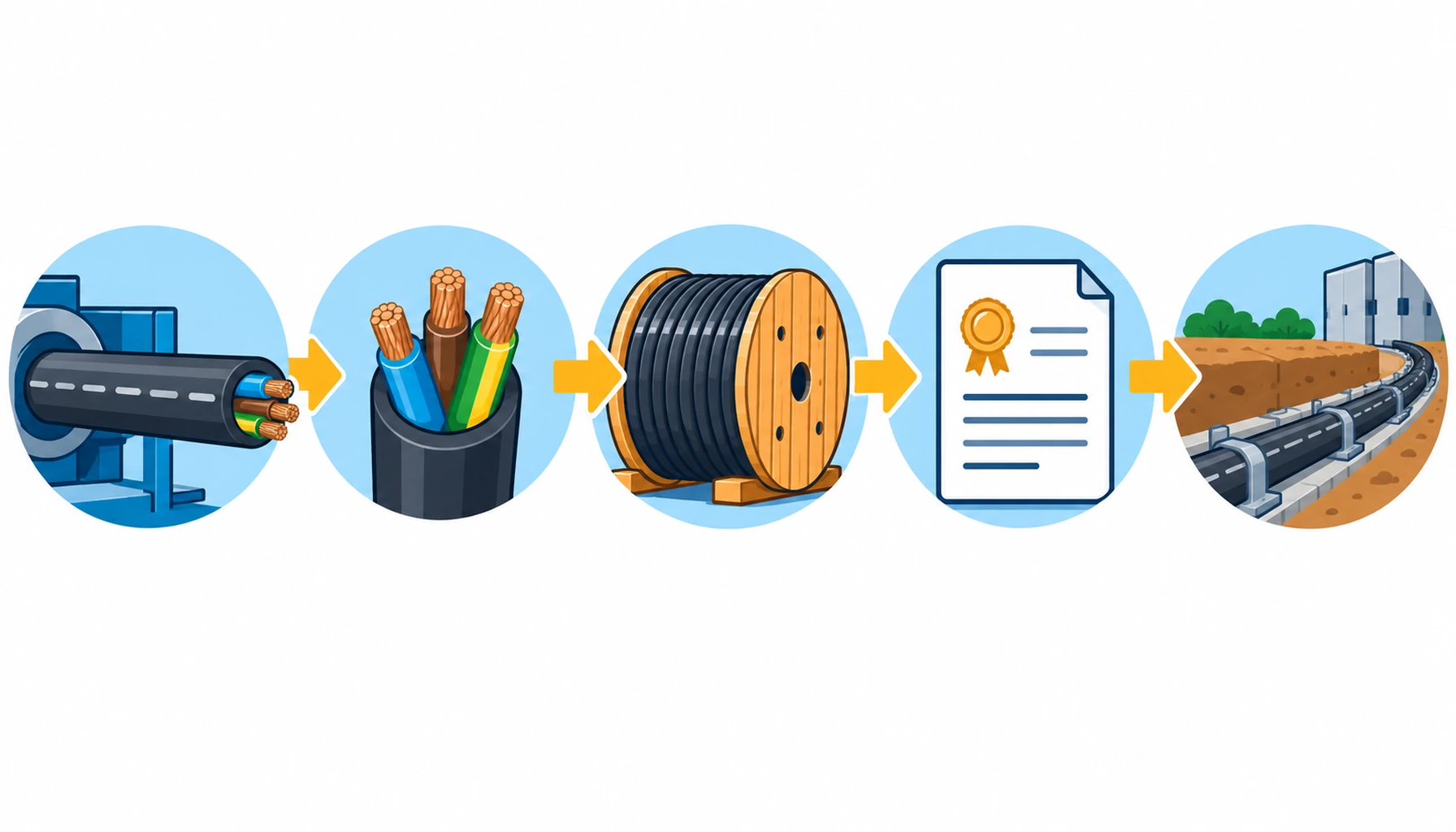
Quick Answer: Cable traceability is the ability to connect a length of cable in service back to the batch, the test records and the material it was made from. It rests on marking: what is printed on the sheath, what is on the drum, and what is recorded when the cable is delivered. Vague marking turns a future fault into an argument, because neither side can prove which batch failed. Write the marking and record requirements into the order and the traceability follows at almost no extra cost.
Introduction
Traceability sounds like paperwork until a cable fails. At that moment the useful questions are which batch it came from, what tests it passed and where the rest of that batch went. If the cable carries no marking and the delivery record is a packing note, none of those questions can be answered.
This guide is written for the buyer putting the requirement into the order. It sets out what has to be traceable, how the marking carries it through the route, what to freeze before the drums are made, and what a handover record has to contain. The evidence that sits behind the marking is the subject of our note on cable factory testing, and the marking carries it to site.
What Traceability Has to Cover
The batch and the melt. Cable is made in runs, and the copper, the compound and the extrusion conditions belong to a batch. When a fault appears, the batch says whether the problem is one length or a whole production run, and that decides whether the response is a repair or a recall.
The test records. Every drum should be linked to the electrical and dimensional tests it passed. Without that link, a fault cannot be separated into a material problem, a factory problem or a site problem, and the investigation starts from nothing.
The construction and the specification. The marking has to show what the cable actually is: conductor size, core count, voltage class and any fire or environment designation. A site that cannot read the construction off the cable will eventually energise the wrong one.
The destination. Traceability runs forward as well as back. If a batch is found to be faulty, the records have to say which circuit each length went into, so the affected lengths can be found rather than guessed at.
The core identification. Within a multicore cable, the cores have to be identifiable at both ends so the terminations land correctly. Core identification is part of marking, and a mistake in it shows up as a misconnected circuit rather than a failed cable, which makes it harder to find.
Marking Methods and What Each One Proves
The table sets out the marking options a buyer can require, where each fits, what to state in the order and how traceability fails when the marking is left to chance.
| Marking element | Where it applies | What to Specify | Evidence to Demand | Cost and Lead-Time Driver | How It Fails |
|---|---|---|---|---|---|
| Sheath legend | Every cable, on the outer sheath at regular intervals | The construction, size, voltage class and standard to be printed, with the interval | A sample sheath legend agreed before production | Near-zero cost if it is agreed before the extrusion run | A site that cannot read the construction off the cable and installs the wrong one |
| Core identification | Multicore and control cables, at both ends | The colour scheme or numbering standard, and how cores are identified at a joint | A core identification schedule with the colour or number sequence | Small cost, but a mistake here is expensive to find | A misconnected circuit that passes inspection and fails in service |
| Drum and length mark | Every drum, linking the cable to its length and record | The order reference, batch, length and circuit to be marked on the drum | Photographs of drum markings before cutting | Administrative cost at the factory and at delivery | A drum that cannot be linked to its test record when a fault appears |
| Batch and certificate link | Orders where a fault would need a batch-level response | The batch reference on the sheath or drum, and the certificate keyed to it | A certificate per batch or per drum that names the reference | Record-keeping time; the main cost is getting it right at the factory | A whole run suspected because one length failed and nobody can separate them |
| Route and as-built record | Any route where lengths go into more than one circuit | Who records which drum went to which circuit, and where the record is kept | An as-built record linking drum identification to circuit | Site recording time, but it prevents a full-route replacement | A batch problem that means finding every length by hand or replacing all of them |
Matching Marking to the Project's Needs
Start with what a fault investigation would ask. Imagine a cable fails two years after handover. The questions will be which batch, what tests, and where the rest of the batch went. Whatever marking answers those questions is the requirement, and anything beyond it is optional.
Then match the marking to the regulation. Where the cable is exported or installed under a certification scheme, the marking has to show what the scheme requires. Our note on the power cable certifications checklist sets out the markings that travel with certification, and the country-specific requirements are covered in our note on import certification by country.
Then match it to the client’s own standard. Utilities, industrial clients and public projects often have their own marking convention, and a supplier who is not told will use their own. Where the client has a standard, attach it to the order rather than describing it, so the factory marks to a document instead of an interpretation.
Then decide the record that goes with it. Marking on the cable is useful only if the delivery record connects it to a batch and a test. Decide who keeps that record and in what form, and make it part of the handover rather than an afterthought.
Then check the marking is readable where it matters. A legend that is unreadable at the point where the cable enters a gland, or core numbers that are hidden inside a joint, do not achieve the purpose. Ask where the marking will actually be read and whether it survives the installation.
What to Freeze Before the Drums Are Made
Six requirements decide whether the traceability survives to the end of the project.
| Decision | What to State | Evidence to Attach | Cost of Leaving It Open |
|---|---|---|---|
| Sheath legend | The exact construction, size, class and standard to print, and the interval | An agreed legend sample before the run | A cable that cannot be identified on site, with re-work at the terminations |
| Core identification | The colour or numbering standard, and how cores are identified at joints | A core identification schedule | A misconnection that passes inspection and fails later |
| Batch reference | Where the batch reference appears, on the sheath or the drum, and how it is keyed | A certificate format keyed to the reference | A whole production run suspected because one length failed |
| Drum marking | The order reference, batch, length and circuit on every drum | Photographs of drum markings before cutting | A drum with no link to its length or test record |
| Certificate link | Whether certificates are per drum or per batch, and what each names | A sample certificate agreed at order stage | Certificates that cannot be matched to the cable delivered |
| As-built linkage | Who records drum to circuit, and where the record lives at handover | An as-built record linking identification to circuit | A batch problem that forces a full-route replacement |
Marking Through the Route
Marking has to survive the installation, not just the delivery. A sheath legend that is lost where the cable enters a duct, or a core identification that is cut away at the gland, leaves the installer working blind exactly where mistakes are made. Plan the marking so it lands where it will be read: at the drum, at the entry to each section, and at both ends of every core.
Where a route is long or moves between circuits, the identification needs a site record as well as a cable mark. Keeping a drum-to-circuit register through the pull is the discipline that turns a cable mark into traceability, because a mark on the sheath says what the cable is while the register says where it went.
Where lengths are jointed, the identification has to cross the joint. A joint that joins two lengths from different batches should record both, so the traceability of the circuit does not stop at the bay. That record is small to keep and impossible to reconstruct later, and it is what makes a joint a traceable part of the route rather than a gap in it.
Evidence and What It Costs
Traceability is mostly a record-keeping cost rather than a material one, and it is cheapest when it is designed in rather than retrofitted. Agreeing the sheath legend before the extrusion run costs nothing; printing it afterwards is a different job. The same principle applies to the certificates and the drum marks, which is why the requirements belong at the enquiry stage. The evidence that travels with a cable from the factory is covered in our note on cable factory audit, and an independent view of the same evidence is covered in our note on third-party cable inspection.
Standard marking covers the construction legend and a drum reference and adds little to a normal order. Client-specific marking adds a sample and an approval step but protects the buyer where the client has a standard. Full batch traceability with per-drum certificates is the heaviest of the three and belongs on orders where a fault would be expensive to localise. Our note on the cable sample approval process sets out where the sample falls in the sequence.
Incoming Inspection and What to Record
Check the legend against the sample. Confirm the sheath marking matches the agreed legend on the cable delivered, because a legend approved and a legend printed are not always the same thing.
Check the drum marks. Read the order reference, batch, length and circuit off every drum, and photograph them before anything is cut, so the delivery record is anchored to the drum.
Check the core identification. On a multicore cable, confirm the cores are identified as the schedule requires at the cut end, because a core identification error is cheapest to find before the terminations are made.
Keep the records together. Match the certificates to the drums, and keep the drum-to-circuit register with them at handover. That file is the whole point of traceability, and it is only useful if a future investigator can open it and find the answer.
When Full Traceability Is Not the Answer
When the cable is standard and cheap. On a short run of ordinary cable, a batch certificate for every drum is record-keeping for its own sake. Match the depth of traceability to the cost of a fault on that route.
When the marking cannot be read where it matters. An elaborate marking scheme that is hidden inside a duct achieves nothing. Where the identification will not be visible in service, put the traceability in the record instead of on the cable.
When the client has no standard. Where the client has not specified a marking convention, imposing a complex one adds cost without adding value. A clear construction legend and a drum reference usually answer the questions a fault investigation asks.
When the traceability stops at the joint. A marking scheme that does not cross the joints leaves gaps exactly where the route is weakest. Either record the joints or the traceability is incomplete, and a half-done scheme can be more misleading than none.
RFQ Checklist
- The exact sheath legend to be printed, with the interval, on a sample agreed first
- Core identification standard for multicore cables, and how it is shown at joints
- Where the batch reference appears: on the sheath, the drum or both
- Drum marking: order reference, batch, length and circuit
- Certificate coverage: per drum or per batch, and what each certificate names
- Any client or regulatory marking standard, attached rather than described
- Whether the marking must survive installation and remain readable in service
- Who keeps the drum-to-circuit register, and where it lives at handover
- Whether jointed lengths from different batches must both be recorded
- Any inspection or audit requirement that verifies the marking before despatch
Conclusion
Traceability is a chain, and marking is the first link in it: the sheath legend, the core identification, the drum mark and the register that ties them to a circuit. Design the marking to answer the questions a fault would raise, agree the legend and the certificates before the drums are made, and carry the identification across the joints. Most of it costs no more than the discipline to write it into the order, and a cable that cannot be identified is a cable that cannot be defended.
Kexingyu Cable Group (KXYE) has manufactured cable in Quanzhou since 1996 and marks and certifies its constructions to agreed legends and client standards, with batch references and drum records that travel with the delivery. Send us the marking standard, the certificate requirement and the record you need at handover, and we will confirm what can be printed on the sheath and what travels on the drum. A request for quotation is the fastest route.