High Temperature Cable for Industrial Plant: Insulation, Derating and Checks
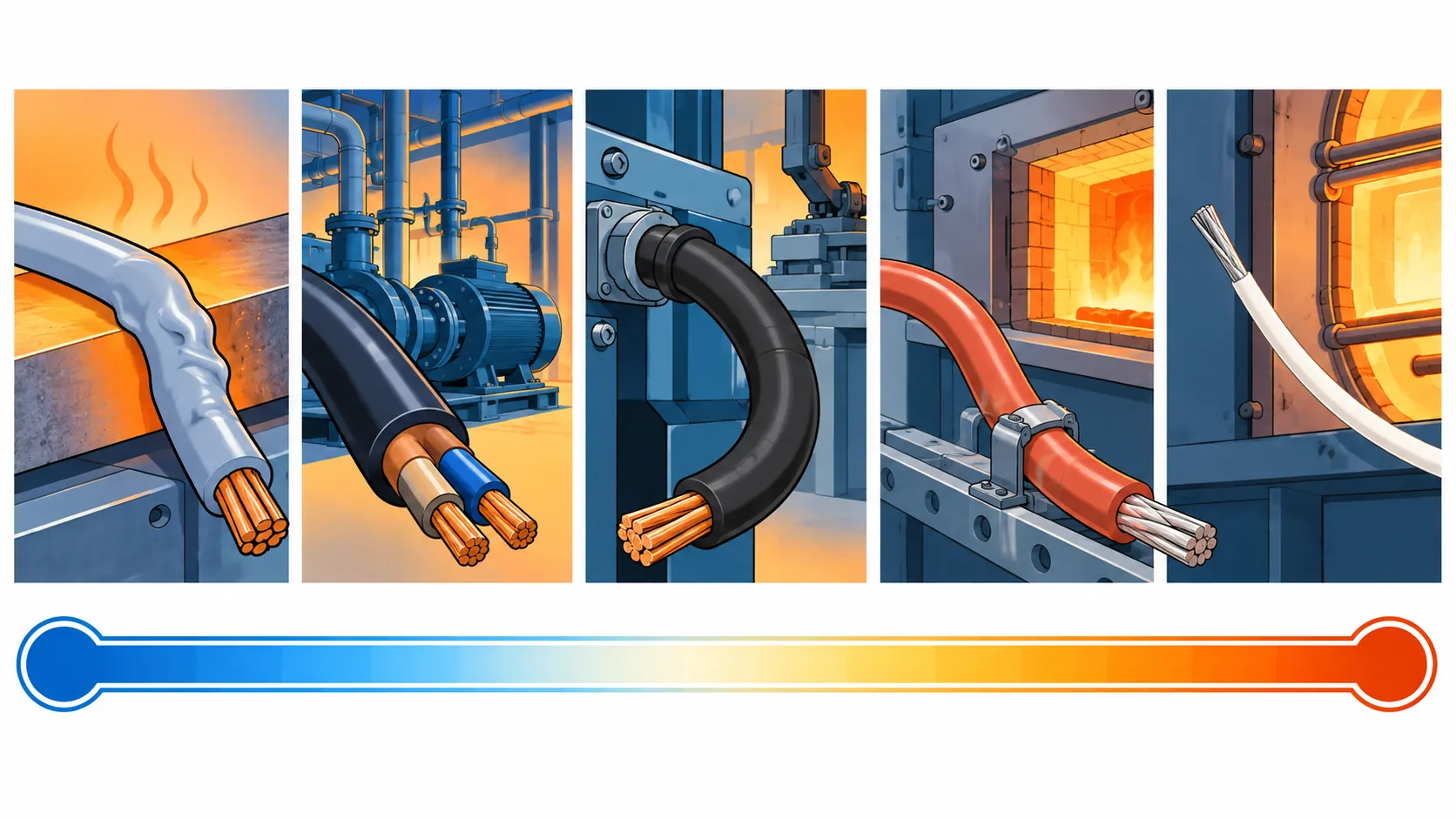
Quick Answer: Two different temperatures get confused on almost every high temperature order. The temperature a conductor can carry continuously is what decides the insulation system, and the temperature of the air or the surface the cable sits against is what decides the derating and whether the run needs a protective sleeve. Most failures blamed on high temperature are a standard cable run too close to a hot surface, or one derated against the wrong ambient rather than a genuine shortage of heat resistance.
Introduction
A cable is one of the few items on a high temperature job that nobody measures. The furnace, the pipe and the duct all have their temperature written on a drawing, while the cable alongside them is often bought on the words heat resistant and installed wherever it fits.
This guide is for the buyer specifying cable for furnaces, kilns, hot process plant, engine areas and roof voids. It separates the two temperature questions that get mixed up, sets out the insulation systems that answer each duty, the decisions to freeze before the order goes out, and the checks that catch a misrated delivery. Temperature-rated constructions sit in our high and low temperature resistant range, and the material comparison behind them is in our note on cable sheath materials compared.
What Heat Actually Does to a Cable
Thermoplastics soften and flow. A PVC or PE sheath loses its mechanical properties as it warms, and a cable clamped against a hot surface can deform under its own cleat long before it fails electrically. Softening is usually the first visible symptom, and it is a warning rather than the end of the story.
Ageing runs on a doubling rule. Insulation life roughly halves for every eight to ten kelvin of sustained extra temperature, so a cable run twenty degrees hotter than its rating does not fail at once, it fails years early. That is the mechanism behind the majority of premature high temperature failures.
Oxidation and embrittlement. Heat plus air hardens and cracks the outer layer, particularly where the cable is also exposed to UV or to oil mist. A cracked sheath admits the second problem, which is usually the one that finishes the run.
Current capacity falls as ambient rises. A cable sized in a cool plant room and installed in a hot one carries less current for the same conductor, and the correction is part of the sizing calculation rather than an afterthought. Where the cable is also grouped, the two corrections stack.
Differential expansion moves things. A hot cable expands more than the steelwork it is cleated to, so the cable works against its supports and frets at the restraints over every thermal cycle.
Insulation and Sheath Systems Compared
The table sets out the systems a buyer chooses between: what each one tolerates, what to specify, the evidence to demand, what drives cost and lead time, and how each one fails when the choice is made on the word heat resistant alone.
| System | What it tolerates | What to Specify | Evidence to Demand | Cost and Lead-Time Driver | How It Fails |
|---|---|---|---|---|---|
| PVC, general purpose | Ordinary plant rooms and control panels, on the lower conductor ratings | The conductor temperature class and the ambient the correction was based on | Compound data with the temperature class and the derating basis named | Cheapest and fastest to supply in every size | A sheath that softens and deforms near a hot surface well inside its electric rating |
| XLPE | Power distribution at the higher standard conductor ratings, with a generous short-circuit figure | Conductor temperature class, the short-circuit rating and the installation method used for derating | Compound data plus the short-circuit temperature and duration | Standard on most power cable; modest premium over PVC | Thermal ageing from a sustained overload, appearing as a cracked insulation years later |
| EPR or rubber | Flexible runs at elevated conductor temperature, where movement and heat arrive together | Conductor class, temperature rating and the flex duty at the service radius | Compound data plus flex results at the working temperature | Costs more than XLPE and runs to order more often | A construction rated hot but not flexible, cracking at the first movement |
| Silicone rubber | Continuous high ambient and radiated heat, including furnace and engine areas | Continuous temperature rating, the short-term peak it tolerates, and the sheath system | Compound certificate naming the continuous and peak temperatures, plus the ageing test | The first real step up in price; lead time follows the compound and the batch | A silicone core in a general-purpose sheath, so the layer that matters is the wrong one |
| PTFE, PFA or glass fibre | The hottest areas, where nothing else survives continuous temperature and fumes | Continuous rating, the chemical exposure and whether a glass braid or a coated layer is needed | Material data plus a temperature and chemical test on the exact construction | The most expensive option and often a made-to-order item | A brittle high temperature layer handled like a rubber cable and cracked at installation |
Temperature, Derating and the Two Ratings That Get Confused
The conductor rating is a construction property. A cable rated for a given conductor temperature can run at that temperature continuously, and that figure is fixed by the insulation system. It says nothing about how hot the air around it may be.
The ambient is a site condition. The same cable in a hotter space carries less current, and the correction factor comes from the installation standard rather than from the cable maker. Our note on cable derating factors sets out how ambient, grouping and installation method combine on one figure.
A hot surface is neither of the above. A cable cleated against a pipe at 200 degrees sees a local surface temperature that a standard ambient correction does not describe. That duty needs a protective sleeve, a stand-off, or a different route, because no derating factor is meant to cover a local hot spot.
Short-circuit and continuous ratings are different numbers. The short-circuit figure is a few seconds at a much higher temperature; the continuous figure is the one that governs ageing. Quoting the short-circuit number as if it described normal operation is a common way to overstate a cable’s duty.
What to Freeze Before the Order Goes Out
Six decisions decide whether a high temperature order can be accepted on site. Each is cheap at specification stage and expensive once the cable is installed and ageing.
| Decision | What to State | Evidence to Attach | Cost of Leaving It Open |
|---|---|---|---|
| Ambient and surface temperature | The air temperature and the temperature of any surface the cable touches, per run | A route drawing with the temperature at each run, taken from the process data | A cable bought for the wrong one of the two, and ageing from the first day |
| Conductor temperature class | The insulation system and its continuous conductor temperature rating | Compound certificate naming the continuous and short-term limits | A construction that runs hot and fails years early instead of immediately |
| Derating basis | The ambient, grouping and installation method the current was corrected for | The sizing calculation showing each correction applied | A cable loaded beyond its corrected capacity in the hottest part of the site |
| Short-circuit rating | The fault level, the duration assumed and the resulting temperature limit | The short-circuit rating on the construction sheet | A protective device setting the cable was never sized for |
| Protection at hot spots | The sleeve, barrier or stand-off at each point where the cable approaches a hot surface | The detail drawing for each hot spot with the stand-off distance | A local hot spot that no ambient correction accounted for |
| Test evidence and marking | The temperature rating to be printed on the sheath and the test that supports it | Compound certificate plus the marking to be verified on arrival | A cable supplied with a general sheath under a high temperature specification |
Installation Around Hot Surfaces
Move the run before buying a hotter cable. The cheapest high temperature solution on most sites is a route that puts the cable a metre further from the furnace, on the cool side of a support, or inside a shaded enclosure. That decision is free at design stage.
Sleeve the hot spots, not the whole run. Where a cable has to pass close to a hot surface, a protective sleeve over that section is cheaper than upgrading the entire run to a high temperature compound. Specify the sleeve material and its temperature rating, and leave a gap for air movement rather than wrapping the cable tight.
Allow for movement at every restraint. A hot cable expands more than its steelwork, so supports, bends and expansion loops belong in the arrangement drawing. Rigid cleating along a run that grows is how a cable frets through its own sheath.
Choose terminals rated for the duty. A high temperature cable landed in an ordinary terminal block puts the weakest material at the hottest point. The terminal and the lug are part of the same specification, and the assembly should be checked after the first thermal cycle.
Survey it hot. A thermal camera survey after commissioning shows which runs are hotter than the design assumed, and it is the only practical way to find a hot spot nobody drew. The wider thermal picture for moving equipment is covered in our note on thermal paths in cable runs.
Incoming Inspection and Site Records
Verify the marking, not the label. A high temperature sheath is normally printed with its temperature class, and the marking on the delivered cable is the cheapest check a buyer has. Where the sheath carries no rating, the specification has not been met however the paperwork reads.
Check the compound certificate against the order. The certificate should name the compound, the continuous temperature and the short-term peak, and the construction sheet should show which layers are of it. A certificate naming only the cable reference does not prove the insulation system.
Cut a sample on the hottest duties. On a silicone or PTFE duty a short sample shows whether the high temperature layer is present on the cores or only on the outer sheath, which is a real substitution and one no certificate catches.
Record the baseline before it runs hot. An insulation resistance reading at commissioning gives something to compare later, when ageing has started and the reading begins to fall. The method is set out in our note on insulation resistance testing.
Cost and Lead Time
PVC and XLPE are stock items in every size and add no lead time. Silicone and EPR constructions are the first real step in price and usually run to order, so they belong in the programme. PTFE, PFA and glass braid constructions sit at the top of the range and often run to order in small quantities, with the longest lead time of the three.
Copper is still the largest element of the price on a power cable, and the compound premium is a smaller number than most buyers expect. Over a long programme, the movement in copper between tender and purchase order is usually the bigger risk, so ask how the copper element is calculated and how long the price holds. That mechanism is covered in our note on copper price and cable procurement.
When a High Temperature Cable Is Not the Answer
When the heat is local. A single hot spot is a routing or shielding problem, and a sleeve there costs a fraction of upgrading the whole run to silicone. Look at where the temperature actually is before the compound is chosen.
When the requirement is fire, not heat. Heat resistance and fire performance are different specifications, and a fire-rated circuit needs a construction tested for circuit integrity, not a compound with a high service temperature. The two are regularly confused in requisitions.
When the failure is at the terminal. A cable that survives the temperature and fails at its termination proves the accessory was not rated for the same duty. Fix the terminals and the cable may be adequate as it is.
When a larger conductor is cheaper. Where a run is hot and heavily loaded, a larger cross-section at a lower temperature often costs less than a specialty compound and carries the current with less ageing.
RFQ Checklist
- The air temperature and the surface temperature at each run, taken from the process data
- Whether the duty is a continuous ambient, a hot surface or a short-term peak
- The insulation system and its continuous conductor temperature and short-term limits
- The derating basis: ambient, grouping and installation method used in the sizing calculation
- The short-circuit rating with the fault level and duration it is based on
- Protective sleeves, barriers or stand-off distances at each hot spot, issued as a drawing
- Support arrangement with allowance for thermal expansion at each restraint
- Terminal and lug material rated for the same temperature as the cable
- Marking on the sheath, with the temperature class to be verified on arrival
- Compound certificate naming the temperature limits, plus any ageing test result
- A thermal survey after commissioning, with the results recorded
- Copper basis and the validity window of the quoted price
Conclusion
High temperature specification comes down to keeping two numbers apart. Fix the conductor rating for the insulation system, correct the current for the ambient the cable actually sits in, and treat a hot surface as a routing and protection detail rather than as a reason to buy a more exotic compound. Most heat failures are a standard cable in the wrong place, and that is settled on the drawing.
Kexingyu Cable Group (KXYE) has manufactured cable in Quanzhou since 1996, including silicone, EPR and PTFE constructions for furnace areas, hot process plant and engine rooms, with compound certificates that name the continuous and peak temperatures. Send us the route with the ambient and surface temperatures, and we will come back with the insulation system, the derating basis and the tests that apply. A request for quotation is the fastest route.