Cable Recycling on Site: Recovering Copper and Cutting Waste
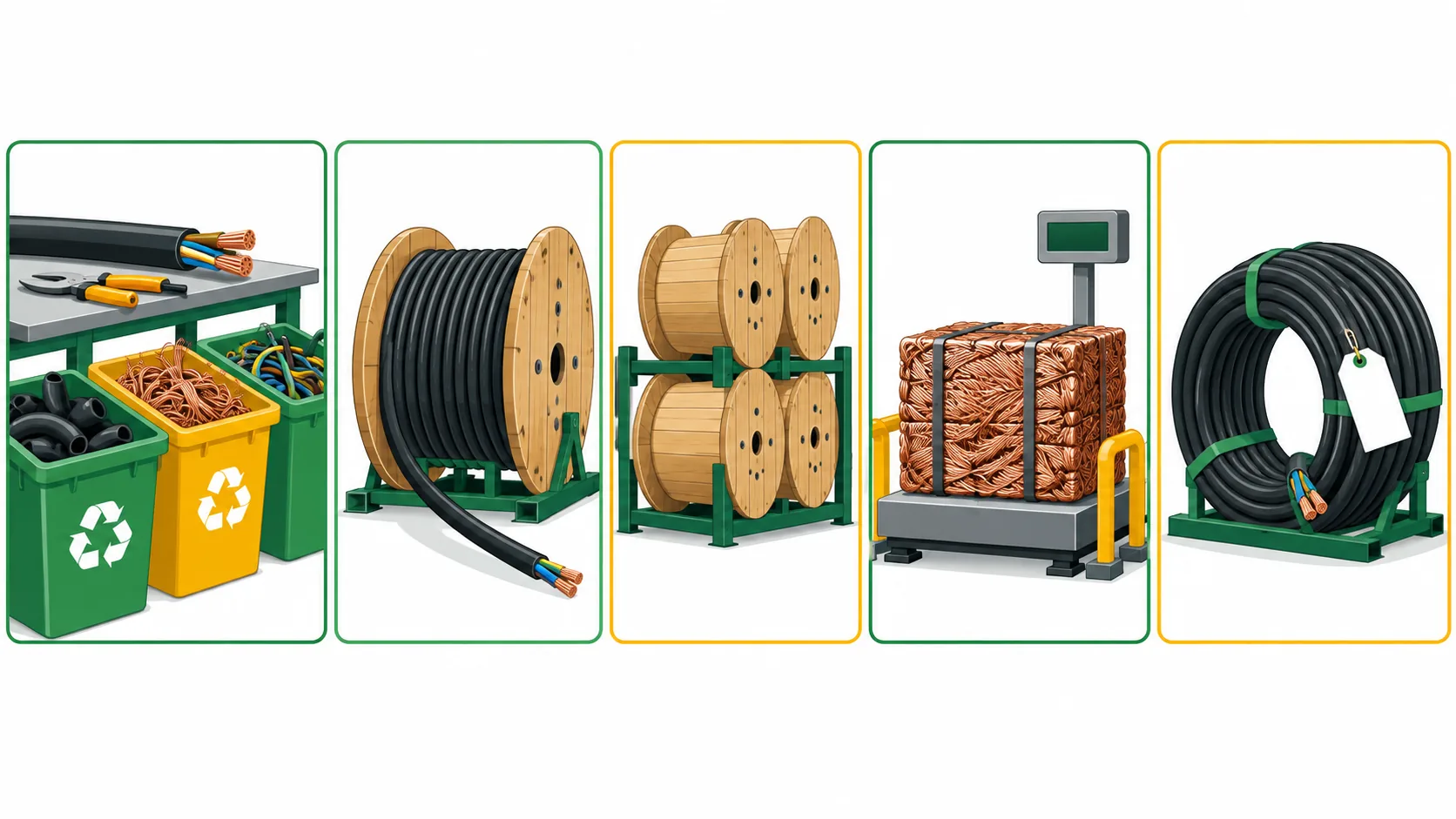
Quick Answer: The copper in a cable is worth several times more separated than mixed, and the difference is decided by how the cable was handled on site rather than by the processor. A bin of clean copper offcuts and a skip of armoured cable with the drums still attached can come off the same project, and the gap between them is a site procedure. Most of the value is created or lost before anyone reaches the yard.
Introduction
Cable waste on an industrial project is large, predictable and mostly avoidable. Offcuts, surplus lengths, damaged sections and empty drums all arrive at the same place within a few weeks of each other, and if they arrive mixed they are worth scrap value. Kept apart, the same material is worth several times more, and a proportion of it never needed to be waste at all.
This guide is for buyers, site managers and stores staff on construction, mining and industrial projects who have to account for cable waste and want the recovery to be worth something. It sets out what is actually recoverable in a cable, the recovery routes compared on value and effort, the procurement decisions that decide how much comes back, and the records that make a programme auditable. The copper recovery mechanism is set out in our note on copper recovery at end of life, and the conductor side of the value is covered in our note on conductor copper purity.
What Is Actually Recoverable in a Cable
The conductor is the value; everything else is cost. Copper or aluminium conductor is where the money is, and on a power cable it is the dominant part of the original price. The insulation, bedding, armour and oversheath have to be separated from it or paid for as disposal, so the recovery question is really how cleanly the conductor can be got out.
Cleanliness sets the grade, and the grade sets the price. Bare bright copper, tinned copper, and copper with insulation attached are three different products with three different prices, and the gap is large. A site that strips offcuts as it goes and keeps them dry will always beat one that delivers mixed cable at the end of the job.
Armoured and lead-sheathed cable costs more to process. Steel armour and heavy sheaths need separation work before the conductor is accessible, and that work is what the processor charges for. On short offcuts the processing cost can approach the metal value, which is an argument for avoiding the offcut rather than recycling it.
Length matters more than weight for reuse. A drum of unused cable in its original length has value as cable and can go back into stock or onto another project. The same material cut into three-metre pieces is scrap. Keeping surplus lengths identifiable and on the drum is the single highest-value recovery action on most sites.
Recovery Routes Compared
The table sets out the routes a site can choose between: what each one recovers, what to specify, the evidence to demand, what drives cost and effort, and how each one destroys value when the programme is set up carelessly.
| Route | What it recovers | What to Specify | Evidence to Demand | Cost and Lead-Time Driver | How It Loses Value |
|---|---|---|---|---|---|
| Surplus returned to stock | Full cable value on unused lengths still on the drum | The condition required for return, and who owns the surplus under the contract | The drum record with length, batch and test evidence | Storage space rather than processing cost | Surplus cut into short lengths for convenience and reduced to scrap value |
| Manufacturer or supplier take-back | Drums, and cable where the supplier runs a return scheme | The return terms, the deposit arrangement and the transport responsibility | A signed return note per consignment | Transport is the main cost, so consolidating matters | Drums returned one at a time at full haulage cost and the scheme abandoned |
| Segregated conductor to a processor | Clean copper or aluminium at the best grade the site can produce | The segregation standard, the bin arrangement and the dryness requirement | Weighbridge tickets by grade, kept as project records | Stripping labour and bin discipline | Copper stored outdoors in wet bins and sold at a lower grade |
| Mixed cable to a dealer | Whatever the dealer can separate, at the lowest grade | The volume, the cable types included and the collection arrangement | Collection notes and the weight reconciliation | Least effort and least value per tonne | Armour, drums and steel mixed into cable loads and deducted from the price |
| Reuse of recovered lengths | A serviceable length for a non-critical duty, avoiding a new purchase | The test and inspection required before reuse, and the duties it may be used on | Test records plus a reuse register identifying where it went | Storage and testing effort, offset by avoided purchase | Untested recovered cable installed on a live circuit with no traceable record |
Why Segregation Decides the Value
Every mixed load pays the processor’s separation cost. The processor separates what arrives, and the cost of that work comes out of the price offered. A site that separates as it goes is effectively paying its own labour rate instead of the processor’s, and it gets a documented grade in return.
Aluminium and copper must never share a bin. The two are separated by density and by price, and a mixed bin is downgraded or rejected. On sites where both are used the bins have to be labelled and kept apart, and the comparison between them is set out in our note on aluminium versus copper cable.
Wet or dirty copper loses grade fast. Copper that has been stored in the open oxidises and picks up contamination, and the loss is a permanent downgrade. A covered bin and a rule about not putting cable waste in with general site spoil is all that stands between a good grade and a poor one.
Drums are a separate revenue line. Steel or composite drums have their own value and their own return terms, and they are usually lost when they are used as bins for waste. Keeping the drum as a drum and the cable as cable is worth more than either on its own. Our note on drum packaging and export covers the return side of the same question.
What to Freeze Before the Order Goes Out
Six decisions decide how much of the material comes back as value. Each is settled in the purchase order, long before the first offcut is made.
| Decision | What to State | Evidence to Attach | Cost of Leaving It Open |
|---|---|---|---|
| Ownership of surplus and offcuts | Whether unused lengths and offcuts belong to the project, the contractor or the supplier | The relevant clause in the purchase order or subcontract | Material that legally belongs elsewhere being used, sold or scrapped |
| Cut-length discipline | The cutting schedule and the allowance for pulls, so offcuts are planned rather than generated | A cutting list reconciled against the route lengths | Short offcuts from every drum, all of them scrap |
| Drum return terms | Whether drums are returnable, the deposit arrangement and who pays the transport | The supplier's return terms in the purchase order | Drums used as bins and a deposit quietly lost across the project |
| Segregation standard | The grades to be produced on site and the bin arrangement for each | A site waste plan showing bins, labels and responsibilities | A single mixed skip and dealer-grade prices for everything |
| Records and reconciliation | The weighbridge tickets and the reconciliation between cable issued and cable scrapped | Monthly reconciliation against the issue records | No way to tell a genuine loss from a large unexplained shortfall |
| Disposal route and compliance | The licensed processor, the documentation required and the environmental obligations | Processor licences and the transfer documentation | Material leaving site without a record, which is a compliance problem later |
Setting Up a Site Programme
Put the bins where the cutting happens. A segregation point in the stores yard is too far away, and everything ends up in the nearest skip. Bins at the cutting station and at each major work face are what make the discipline realistic, and the programme should be designed around where material is actually generated.
Label by grade, not by material. A bin marked copper is ambiguous, while a bin marked clean bright copper offcuts and a second marked tinned or insulated tell the person holding the piece where it goes. The value of the programme is in the second-level distinction, and that is the one that gets left off.
Keep the surplus on the drum and identified. A surplus drum labelled with its construction, length and batch is either a stock item or a return, and it stays valuable. The same drum opened and cut is scrap, and the difference is a label and a store location.
Reconcile what was issued against what came back. A monthly comparison between cable drawn from stores and cable scrapped will show a shortfall before it becomes a habit. On a large project the reconciliation is also the control that stops good cable going into a skip, and the discipline behind it is the same as the one in our note on cable price breakdown.
Records, Compliance and Evidence
Keep the weighbridge tickets as project records. A recovery programme that cannot produce a weight by grade is only a claim, and weight records are also the basis for any reconciliation with the client or the main contractor. File them with the cable issue records rather than with general waste paperwork.
Document the disposal route. Material leaving site has to go to a licensed processor with the transfer documentation kept, because an unrecorded load is a compliance exposure that outlives the project. The paperwork is worth more than the scrap price on a site that is audited.
Record any reuse with its test evidence. Where a recovered length is reused, the test result and the location belong on a register, so a later fault can be traced. Reuse without a record is a saving that becomes a liability.
Cost and Lead Time
A segregation programme costs bins, labels and a small amount of labour, and the return is entirely in the grade of the material sold. Drum return is a transport cost against a deposit, and it only works when loads are consolidated. Returning surplus as cable costs storage and administration and returns the full material value, which is the largest single item in most programmes and the one most often ignored.
On the buying side, copper is the largest element of the cable price, so the same question comes up twice: what the copper element is at purchase, and what it is worth at recovery. Both are covered in our note on copper price and cable procurement, and the contract mechanism that fixes a price for a period is set out in our note on locking a copper price into a supply contract.
When a Recycling Programme Is Not the Answer
When the material is small and the site is remote. On a short project far from any processor, the transport cost can exceed the value recovered, and a simple drum return plus a single mixed load is the sensible arrangement. A programme should match the project, not the corporate template.
When the real problem is over-ordering. A site that generates a large volume of surplus has a procurement problem before it has a recycling opportunity. Cutting the order accurately saves more than any recovery route can return.
When the waste is contaminated. Cable recovered from a hazardous area, or from a fire, may have contamination or disposal restrictions that make recovery a specialist job. Check the disposal route before assuming the material is scrap cable.
When the labour has somewhere better to be. Stripping cable by hand on a project with a fixed completion date can cost more in labour than the grade uplift is worth. Do the arithmetic per tonne before committing staff to it, and separate only where the numbers justify it.
RFQ Checklist
- Ownership of surplus lengths and offcuts, stated in the purchase order or subcontract
- Cut-length schedule and pull allowance, so offcuts are planned rather than created
- Spare allowance per drum and the length at which a surplus stays returnable
- Drum return terms, deposit arrangement and who pays the transport
- Segregation grades to be produced on site, with the bin arrangement and labelling
- Covered storage for clean conductor to protect the grade
- Weighbridge tickets by grade, reconciled monthly against cable issued
- A licensed processor, with transfer documentation kept as a project record
- A reuse register, with the test evidence and location for every recovered length
- Separation of drums, steel and cable so none is used as a bin for another
- Copper basis at purchase and the validity window of the quoted price
- Transport consolidation plan, so recovery is not lost in haulage cost
Conclusion
Cable recycling is decided at the cutting station and in the purchase order, not at the yard. Segregate by grade where the cable is cut, keep surplus on the drum and identified, return the drums and reconcile what was issued against what came back. Do those four things and the recovery pays for itself without a corporate programme; skip them and the same material leaves site at dealer prices.
Kexingyu Cable Group (KXYE) has manufactured cable in Quanzhou since 1996, supplying industrial projects with construction data, drum records and cut-length support that make a site recovery programme workable. Send us the cutting schedule and the drum requirement, and we will come back with the construction, the drum arrangement and the records that apply. A request for quotation is the fastest route.