Handling Cable Non-Conformance: What Happens When a Delivery Fails Inspection
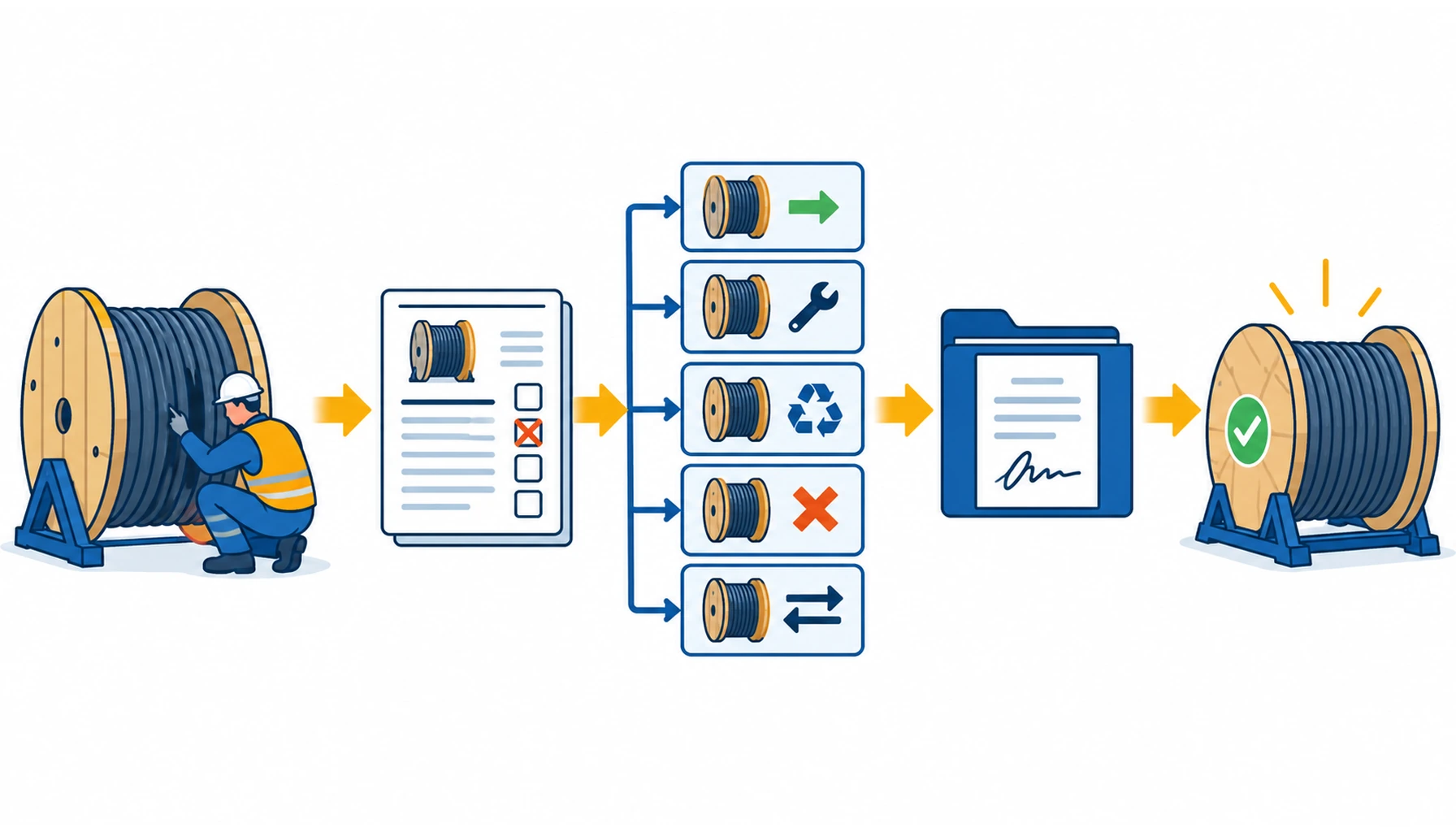
Quick Answer: Cable non-conformance is a process, not an argument. What decides the outcome is whether the goods were inspected against an agreed specification, whether the finding was recorded while the evidence was still available, and whether the purchase order named the disposition route in advance. A rejection argued from memory three weeks later usually ends in a split cost that nobody planned for.
Introduction
Every cable order that reaches site has a small chance of failing inspection. A drum is short by a few metres, the sheath marking does not match the drawing, a routine test certificate is missing, or the conductor measures outside the agreed class. None of these are disasters. What turns a defect into a dispute is handling it late and informally.
This page is written for site buyers, QA inspectors and project engineers who have to close out a failing delivery. It covers where non-conformance actually starts, the three kinds that reach a site, the first 48 hours, the disposition routes and what each one costs, the evidence chain that decides a claim, and the six decisions to freeze before the order is placed. Where the finding is a length shortfall, the method of measurement is set out in our note on cable length tolerance.
Where Non-Conformance Actually Starts
Most findings trace back to the enquiry, not the factory. If the purchase order did not state the conductor class, the sheath compound, the drum lengths or the test standard, the supplier has met whatever they quoted and the buyer has no baseline to reject against. Clarity at enquiry is the cheapest form of quality control.
The second source is the receipt process itself. A delivery signed for unchecked, offloaded into the store and mixed with other drums cannot be rejected cleanly later. The drum number and the finding have to be recorded at the point of receipt, in front of the carrier, with photographs taken before anything moves. Our note on cable labelling and documentation explains what the drum label is supposed to carry.
The third is a genuine production or handling fault. Sheath damage from a bent flange, a conductor outside the specified class, a failed voltage withstand test on a sample, or a length outside tolerance. Where this happens, the factory test records are the starting point, because they show what the cable should have been at the moment of release.
The Three Kinds of Non-Conformance That Reach a Site
Documentation non-conformance. The cable is very likely fine but the paperwork is not. Certificates missing, test reports not traceable to the drum number, the marking on the sheath different from the approved drawing, or the label showing a construction reference that does not match the order. This is the most common finding and the easiest to close, provided it is raised before the drums are installed.
Commercial non-conformance. The quantity, the drum lengths or the packing differ from the order. Short lengths on a drum that was specified to avoid a joint are a commercial problem with a technical consequence, because the fix on site is a joint or a re-order. Length and packing findings need the delivery note, the drum schedule and a measured sample to settle.
Technical non-conformance. The cable does not meet the agreed construction or test requirement. Concentric conductor resistance, insulation thickness, sheath mechanical properties, flame test performance, or a withstand test that the sample failed. These findings are the expensive ones, because they usually mean the drums are not usable and the programme is at risk.
What to Do in the First 48 Hours
Stop the drums and segregate them. Anything that may be the subject of a claim should be moved out of the normal store, tagged, and kept unopened or unwound. Cable that has been cut and installed cannot be returned, and the moment it is paid out the evidence of how it arrived is gone.
Record the finding in writing on the day. A non-conformance report needs the drum number, the quantity affected, the requirement that was not met, the measurement or observation that shows it, and the reference to the agreed specification. Photographs with the drum number visible, and the delivery note countersigned by the driver, are what makes the report stand up.
Notify the supplier immediately and in writing. A named contact, a reference number and a required response date. Suppliers respond to a logged, dated notification differently from a phone call, and the response clock matters when the same drum is holding up a pull. Where an independent party will be asked to look at the cable, our note on third-party cable inspection covers how that is arranged.
Do not repair or re-test on your own initiative yet. Changing the condition of the goods before the supplier has been given a chance to inspect is the fastest way to weaken a claim. Where an urgent repair is unavoidable, photograph the condition first and get written agreement that the repair does not affect the claim.
Disposition Routes Compared
The table compares the routes available once a non-conformance has been accepted as valid, what each one fixes, what has to be specified, the evidence it needs, what drives cost and time, and how each one fails.
| Route | What it fixes | What to Specify | Evidence to Demand | Cost and Lead-Time Driver | How It Fails |
|---|---|---|---|---|---|
| Use as is with concession | A deviation that does not affect the duty of the circuit | The deviation accepted, the limit of acceptance and the file reference | A signed concession note from the engineer of record | No rework, so the cheapest route and the fastest | A concession granted on paper for something that later matters in service |
| Repair or re-terminate | Local sheath or termination defects on drums that are otherwise sound | The repair method, the materials, who carries it out and who witnesses it | Before and after photographs, plus a post-repair test record | Labour and a test, with little effect on the programme | A repair with no test record, which is rejected at the next inspection |
| Re-test the affected drums | A finding on one test result where the rest of the batch may be sound | The test to be repeated, the standard, the sample size and the witness | A method statement and the full test report, not only the result | Bench time and a witness, with a short delay | A retest that passes but does not re-establish traceability to the batch |
| Replace the affected drums | Cable that fails the agreed construction or test requirement | The replacement schedule, the priority order and who pays freight | A production commitment with a dated dispatch plan | Production slot and freight, so the longest delay of the four | A replacement that arrives after the pull window closes |
| Reject and recover the cost | A whole order that cannot be used and will not be replaced in time | The claim basis, the evidence list and the notice period required | The NCR file, the test records and the correspondence log | Full re-procurement, usually the most expensive outcome | A claim filed after the evidence has gone cold and the window has closed |
Documenting the Evidence Chain
The agreed specification is the anchor. The claim is decided against what the order said, not against what the parties remember discussing. Keep the approved drawing, the datasheet, the sample approval record and the test standard together in the same file as the purchase order. Where a sample was approved before production, that signed record is normally the first document anyone asks for.
Traceability is what makes a finding stick. A test certificate that cannot be tied to the drum number on site proves nothing about those drums. The drum label, the packing list, the release note and the test report have to form a chain from the factory floor to the hardstanding, otherwise the supplier can argue that the failure belongs to a different drum.
Contemporaneous records beat reconstructed ones. A note written on the day, with a time, a name and a photograph, is worth more than a fuller narrative written three weeks later. Site diaries, gate records and the carrier’s paperwork all help, and none of them take long to keep if the discipline is set before the delivery.
Deciding Between Repair, Replace and Reject
Start from the consequence, not the defect. A cosmetic sheath mark on a drum feeding a fixed installation is not the same finding as a conductor resistance outside class on a trailing cable. The question is whether the deviation changes the duty, the life or the approval position of the circuit, and that is an engineering judgement, not a purchasing one.
Check what the standard actually allows. Many apparent defects are inside the permitted tolerance of the relevant test standard. Measuring a length shortfall against a nominal figure rather than the permitted tolerance is a common cause of claims that collapse. Understanding the mechanical and electrical test methods behind the numbers avoids that, and our note on factory testing sets out what is normally checked before release.
Weigh the programme against the principle. A full rejection on a sound batch delays the pull and costs more than the defect. A workable sequence is to sort the drums into usable, repairable and reject, agree the disposition on the first category immediately, and negotiate the rest in parallel. Where the route ends in a defective performance argument, the terms are dealt with in our note on cable warranty terms.
What to Freeze Before the Order Goes Out
Six decisions decide how a failing delivery will be handled long before anything fails. Each belongs in the purchase order or the specification.
| Decision | What to State | Evidence to Attach | Cost of Leaving It Open |
|---|---|---|---|
| Acceptance criteria | The standard, the class and the tolerance each property is judged against | The specification clause and the test standard reference | An argument about whether the cable was ever out of specification |
| Inspection point | Whether inspection is at the factory, on receipt, or both | A signed release note and a receipt inspection record | A finding raised after the cable is installed and cannot be returned |
| Notification period | How long after receipt a claim can still be raised | The contract clause with the number of days stated | A valid claim lost because it was raised outside the window |
| Evidence list | The exact records the supplier will accept as proof of a finding | A photograph schedule plus the measurement method | A claim refused for lack of traceable evidence |
| Disposition routes | Which of the routes are available and who chooses between them | A clause naming the disposal authority | Drums held in limbo while the parties disagree on the remedy |
| Cost recovery basis | Whether freight, retest, downtime and expediting are recoverable | A schedule of recoverable heads of cost | A settlement that covers the cable but not the programme damage |
Cost and Lead Time
The expensive part of a non-conformance is rarely the cable. A re-test or a repair costs a fraction of what a delayed pull costs once plant, labour and access are mobilised. That is why the disposition decision should be driven by the programme consequence and priced afterwards, rather than the other way round.
Replacement drums come from a production slot, not a shelf. A replacement made to the same construction usually needs conductor, extrusion and test time, and it competes with other orders for capacity. The realistic answer to how long a replacement takes comes from the factory’s current schedule, and the lead-time structure is described in our note on cable MOQ and lead time.
Administration is the slowest step. Reports written late, missing photographs and unclear acceptance criteria stretch a two-week settlement into three months. Buyers who fix the evidence list at enquiry close their claims faster than buyers who negotiate harder on a weaker file.
When a Formal Non-Conformance Report Is Not the Answer
When the specification was never agreed. If the order left the construction or the test standard open, there is no baseline and an NCR has nothing to measure against. Fix the specification first, and treat the finding as a variation rather than a defect.
When the deviation is inside tolerance. Cable that measures within the permitted range of the applicable standard is conforming, however far it sits from the nominal figure. Raising a report on a conforming delivery damages the relationship and uses up goodwill that a genuine claim will need later.
When the damage happened after receipt. Dragging, dropping or storing a drum in water causes damage that looks exactly like a factory fault. If the receiving inspection was not recorded, the buyer cannot prove when it happened, and the claim will be resisted. Keep the receipt record and the storage conditions documented.
When the supplier is a trader rather than a manufacturer. The party who cannot see the production line and the test bench cannot answer the technical questions an NCR raises. Our note on manufacturers compared with trading companies explains why that gap shows up first at exactly this point in a project.
RFQ Checklist
- The acceptance criteria for every property the order will be judged against
- The applicable standard and the test method for each one
- The permitted tolerance on length, conductor resistance and dimensions
- Whether inspection is at the factory, on receipt, or witnessed at both
- The traceability requirement linking test records to drum numbers
- The drum marking and labelling content, agreed before production
- The notification period for a claim, in days from receipt
- The evidence list the supplier will accept as proof of a finding
- The party with authority to choose the disposition route
- The recoverable heads of cost, including freight and retest
- The response time required from the supplier after notification
- The names of the contacts who handle a claim on each side
Conclusion
Non-conformance is decided at enquiry, discovered on receipt, and settled on paperwork. The buyers who close claims cleanly are the ones who wrote the acceptance criteria down, inspected against them on the day the drums arrived, and had a disposition route named in the order before it was placed. The technical finding is usually the smallest part of the problem.
Kexingyu Cable Group (KXYE) has manufactured cable in Quanzhou since 1996 and keeps the release records, drum traceability and test reports that a claim is decided on, so a finding is answered from the file rather than from recollection. Send us the specification and the acceptance criteria, and we will confirm the test and documentation package that comes with the order. A request for quotation is the fastest route.