Buying Power and Control Cables for Projects in Kyrgyzstan
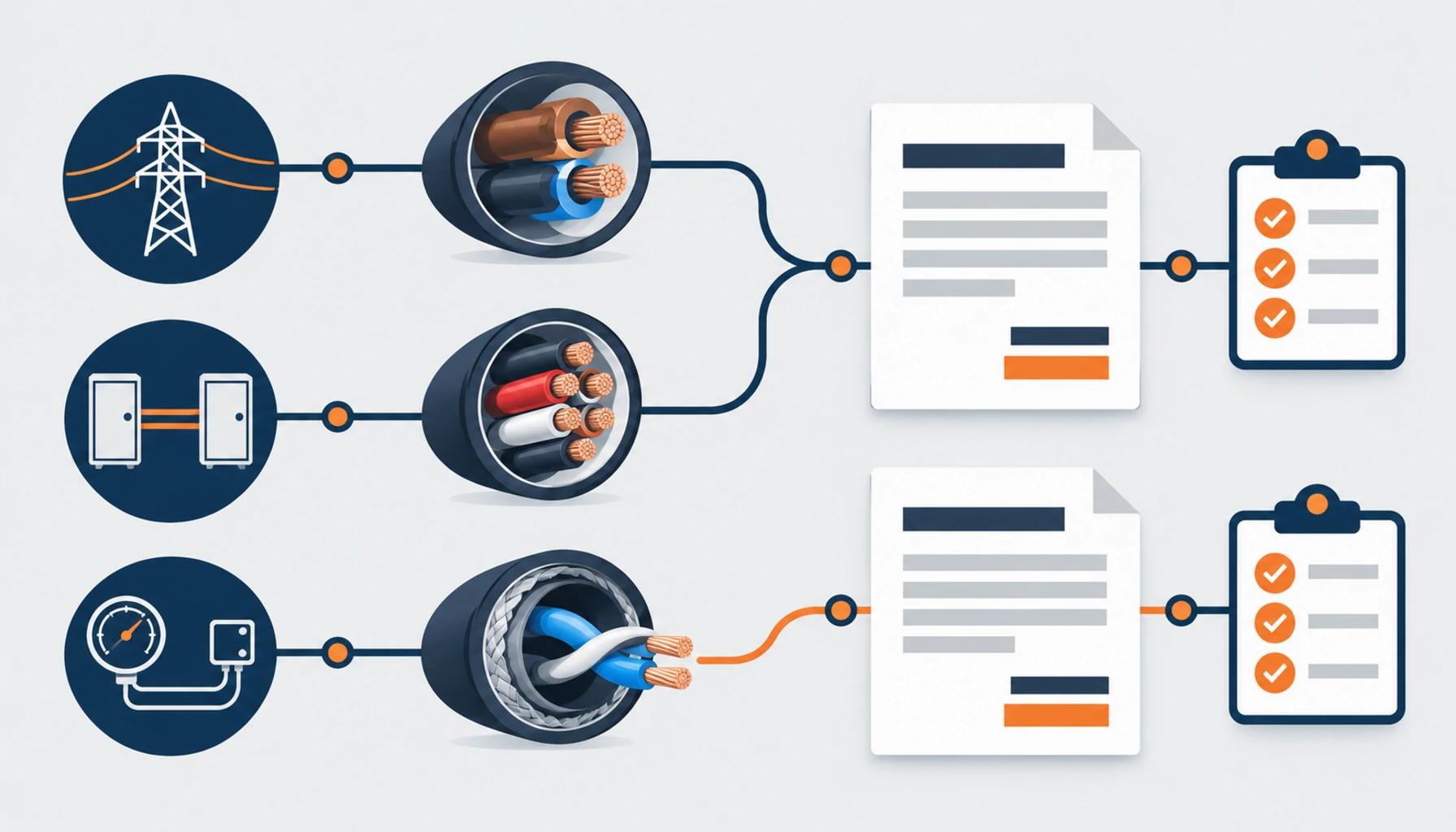
Quick Answer: A Kyrgyzstan project buys power and control cable as separate circuits with separate requirements, and the purchase works best when the enquiry keeps them that way. Group the circuits, match a cable type and core count to each, state the site temperature and outdoor exposure where they are real, add the mechanical protection the routing needs, and ask for the groups quoted separately. Confirm deviations and samples against the circuit requirements, and the delivered cable will match the project it was designed for rather than a supplier’s standard bundle.
Introduction
Most projects in Kyrgyzstan buy two cable families in one order: the power circuits that feed the equipment, and the control circuits that run between panels. The two families are bought from overlapping but not identical capabilities, and an enquiry that bundles them into one undifferentiated list usually gets one blended answer that serves neither. The circuit is the natural unit of the purchase, because the circuit is where voltage, cores, routing and environment come together.
This guide is for contractors and project buyers buying power and control cable for projects in Kyrgyzstan. It works through the purchase by circuit: grouping, matching cable types and electrical requirements, the site conditions that attach to real circuits, outdoor exposure and mechanical protection, why the groups are quoted separately, and how deviations and samples are confirmed. The control constructions behind these circuits are shown in the control cable range, and the distinction between the control and instrumentation families is set out in our note on control versus instrumentation cable.
Supplier screening for Kyrgyzstan, which comes before any of this, is in our checklist for Kyrgyzstan.
Group the Purchase by Circuit, Not by Product
List the circuits first, then the cables. Incoming distribution, motor and equipment feeders, panel-to-panel control runs, and any instrumentation pairs the project carries. Each circuit carries its own voltage, core count, routing and environment, and the cable follows from the circuit rather than from a catalogue. A circuit-ordered list is also the list a site can check against its drawings at receipt.
Keep power and control as separate groups in the enquiry. They are produced on different lines, evidenced by different reports and often quoted with different MOQ behaviour. Asking for the groups quoted separately, with subtotals, keeps the offer legible and the comparison honest.
Instrumentation is a third group where it exists. Where the project carries screened measurement circuits, they belong in their own group with their screen structure specified, because their requirements are closer to each other than to either power or control. Folding them into the control group is how screen requirements get lost.
Match Cable Types and Electrical Requirements to Each Circuit
Power circuits: voltage in full and the conductor sized by the load. Each feeder states its rated voltage fraction, conductor material and section, and cores, including reduced neutrals where designed. The installation method, buried, ducted or tray, shapes the armour and sheath fields. These are the same fields that matter on any power purchase, and the construction logic is set out in our note on XLPE cable construction.
Control circuits: core count and the electrical duty of each core. The number of cores follows the panel wiring design, and where cores carry different duties, supplies, signals and interlocks, the core count and any screen requirement follow the drawing rather than a standard bundle. The common constructions in this family, and how they are written, are covered in our note on KVV control cable.
Write each circuit as one line with its standard. The standard the delivery is checked against travels with the line, as everywhere in this series. Where a circuit’s requirement and the supplier’s standard construction differ, the difference is a deviation with a reason, decided against the circuit’s duty.
Attach Site Temperature Where It Is Real
The buyer supplies the conditions, not the assumption. Projects in Kyrgyzstan run in cities, valleys and high ground, and the installed temperature range comes from the site, not from the country’s reputation. Where a circuit is genuinely exposed to cold, state the installed temperature, the duty, fixed, installed and bent, or dynamic, and the test expected behind it. Where it is not, leave the field out rather than paying for a rating the circuit never meets.
Storage and installation are cold too. Cable installed in summer may be pulled and bent in winter, and the low-temperature flexibility requirement often attaches to the installation moment rather than the service. That distinction is worth writing into the condition, because it decides which constructions qualify and which tests answer them. Cold-duty behaviour and its tests are covered further in our note on cold flex testing.
Heat sources are conditions as well. Circuits routed near heat-emitting equipment carry a temperature condition from above as well as below. The condition field is the same; only the direction differs, and the supplier answers it with the compound and the evidence.
Handle Outdoor Exposure and Mechanical Protection
Outdoor exposure is a sheath property, line by line. Circuits routed outdoors carry UV and weathering exposure, and the sheath compound and any evidence follow the line. Indoor circuits do not need the rating, and applying it everywhere is a quiet premium on cable that never sees daylight.
Mechanical protection follows the routing. Buried runs ask about armour; tray and duct runs ask about pulling and bending; runs through traffic areas ask about impact. The routing is on the project drawings, and stating it per circuit lets the supplier confirm the construction rather than guess it. The practical routing-versus-construction trade-offs are covered in our note on flexible versus rigid cable on site.
Where two circuits share a route, say so. Shared routes sometimes justify a shared trench or tray decision and sometimes a separation requirement. Either way the circuits remain separate lines with their own requirements; the route is context, not a reason to merge the purchase.
Ask for the Groups Quoted Separately
Separate quotes keep the offer legible. Power and control lines price differently, move on different production schedules and carry different documents. An offer with group subtotals lets the buyer accept, delay or rescope one group without unravelling the other, which matters on projects where panel delivery dates and civil works rarely move together.
MOQ behaves differently per group. Control constructions often carry per-type minimums that a small project feels, and power constructions are ordered in drum-length units. The MOQ structure and how it moves with order size is set out in our note on cable MOQ and lead time, and the per-group answer is what the comparison needs.
Documents follow the groups too. Power constructions and control constructions are evidenced by different reports, and the receiving inspection checks them against different drawings. Asking for the document set per group, tied to drum numbers, keeps the receipt check as organised as the enquiry was.
The enquiry that produces per-group offers is set out in our guide to requesting a cable quotation for Central Asian projects.
Confirm Deviations and Samples Against the Circuit Requirements
Deviations are judged circuit by circuit. A sheath proposal is weighed against the exposure that circuit actually has; a core-count change against the panel design it feeds. The three-column format, specified, proposed, reason, works here as everywhere in this series, and the record travels into the order annex.
Sample the circuits whose failure costs the most. Usually the main power feeder and the control construction used in the largest quantity. The sample is judged against the circuit requirement, including any stated temperature condition, and the approval record becomes the receipt benchmark for the batch.
Keep the receipt check organised by circuit. Drums matched to packing lists, batch reports tied to drum numbers, and each group checked against its own drawing lines. An order bought by circuit is checked by circuit, and the packaging that survives the route is what makes the check possible, set out in our note on export drum packaging.
Circuit, Cable and Confirmation Table
The table sets out the purchase by circuit type: the cable family each circuit calls for, the parameters to confirm before ordering, and the evidence that answers them.
| Circuit Type | Cable Family to Match | Parameters to Confirm | Evidence That Answers It |
|---|---|---|---|
| Incoming distribution | Power cable at the service voltage, armoured per routing | Voltage fraction; conductor material, class and section; cores; armour; sheath; drum lengths | Type report for the construction; routine batch reports tied to drums |
| Motor and equipment feeders | Power cable sized to the load, flexible class where terminated tight | Voltage fraction; conductor and section; installation method; bending constraints | Construction named in the offer; deviation sheet where it differs |
| Panel-to-panel control | Control cable, core count per the wiring design | Core count and duties; screen where required; sheath and temperature condition where real | Report on the control construction; sample record for the largest-quantity type |
| Instrumentation pairs (where present) | Screened instrumentation cable | Individual and overall screen structure; pairing; sheath | Report naming the screened construction and its test |
| Outdoor runs (any group) | Weather-resistant sheath on the affected lines | UV and weathering condition attached to the line; compound and evidence | Material evidence for the stated exposure |
| Cold-exposed runs (where real) | Construction qualified for the stated duty | Installed temperature; duty, fixed, bent or dynamic; test expected | Test behind the temperature claim, named per line |
Cost and Lead Time Across Two Families
Two families mean two production schedules. Power and control constructions run on different lines, and the order ships when both are done. Asking for the production time per group, and per line within the group, is what tells you whether one group should deliver first. Where the panels arrive late, the control cable can follow the power cable without cost, but only if the offer was built to allow it.
The copper basis covers both families, unevenly. Power constructions carry more metal per metre than control, so a market move moves the groups by different proportions. One basis and one validity window across the offer keep that movement visible and comparable rather than hidden in blended subtotals.
Small control quantities carry per-type minimums. A project with a dozen control constructions can find the minimums adding up to more than the project needs. Consolidating core counts where the design allows, or accepting the nearest standard construction as a recorded deviation, are the two levers, and both are cheaper at quotation stage than at the order.
Freight follows the drums, and the drum plan follows the circuits. Power drums are heavy freight; control cable packs differently. Confirming the drum plan and the receiving point’s equipment in the quotation keeps the landed cost honest and the unloading uneventful, which is the outcome every project prefers.
| Feature | Power Group | Control Group | Instrumentation Group |
|---|---|---|---|
| Production behaviour | Drum-length units; fewer lines, longer set-ups at higher voltages | Per-type runs; many small set-ups across core counts | Screened constructions on dedicated processes |
| MOQ behaviour | By drum length and construction | Per type; felt most on small projects | Per construction; pairs and triads quoted separately |
| Lead documents | Type report per construction; routine reports per drum | Report on the control construction; batch results tied to drums | Report naming the screen structure and its test |
| Copper exposure per metre | Highest | Moderate | Lowest |
| Typical delivery split | Often first, matched to civil and equipment dates | Follows the panel programme | Follows the panel programme |
| Common deviation candidates | Armour type, sheath compound | Core count consolidation, screen additions | Pairing format, screen structure |
When Circuit-Based Buying Is Not the Answer
When the purchase is standard stock. A distributor restocking control constructions buys by product, not by circuit. The country checklist for order execution covers that path; this guide is for the project purchase.
When the design is still moving. Circuit lists written before the panel design settles will be rewritten. Wait for the drawings, or quote the firm circuits only and label the rest.
When one circuit dominates the order. Where a single feeder accounts for most of the value, the purchase is really a power cable purchase with a control tail. Treat it as such, and the group structure still holds for the remainder.
When the site conditions are unknown. Conditions guessed are conditions wasted. Where the environment has not been assessed, leave the condition fields out and buy the baseline construction, rather than paying for ratings nobody can justify.
RFQ Checklist
- Circuits listed as circuits: incoming distribution, feeders, control runs, instrumentation where present
- Power and control quoted as separate groups with subtotals
- Voltage fractions, conductor materials, classes and sections per power line
- Core counts and duties per control line, screens specified where required
- Site temperature and outdoor exposure attached only to the circuits that carry them, with the duty named
- Mechanical protection stated per routing: armour, pulling, bending, impact
- MOQ and drum lengths requested per line, with the tolerance confirmed
- Deviations judged circuit by circuit and recorded in the annex
- Samples for the highest-consequence circuits, on the batch line, with approval records
- Document sets requested per group, tied to drum numbers
Conclusion
A power and control cable purchase for a Kyrgyzstan project is organised by its circuits. Each circuit carries its voltage, its core count, its routing and its real conditions, and the enquiry that preserves that structure gets an offer the site can actually use. The groups quoted separately, the deviations judged against the circuit’s duty, and the receipt checked by drawing: the same order from enquiry to handover, with nothing lost between the design and the drum.
Kexingyu Cable Group (KXYE) manufactures power and control constructions in Quanzhou and quotes circuit-ordered enquiries group by group, with conditions answered by evidence and deviations decided against the duty. Send us your circuit list, quantities and destination, or upload your drawings and specification, and we will quote against the circuits as designed. A request for quotation is the fastest route to start.