Flexible vs Rigid Cable: Choosing Conductor Class for the Job
Quick Answer: The flexible vs rigid choice is set by how the cable moves, not by how it looks in the catalogue. If a cable is installed once and never touched, buy the cheaper rigid or compacted construction. If it is dragged, reeled, re-terminated, or landed on a moving machine, pay for a flexible class and name that class in the specification. Getting it right costs a few percent. Getting it wrong shows up as a broken core behind a gland eighteen months later.
Introduction
Conductor class is the least glamorous line in a cable specification and the one that causes the most rework. Two cables can carry the same current, meet the same voltage class and look identical on the sheath, and still be wrong for each other’s job, because one is built around a compacted strand and the other around thousands of fine wires.
This guide is written for the person signing the requisition. It covers what each class is for, where rigid wins, where flexibility earns its cost, the numbers that force the decision, and the eight items to freeze before the order goes out. The class numbers quoted are the IEC 60228 ones most suppliers work to, described in our note on IEC 60228 conductor classes.
What Conductor Class Actually Changes
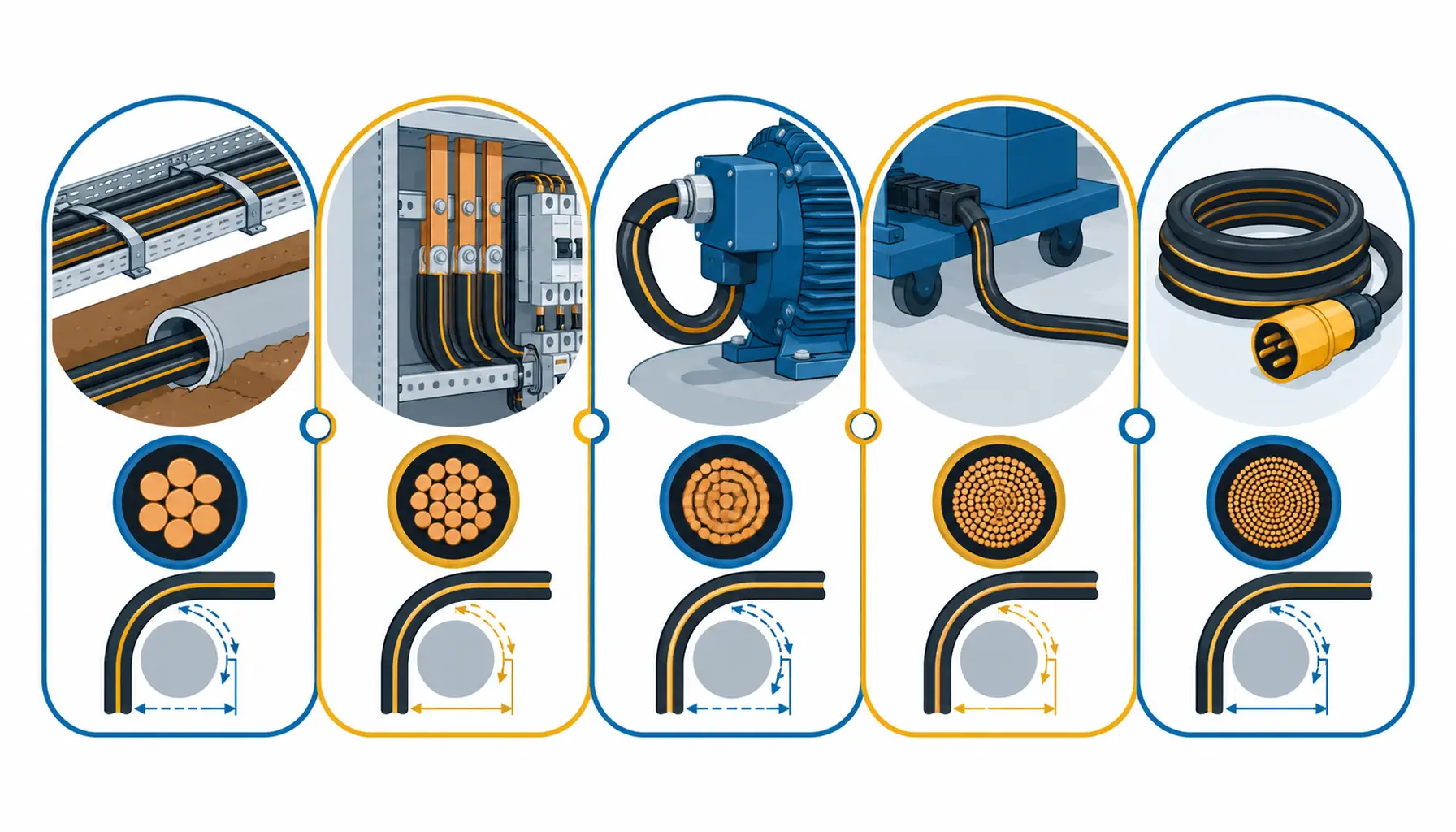
Class 1 and class 2 are the fixed-installation classes. Class 1 is a single solid wire, still common in small building wire. Class 2 is stranded but stiff, and in compacted or sector-shaped form it is what most power cable in a tray or duct is built on. It holds a bend, fills a duct efficiently and costs the least to make.
Class 5 and class 6 are the flexible classes. Class 5 uses fine strands, class 6 finer still. The copper is the same grade, so material cost barely moves. You pay for drawing the wire thinner and stranding it in more passes. What you buy is bending life, tested under the methods in our note on cable flex testing methods.
What you trade. Flexible conductor is larger in diameter for the same cross-section and needs more support in a long horizontal run. None of that matters in a duty flexibility is bought for.
Where Rigid Wins
Buried and ducted runs. Once a cable is pulled into a duct and backfilled, nobody touches it for decades. Compacted class 2 is cheaper, pulls well when sized correctly and takes less duct space for the same current.
Tray runs in plant rooms and risers. Laid once, cleated and left. Rigid conductor holds the shape it is bent into, which gives a neat riser and predictable radii at each change of direction.
Panel and switchgear wiring. Bent once, formed to the terminal and left. Solid wire takes a better torque at a screw terminal than a bundle of fine strands, which spreads unless a ferrule is fitted.
Where the section is large. At that scale the price gap between class 2 and class 5 is real money, and buying flexibility nobody will use is the most common over-specification on industrial projects.
Where Flexibility Earns Its Cost
Machine connections. The last two metres between a fixed tray and a motor terminal box is where vibration, thermal cycling and a fitter with a spanner meet. A class 5 or class 6 tail absorbs that movement instead of feeding it into the termination.
Trailing, reeling and festoon duty. Where the cable is dragged behind a machine, wound onto a drum or run through a festoon, strand class is a purchase order clause rather than a preference. Rigid conductor fails as a strand break inside the insulation, invisible until it becomes an earth fault.
Repeated flexing in machinery. Cable carrier, harness and moving gantry duty sit in class 6 territory, and the gap between a general flexible cable and a genuine continuous-flex construction is wider than the gap between class 5 and class 6. Our note on high-flex versus standard cable covers where the boundary sits.
Portable tools and temporary distribution. Anything coiled and moved needs a flexible class, because coiling is itself a flex cycle.
Flexible tails at both ends of a rigid run. This is the pragmatic answer on most projects: run the main in class 2 and land into a flexible tail at each moving end. It is why a small quantity of flexible cable often appears on an otherwise rigid order.
The table below sets out the conductor class purchase, duty by duty: what to specify, what evidence to demand, what drives cost and lead time, and how each choice fails when it is made loosely.
| Site duty | Class to buy | What to Specify | Evidence to Demand | Cost and Lead-Time Driver | How It Fails |
|---|---|---|---|---|---|
| Fixed tray, duct and buried runs | Class 2, compacted or sector-shaped | Cross-section, conductor material, duct fill, pulling tension limit, bend radius at each change of direction | Conductor resistance per kilometre on the finished length, dimensional record, sheath thickness | Copper content dominates; compaction saves diameter rather than metal | Damage during the pull at a tight bend; a cable that fills the duct and cannot be recovered |
| Panel, switchgear and busbar wiring | Class 1 or class 2, or class 5 with ferrules | Bend radius at the terminal, terminal type and torque, ferrule requirement, core identification | Terminal compatibility statement, torque values, forming instructions | Labour dominates; the cable is the cheap part of this line item | Strands spread at a screw terminal, poor contact and heat rise at the joint |
| Machine and equipment connections | Class 5, with a flexible tail each end | Tail length, allowable movement, bend radius at the gland, screen arrangement where screened | Flex data at the declared radius, gland compatibility, screen continuity on the assembly | Fine stranding and screening add cost; factory-fitted tails add days | Core break inside the insulation behind the gland, appearing as an intermittent earth fault |
| Trailing, reeling and festoon duty | Class 6, continuous-flex construction | Duty cycle, travel length, winding geometry and tension, torsion requirement, minimum bend radius in service | Flex and torsion results at the declared radius and cycle count, sheath wear data | Construction complexity, not copper, sets the price band; bespoke lengths add weeks | Corkscrewing on spiral drums, strand fatigue at the guide, sheath flattened at the drum entry |
| Flexible tails, pendants and portable equipment | Class 5 or class 6 by coiling frequency | Core count, coiling frequency, ingress protection required, strain relief at each end | Flex data at the coil radius, strain relief test, impact and abrasion results | Jacket material matters more than the conductor at this size; moulded ends add cost | Core failure at the strain relief, jacket split at the coil, connector body cracking |
The Numbers That Decide It
Bending radius in the duty, not on the datasheet. A supplier quotes the radius the cable tolerates once. A moving application needs the radius it tolerates a few million times, which is larger. Ask for both in writing and specify the service figure. Our note on cable minimum bend radius explains where the datasheet figure is generous.
Cycle count against radius. Flex life is a curve, not a number. Halve the radius and the achievable cycles fall by an order of magnitude or more. A cycle figure quoted without the radius and the travel length is not a specification, which is why the test standard and rig geometry have to travel with the quotation.
Strand count and strand diameter. Two cables can both be called class 5 and still behave differently, because the class sets a maximum strand diameter rather than a fixed construction. Where the duty is severe, ask for the actual strand count and nominal strand diameter, and whether the strand is bunched or rope-laid.
The fill factor trade. Flexible conductor needs a larger gland, duct and tray for the same current. Where containment is already sized, that cost belongs in the comparison rather than being discovered at installation.
Termination implications. Fine strands need a ferrule or a pressure plate rated for flexible conductor. A class 6 cable landed in a lug intended for class 2 copper passes a resistance check at commissioning and loosens in service. Armour is a separate question, covered in our note on armoured versus unarmoured cable.
Terminations and Glands
Most flexible cable failures are termination failures, and they cluster where a flexible cable is clamped as if it were rigid.
Clamping. Support the cable so movement happens in the free length, not at the gland. A cleat fitted hard against the gland neck feeds every cycle into the termination. On a moving machine the support arrangement is part of the specification and should be drawn, not left to site.
Gland type. Fine strands need a gland that compresses around the sheath rather than one relying on the conductor holding its shape. A gland chosen for rigid cable gives no strain relief on a flexible one, and the cable creeps out of it.
Mixing classes in one circuit. A rigid feeder landed directly onto a moving machine, with no flexible tail, is a common saving that returns as repeat termination failures.
Sizing Does Not Change with Class
Conductor class does not change the current-carrying calculation. A 95 mm2 class 2 and a 95 mm2 class 6 conductor have essentially the same resistance, so the same voltage drop over the run. What changes is outside diameter and the installation allowance.
When a run sits at the limit of its voltage drop, the fix is a larger cross-section, a shorter route or a closer source of supply, not a different strand class. Fault level and protective settings belong to the same package; our note on grounding and bonding verification covers the source-end checks.
What to Freeze Before the Order Goes Out
These eight items are cheap at specification stage and expensive once drums are on a truck.
| Decision | What to State | Evidence to Attach | Cost of Leaving It Open |
|---|---|---|---|
| Movement per run | Fixed, flexed occasionally, or continuously flexed, run by run | A cable schedule mapping each run to its duty and cycle count | One rigid construction bought for a duty that needed class 6 |
| Conductor class and stranding | Class number, strand count and strand diameter for the sizes quoted | Construction sheet with the strand build and resistance per kilometre | A cheap class 5 substitute that fails early in a severe duty |
| Bending radius in service | The radius the cable lives at, at each end and along the route | Layout sketch with the radius marked at every restraint and guide | Repeated sheath and core failure at the tightest point |
| Insulation and sheath system | Insulation type and sheath compound, matched to the site conditions | Compound declaration and the applicable test evidence | A cable that is electrically right and environmentally wrong |
| Termination and gland type | Lug or ferrule type, gland model, and whether the gland suits fine strands | Termination instructions and torque values for the assembly | Strand spread at the terminal and heat rise at the joint |
| Support and strain relief | Cleat spacing, gland support and where movement is allowed | A support arrangement drawing accepted before installation | Every flex cycle transferred into the termination |
| Lengths and factory ends | Working lengths, factory-fitted ends, drum sizes and mass limits | A packing list checked against the cable schedule | A joint in the middle of a moving run |
| Test and evidence plan | Which flex, resistance and continuity tests are witnessed, and what ships per drum | A written plan with acceptance criteria and dates | A volume accepted on a sample nobody kept |
Lead Time and Cost
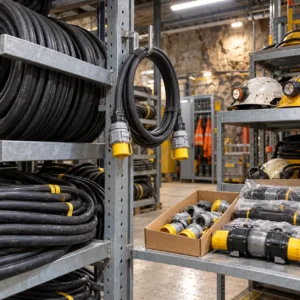
Stock constructions ship in days, limited to the classes, sizes and drum lengths a supplier holds, and they are usually class 2 because that is what sells in volume. Made-to-order flexible cable is the normal case and runs on stranding, compound and drum lengths. Continuous-flex constructions are the longest, because the build is slower and flex testing takes days.
Copper is the largest component and strand class changes how much work goes into a kilogram of it, but that gap is stable enough to budget against. What is not stable is copper itself. Industrial programmes run long, so a tender-stage quotation can be months from the purchase order, and on a large feeder that movement outweighs the manufacturing margin. Ask how the copper element is calculated and how long the price holds; our note on copper price and cable procurement covers how that is normally handled.
Incoming Inspection
Against the drum. Count drums against the packing list, verify marked lengths and photograph the drum markings before anything is cut. Where a construction certificate names a strand class, the drum reference links the delivery back to it.
Conductor checks on a sample. Count the strands and measure strand diameter on one core. Ten minutes settles whether the class quoted is the class delivered. Then measure resistance per kilometre against the figure for that class.
Flex evidence and accessories. Match the flex report to the construction delivered, confirm that glands, ferrules and lugs match the strand class, and check that torque values ship with the goods.
When a Flexible Conductor Is Not the Answer
When the failure is routing, not strand class. Repeated core breakage at the same point is usually a restraint, a guide or a radius problem. Buying a higher class into the same route moves the failure a few months later. Our note on cable damage wear patterns sorts one from the other before money is spent.
When a run nobody will move is bought flexible. A buried feeder in class 6 pays for a property it will never use, in a larger diameter that changes the containment.
When a flexible tail hides a machine alignment problem. A flexible connection absorbs normal movement, not a machine installed out of line. Using it that way adds a consumable cost to a fault that belongs at the mounting.
When one class is asked to cover the whole site. On most industrial projects the right answer is one rigid specification for the fixed population and a smaller flexible order for the ends that move. Buying one class for everything is how a specification doubles a cable budget.
RFQ Checklist
- Movement duty per run: fixed, infrequent flex or continuous flex, with cycle count where known
- Conductor class named per run, with strand count and nominal strand diameter for the major sizes
- Cross-section, conductor material and the applicable resistance per kilometre
- Bending radius in service at each restraint, guide and termination, separate from the installation figure
- Insulation type and sheath compound, matched to temperature, oil, chemical and UV exposure
- Core count, screen arrangement and whether screens are individual or overall
- Voltage class and insulation level per circuit
- Termination and gland type, with confirmation that the gland suits fine-stranded conductor
- Support, cleat spacing and strain relief arrangement, issued as a drawing
- Working lengths, drum sizes, mass limits and whether ends are factory-fitted
- Flex, torsion, resistance and continuity tests to be witnessed, with records per drum
- Copper basis and the validity window of the price
Conclusion
Conductor class follows movement, and everything else follows the class. Write the duty, the radius and the cycle count into the specification, choose the class that suits them, and let price competition work on the parts of the order that genuinely have a choice. Specify the ends and the glands as carefully as the cable, because that is where flexible cable usually fails.
Kexingyu Cable Group (KXYE) has manufactured cable in Quanzhou since 1996, supplying fixed power, control and flexible constructions in the strand classes industrial sites call for, with construction sheets that name the strand build and test records that travel with the drums. Send us the cable schedule with the duty, the movement, the radius and the site conditions, and we will come back with the constructions, the evidence that applies to each and a delivery plan against your programme. A request for quotation is the fastest route.