Reading GOST Cable Designations: AVBbShv, AABl and What They Map To
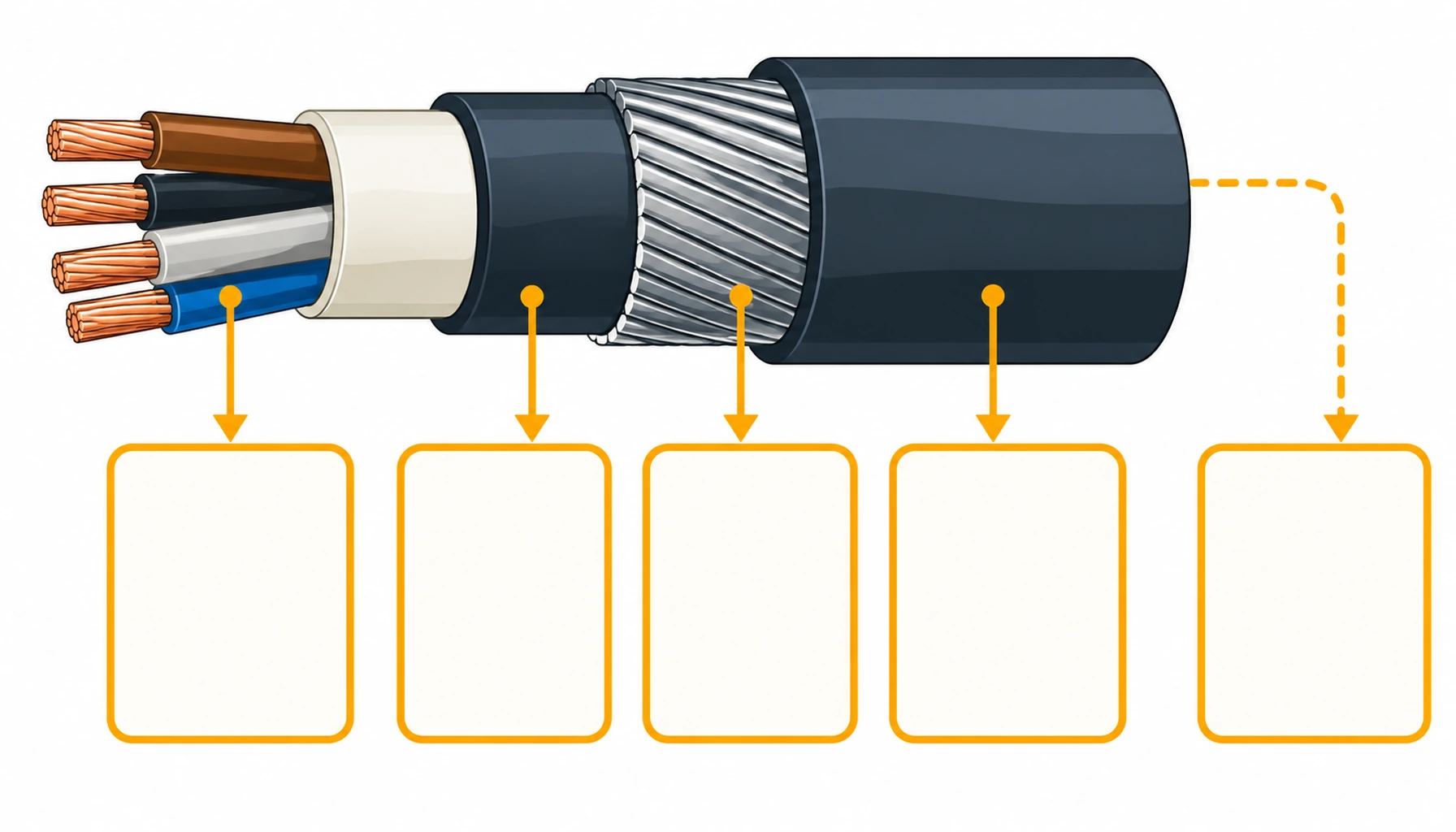
Quick Answer: A Russian cable designation is a construction code read left to right, one letter group per layer. AVBbShv is aluminium conductor, PVC insulation, steel tape armour without a bedding, PVC hose sheath. AABl is the older paper-insulated family with the same armour logic. The string tells you how the cable is built and says nothing about its test results, its screen section or its fire class, so it cannot be translated into an IEC type reference. Read it as a parts list, then write that parts list into the order.
Introduction
A buyer in Almaty or Tashkent receives a schedule with a column of codes: VVG, AVBbShv, AABl, APvP, KVVG. The same schedule has a second column in English that says XLPE, armoured, control. Somebody has to decide whether the two columns describe the same cable, and the answer decides both the price and whether the drums get accepted.
This guide decodes the string position by position, marks the suffixes that change fire behaviour, and shows where the code runs out of information. It is for EPC buyers, distributors and engineers converting a Russian-language specification into something a factory can quote. The wider question of how the two standards systems relate is covered in our standards explained section.
The String Is a Construction Code
Every letter names a layer or a material, in the order the layers are built. The first position is the conductor, the second the insulation, then anything between the insulation and the outside, then the sheath. Suffixes at the end describe behaviour rather than construction, which is why ng, LS and FR can be added to the same base string.
That order is what makes the code readable. Once a buyer knows the positions, an unfamiliar string can be walked through in a minute and the missing information becomes obvious. A designation that stops after the insulation letter is telling you there is no armour and no outer cover, not that the datasheet is incomplete.
What the code never contains is a number. Cross-section, voltage class and core count sit outside the letters, usually in front of or after them, which is why a full line item reads as a code plus three figures and not as a code alone.
Position by Position: Conductor and Insulation
A leading A means aluminium conductor. A copper conductor is unmarked, so VVG is copper and AVVG is the same cable in aluminium. This is the single most expensive letter to miss, because the price difference is large and the substitution is easy to make on a busy schedule.
The second letter is the insulation. V is polyvinyl chloride. Пв is cross-linked polyethylene, which is what the medium voltage strings carry. А as a second letter, as in AABl, means impregnated paper, the older family that still appears in rehabilitation work and in specifications copied from a 1980s design institute file.
The conductor letter also carries a class convention that the string does not show. Whether a conductor is round, shaped or flexible is set by the class table, not by the designation, and the same code can be supplied at two classes with different bending behaviour. Our note on IEC 60228 conductor classes sets out how the classes compare.
Sheath, Armour and the Cover Suffixes
Б is steel tape armour. The small б that follows it means the armour sits directly on the inner sheath with no bedding, which is a common Russian construction and is not the same as an armoured cable with a bedding layer. A buyer comparing two offers needs both letters, not just the first.
Шв is a PVC hose sheath over the armour, and in the unarmoured strings the second V does the same job. Г at the end means no protective cover at all, the bare-sheath version used indoors and in trays where nothing abrades the cable.
Medium voltage strings add their own positions. APvP is aluminium conductor, XLPE insulation, polyethylene sheath, and the armoured versions insert the same БбШ chunk between insulation and outer cover. A polyethylene sheath resists moisture better than PVC and resists flame worse, which is a trade the schedule rarely states and the buyer usually discovers in the fire annex.
The Suffixes That Change Fire Behaviour
ng means the cable does not propagate flame when tested in a bundle. It is the suffix that appears in almost every building specification written after 2005, and it changes the compound rather than the geometry, so the string looks similar and the price does not.
LS means low smoke, HF means halogen free. Both are compound claims. LS is normally paired with ng and quoted as ng-LS; HF is a stronger claim that also covers the acid gas question. A designation carrying HF and a datasheet carrying no halogen test result is a contradiction worth resolving before the order.
FR means circuit integrity under fire and belongs to a different test family from the other three. An FR string claims the cable keeps working for a stated time, and the time is not in the code. Ask for it, along with the test method. Our note on IEC 60332 categories shows how the IEC side of that question is structured.
None of these suffixes translates into an IEC category on its own. A buyer writing an IEC-flavoured schedule has to convert ng-LS into a bunched flame test plus a smoke figure, and the conversion belongs in the clause rather than in a footnote.
Three Families That Break the Pattern
Control cable starts with K. KVVG is copper, PVC insulated, PVC sheathed, no cover, and the string then behaves like the power code. The trap is that control cable is frequently sold against a manufacturer specification rather than a GOST, so the same letters can hide two different wall thicknesses.
SIP overhead bundles use a different logic altogether. The SIP-1, SIP-2 and SIP-4 labels describe how many conductors are insulated and whether a separate messenger exists, not a layer stack. Reading them as if they followed the power code produces a conductor count that nobody ordered.
Imported cable uses brand names. A European or Chinese maker prints its own type reference, and the reference may encode a construction family rather than a layer list. When the offer says N2XH or YJV, the buyer has to ask for the layer list in words before comparing it with a GOST string.
GOST Designations and What They Map To
The table walks the five strings that appear most often in Central Asian enquiries, with the construction behind each and the field that has to be written out in the order.
| Designation | Letters Decoded | Construction You Get | Typical Duty | What to Add in the RFQ |
|---|---|---|---|---|
| VVG | Copper, PVC insulation, PVC sheath, no cover | Unarmoured copper cable, single PVC jacket | Indoor trays, panel wiring, lighting | Conductor class, core colours, flame suffix |
| AVBbShv | Aluminium, PVC insulation, steel tape armour, no bedding, PVC hose | Armoured aluminium cable with tape and hose | Buried runs, duct banks, plant yards | Bedding absent, or bedding required as an alternative |
| AABl | Aluminium, paper insulation, steel tape armour, cover variant | Impregnated paper cable, armoured | Rehabilitation of older substations | Whether paper is still accepted, and the termination type |
| APvP | Aluminium, XLPE insulation, polyethylene sheath | Unarmoured XLPE cable with PE jacket | Medium voltage feeders, 6 to 35 kV | Screen section, U0/U, flame requirement |
| KVVG | Control cable, copper, PVC insulation, PVC sheath, no cover | Unarmoured control cable, stranded cores | Interlocks, signalling, metering | The TU number, screen on pairs, core numbering |
Reading a Foreign Offer Back Into a Designation
The reverse direction is where most disputes start. A supplier answers a Russian-string enquiry with an IEC type reference, and the buyer has to decide whether the answer covers the question. The only reliable route is to rebuild the layer list from the offer and compare it against the letters, one position at a time.
Do that on paper and keep it. A one-page comparison with the designation on the left and the offered construction on the right is worth more than a compliance statement, because it shows which position was matched and which was assumed. Our note on IEC 60502 gives the construction vocabulary for the right-hand column.
Transliteration adds its own errors. B and V swap freely between systems, б becomes b or bb, and a Cyrillic В read as a Latin B turns a PVC insulation into something that does not exist. Ask for the string to be printed in the original alphabet on the drum and in the certificate, and compare the two.
Layer thickness is the field that disappears in translation. The code names materials; the tables set thicknesses, and a string can be satisfied by two different wall thicknesses while both suppliers claim the same designation. The thickness belongs in the order as a table reference, not as a word.
The certificate and the drum label are where the string is finally tested. A designation printed three different ways across the offer, the drum and the certificate is a document set nobody can defend at the site gate, and reprinting a label after delivery is not a fix. Our notes on cable marking and traceability and cable labelling and documentation list the fields that have to agree.
Designation Order Freeze List
These are the fields to settle before the purchase order is written, in the order they usually cause trouble.
| Item to Freeze | How to Write It Into the Order | Evidence to Attach | Cost of Leaving It Blank |
|---|---|---|---|
| Original-alphabet designation | String printed as it appears on the drum and in the certificate | Drum label photo and certificate copy | Latin transliteration checked against nothing |
| Conductor letter | Copper or aluminium stated in words as well as in the code | Conductor class table row | Aluminium supplied against a copper reading |
| Armour and bedding | Tape or wire, bedding present or absent | Construction drawing through the armour | Bedding missing where the duct is wet |
| Sheath compound | PVC, polyethylene or halogen free, named in full | Compound datasheet with test figures | PE sheath accepted into a flame-classified route |
| Fire suffix | ng, LS, HF or FR written out with the test method | Test report naming the suffix and the method | Suffix printed, no test behind it |
| Wall thickness | Table reference for insulation and sheath thickness | Dimensional check sheet per drum | Two suppliers meeting one string at two thicknesses |
| Control cable TU | TU number quoted, not the word GOST | TU document with the core schedule | Two TUs quoted under one line item |
When a Designation Is Not the Answer
When the schedule gives a code and nothing else. A designation cannot be priced without a cross-section, a voltage class and a core count. An enquiry built on codes alone comes back with a range of prices that cannot be compared, and the cheapest of them will be the thinnest cable in the list.
When the code is treated as the acceptance criterion. The drum arrives with a construction, a thickness and a test sheet, and those are what the inspector checks. What makes that check quick is a routine test report per drum, described in our note on cable factory testing, not a longer string on the label.
When the cable is going into an existing installation. The string describes the new cable, not the ducts, glands and joints it has to fit. On a rehabilitation, the existing clamp spacing and termination type decide more than the letters do, and neither is in the code.
When the buyer is working from a photograph of a drum. A drum label photographed at an angle loses the suffixes, and the suffixes are where the fire claim sits. Ask for the label as a document, and for the certificate that repeats it.
When two codes are offered as alternatives. AABl against APvP is not a like-for-like choice, however similar the armouring sounds. One is paper, one is XLPE, and the jointing, the derating and the end-of-life plan all differ. Price the difference properly before accepting the substitution.
RFQ Checklist
- Designation in the original alphabet, printed as it will appear on the drum
- Copper or aluminium stated in words next to the code letter
- Voltage class and cross-section given as figures, not implied
- Armour type and whether a bedding is present
- Sheath compound named, with the fire suffix written out
- Test method for the fire claim, and the duration for FR constructions
- Conductor class, core count and core colour schedule
- TU number for control cable, not the word GOST
- Wall thickness table reference for insulation and sheath
- Layer list requested from the supplier as a comparison sheet
Conclusion
The designation is the cheapest part of the order to get right and the most expensive to get wrong, because a wrong letter survives every later check. It is printed on the drum, repeated on the certificate and quoted back in the invoice, so a mistake made at enquiry stage stays consistent all the way to the site.
Kexingyu Cable Group (KXYE) quotes both directions, from a Russian string to a construction list and from an IEC reference back to the letters, with thickness tables and test documents attached per drum. Send the schedule with the original designations kept intact. A request for quotation is the fastest start, the field list is in our industrial cable RFQ checklist, and the regional picture is in the Central Asian cable buying hub.