Wind Farm Cable in Kazakhstan: Collection Systems and Procurement
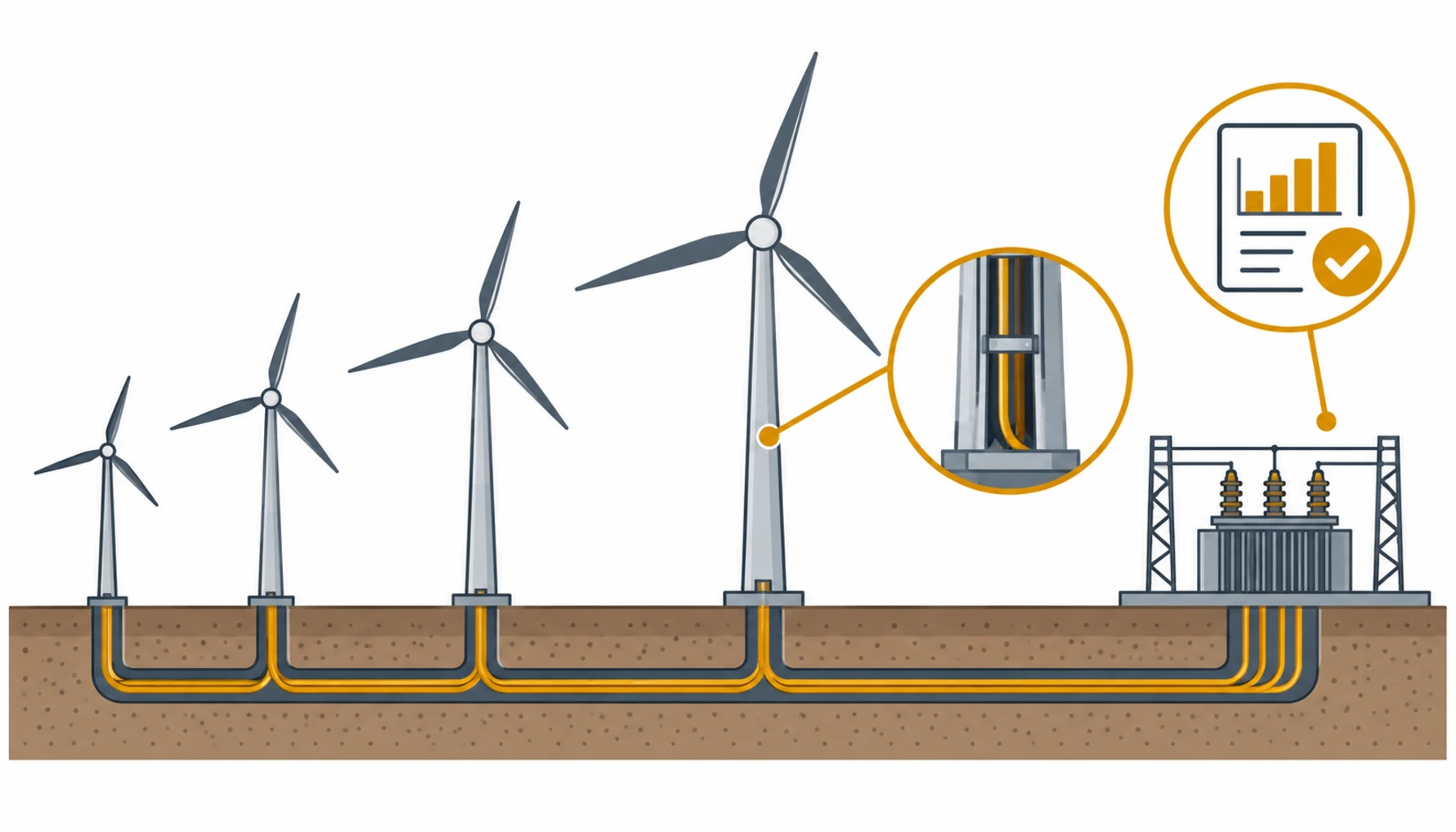
Quick Answer: A wind farm is a cable plant with turbines on it. Power from each machine travels down the tower, along a buried medium voltage string to neighbours, and on to the substation that meets the grid. The specification work splits the same way: the tower section, the string cable and the substation feeders each carry their own voltage class, cold duty and evidence list, and each is quotable only when it is bought as its own line.
Introduction
This page covers the cable side of wind farm projects in Kazakhstan: how the collection system divides into circuits, what the steppe climate and soil do to buried routes, which compliance evidence the grid connection actually demands, and what to freeze in the RFQ so the package is quotable. It is written for the developer, the EPC and the owner’s engineer buying the cable.
The regional buying context sits in our Central Asian cable buying hub. Our note on solar cable suppliers for Uzbekistan covers the region’s other renewable buildout; wind differs in voltage class, in route length and in the grid conversation, and this page stays with those differences rather than repeating the solar checklist.
Why Collection Cable Is a Procurement Topic of Its Own
Scale comes first. A utility wind farm concentrates dozens of machines across kilometres of steppe, and every one of them connects through cable rather than through the overhead lines a conventional plant might use. The collection system is therefore one of the largest single purchase packages in the project, and it is bought early, against terrain data that arrives late.
Environment is the second fact. Winter on the steppe drives design temperatures far below the ratings that serve temperate projects, soil freezes deep, and the ground between turbines moves with frost heave in spring. A collection cable specified from a temperate datasheet survives the tender and fails the second January, which is long after the contractor has demobilised.
Evidence is the third. The grid connection, the turbine warranty and the insurance file all lean on the same test reports and type certificates, and each party asks in its own format. Procurement that collects the evidence with the cable, instead of after delivery, avoids the commissioning queue that forms when papers chase drums.
Mapping the Collection System
The system divides into four cable duties. Inside each tower, a low voltage section runs from the converter to the base and a control section carries signals up the tower. From the base, a medium voltage string cable runs turbine to turbine at the collection voltage. At the end of the string, a feeder carries the gathered power to the substation, where medium voltage switchgear hands over to the export connection.
The split matters commercially because each duty has a different supplier logic. Tower cable follows the turbine maker’s interface drawings; string cable follows the collection design and the route survey; substation feeders follow the switchgear layout and the protection scheme. A package that keeps the four apart lets each line be quoted, checked and delivered on its own schedule instead of slipping with the whole.
The split also assigns evidence. The tower section inherits the turbine certification; the string cable carries the routine and type tests behind the collection voltage; the substation feeders carry the tests the network agreement names. Table 1 lines the duties up against construction and the evidence that decides acceptance, and the freeze list in Table 2 turns that into order lines.
Medium Voltage Strings: Class and Insulation
The collection voltage is the first specification decision, and it is set by the grid study and the turbine converter, not by habit. Higher collection voltage means fewer strings and smaller copper, but it raises the insulation class, the termination kit range and the testing regime, so the choice is a procurement trade, not a drawing detail to be inherited from the last project.
Construction follows the route more than the rating. Buried strings in moving, freezing soil want a construction with a sheath and armour chosen for mechanical load and moisture, and the design behind that choice is the same one described in our note on buying medium voltage XLPE cable for Kazakhstan, where the voltage classes and the GOST and IEC routes are set out for grid projects generally.
Length strategy belongs with the order, not after it. Strings between turbines are short, repetitive runs, and drum lengths matched to the spacing cut joints dramatically; the ordering logic is the same one set out in our note on drum length and joint placement. Every joint removed from a string is one fewer termination to buy, test and dig up in a January to come.
Tower Sections and the Base Cabinet
The tower section is bought against the turbine maker’s drawings, and its discipline is interface control. Converter outputs, cage climbs, service voltages and the base cabinet all fix construction, length and termination, and a substitution here voids warranties faster than any other cable decision in the project. The order line names the turbine model and drawing revision, not just a cross-section.
Cold is the governing stress in the tower too, because the section stands through winter unpowered in part, and flexibility at low temperature decides whether installation can proceed at all in the seasons available. The cold-duty logic is the same one described in our note on low temperature flexible cable, applied to fixed runs rather than moving ones.
The base cabinet is where tower cable meets string cable, and it is the natural checkpoint for the package. Terminations, glands and the first set of tests land here, so the delivery plan should stage tower cable, string drums and termination kits to arrive together per string. Staging by cable type instead of by string builds a warehouse, not a workflow.
Buried Routes: Cold, Soil and Terrain
The buried network is where wind farm cable is won or lost, because the routes are long, the soil is hostile and the repair season is short. Frost depth sets the bury line in the north; rodent and moisture exposure shapes the sheath; and the terrain between turbines, drained in one draw and bogged in the next, decides where the route can even be trenched.
Derating belongs in the design before the order. Buried groups of strings share trenches on part of their runs, soil resistivity varies across the site, and summer soil temperatures near a busy route are higher than the datasheet assumed; the method for all of it is the one in our note on field derating of cable ampacity. A route sized without derating buys copper twice, once at the order and once at the upgrade.
Route documentation is part of the deliverable, not a courtesy. As-built depths, marker tape, joint positions and test records turn the buried network into an asset that can be maintained, and the insurance file will ask for them. The marking and traceability discipline behind those records applies at field scale.
Grid Connection and Compliance Evidence
The collection system ends at the grid, and the grid conversation shapes the cable package. The connection agreement names the voltage class, the fault levels and the tests the network operator expects, and the substation feeders and switchgear interface inherit those lines. Cable bought before the agreement is read gets re-bought; the sequence is a procurement decision, not a legal formality.
Converter interfaces add their own requirements. Turbine converters interact with the network through the collection system, and the compliance conversation rides partly on the cables that carry it; the electrical side of that interface is set out in our note on inverter grid code compliance. The cable buyer’s share of it is screening, construction and evidence that the string behaves as the study assumed.
The practical rule for procurement is simple: the evidence list is written into the RFQ, item by item, and the supplier confirms it line by line with the offer.
Buying the Package: Tests, Delivery and Site Realities
The wind season is a logistics season. Crane days, trenching windows and turbine delivery dates fix when cable can be laid, and the cable schedule is built backwards from them, string by string, with drums staged per section. The lead time conversation for the lane is the one in our Kazakhstan supplier guide, and it belongs in the order, not in the delay claim.
Third party eyes are worth their fee on this package. The volumes, the voltages and the burial make rework expensive in a way few other projects match, and independent inspection before shipment catches what a routine report cannot; the mechanics are described in our note on third party cable inspection. The same logic applies to the termination kits, which arrive as small boxes with large consequences.
Quotation comparison only works when the envelope is common. String lengths, joint counts, termination kits, tests and delivery staging differ enough between offers to hide a margin in any of them, and the comparison method that exposes the difference is the one in our note on comparing cable quotations from China for Central Asia. Table 2 is the freeze list that makes the envelope common before offers land.
The Collection Duty Map
Table 1 lines up the four cable duties of a wind farm against construction, the governing input and the evidence that decides acceptance.
| Circuit Duty | Typical Construction | Governing Input | Evidence to Demand |
|---|---|---|---|
| Tower section | LV power and control per turbine drawings | Turbine interface and drawing revision | Turbine maker approval, cold flexibility |
| String cable | MV XLPE, armour and sheath for soil | Collection voltage, frost and terrain | Routine and type tests, drum length plan |
| Substation feeders | MV cable per switchgear layout | Connection agreement and protection | Tests named in the network agreement |
| Route records | As-built depths, joints, marker tape | Insurance and maintenance needs | As-built dossier per route |
| Termination kits | Kits matched to cable and gear | Cable construction and switchgear brand | Kit compatibility statement per end |
The Wind Farm RFQ Freeze List
Table 2 is what to settle before the enquiry goes out, because these lines decide whether the offers can be compared at all.
| Item to Freeze | How to Write It | Evidence to Attach | Cost of Leaving It Blank |
|---|---|---|---|
| Collection voltage | Class and standard named per string | Grid study extract | A package quoted on the wrong class |
| Cold rating | Design temperature and flexibility test | Site climate data | Cable that cannot be laid in season |
| Drum lengths | Matched to turbine spacing per string | String schedule with lengths | Joints bought by the dozen |
| Derating basis | Soil, grouping and temperature named | Derating calculation per route | Copper bought twice |
| Evidence list | Tests and certificates item by item | Connection agreement extract | Papers chasing drums at commissioning |
| Tower interface | Turbine model and drawing revision named | Turbine maker drawings | A substitution that voids a warranty |
| Delivery staging | Drums and kits staged per string | Site schedule with crane dates | A warehouse instead of a workflow |
When Copying the Solar Checklist Is Not the Answer
When the collection voltage is inherited from a solar project. Solar strings live at low voltage and gather at the inverter; wind strings live at medium voltage from the turbine base. The voltage class, the termination range and the testing regime all differ, and a specification carried across buys the wrong kit before the first offer arrives.
When the route is drawn before the survey. Strings are buried across ground that floods, heaves and thaws unevenly, and a route fixed on the desktop meets conditions the drawing never priced. Route confirmation after the survey is the cheapest change order the project will ever sign.
When derating is an afterthought. Shared trenches, varying soil and summer warmth cut capacity below the datasheet number, and the shortfall is found after energisation. The derating calculation belongs in the RFQ as a named document with its inputs stated.
When tower cable is treated as generic. The tower section answers to the turbine maker’s drawings and warranty, not to the open market. A substitution saves a margin on the order and cancels it in the warranty, and the drawing revision named in the order is what prevents the argument.
When the evidence list is left to delivery. The connection agreement, the turbine warranty and the insurer each want papers, and they want them before energisation. An evidence list written into the RFQ is the only version of this story that ends on schedule.
RFQ Checklist
- Collection voltage class and standard named per string
- Cold design temperature and flexibility requirement stated
- Drum lengths matched to turbine spacing, string by string
- Derating basis stated: soil resistivity, grouping, seasonal temperature
- Evidence list itemised from the connection agreement
- Turbine model and drawing revision named for tower sections
- Termination kits matched to cable and switchgear, per end
- Delivery staging plan keyed to crane and trenching dates
- Third party inspection scope agreed before shipment
- As-built documentation format agreed with the owner’s engineer
Conclusion
A wind farm collection system is bought as four duties that share a schedule: tower cable answering to the turbine drawings, string cable answering to the ground, substation feeders answering to the grid agreement, and records answering to everyone. Packages that keep the duties apart are quotable and inspectable; packages that bundle them are one price, one delay and one argument waiting for January.
Kexingyu Cable Group (KXYE) supplies wind farm collection packages with medium voltage strings, tower sections and termination kits in one schedule, tested to the evidence list in your connection agreement. Send the string schedule and the site climate data. A request for quotation is the fastest start.