Africa's Data Centers: Cable Demand in Nigeria, Kenya and Egypt
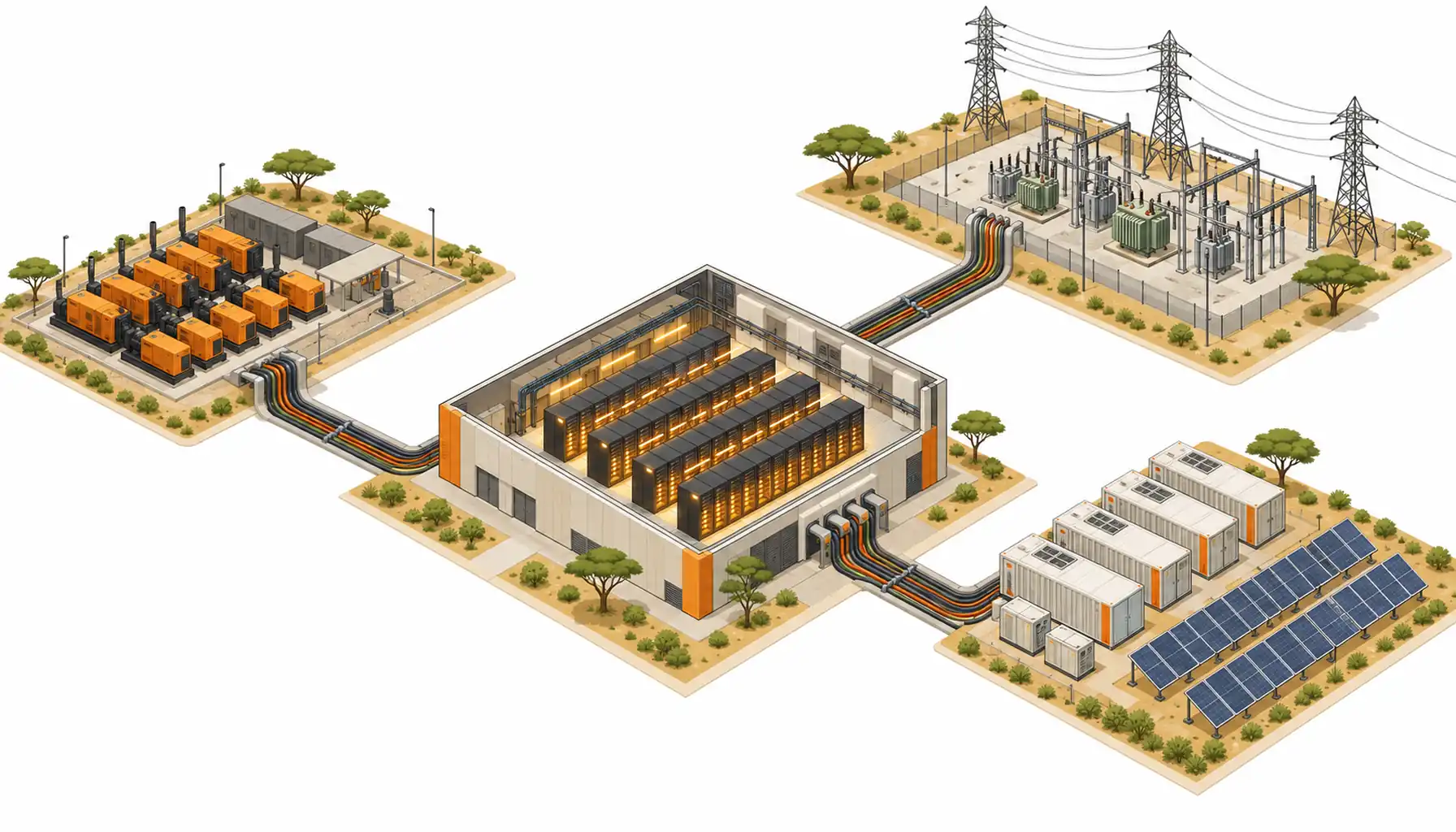
Quick Answer: Africa’s data center demand concentrates in Lagos, Nairobi and Cairo — and its cable bills carry a hybrid-power signature where generator, storage and UPS cabling join every hall’s order.
Africa’s data center story is often told as a promise — the continent’s digital future always arriving, never landing. The landing zones are now identifiable. Nigeria’s commercial capital, Kenya’s East African hub, and Egypt’s North African gateway carry the continent’s most serious hall construction, backed by cloud regions, submarine cable landings and a mobile-first digital economy that needs compute at home. What makes the African data center bill distinctive is the power context it grows in. Grids are unreliable by design conditions rather than by choice, and the backup culture runs so deep that every hall carries generation, storage and UPS together. For a cable supplier, that means the standard hall bill arrives with additional families attached — and the market rewards suppliers who understand the hybrid-power reality instead of quoting past it.
Introduction
The continental context is electrification first. The grid programs and mini-grid buildouts tracked in Africa rural electrification and the off-grid demand patterns of Nigeria mini-grid equipment are wiring the population the data centers will serve, and both programs buy cable at scale. The data center layer sits on top, concentrated in three metros. Lagos, where Nigeria’s enterprise and fintech economy anchors the largest West African cluster. Nairobi, where Kenya’s connectivity and green-energy grid make it the region’s most bankable hall market. And Cairo, where Egypt’s position on submarine routes and its new-capital construction program scale the North African bill. The continent-wide demand curve feeds the global analysis of data center power demand growth — Africa is its smallest major region by installed capacity and its most underbuilt relative to users, which is exactly the ratio that draws investment.
The Hybrid-Power Signature: What the Bill Adds
A data hall on a reliable grid buys one power chain; a data hall on an unreliable grid buys three. African campuses typically run utility intake, on-site generation and battery storage together, with the UPS layer bridging the transitions — and each layer buys cable. The generation-to-hall wiring, the battery-room cabling and the storage integration follow the patterns of generator-storage hybrid systems, and the storage-side families repeat wherever storage firms a digital load. The UPS sizing discipline of UPS sizing for data centers carries a distinctly African flavor: autonomy windows are longer, redundancy paths are more physical, and the cable runs between power islands are longer and more numerous than in grid-stable markets. The hall interior remains the standard bill — MV intake, LV distribution, LSZH cabling through occupied spaces — but the surrounding power architecture roughly doubles the cable families a single campus buys. Suppliers who quote only the hall bill misread the market by half.
| Hub | Demand Character | Cable Bill Emphasis |
|---|---|---|
| Lagos, Nigeria | Fintech and enterprise anchor; grid-weakest of the three | Heaviest generation and storage cabling; ruggedized LV |
| Nairobi, Kenya | Green-grid advantages; regional connectivity hub | Standard hall bill plus solar-storage integration |
| Cairo, Egypt | New-capital construction; submarine cable gateway | Program-scale MV; construction-schedule discipline |
| Continental layer | Electrification programs feeding future demand | MV distribution, conductor, mini-grid cable at scale |
How the Three Hubs Buy
Lagos buys around reliability. Campuses there are engineered for the worst the grid does, so the generation and storage cabling families lead every conversation, and durability evidence — sheath performance, temperature behavior, batch consistency — separates suppliers in a market that has seen every kind of product. Nairobi buys around finance. The hall market there is the continent’s most institutionally funded, which means consultant-gated specifications, IEC-based evidence files and the certification discipline of the power cable certifications checklist decide who is even eligible. Cairo buys around program scale. The new-capital construction and its data infrastructure move on government-adjacent schedules that reward factories able to hold volume across long construction calendars — and that price the program, not the drum. Three hubs, three buying logics, one shared truth: in all three, the cable supplier who understands why the power architecture looks the way it does outperforms the supplier who merely fills the bill of quantities.
Qualifying Across the Continent
The supplier posture that works in Africa combines three elements. First, the hybrid-power file: families spanning MV intake, generator and storage cabling, UPS runs and hall distribution, presented as one integrated bill — the systems logic that African EPCs, juggling power islands on constrained sites, reward directly. Second, evidence that survives scrutiny. Nairobi’s institutional funding imports international consultant standards, Lagos’s enterprise customers audit what they buy, and Cairo’s programs demand batch traceability across years of delivery. Third, calendar honesty at program scale. African construction timelines slip for reasons cable cannot fix, but cable arriving late guarantees its own blame — the suppliers who keep the continent’s business are the ones whose delivery dates hold. The recurring failure patterns of international power equipment sourcing mistakes apply with an African accent: the costliest error is treating a continent as one market, when three metros run three different buying logics underneath one shared power reality.
| Stage | Action | Classic Trap |
|---|---|---|
| Market mapping | Lagos, Nairobi, Cairo loggedics mapped separately | One continental pitch across three different buyers |
| Bill assembly | Hall bill plus generation, storage and UPS families as one file | Quoting only the hall interior and missing half the order |
| Evidence | IEC files, durability data and batch traceability per hub | Evidence assembled after the consultant shortlist closed |
| Calendar | Program-scale schedules quoted and held | Cable late into a slipped, rescheduled construction window |
| Compounding | Continental electrification volume held alongside hall programs | Chasing halls while ignoring the grid volume that feeds them |
When Potential Is Not the Same as Volume
Two cautions keep the Africa story honest. The continent’s potential is real, but its near-term volume concentrates in three metros and a handful of programs — a supplier modeling Africa with population math buys inventory the market cannot yet absorb. And the hybrid-power signature that makes the bill distinctive also makes it demanding. Generation and storage cabling carry harder duty cycles and harsher environments than hall-interior runs, so the product discipline must match the market’s reality, not its brochure. Enter where the volume lands, price the full bill honestly, and let the electrification layer — the continental story that feeds everything else — build the base the halls will stand on.
RFQ Checklist: Africa Lines for the RFQ
Put the market’s questions in writing:
- Full hybrid-power bill quoted: hall, generation, storage and UPS families
- Durability evidence stated: sheath, temperature and duty-cycle data
- IEC type-test files prepared to consultant format per hub
- Batch traceability and marking format per program year
- Program-scale delivery calendar with slippage buffers explicit
- MV and conductor volume quoted alongside hall-scale families
- Hub-specific terms: Lagos durability, Nairobi evidence, Cairo scale
Conclusion
Africa’s data centers land where the power, the connectivity and the money intersect — Lagos, Nairobi and Cairo — and their cable bills carry the hybrid-power signature of grids that never assumed reliability. The market rewards suppliers who quote the full bill, prove durability and hold program calendars, with the continent’s electrification buildout underneath providing the volume layer that compounds between hall programs.
Kexingyu Cable Group (KXYE) serves Africa’s hubs with the posture their power reality demands: integrated hybrid-power cable bills, durability and traceability evidence built for audited buyers, and program-scale calendars held across long constructions — cable supply for a continent whose digital future is arriving one substation at a time.