Aggregate Crushing and Screening Lines: Buying Power and Control Cable

Quick Answer: An aggregate plant is the harshest fixed cable environment in the quarry business: crushers start against loaded chambers, screens shake every metre of cable all day, dust packs into every termination, and conveyors move the product between machines that never stop. Buy the medium voltage feed as armoured construction, buy screen and feeder runs for vibration rather than price, keep control wiring screened and segregated, and write the inspection routine into the order.
Introduction
Aggregate plants fail electrically in the same places year after year, and nearly every failure traces back to a cable that was specified for amps instead of for the plant. The primary crusher tugs its feed against a full chamber every start. The screens vibrate their connections loose. The dust does the rest.
The buying task is to match four different duties inside one plant: the incoming supply, the machine power runs, the control and instrumentation layer, and the mobile links around loaders and stockpiles. This guide covers what to specify for each, what evidence to demand, and where the money actually goes.
The Supply Side: MV Feed and Site Distribution
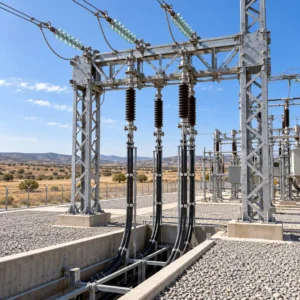
Most fixed aggregate plants take a medium voltage feed to a site substation, and the feed is the cable with the longest replacement consequence in the plant: it runs from the utility connection across ground that carries trucks, loaders and excavators all day.
Armoured construction. Direct-buried or ducted MV feed across a quarry floor should be steel wire armoured, with the armour earthed at both ends and the route marked. Where the feed crosses vehicle routes, duct it and depth-protect it; where it runs on the surface between buildings, protect it mechanically. Our medium voltage XLPE armoured cable is the standard construction for this duty, and our note on armoured versus unarmoured cable explains where the armour earns its cost.
Substation sizing. The transformer feeding the plant is sized on the motor starting case, not the running case: a jaw crusher starting against a choked chamber draws a start current that decides the supply, and undersized plant transformers show up as nuisance trips on every restart after a bridge. Size the supply with the plant list in hand, and our note on transformer capacity sizing walks the calculation. Where the plant grows in phases, a prefabricated substation keeps the supply step ahead of the crushers.
Machine Power Runs: Crushers, Screens and Conveyors
Below the substation, the plant is a low voltage network of short, brutal runs. Each duty has its own failure mode, and the specification answers each one.
Crusher feeders. The primary and secondary crusher drives take the largest starts in the plant. Size the conductor on starting current and run length together, prefer XLPE insulation for its thermal head, and keep the runs as short as the layout allows. Derate for grouping where several feeders share a rack, because crusher houses run hot; our note on cable derating factors lists the corrections that matter.
Screen and feeder runs. Vibrating screens shake their connections continuously, and the cable that fails first in most plants is the one bolted to the screen side. Route the last metres in a slack service loop that isolates the screen’s motion from the fixed run, support the loop so it flexes in one controlled place, and buy fine-stranded conductor for the moving section. The screen panel is the plant’s worst place to save money on conductor class.
Conveyor runs. Conveyor motors sit at the head and tail of long spans, and their cable runs follow the structure: exposed to sun, dust and wash-down. UV-stable sheaths and a containment route that keeps the cable off the ground and out of the spillage line are the two decisions that decide conveyor cable life.
Jackets. Across the whole plant, the sheath takes rock dust, spillage, grease and the occasional loader nudge. A hard, abrasion-resistant jacket is cheap at specification and priceless at year three; our note on abrasion-resistant jackets compares the compounds worth asking for.
| Duty | Environment | What to Specify | Evidence to Demand | Cost and Lead-Time Driver | How It Fails |
|---|---|---|---|---|---|
| MV incoming feed | Buried or ducted across plant traffic routes | Steel wire armoured XLPE, route marked, ducted at crossings, armour earthed both ends | Type test certificates, armour earth records, route drawings | Longest lead item in the plant order; cable weight drives freight | Third-party strike on an unmarked route; water ingress at joints |
| Crusher and conveyor power | Hot crusher house, exposed conveyor structure | XLPE insulation sized on starting current, grouped-circuit derating, UV-stable sheath outside | Conductor resistance, derating calculation, sheath UV test data | Copper content plus sheath compound; standard sizes ship from stock | Chronic overload from ignored derating; sheath chafe on structure edges |
| Screen and feeder runs | Continuous vibration at the machine | Fine-stranded conductor on the moving section, slack service loop, single controlled flex point | Stranding class declaration, flex test data, loop routing sketch | Small copper premium on the moving section; big downtime saving | Strand fatigue at the screen gland, terminations shaken loose |
| Control and instrumentation | Dust-packed trays alongside power runs | Screened control cable, segregated from power, sealed glands at every panel entry | Screen coverage data, pair geometry, gland ingress ratings | Modest copper content; installation labour dominates | Interference from drive cabling, dust-packed enclosures, chafed pairs |
Vibration and Movement: Routing Details That Decide Cable Life
Between the specification and the failure record sits the routing, and on an aggregate plant the routing decisions are worth more than a compound upgrade. Vibration kills cable at points of constraint, so the plant standard should treat every machine connection as a movement problem: leave a service loop, support it so it flexes in one place, and clamp the fixed run beyond the influence of the machine.
The same logic applies to runs that cross plant traffic. Cable laid on the ground across a haul route is consumed on schedule, no matter what it is made of. Overhead routing on the conveyor structure, or ramps and ducts at crossings, converts a recurring replacement into a one-time installation cost. Where runs must pass through working areas, edge protection on the containment matters as much as the sheath compound, because a steel edge under a cable’s own weight does the abrasion testing for you.
Write these rules into the installation scope rather than leaving them to the crew. The RFQ should ask bidders to price service loops, supports and crossing protection explicitly, because a quote that leaves routing out is not cheaper; it is just quoting a shorter life. Plants that enforce the routing standard routinely see screen and conveyor connections outlast the machines they serve, and the maintenance crew’s weekend list gets shorter without a single component upgrade.
Control and Instrumentation: The Layer That Runs the Plant
Power cable gets the attention and control cable gets the blame. An aggregate plant’s automation layer carries interlocks between the crusher house, the screens, the conveyors and the loadout, and it fails in two ways: interference and ingress.
Screening and segregation. Screened control cable, routed with separation from the power runs it parallels, is the first half of the answer. Our screened silicone control cable is built for exactly this duty where panels run warm and pairs carry critical interlocks. The second half is gland discipline: every panel entry sealed to its ingress rating, because dust-packed enclosures cause more control faults than any electrical argument.
What to specify. Pair geometry that holds the twist, screen coverage declared, sheath compound matched to the tray environment, and cores sized for the actual coil loads rather than a generic 1.5 mm default. Control cable is inexpensive relative to the downtime it protects, so the specification question is never cost; it is whether the declaration covers the environment.
Mobile Links: Loaders, Stockpiles and the Plant Perimeter
Around the fixed plant, a layer of temporary and semi-mobile cable serves the loader workshop, the stockpile conveyors that get repositioned, and the ancillary equipment that moves with the working face. This layer is bought badly more often than the fixed plant, because nobody owns it.
Give it an owner and a standard: heavy rubber flexible construction for anything reeled or dragged, repositionable runs on cable ramps or overhead, and the same incoming inspection as the fixed plant. Where conveyors are telescoped or relocated between stockpiles, the connecting cable needs a flexing and reeling construction, not a fixed-installation type with a plug on the end. A one-page perimeter standard, enforced at toolbox talks, ends the taped-joint culture that keeps this layer alive on most sites.
Procurement Structure: Packages, Spares and Lead Times
An aggregate plant order is a package, not a list: MV feed, power runs, control layer and the perimeter, bought together, arrive together, and share one set of test records. Plants that buy cable machine by machine from different suppliers end up with mixed constructions, orphan lengths and no resistance baselines to compare future tests against.
Spares belong in the original order. Two spare drums of the screen’s moving-section cable and one of each critical conveyor run cost little next to a stopped plant, and they let the maintenance crew repair with the correct construction instead of whatever is on the rack. On lead times, standard low voltage constructions ship in days; armoured MV feed and bespoke lengths are the items that need ordering against the project programme, and our note on cable MOQ and lead time covers how to phase the order. Buying the package from one coordinated source also simplifies the warranty conversation, and our note on coordinated power equipment supply explains the mechanics for plants that also need transformers and switchgear.
Incoming Inspection and Records
Against the order. Verify drum lengths and constructions against the schedule, check sheath markings match the specification, and cut a sample on each construction to confirm conductor area. Aggregate plants receive cable from many directions over the years, and the order document is what keeps the stock rack coherent.
Baseline tests. Record insulation resistance on every power run at handover, before energisation. The baseline is what makes the annual test meaningful, and plants without one replace cable on age instead of evidence. Our note on insulation resistance testing covers the routine.
Records on the plant. Keep the route drawings, derating calculations and test records in one file that the next contractor can find. The plant outlives the people who bought the cable, and undocumented routes become strike hazards within one groundworks campaign.
| Decision | What to State | Evidence to Attach | Cost of Leaving It Open |
|---|---|---|---|
| MV feed construction | Steel wire armoured XLPE, route marked, ducted at crossings | Type test certificates and route drawings | The plant's longest-consequence cable exposed to strikes |
| Sizing basis | Starting currents and derating basis per machine | A derating calculation signed against the motor list | Feeders that run hot and trip on every restart |
| Screen connections | Fine-stranded moving section with a slack service loop | Stranding declaration and routing sketch | The plant's most frequent cable failure, repeated yearly |
| Control layer | Screened control cable, segregated routing, sealed glands | Screen coverage and gland ingress ratings | Intermittent control faults nobody can trace |
| Spares | Moving-section and critical-run drums in the original order | A spares schedule named in the contract | Emergency buys at worst prices with wrong constructions |
| Records | Baseline insulation resistance at handover, one file | Test records attached to the delivery note | Replacement by age instead of evidence |
When an Aggregate Plant Cable Standard Is Not the Answer
When the start problem is mechanical. A crusher that trips on every start may have a choked chamber, worn liners or a failing bearing, and a bigger cable will not fix it. Diagnose the machine before re-ordering the supply.
When the screen fault is the spring. Screens that shake their terminations loose are often running with degraded isolation springs, amplifying motion no cable survives. Fix the springs, then route the service loop.
When the dust ingress is a gland problem. Control faults blamed on interference are often unsealed panel entries. Gland kits cost less than a control system upgrade.
When the plant needs automation cabling design. A control layer carrying safety interlocks deserves a designed network, not a tray of generic screened pairs; bring the integrator in before buying.
RFQ Checklist
- Single-line diagram with motor ratings and starting currents per machine
- MV feed route with crossing points and protection method stated
- Conductor sizes derived from a stated derating basis, not nameplate amps
- Fine-stranded construction declared for screen and feeder moving sections
- Screened control cable with coverage and pair geometry declared
- UV and abrasion sheath data for exposed conveyor runs
- Spares schedule: moving-section and critical-run drums in the original order
- Baseline insulation resistance records at handover
- Drum lengths matched to real runs to minimise joints
- Delivery phased to the construction programme
Conclusion
Aggregate cable is bought well when the four duties are specified as four duties: armoured MV with a marked route, power runs sized on starting and derating, screen connections built for vibration, and a screened, sealed control layer. Enforce the routing standard with the same weight as the specification, because routing is where most of the life is actually lost. Add the spares and the baseline records at handover, and the plant’s electrical argument shrinks to genuine machine faults.
Kexingyu Cable Group (KXYE) has manufactured cable in Quanzhou since 1996, supplying armoured MV feed, plant power runs and screened control constructions to crushing and screening projects, with transformer and switchgear supply available through the same channel. Send us your single-line diagram and machine list, and we will come back with the constructions, the derating basis and a phased delivery plan. The fastest route is a request for quotation.