Southeast Asia Machine Imports: Standards Expectations in Vietnam, Thailand and Indonesia
Quick Answer: In all three markets cable is a regulated product with a mandatory certificate, not a component argued from evidence. That turns certification into a lead-time item you plan before quoting.
Southeast Asia is where cable certification stops being a documentation exercise and becomes a project milestone. Vietnam, Thailand and Indonesia each maintain a mandatory scheme covering cables as products, each enforces it at the border, and each requires a locally established entity or a local representative somewhere in the chain. A machine builder shipping into an industrial estate in one of these countries is therefore managing three things at once: a technical specification, a certification process with its own calendar, and a commercial arrangement that has to exist in the destination country before the process can even start.
Introduction
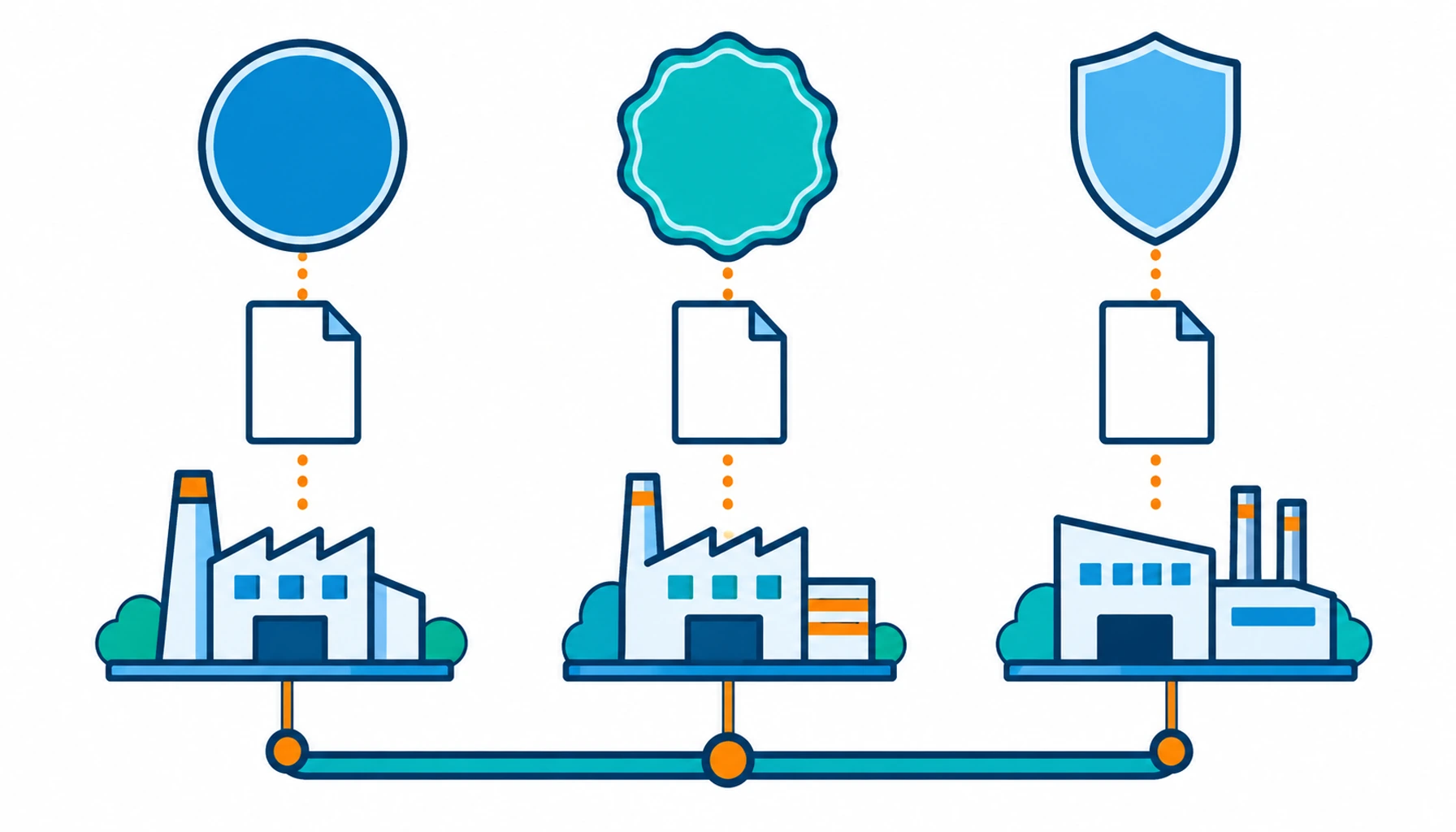
The three schemes share a shape. A national standards body maintains a mandatory list, a conformity assessment body accredited in that country performs testing and factory audit, a certificate is issued for a defined term, and a mark is applied. Where they differ is in who may hold the certificate, how deep the factory audit goes, and how much documentation has to be in the local language.
Two features are common to all three and worth internalising early. First, existing international test reports can reduce testing but do not replace the national certificate, so the certification itself is unavoidable. Second, the certificate attaches to a product and a production site, so a new variant or a second factory is a new case rather than an amendment. Suppliers who treat certification as a formality discover both facts at the worst moment, which is after a purchase order has been accepted. The same structure across other markets is surveyed in the guide to cable certification checklists.
Three Schemes, One Shape
Vietnam’s conformity mark sits under the law on product and goods quality, administered through the science and technology ministry’s standards directorate, with a designated certification centre issuing and designated laboratories testing. Thailand’s scheme is run by the national industrial standards institute under industrial product standards legislation, with a mark applied to products in the compulsory list. Indonesia’s national standard certificate is issued by accredited certification bodies and requires both testing and a factory audit.
| Market | Scheme and standards | Route and validity | Who holds it |
|---|---|---|---|
| Vietnam | National conformity mark; safety technical regulation covering wires and cables up to 1000 V, with a separate electromagnetic compatibility regulation | Batch mode for a single consignment, or type mode with factory audit and a multi-year certificate under annual surveillance | An entity established in the country, which overseas manufacturers reach through a local partner |
| Thailand | National industrial standard mark; cable standards for PVC and rubber insulated types up to 450/750 V, plus flame retardant and XLPE material standards | Testing plus factory assessment, with the licence held for the product and site | A locally registered licence holder, usually the importer or an authorised agent |
| Indonesia | National standard certificate; standards for PVC insulated cable, power cable, conductors, rubber insulated types and flame performance | Type testing plus factory audit, with a multi-year certificate and annual surveillance; single-consignment mode also exists | An entity registered in the country, working with an accredited certification body |
| Malaysia | National certification referencing the international power cable standard, with emphasis on discharge testing at higher voltages | Certification against the applicable standard for the product | The manufacturer or its local representative, through the national certification body |
Vietnam: Type or Batch, and Which You Need
The Vietnamese scheme offers a genuine choice that suppliers often overlook. A batch route lets a single consignment be tested and certified for that shipment alone, which suits a one-off machine package and avoids a factory audit. A type route requires initial testing and a factory assessment, and produces a certificate valid for several years under annual surveillance, which suits continuous supply.
Choosing wrongly is expensive in both directions. A supplier who intends to supply for years but takes the batch route pays for testing on every shipment and never builds a qualification record. A supplier who uses the type route for a single machine pays for an audit they will never amortise. The conformity declaration also has to be registered with the provincial authority, and overseas manufacturers need a factory registration, both of which sit outside the testing itself and therefore outside most suppliers’ planning.
Thailand: The Licence Has to Be Held Locally
Thailand’s distinguishing feature is the holder requirement. A foreign manufacturer does not apply directly; the licence is held by a locally registered entity, typically the importer or an appointed agent, which means the commercial relationship in the destination country is a precondition of the certification rather than a consequence of it.
The cable standards themselves are recognisable, derived from the international series for PVC-insulated and rubber-insulated cable, with separate standards for flame retardant performance and for cross-linked insulation material used in power cable. Because the standards are revised periodically, the applicable version at the time of application matters, and testing against a superseded version is a common and avoidable delay.
Indonesia: The Deepest Audit of the Three
Indonesia imposes the heaviest process. The certificate is issued by an accredited certification body after type testing and a factory audit, carries a multi-year validity with annual surveillance, and requires documentation in Indonesian. Factory audits for overseas manufacturers are conducted at the plant, which means travel, scheduling and translation all sit on the critical path. A recognised quality management certificate commonly strengthens the assessment, though the audit happens regardless.
The financial scale is worth stating plainly, because it changes how a supplier should quote. Certification for a single product family runs into the thousands of dollars once testing, audit fees, travel and documentation are counted, before any product cost. For a supplier entering the market this is an investment decision, not a line item, and the cost only makes sense across a sustained supply relationship. Customs enforcement is correspondingly strict: goods without the mark, or whose model does not match the certificate, can be held, returned or destroyed.
Tropical Conditions Change the Specification
The climate is not a footnote in these markets. High humidity and sustained heat affect both insulation performance and the behaviour of terminations, and installations frequently see voltage fluctuation beyond the nominal range. Current-carrying capacity has to be corrected for ambient temperature rather than quoted at reference conditions, the same arithmetic that applies in Gulf projects and set out in the cable selection guide. Enclosure and panel thermal design matter more, which is where the guidance in the industrial power distribution guide applies, and the demand profile behind these industrial estates is described in the analysis of Vietnam industrial park power demand alongside the regional picture in Southeast Asia data centre power.
Humidity is the specification consequence that gets missed most often. A compound chosen for a dry European plant can absorb moisture over years in a tropical installation, and terminations that rely on a particular preparation method may need a different approach where condensation is normal. This is a design conversation worth having before the order rather than after the first wet season.
Preparing the File Before You Quote
The certification lead time is the longest item in the chain for these markets, so the preparation happens alongside the technical specification rather than after the order. Practical comparisons of how the three markets handle documentation and audit are covered, in the case of Vietnam, in the wider regional analysis of international sourcing pitfalls. The table below lists what has to exist before a certificate can be applied for.
| Item | Why it gates the process | Typical lead time |
|---|---|---|
| Local entity or representative | The certificate is held locally in Thailand and reached through a partner elsewhere | Weeks to months, depending on the relationship |
| Applicable standard version confirmed | Testing against a superseded version is rejected | Days, but easy to get wrong |
| Test samples for the destination laboratory | National testing is required even where international reports exist | Weeks, including shipping |
| Factory audit scheduling | Overseas audits require travel and translation arrangements | Weeks to months |
| Local-language documentation | Required for technical files and labels | Days to weeks, depending on volume |
| Quality system evidence | Strengthens the assessment and is expected in Indonesia | Existing certificates shorten this to zero |
When the Certificate Is Not the Answer
Three limits. A certificate approves a product for a market; it does not make it right for the application, and a certified construction can still be undersized for tropical ambient or wrong for a moving axis. Certification says nothing about flex endurance, so moving applications need their own test evidence regardless of the mark. And the certificate covers a product and a site, so a change of factory or a new variant starts a new process at exactly the point where a project is least able to absorb a delay.
RFQ Checklist: Cable for a Southeast Asian Project
Send these with the inquiry so certification and engineering are planned together:
- Destination country, and whether the project needs a single-consignment certificate or a multi-year qualification
- Whether a local entity or representative already exists on the buyer’s side, or has to be arranged
- The standard versions applicable in the destination market, confirmed at application time
- Design ambient temperature and humidity, with the sizing correction applied
- Local-language labelling and documentation requirements
- Which test reports already exist and can be reused as a basis for national testing
- Certification lead time planned against the delivery schedule, not after it
- Any construction change control process, since a change can invalidate a certificate
Conclusion
Southeast Asia’s three largest automation markets all treat cable as a regulated product, and all three require a presence in the country before a certificate can be obtained. That makes qualification a project input with a calendar attached, and it makes the local commercial relationship part of the technical plan. Suppliers who start early, confirm the standard version, and budget for the audit find the route predictable. Suppliers who treat it as paperwork find a container sitting at a port while a certificate is arranged for the first time.
Kexingyu Cable Group (KXYE) supplies control, power and motion cable with the test documentation and technical files these schemes require, and where a qualified version of a construction is needed we source it through our partner arrangements and identify the certificate holder honestly. Send the destination markets and the certification route your project intends to use through the RFQ page, and the China-side documentation that supports the same submissions is collected in the guide to Chinese electrical equipment certification.