How to Buy Robot Cable from China: A Step-by-Step Guide
Quick Answer: Buying robot cable from China goes well when you qualify the factory before discussing price, then buy on test evidence, construction control and documentation rather than the lowest per metre number.
The first order usually starts with a spreadsheet and a wish. Someone in procurement has three quotes from Chinese suppliers, one of them dramatically lower than the other two, and a deadline. The cheapest quote becomes the reference point, the order goes out, and eight weeks later the cable arrives with a construction that nobody can trace back to a test report. That story repeats across robotics projects because robot cable looks simple from the outside. It is copper, insulation and a jacket, wrapped around a coil.
Introduction
Inside a robot cell, though, cable is a wear part on a countdown. A torsion-rated cable in a wrist axis may see millions of twist cycles in a normal service year, and the difference between a construction that survives those cycles and one that does not is rarely visible in a photograph or a price. It lives in stranding patterns, compound formulations, shield geometry and the discipline a factory applies to holding all of them constant batch after batch. None of that travels well through a marketplace listing, which is why buying robot cable from China rewards a structured process rather than a fast negotiation.
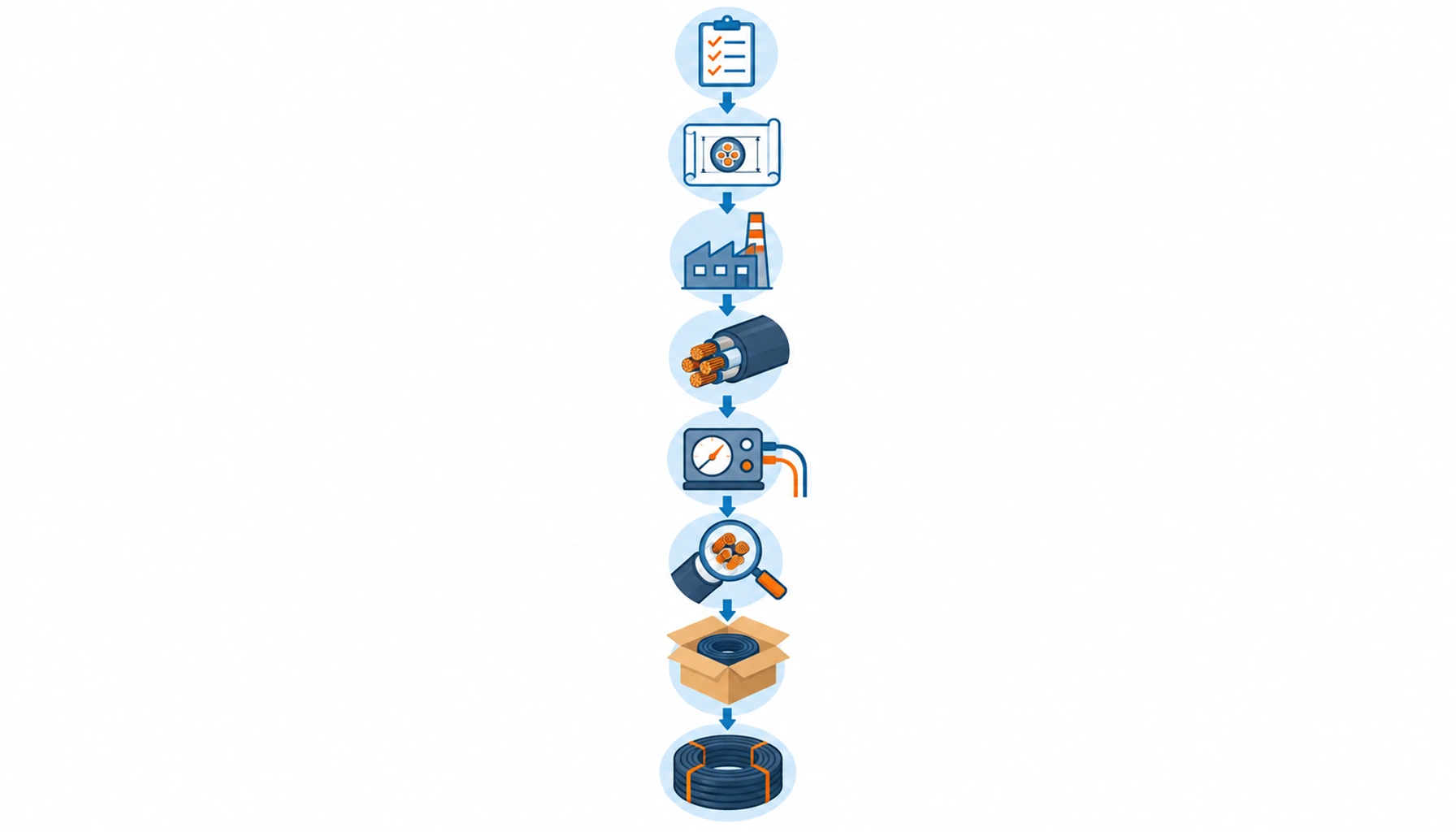
This guide walks the process in eight steps, in the order that keeps risk lowest. It is written for machine builders, integrators and maintenance buyers who need cable that behaves the same way on the twentieth delivery as it did on the first, and who would rather spend a week qualifying than a quarter recovering.
Why Robot Cable Punishes Casual Sourcing
Three properties of the product make casual sourcing expensive. The first is that failure is delayed. A cable with the wrong stranding pattern does not fail in the warehouse; it fails after months of bending, usually on a machine that is running production. The second is that the failure signature is ambiguous. When a torsion cable breaks at 300,000 cycles instead of three million, the cause could be construction, it could be installation radius, it could be a bend in the routing that the cable was never specified for. Proving which one takes data the buyer probably did not collect. The third is that the replacement cost is not the cable cost. It is the downtime, the technician, the missed shipment, and in a warranty dispute, the customer relationship.
That combination shifts the entire economics of the purchase. A cable bought at thirty percent below market is only cheaper if it behaves identically in service, and the only way to know that before the order is to read evidence. The sourcing disciplines that apply to power equipment broadly, laid out in the guide to sourcing power equipment for EPC projects, hold for robot cable with one addition: here the technical review matters more than the commercial one, because the product cannot be inspected into compliance after delivery.
The Eight Steps, in Order
The sequence below is not bureaucratic. Each step exists because skipping it moves risk somewhere expensive. Qualification comes before quotation so that quotes are comparable, sampling comes before the bulk order so that the construction is proven before it is repeated a thousand times, and shipping terms come last because negotiating freight before the product is defined is negotiating about the wrong thing. Buyers who follow the order rarely find surprises at the end. Buyers who start at step six usually do.
| Step | What it settles | Evidence to demand | Cost of skipping it |
|---|---|---|---|
| 1. Define the duty | What the cable must survive: bend, torsion, travel, temperature | Written duty profile with cycle counts and radius | Every quote answers a different question |
| 2. Qualify the factory | Whether the supplier makes the cable or resells it | Stranding equipment list, process flow, audit access | Price compared across unlike supply chains |
| 3. Read the evidence | Whether flex life claims are testable | Bend and torsion reports with pass criteria and setups | Claims that cannot be reproduced or defended |
| 4. Fix the construction | The exact build you are buying | Conductor stranding, shield, jacket compound, dimensions | Silent substitutions between batches |
| 5. Sample and test | Whether the build performs in your duty | Sample units plus agreed test protocol | Bulk order built on an untested assumption |
| 6. Agree commercial terms | Price basis, MOQ, lead time, change control | Written quotation referencing the fixed construction | Ambiguity that surfaces as a dispute |
| 7. Settle shipping | Who carries cost and risk in transit | Incoterm, packing specification, drum and reel rules | Damage or duty surprises at destination |
| 8. Verify on arrival | Whether what shipped matches what was agreed | Incoming inspection, batch records, retained samples | Recurring defects discovered by the end customer |
Where the Process Usually Breaks
Steps two and three carry more weight than their place in the list suggests, because they decide whether the numbers in the other steps mean anything. A factory that draws its own conductors, strands them in house and controls its own extrusion is a different animal from a trading office that buys finished cable and relabels it, and the two will quote you differently for reasons that have nothing to do with quality. The questions that separate them in a single call are collected in the checklist for evaluating a Chinese cable manufacturer.
When Buying from China Is Not the Answer
The break points are predictable. Buyers rush step one because the duty profile feels obvious, then discover at commissioning that the cable is routed over a radius nobody specified. They compress step four because the construction looks standard, then receive a second batch with a different jacket compound and no notice. And they treat step six as the beginning of the relationship rather than the end of the specification, which is how a purchase order ends up referencing a datasheet that the factory considers indicative rather than binding.
Fix the construction in writing, down to stranding and compound, and make change control part of the commercial terms instead of an afterthought. A supplier that accepts a change-notification clause is telling you something about its own confidence; one that resists it is telling you the same thing, more cheaply. The same discipline applies to the paperwork side of the purchase, where the mistakes in international power equipment sourcing tend to reappear in miniature: unclear Incoterms, packing that suits a container rather than a cable, and documentation that arrives after the goods.
| Route | Best for | What you gain | What you give up |
|---|---|---|---|
| Direct from a manufacturer | Repeat buyers with a defined construction | Construction control, traceability, technical dialogue | Higher MOQ and longer first-order setup |
| Through a trading company | Buyers assembling a mixed basket of items | One invoice, one shipment, less administration | Visibility of the actual production line |
| Regional stockist | Urgent replacement and small quantities | Fast delivery, no import process | Premium price and limited construction choice |
| Marketplace listing | Non-critical, low-cycle applications only | Low entry cost and quick ordering | Almost no evidence and no change control |
| Engineering partner | New machine designs and custom harnesses | Design input, joint testing, shared standards | Longer qualification and closer dependency |
RFQ Checklist: What to Send Before Price Comes Up
Most robotics buyers end up in two of these routes at once, and that is fine as long as the split is deliberate: direct supply for production cable where consistency is worth the setup, and a stockist for the emergency spool that keeps a line running on a Friday night. What does not work is using a marketplace listing for a torsion-rated axis and discovering the difference at the customer’s site.
Conclusion
Three situations argue against it. If your annual volume is a few hundred metres of standard cable, the qualification effort will cost more than the saving, and a domestic distributor is the rational choice. If the cable carries a certification that your customer requires for the specific construction and the factory cannot document that certification for that build, the price advantage is irrelevant, because the product cannot be installed legally. And if your project has no tolerance for a learning curve, the first order is not the place to run an experiment: qualify a supplier on a small programme, then move production cable once the evidence is in hand. The certification question deserves its own frame of reference, and the requirements around Chinese electrical equipment certification apply to cable construction claims in much the same way.