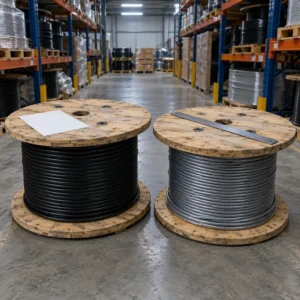
In-Country Cable Stock: Warehousing and Consignment in Central Asia
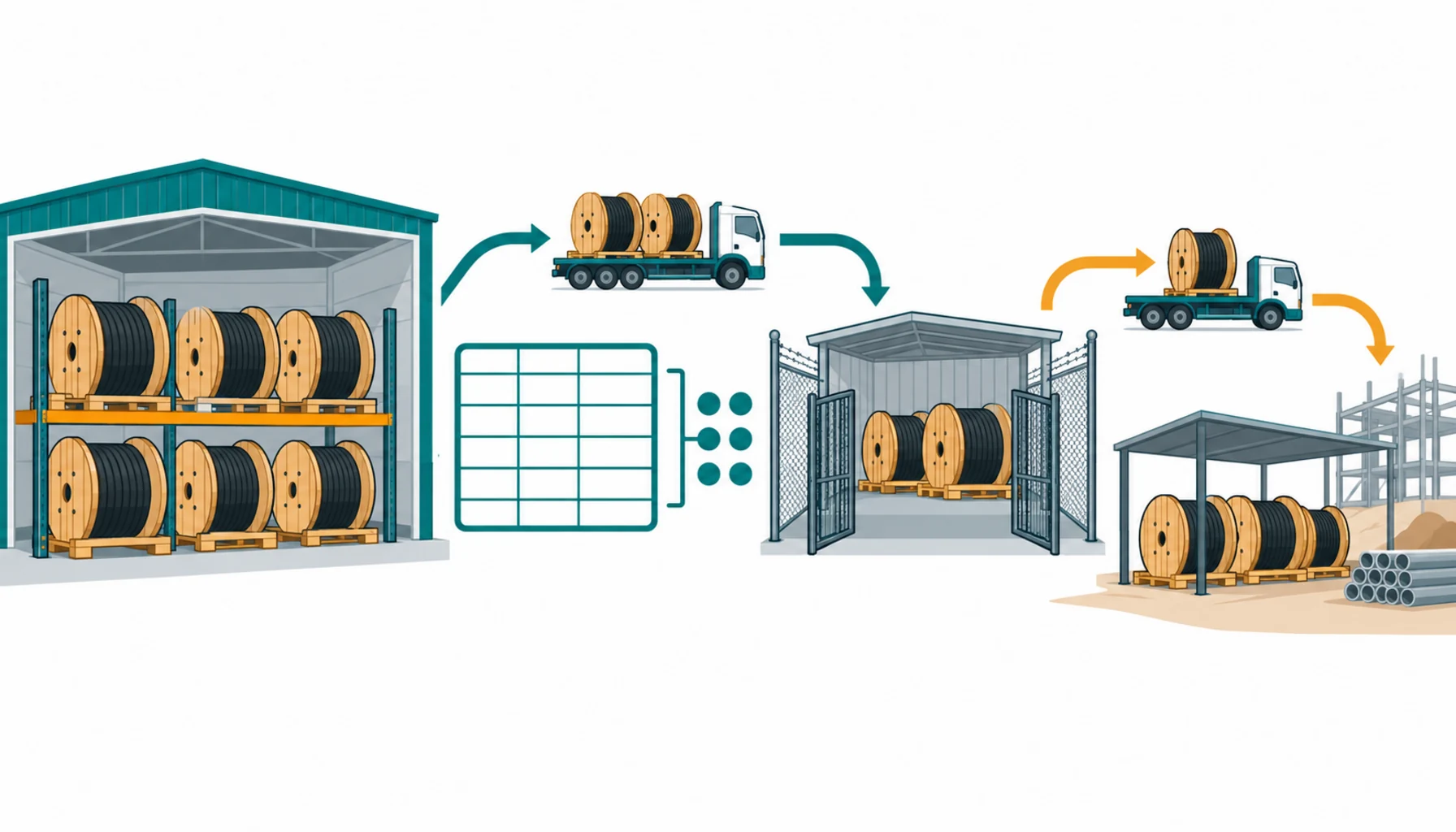
Quick Answer: Holding cable in the country is the answer to a lane that takes weeks: an importer with drums on the ground sells availability instead of promises. Three models do the work, own warehouse, bonded storage and consignment at the customer, and they differ in who pays duty when, who owns the drums and who counts them. The model is the easy part. The stock that works is defined by rotation, records and drum care, and by a replenishment rule that was written before the first drum was bought.
Introduction
This page covers cable stock held inside the region: the three warehousing models importers actually use, what belongs in a regional inventory and what does not, how drums age in storage, and how consignment stock is structured so that title, payment and count stay reconciled. It is written from the importer’s and programme buyer’s side of the desk.
Stock at the construction site is a different discipline with a different owner, and it is covered in our note on site cable stock strategy. The regional buying context sits in our Central Asian cable buying hub; this page stays with the warehouse.
Why Importers Hold Stock on This Lane
The lane takes weeks and the season compresses demand into months. A contractor who must order from abroad for every drum buys transit risk with every call-off, and a distributor who imports against orders sells promises that a blocked crossing can break. Stock converts both exposures into a warehouse bill, which is usually the cheaper risk to carry.
Stock also changes what can be sold. Small and mid-size buyers in the region buy by the drum and by the week, and they buy from whoever has the drum in country. An importer with a working inventory serves that demand entirely; an importer without it serves only the project tier, and competes there on price alone.
The economics have a floor, though. Cable is a metal-heavy product, so stock is capital that moves with the copper price, and every drum in the warehouse carries duty already paid or deferred. The models below are, at bottom, three answers to those two facts. The importers who win the small-drum market are the ones whose availability is real, and availability is a warehouse fact before it is ever a sales claim.
The Three Stock Models: Own, Bonded, Consignment
Own warehouse is the simplest model: goods imported, duty paid, drums on the importer’s floor, sold as local stock. It is flexible and it prices the cleanest, and it carries the duty and the copper capital from the day of import regardless of when the drum sells.
Bonded storage defers the duty. Goods sit in a bonded warehouse uncleared, and duty falls due when the drum is released for sale. That suits importers serving several markets or waiting on a tender outcome, at the cost of a procedure every release and a bond requirement at the warehouse, and a release that still takes days when the buyer is in a hurry.
Consignment moves the warehouse to the customer: drums placed at the buyer’s premises, owned by the supplier until drawn, paid on use. It is the deepest form of availability and the most demanding to run, because it asks two companies to keep one count. The distributor variant, stock held by a local wholesaler on agreed terms, sits between the models, and the wholesale route for building wire in the region is described in our note on wholesale building wire in Uzbekistan.
What Belongs in a Regional Stock
A regional stock earns its space by frequency, not by coverage. The drums that turn are the common constructions in the demand the importer actually sees: low voltage power in the standard sizes, control cable in a few cores, building wire in the colours that sell, and a narrow band of the medium voltage that repeats locally. Everything else is an order, not stock.
Depth follows the same logic. Two to four drums of a fast mover is not a stock, it is a queue; twenty drums of a slow mover is a warehouse renting space for copper. The honest sizing method is demand per month per construction, sized against the replenishment lead time, which for this lane is itself a variable to be planned. A stock sized this way also survives the season: it runs thinnest exactly when the lane is slowest to replenish, which is when depth matters most.
Mining and industrial programmes sometimes justify a deeper exception stock, because their downtime cost per day dwarfs the carrying cost of a drum. That arithmetic, and where it holds, is set out in our note on mine cable spares and downtime. For everyone else, the rule stands: stock what turns, order what does not, and the order lead time is planned with the same method.
Storage Conditions and Drum Integrity
Cable ages in storage more than buyers expect, and mostly at the edges. Drums standing on soil take moisture into the flange and the cable end; drums in direct sun age the sheath on the exposed outer turn; and a drum rolled carelessly across a yard collects the damage pattern that a later dispute will blame on the factory.
The warehouse standard is short: dunnage under every drum, ends sealed and capped, drums rotated a quarter turn on a stated interval so the same turn is not always at the bottom, and a stack limit that respects the drum build. Covered storage beats open storage by a wide margin, and for outdoor stock, covers belong on the drum, not on the shelf beside it.
Rotation is also a product-protection habit. A drum that has stood for two years should be inspected and re-tested on resistance before it ships, and that is a normal request to make of a supplier rather than an insult. The ageing signals worth checking are catalogued in our note on cable damage and wear patterns.
Running the Stock: Rotation, Records and Drum Care
A stock that cannot be counted does not exist. Every drum carries its number, construction, length and receipt date, and the record shows where it stands, warehouse, bonded store or customer site. The discipline is the same traceability chain described in our note on cable marking and traceability, extended from the factory to the shelf.
Records earn their keep at the moments that matter: a warranty question about a drum drawn two years ago, a length dispute on a part-used return, or a stock audit against a consignment agreement. A ledger that reconciles drum numbers with delivery notes turns each of those into a lookup instead of an argument.
The labelling layer makes it work in practice, because warehouse staff work from what is on the drum, not from a database. The labelling set that survives handling, and the documents behind it, are covered in our note on cable labeling and documentation, and the same set serves the stock ledger and the site delivery alike.
Pricing, Replenishment and the Commercial Side
Stock pricing has to answer for its capital. A drum in the warehouse carries the copper it was bought on, the duty status of its model, and the carrying cost of the weeks it has stood. An importer who prices stock from the last purchase invoice is quoting history; the defensible price tracks the current material basis plus the cost of holding, and states which drums are duty-paid stock and which are on release.
Replenishment is a rule, not a reflex. Each stocked construction carries a reorder point tied to demand per month and the replenishment lead time, and the order goes when the point is crossed, whether or not the month has been quiet. Rules survive the season; reflexes buy copper at the worst moment of the autumn rush.
For programme buyers, the commercial structure can go further than a price list: a framework with call-off rights against agreed stock levels, with the replenishment rhythm written in. The drafting pattern is the one described in our note on moving from RFQ to a framework agreement, and after-sales duties around stock, returns and technical support are set out in our note on cable after sales support.
Consignment Mechanics: Title, Payment and Count
Consignment stock lives or dies on three definitions written before the first drum moves. Title: the supplier owns the drums until they are drawn, and insurance responsibility follows the same line. Draw: the event that transfers ownership, usually issue from store against a signed requisition. Count: who holds the ledger of truth, and how often the two sides reconcile it. Put the three on one page of the agreement before the drums ship; every later document is a variation on them.
Payment follows the draw, on an agreed cycle with an agreed statement. The reconciliation habit is what keeps the trust: a monthly count where supplier and buyer walk the racks together, matched against the draw records, with discrepancies resolved on the spot rather than at contract end. Programmes that skip the counts discover the gap at the worst possible moment, the final settlement.
Consignment suits integrators and programme owners who consume continuously and can offer secure storage, and it suits suppliers with a proven local partner. The structure repeats the spares-programme logic set out in our note on cable spares programmes for integrators, applied at warehouse scale instead of the project scale.
The Stock Model Map
Table 1 lines up the three models and the distributor variant against duty timing, capital and the fit for each.
| Model | Duty Timing | Capital Owner | Best Fit |
|---|---|---|---|
| Own warehouse | Paid at import | Importer | Fast movers with steady local demand |
| Bonded storage | Deferred to release | Importer, duty unpaid | Tender-bound volume and multi-market stock |
| Consignment | Paid on draw | Supplier until drawn | Programme buyers with secure storage |
| Distributor stock | Paid at import by distributor | Distributor | Building wire and small-drum demand |
| Direct order, no stock | Paid at import by buyer | Buyer, from order | Project volumes and special constructions |
The Stock Freeze List
Table 2 is what to settle before the first stocked drum is bought, because these lines are the difference between an inventory and a rumour.
| Item to Freeze | How to Write It | Evidence to Attach | Cost of Leaving It Blank |
|---|---|---|---|
| Stocked list | Constructions and sizes by demand per month | Demand record per construction | Copper parked where nothing turns |
| Reorder points | Point per construction, tied to lead time | Replenishment rule sheet | Autumn rush bought at the worst price |
| Duty model | Paid, bonded or on-draw, stated per drum batch | Warehouse and bond documents | A price no one can defend |
| Storage standard | Dunnage, sealed ends, rotation, stack limit | Warehouse instruction with photos | Ageing blamed on the factory |
| Records | Drum number to location, receipt to draw | Stock ledger format | A warranty question with no history |
| Pricing basis | Material basis plus carrying cost, by duty status | Price rule with the basis named | Stock sold below its own capital |
| Consignment terms | Title, draw event, count cycle and settlement | Consignment agreement | A gap discovered at final settlement |
When Holding Stock Is Not the Answer
When the demand is one project. A single project’s volume is an order, not a stock. Buying ahead of a tender in the hope of winning it parks duty-paid copper behind a decision that has not been made.
When the construction does not turn. A slow mover in stock is a warehouse renting space to copper, and the rent compounds with the copper price. Order it when it is called for, and sell the lead time honestly.
When storage conditions cannot be met. Stock on soil, in sun, without rotation, is inventory quietly ageing toward a claim. If the warehouse cannot meet the standard, the drums are better off in transit than on the floor.
When nobody owns the count. Consignment without a reconciliation habit is two companies believing two numbers. The model needs a ledger owner and a count cycle before the first drum ships, not after the first dispute.
When the price cannot answer for the capital. Stock priced from an old invoice against a moving metal basis sells availability at a loss. If the pricing rule cannot be stated, the stock is not yet a business.
RFQ Checklist
- Stocked list sized by demand per month per construction
- Reorder points tied to the replenishment lead time of the lane
- Duty model per batch stated: paid, bonded or on draw
- Storage standard written: dunnage, sealed ends, rotation, stack limit
- Drum-level records linking number, location, receipt and draw
- Pricing rule from current material basis plus carrying cost
- Re-test commitment for drums held beyond a stated interval
- Consignment terms defining title, draw event and count cycle
- Monthly reconciliation agreed for any consignment location
- Framework call-off terms for programme buyers, in writing
Conclusion
Stock in the region is a service built on a warehouse floor: the right constructions, sized to demand, stored so they age well, counted so they can be trusted, and priced so the capital answers for itself. The model, own, bonded, consignment or distributor, is a choice about duty and ownership; the discipline behind it is the same in every case.
Kexingyu Cable Group (KXYE) supplies regional stock programmes with drum-level traceability, replenishment sized to call-off patterns and consignment terms that reconcile cleanly. Describe the demand and the storage you can offer. A request for quotation is the fastest start.