Crush Resistant Cable in Heavy Traffic: Armour, Bedding and Protection
Quick Answer: Crush resistance is about the load path, not a thicker sheath. A cable survives a wheel or a dropped load when the force has a stiff path around the cores, which usually means steel tape or steel wire armour over a bedding layer, or a separate duct that carries the load instead of the cable. A thicker polymer resists abrasion, not crushing, and buying one in place of the other is the most common way to spend money on the wrong part.
Introduction
On a mine, a quarry or a construction site the cable is often the last thing anyone thinks about when a route is chosen, and the first thing to fail when a truck drives over it. Crush damage rarely looks dramatic: the sheath may be intact and the cores deformed inside it, and the circuit fails later as an intermittent fault that is hard to find.
This guide is for the buyer who has to specify cable for a route that carries loads. It covers what actually crushes a cable, the armour and protection structures that answer it, the decisions to freeze before the order goes out, and the checks that catch damage before a run is buried. The armour choice itself is set out in our note on armoured versus unarmoured cable, and the wear side of the problem is in our note on cable damage wear patterns.
What Actually Crushes a Cable
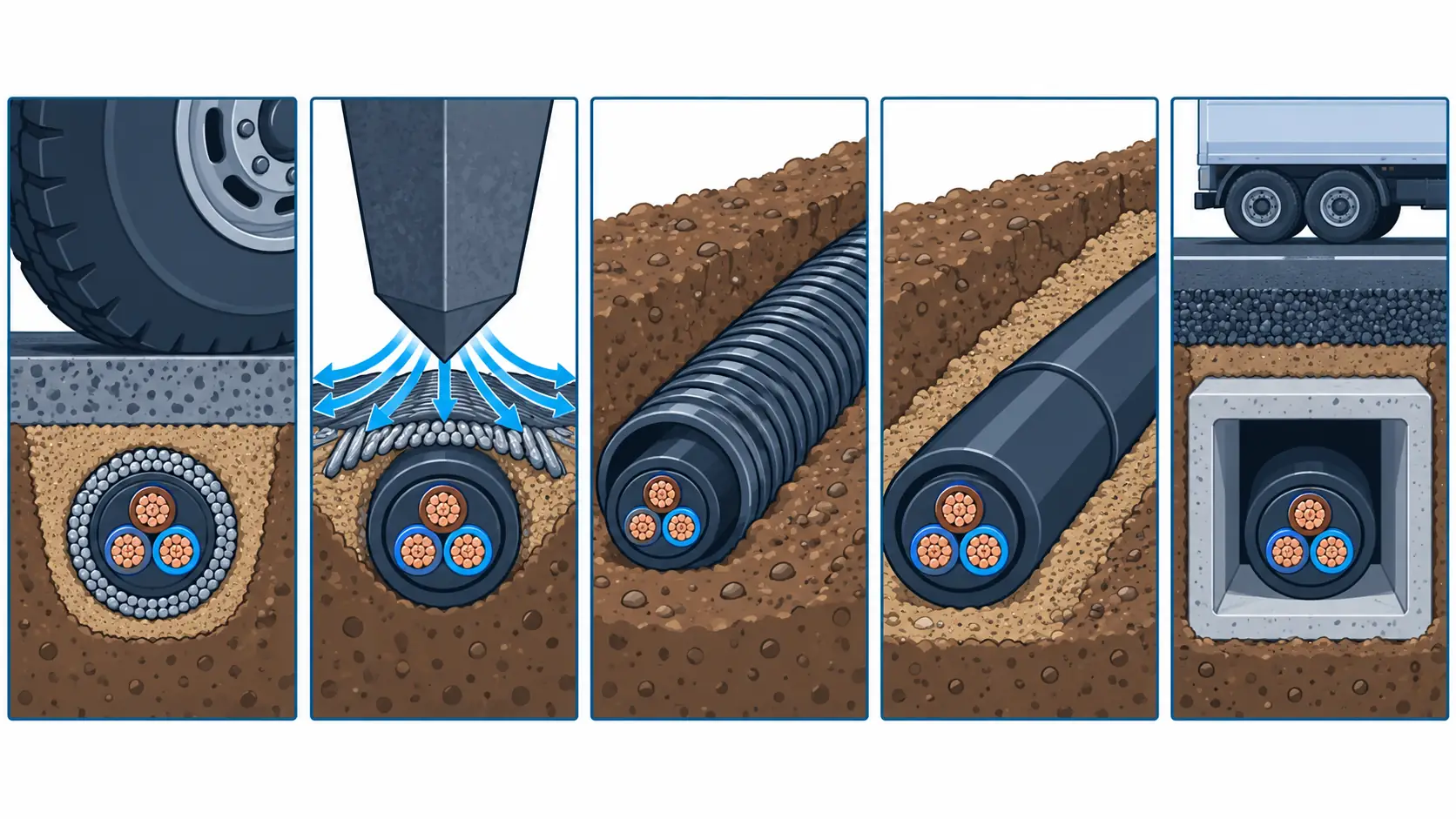
A wheel or a track passing over it. The load is high and short, and it lands on whatever is between the tyre and the cable. A cable lying on hard ground takes nearly the full vehicle load; a cable on soft fill spreads it, which is why the same cable survives one crossing and fails on another.
A dropped load or falling rock. In a mine or a quarry the impact is a point load with an edge, and a sharp edge concentrates the force into a few square centimetres. This is the case where bedding between the armour and the cores matters most.
Sustained pressure rather than impact. Cable stacked under a reel, clamped hard against a sharp support or trapped under a steel plate can deform over months at far lower loads than a wheel imposes in a second.
Movement plus abrasion. A cable that vibrates against a sharp edge wears through its outer layer, and the damage becomes a crush point once the protection is gone. The two mechanisms usually arrive together, which is why the route and its supports belong in the specification.
Protection Structures Compared
The table sets out the structures a buyer actually chooses between: what each one resists, what to specify, the evidence to demand, what drives cost and lead time, and how each one fails when it is chosen on the basis of a single word in a catalogue.
| Structure | What it resists | What to Specify | Evidence to Demand | Cost and Lead-Time Driver | How It Fails |
|---|---|---|---|---|---|
| Steel tape armour | Point loads and moderate impacts across a flat or gently curved run | Tape thickness and coverage, overlap, and the bedding layer under it | Construction sheet with the tape dimensions and the bedding named | Standard on many power cables; adds little lead time in common sizes | Tape opened by a sharp edge or by bending below the minimum radius |
| Steel wire armour | Heavier point loads, tension and impact, and routes pulled through ducts | Wire diameter and count, coverage, and the earthing arrangement for the armour | Construction sheet with the wire specification and a bonding test on the finished length | More metal and a slower lay-up than tape; adds both cost and lead time | An armour that spreads the load but leaves the cores unsupported because the bedding is missing |
| Interlocked or flexible metallic conduit | Crush and abrasion along a moving or exposed section without stiffening the whole run | Conduit material, wall thickness, and how it terminates at each end | Conduit specification with material, thickness and ingress rating | Small material cost per metre, but skilled fitting and terminations add programme time | Conduit ends left open, so the cable inside is unprotected where it matters most |
| Heavy sheath and bedding, no armour | Abrasion and light impact, where the route is already protected from wheels | Sheath compound and thickness, with the abrasion and impact evidence | Abrasion and impact test results on the compound, to a named standard | Cheapest of the options and usually the fastest to supply | A thicker sheath bought for a duty that needed a load path, and a crushed core inside |
| Separate protective system | Vehicle crossings, buried runs and any point where the cable should never take the load | Duct, box or cover type, its load rating and the bedding under it | Load rating for the protection, plus the installation detail at each crossing | Civil work dominates the cost and the programme, not the cable | A duct that carries the cable but not the load, cracking under a wheel and pinching the cable |
Armour, Bedding and the Load Path
Armour spreads a point load. A tape or wire armour turns a wheel force into a distributed pressure around the circumference, which is why an armoured cable survives a crossing that flattens an unarmoured one. The stiffer the armour, the wider the area that shares the load.
Bedding protects the cores from the armour. When a load deforms the armour inward, the cores underneath are pressed against it. A proper bedding layer under the armour absorbs that and keeps the load off the insulation, which is why a construction with armour and no bedding is a false economy.
Armour also stiffens the cable. Crush resistance comes with a larger minimum bend radius, a harder pull and a heavier termination. The radius figure is covered in our note on cable minimum bend radius, and the figure in a datasheet is usually the installation radius rather than the one the cable lives at.
The armour has to be earthed. Steel armour over a live cable is a metallic layer that must be bonded at both ends, and the bond is a commissioning item rather than an afterthought. On a route that also carries a variable-speed drive, the earthing and screen arrangement is worth reviewing with the drive supplier.
What to Freeze Before the Order Goes Out
Six decisions decide whether a crush-duty order can be accepted on site. Each is cheap at specification stage and expensive once the drums are on the haul road.
| Decision | What to State | Evidence to Attach | Cost of Leaving It Open |
|---|---|---|---|
| Load and frequency | The vehicle or load at each crossing, how often it passes, and whether it is a point or a spread load | A route drawing with crossings, loads and frequency marked | A structure sized for the wrong load, or a cable that never takes a load at all |
| Armour type and coverage | Steel tape or steel wire, with dimensions and the coverage required | Construction sheet naming the armour and its dimensions | Armour that is thinner or shorter in coverage than the specification intended |
| Bedding and inner sheath | The bedding layer between armour and cores, and its material | The construction sheet showing every layer in order | Armour deforming straight onto the insulation at the crush point |
| Bend radius and pull limits | The radius in service and the pulling tension allowed on the route | A route drawing with radii and an agreed pull limit | Armour opened at a tight bend and the cable damaged before it is energised |
| Armour earthing and bonding | Where the armour is bonded, with what glands, and how continuity is proved | A bonding schedule and a continuity test on the finished run | An unbonded armour that becomes a shock risk and a fault path |
| Crossing protection detail | Duct, box or cover at each crossing, with its load rating and bedding | The civil detail for each crossing, with the load rating named | A duct that cracks under a wheel and pinches the cable inside it |
Installation, Supports and Protective Ducts
Decide where the cable should not be. The best crush protection on most sites is a route that keeps the cable off the haul road, carried overhead or in a covered trench. That decision is made at design time and rarely revised once the civil work starts.
Use a duct that carries the load. A duct rated only for the cable’s weight will crack under a vehicle, and the crack pinches the cable more sharply than the bare ground would. Specify the crossing protection to the wheel load, not to the cable, and lay it on a proper bed.
Protect the edges. Where a cable changes direction over a steel edge, a saddle or a roller protects the armour from the abrasion that would otherwise create the crush point. This detail costs almost nothing and is omitted constantly.
Leave access for inspection. A run that is fully buried with no draw pits cannot be examined, and the first sign of trouble is a fault. Where the crossing matters, leave a point where the cable can be seen; the inspection routine is described in our note on in-service cable testing.
Incoming Inspection and Damage Records
Look at the drum before the run. Impact damage often happens in transit, and a drum that has shifted or been slung badly shows it on the outer layers. Photograph the drum and the sheath at goods-in, before anything is pulled.
Check the construction against the order. Confirm the armour type and dimensions on the construction sheet, and cut a sample where the duty is severe, so the layers can be seen rather than assumed. The layer order is what makes the difference between armour that protects and armour that damages.
Test armour continuity and bonding. Continuity from end to end and from the armour to the earth bar is a commissioning test, and it is also the fastest way to find a break caused by handling. Record the results beside the drum references.
Repair and record, do not conceal. Where a sheath is damaged, use the maker’s repair material so the patch is as good as the layer it replaces, and record where the damage was. A concealed repair is how a crush point reaches service undocumented.
Cost and Lead Time
Unarmoured heavy-sheath constructions are the cheapest and the fastest, and they are the right answer where the route is already protected. Steel tape armour is a common stock option on power cable and adds little time. Steel wire armour and special armours cost more in both metal and process time and can run to order, and separate protection systems move the cost into civil work, where it belongs to the programme rather than the cable order.
On armoured power cable the copper is still the largest component and the armour is a modest addition. Over a long site programme the movement in copper between tender and purchase order usually outweighs the armour premium, so ask how the copper element is calculated and how long the price holds; the mechanism is covered in our note on copper price and cable procurement.
When More Armour Is Not the Answer
When the damage is abrasion, not crush. Repeated wear at a support is a routing problem, and a heavier armour wears against the same edge. Fix the edge and the abrasion evidence is in our note on the abrasion resistant cable jacket.
When the cable should not be in the road at all. No armoured cable is designed to be driven over daily. Where the crossings are frequent, the answer is a route or a duct, and the cable specification cannot compensate for the wrong decision.
When the armour breaks the installation. Stiffer cable needs larger radii, harder pulls and heavier terminations, and on a tight route those costs can exceed the value of the protection. Match the armour to the route as well as to the load.
When a duct is cheaper. A short length of correctly rated duct over a crossing often costs less than upgrading the whole run to wire armour, and it protects the cable exactly where the load is.
RFQ Checklist
- The load at each crossing, its frequency and whether it is a point or a spread load
- Where the cable must stay clear of traffic, and the route that achieves it
- Armour type, dimensions and coverage, and whether tape or wire is required
- The bedding layer and inner sheath, named in layer order on the construction sheet
- Minimum bend radius in service and the pulling tension permitted on the route
- Armour bonding arrangement, with the glands and the continuity test specified
- Crossing protection type, its load rating and the bedding beneath it
- Edge protection, saddles and rollers at every change of direction
- Sheath repair material and the procedure to be issued with the delivery
- Points where the installed run can be inspected, with access left for it
- Continuity and bonding records, plus any witnessed impact or crush test
- Copper basis and the validity window of the quoted price
Conclusion
Crush protection is a load-path decision before it is a materials decision. Work out what the cable has to survive, put a stiff layer around the cores with a bedding under it, protect the crossings with something rated for the wheel, and keep the run out of the road where you can. Buying a thicker sheath for a wheel load is the one mistake that answers nothing.
Kexingyu Cable Group (KXYE) has manufactured cable in Quanzhou since 1996, including steel tape and steel wire armoured power and control constructions for mine haul roads, quarries and construction sites, with construction sheets that name every layer and bonding records that travel with the drums. Send us the route with its crossings and loads, and we will come back with the armour, the protection detail and the tests that apply. A request for quotation is the fastest route.