
Custom Cable Orders: What Chinese Factories Can and Cannot Customize
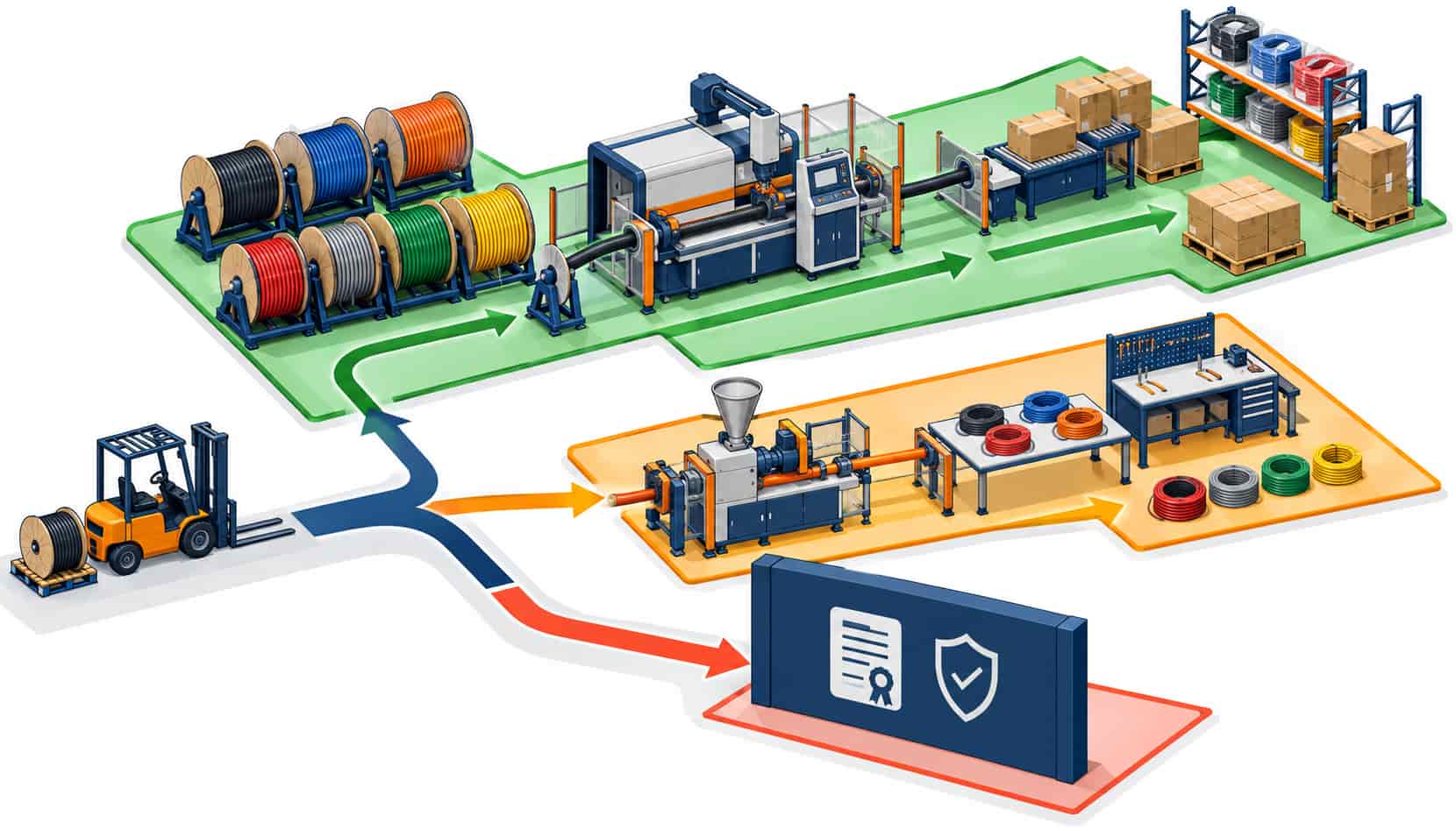
Quick Answer: Chinese factories routinely customize conductor size, materials, colors, printing and packing — but certification scope, standard geometry and MOQs are boundaries, not variables; knowing which is which keeps projects moving. "Can you make it like this?" is the first question every serious cable buyer asks a Chinese factory, and the honest answer is a map with green zones, amber zones and hard walls. Nearly everything visible on the finished cable — its metals, materials, colors, print, packing — moves easily through a custom order. What resists customization is the invisible infrastructure behind it: the certificates the destination market demands, the standards the design was drawn to, and the economics of a production line that runs best in kilometers, not meters. This guide walks the map, so your next custom RFQ lands on the green zones and quotes accurately instead of optimistically.
Introduction
Cable is a made-to-order product by nature. A factory that can extrude PVC can usually extrude LSZH, and a stranding line that builds one cross-section builds its neighbors. That’s why Chinese cable manufacturers say “yes” to customization far more readily than many product categories — the equipment is flexible even when the process discipline isn’t free. But every custom variation taxes the schedule somewhere: in raw material minimums, in type-test evidence, in setup scrap, in lead time. Buyers who understand where the flexibility genuinely lies get factories that co-engineer with them. Buyers who assume “custom” means “free-form” get quotes padded for the unknown. The map below is that understanding, written from the factory floor outward.
The Green Zone: What Customizes Routinely
The everyday customizations cost little and quote fast. Conductor cross-sections within the standard ladder are all one stranding-line setup away. Insulation and sheath materials swap along the material matrix — PVC to LSZH to XLPE — provided the compound is in stock and the extrusion line is compatible. Sheath colors are a pigment order; standard RAL shades run almost as routine as black. Jacket printing is fully custom: your company name, project reference, meter marks and batch coding, with printing plates or ink-jet setups made per order. Drum sizes, drum labeling, coil lengths and export packing — palletized, containerized, seaworthy — are logistics options rather than engineering ones. And voltage classes within the factory’s certified range adjust with insulation thickness. None of these demands new tooling with long lead times. Most quote within days and run within the normal production window.
| Dimension | Flexibility | Typical Extra Cost / Lead Time | Buyer Action |
|---|---|---|---|
| Conductor size & metal | High â within standard ladder and Cu/Al families | Minimal; copper price flows through market | Specify ampacity, not just size |
| Insulation / sheath material | High across stocked compounds | Minor premium for LSZH/XLPE; none for PVC variants | Confirm compound certification evidence |
| Jacket color | High â RAL shades routine | Small pigment premium; slightly longer for exotic colors | State RAL code, not color names |
| Printing & marking | Full custom text, meter marks, logos | Plate or setup fee first order; negligible after | Provide print artwork before sample |
| Packing & drums | High â drum size, coils, export packing | Logistics cost only | State drum weight limits for the site |
| Novel compound or geometry | Moderate â depends on tooling and extrusion | Tooling, trial runs, weeks of lead time | Ask for a sample run first |
| Certification scope | Wall â certificates cover what they cover | New certification = months and fees | Match the certificate list before the design freezes |
| Standard geometry | Wall â recognized standards have fixed requirements | Non-compliant "customs" void the mark | Customize around the standard, not against it |
The Amber Zone: Possible, but Priced and Scheduled
Between the green zones and the walls sit the customizations that are real but not free. Novel compounds — a specific flame class the factory does not stock, an oil-resistant formulation, a halogen-free armor sheath — require material procurement, trial extrusion and scrap allowance. Non-standard constructions, like an unusual core count or a composite of shield, armor and sheath the line runs rarely, carry setup inefficiency and a longer quality-control loop. Small trial runs of a new construction cost proportionally more per meter than the production quantity that follows, and honest factories say so. The right way through the amber zone is a paid sample or pilot order: the factory proves the construction, you verify it against your installation, and the production order inherits the validated parameters instead of discovering them at container volume. The paperwork that should travel with any pilot — test scope and traceability — is the discipline in our equipment datasheet reading guide.
The Walls: What Does Not Customize
Three boundaries don’t move, and quoting against them wastes everyone’s time. First, certification scope: a factory’s certificates cover specific products tested to specific standards — a certificate can’t be stretched to cover your custom variation by goodwill, and a new certification cycle takes months and real fees. Second, standard geometry: recognized standards fix construction requirements, and a “custom” cable that violates them forfeits the mark. You can customize the color and the print on a standard-compliant cable, not its insulation thickness. Third, minimum order quantities: extrusion and stranding lines run economically in production lengths, and the MOQ for a custom construction is usually higher than for a stock item because setup scrap amortizes over less volume. The relationship between custom manufacturing and the certificate wall is the core of the OEM versus ODM distinction — the same logic that separates a factory’s catalog from its capability.
Writing the RFQ: How to Get an Accurate Custom Quote
Custom quotes go wrong in the gap between what the buyer meant and what the factory read. Close the gap in writing. State the destination market and its certification requirements first, because that frames everything. Then specify the construction layer by layer — conductor metal, size and class; insulation material and thickness; core count and identification; any shield, armor and its wire size; inner and outer sheath material and color; rated voltage; and the standard the design follows, or the performance values it must meet if no standard applies. Add the commercial frame: total quantity and its split by size, delivery drums and packing, required documents, and the destination port. Attach a drawing or cross-section sketch where one exists. A quote built on that RFQ returns buildable numbers. A quote built on “similar to the attached photo” returns a price that changes at order confirmation. The RFQ framing logic is the same one used for full electrical scopes in our EPC sourcing guide.
Sample, Test, then Scale: The Custom Order Sequence
The disciplined custom project runs three steps. The sample step produces a short length to the agreed specification — enough to verify construction, printing and workmanship, and to run destination-side tests if the design is novel. The pilot step produces a production-representative batch, letting the factory tune the line and you verify consistency, with batch test reports keyed to the production parameters. The production step then runs at scale with the frozen specification, and any later change — even a color — goes through a documented revision instead of a phone call. Skipping steps doesn’t save time; it relocates the discovery of problems to the least forgiving point in the project, which is the jobsite. The timeline cost of skipped verification is a recurring character in our cable sourcing delays guide.
Verification: Keeping the Custom Order Honest at Delivery
Custom products lack the commodity anchor of catalog items — nobody else’s price or datasheet disciplines the order — so verification carries more weight. Require the batch test report for the specific custom parameters, not a generic catalog datasheet. Check the drum printing against the agreed format at receipt. If the destination market requires certification evidence, the paperwork trail from the factory’s certificate scope through the batch tests to the shipment must connect — a chain the customs and inspection logic follows in our China electrical equipment certification checklist. And audit the factory’s capability claims before the PO, not after: the verification checklist that separates real custom capability from sales-deck capability is the one in our power cable manufacturer checklist.
| RFQ Item | Write This | Common Mistake |
|---|---|---|
| Destination & certification | Market named, certificate list attached | Certification asked after the design freezes |
| Construction | Layer by layer: conductor, insulation, shield, armor, sheath | A photo plus "similar to this" |
| Standard / performance | Governing standard cited, or target values stated | Assuming the factory infers the standard |
| Appearance | RAL color code and print artwork attached | Color names like "dark grey" |
| Quantity & packing | Totals, size split, drum limits, export packing | Quantity given after first quote |
| Verification | Sample step with written acceptance criteria | Skipping the sample to save weeks |
When Custom Is Not the Answer
Honest factories talk buyers out of customization more often than into it, and the reasons are sound. If a standard product meets the need, the custom premium buys nothing but risk. If the quantity is small and the schedule tight, a standard cable with an approved substitution note beats a custom order chasing a container date. If the customization is cosmetic — color or print on a standard construction — it’s worth doing; if it’s structural, the engineering burden of proving the novel construction usually outweighs the benefit. And if the “custom” need is really a translation problem — a Chinese designation that has an exact standard equivalent — the decoder work comes first, and the custom order dissolves. The cheapest custom cable is the one you find out you didn’t need.
RFQ Checklist: Ordering Custom Cable
Make the custom order quotable, so include:
- Destination market and its certification requirements stated first
- Layer-by-layer construction: conductor, insulation, cores, shield, armor, sheath
- Rated voltage and the governing standard, or target performance values
- Jacket color (RAL), print format and meter-marking requirements
- Quantity with size breakdown, and split deliveries if any
- Drum type, weight limits and export packing requirements
- Required documents: batch test reports, certificates, packing list format
- Sample or pilot step agreed with acceptance criteria in writing
- Specification revision process named before the PO
- Factory capability verified against the checklist before quoting
Conclusion
Chinese cable factories customize more than most buyers expect — metals, materials, colors, printing, packing, all inside the normal production rhythm — and less than optimistic buyers hope, where certificates, standard geometry and MOQ economics draw the walls. Treat customization as co-engineering with the green, amber and wall zones mapped, sequence it sample-pilot-production, and put the specification in writing at every step.
Kexingyu Cable Group (KXYE) runs custom orders on exactly this discipline — capability confirmed up front, construction quoted layer by layer, and every custom parameter backed by batch documentation — so the cable that arrives is the cable the project specified, export-ready.
Recent Posts

Power Cable Warranty Terms: What to Demand and What to Watch For
Power Cable Warranty Terms: What to Demand and What to Watch For Quick Answer: A usable warranty names its scope, duration, evidence standard, exclusions and
The Cable Sample Approval Process: What to Test Before Mass Production
The Cable Sample Approval Process: What to Test Before Mass Production Quick Answer: Sample approval tests the supplier’s claims while changes are still cheap —
Cable Drum Packaging for Export: Specs, Marking and Transit Protection
Cable Drum Packaging for Export: Specs, Marking and Transit Protection Quick Answer: Export packaging is a technical specification: drum size for weight and bend radius,