Buying Delivery Robot Cable for Sidewalk Fleets: Duty Cycles, Weather and What to Specify
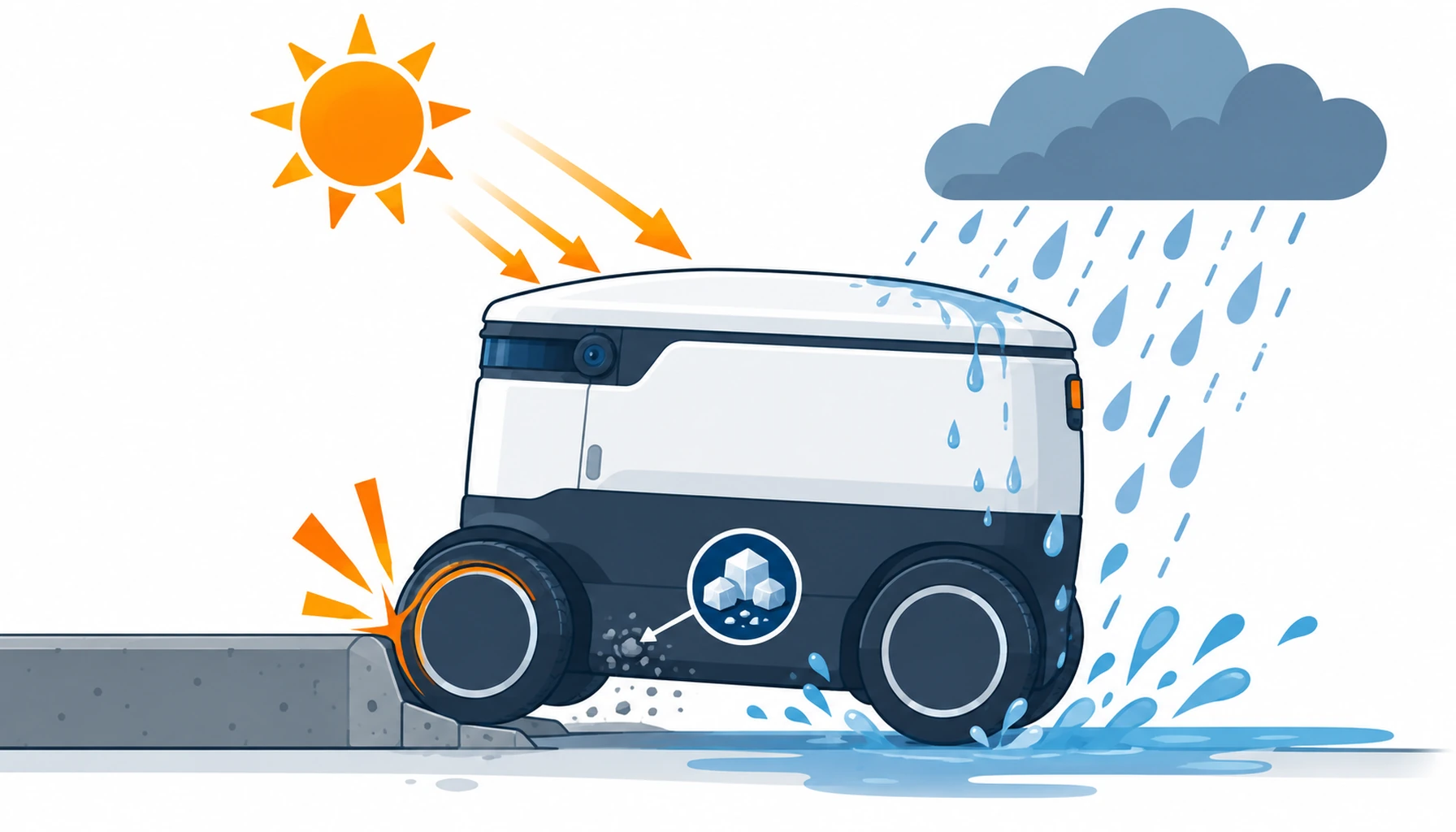
Quick Answer: A sidewalk delivery robot is a fleet asset used by people who did not buy it, in weather nobody scheduled. Its cable has to survive curb strikes, standing water, months of ultraviolet light and a charge cycle several times a day. The specification that matters is a cycle count, a sheath chemistry, a water path and a swap time, and only the first of those is easy to get from the robot builder.
Introduction
Warehouse automated guided vehicles and street delivery robots look similar on a specification sheet and behave nothing alike. Inside a warehouse the floor is flat, the temperature is controlled, and the vehicle never leaves a known route. On a pavement the same chassis meets kerbs, ramps, puddles, road salt, construction dust and, occasionally, a person who kicks it.
The indoor case is well covered in our note on AGV and AMR cable. This guide is about the outdoor variant, where the cable is decided by weather and by the fact that a single failed unit is a visible service interruption rather than an internal line stoppage.
Why Street Duty Is Harder Than Warehouse Duty
The first difference is the route. A warehouse vehicle follows tape or a mapped lane and can be given a smooth floor; a delivery robot has to mount a kerb, cross a dropped kerb and survive a paving slab that sits ten millimetres proud. Those events load the harness in a direction the designer never drew, and they happen hundreds of times a week.
The second is water. Rain is obvious, but the damaging water is the splash from a puddle at speed and the standing water a robot parks in while it waits for a customer. Both arrive under pressure and both reach places a rain shower does not. Sheath selection for that case is covered in our range of waterproof cable, which is built around water paths rather than around a single ingress claim.
The third is light. Ultraviolet exposure degrades polymer sheaths, and a delivery robot spends most of its life outside. Over a two-year deployment the cumulative dose is significant, and it affects the compound rather than the conductor, so the failure appears as a cracked or chalky jacket long before any electrical symptom. Products built for that exposure, such as the UV resistant cable range, exist because a general-purpose sheath is not specified for it.
The fourth is handling. Fleet operators swap batteries, lift units into vans, and pull a robot by whatever part comes to hand. The cable is grabbed as often as any structure on the machine, and no bend radius survives being used as a handle.
Vandalism is a real line item in some markets. Units parked overnight have had covers opened, connectors pulled and, in a few cases, harnesses cut. No cable specification prevents that, but a harness that is replaced as an assembly rather than repaired on the street keeps the incident to a depot visit, and that is worth stating when the fleet contract is priced.
The Duty Cycle: Stops, Starts and the Kerb Event
Delivery duty is not one long motion. It is thousands of small lid openings, arm extensions, wheel turns and suspension movements, punctuated by a few dozen harder events where the robot mounts a kerb. A cable rated for continuous flex may still be the wrong choice, because the punishing load is the repeated small movement with a heavy impact mixed in.
Declare the kerb event separately. It is a shock load, not a flex cycle, and the two are tested differently. Ask the builder how many kerb mounts a unit performs per day and what the vertical travel of the suspension is at that moment, because that figure sets the service loop length at the wheel bay.
Then declare the service loop. The loop that feeds a moving wheel or a tilting lid is the part that fails first, and its length is set by the travel it has to absorb rather than by convenience. The mechanics behind that figure are in our note on cable minimum bend radius, and the same arithmetic applies to a loop with a larger safety factor.
The Decision Table: Four Outdoor Run Strategies and What Each One Costs
| Strategy | What to specify | Evidence to demand | Cost and lead time | Where it fails |
|---|---|---|---|---|
| Standard flexible cable, exposed | Sheath compound, UV statement and the exposed run length | A UV and water test on the compound, not the conductor | Lowest unit cost, shortest lead time | A chalky jacket and a wet connector after one wet season |
| Weather-resistant sheath, exposed | UV grade, temperature window and abrasion figure | A weathering test with hours and exposure stated | Slightly higher cost, standard lead time | Paying for UV grade where the run is already inside the body |
| Routed and sealed inside the chassis | Route, grommets, drain points and clearance at full travel | A layout drawing checked at full suspension travel | Higher design effort, same build cost | Water entering at a grommet that was never sealed |
| Armoured or sleeved external section | Sleeve type, coverage and the replacement interval | An impact test at the real kerb contact point | Add-on cost at assembly | A sleeve that traps road salt against the sheath |
| Separate charging tails | Docking current, tail length and connector family | A temperature rise record at the docking burst | Extra hardware, standard lead time | Docking current pushed through an undersized control core |
Charging, Swapping and Fleet Uptime
A delivery robot may dock three or four times a day, and every docking event pushes current through a cable that is still warm and often still wet. That combination is harder on insulation and terminations than the working cycle is, and it is why the charging path deserves its own conductor size rather than a spare pair borrowed from the control bundle. The current side of that choice is set out in our note on robot battery cable.
Docking also produces a mechanical event. A robot that rolls onto a pad misaligned by twenty millimetres loads the tail sideways every time, and a tail that was specified for a straight plug will eventually break at the connector. Specify the misalignment tolerance and let the supplier decide how to absorb it.
Fleet uptime then comes down to swap time. If a harness can be changed by a depot technician in an hour, a failure costs an hour of one robot’s day; if it needs a factory visit, it costs a week. Building the harness as a replaceable assembly with a documented procedure is cheaper than making the cable survive everything. Our note on robot cabling serviceability sets out the three access levels and what each one costs to build.
What to Freeze Before the Order
| Item | What to state | Evidence to attach | Cost of leaving it open |
|---|---|---|---|
| Flex cycles | Cycles, arc and the joint each figure belongs to | A duty figure from the vehicle's own route study | A rating that cannot be verified or used |
| Kerb events | Suspension travel and the number of mounts per day | A shock or impact figure at the wheel bay | A loop that fails at the wheel within a season |
| Water path | Where splash reaches the harness and where it drains | An ingress test at the mated joint plus a drain detail | Water travelling along the core to a dry compartment |
| UV statement | Exposure hours expected over the service life | A weathering test with hours and conditions stated | A jacket that cracks in year two with no warning |
| Sheath compound | Road salt, oil and cleaning chemical exposure | A chemical resistance statement for each agent | A swollen jacket and a raised bend radius |
| Docking current | Current, duration and conductor size for the tails | A temperature rise record at the docking burst | Warm terminations and a shortened connector life |
| Bend radius | The figure for the assembled harness at the wheel bay | A flex figure at the tightest point of travel | Core damage hidden inside the bundle |
| Sleeve or armour | Which sections are protected and how they are replaced | An impact test at the real contact point | Corrosion trapped under a sleeve nobody removes |
| Labels and split point | Where the harness splits and how it is marked | A labelling sample on the first article | A depot repair that starts by tracing cables by hand |
| Spare harnesses | How many assemblies are held per depot | A spares list agreed with the depot, not head office | A fleet waiting on a part while the units sit idle |
When a Delivery Robot Cable Specification Is Not the Answer
When the deployment is a trial. A single site running five units does not justify a bespoke compound. Buy a proven outdoor-rated cable with a sound UV and water story, label it properly, and spend the difference on spares. The specification should harden when the fleet count and the route profile are known, not before.
When the failures are impact damage rather than insulation faults. If harnesses are being replaced after kerb strikes and the insulation tests are clean, the answer is routing or a replaceable sleeve, not a different compound. The patterns that identify impact damage are set out in our note on robot cable failure, and re-specifying the sheath will not fix a loop that hangs where a kerb can reach it.
When the robot is actually used indoors. Some delivery fleets operate inside malls, airports and campuses, where the conditions belong to the service robot case rather than the street case. Our note on service robot cable covers that duty, and buying street-grade armour for it adds stiffness and cost for nothing.
When the fleet has no depot. If harnesses have to be shipped to a factory for repair, a heavier cable will not compensate. Fix the access level first, because an unreachable harness turns every cable decision into a service-level risk. Where the machine parks outdoors all night, it is also worth reading our note on patrol robot cable, which covers continuous outdoor standby duty.
RFQ Checklist
- Flex cycles and arc for each moving joint, taken from the route study rather than the datasheet
- Kerb mount count per day and suspension travel, with a shock or impact figure at the wheel bay
- Water path described, including where splash reaches the harness and where it can drain
- Expected outdoor exposure hours over the service life, with a weathering test stated in hours
- Road salt, oil and cleaning agent exposure named, with a chemical resistance statement each
- Docking current, duration and tail conductor size, with a temperature rise record
- Bend radius given as a harness figure at the tightest point of full suspension travel
- Sleeve or armour specified as a replaceable part, with an impact test at the contact point
- Label scheme and split point defined, with a sample on the first article
- Spare harness level agreed per depot and priced as a finished assembly
Conclusion
A delivery robot cable is bought on four things a datasheet usually omits: the kerb event, the water path, the outdoor exposure hours and the depot swap time. Write those four into the specification and the rest is ordinary cable buying. Leave them out and the first wet winter will find them for you.
Kexingyu Cable Group (KXYE) has supplied flexible, weather-resistant and water-blocking cable since 1996, and builds harnesses so the geometry approved on the first article is the geometry that ships. Send us the route study, the exposure hours and the charging profile, and we will return sheath options and sample harnesses for a street trial; the fastest route is a request for quotation.