Elevator Traveling Cable: What to Specify and How to Buy It Properly
Quick Answer: An elevator traveling cable is the only cable in a building that is expected to survive millions of bend cycles while hanging its own weight in a shaft. It carries power, control, communication, often a video feed and sometimes the emergency telephone in one composite construction, and replacing it means taking the lift out of service. Buy it on bending life at a stated test basis, on a hanging length that matches the shaft, and on a composite design that removes every cable you would otherwise have to hang beside it.
Introduction
The traveling cable is the part of a lift installation that nobody thinks about until it fails. It runs from the machine room or controller to the car, hanging in a loop that opens and closes every time the lift moves, and it carries everything the car needs: motor and brake supplies where the drive is on the car, control signals, the car lighting and ventilation, the alarm and intercom, and increasingly a video and data connection.
That combination of mechanical duty and mixed signal content is what makes the procurement different from an ordinary cable purchase. This guide covers what the cable has to do, the evidence worth asking for, and the decisions to freeze before the order.
What a Traveling Cable Actually Has to Do
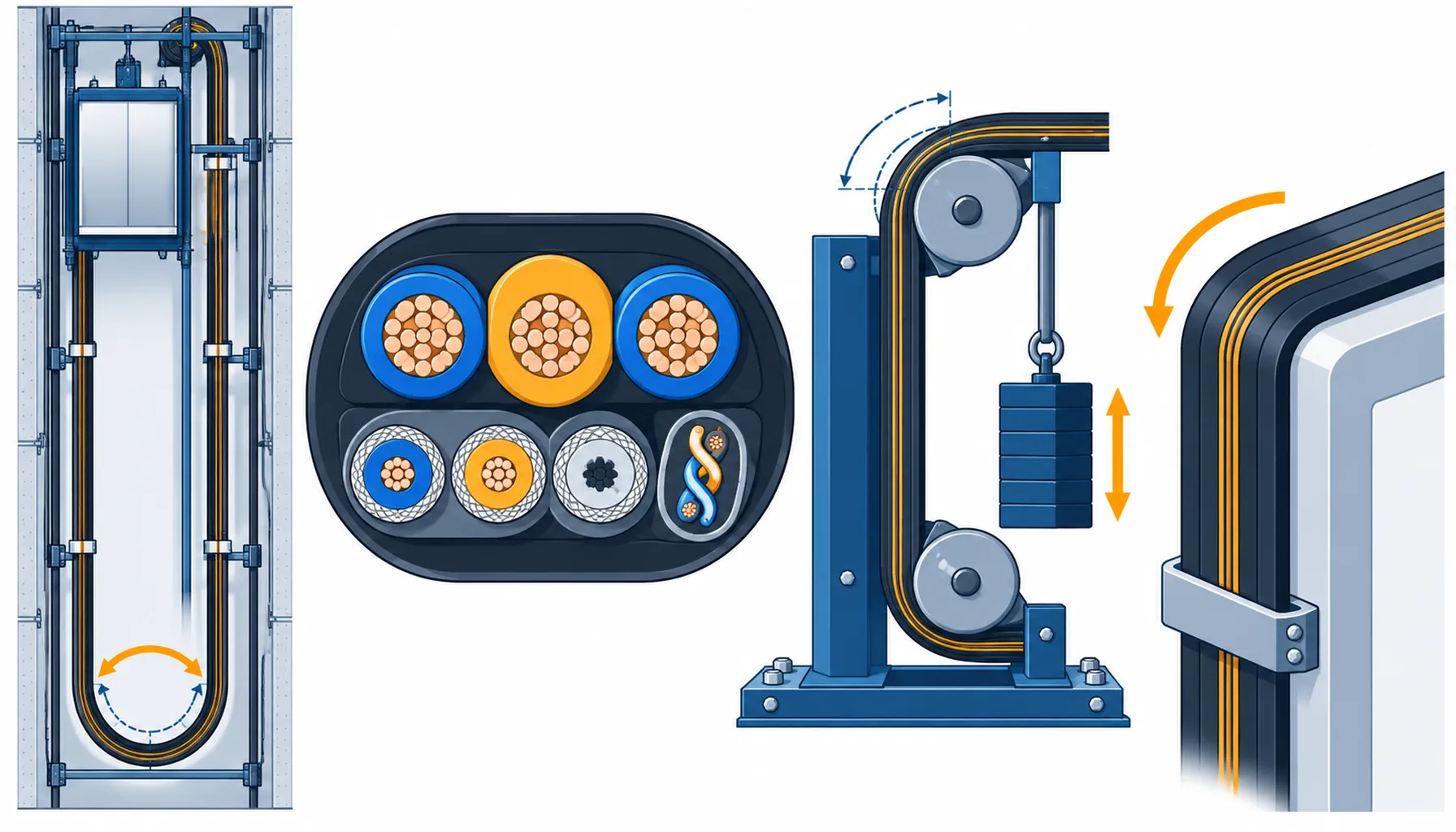
Survive the bend cycle count. Every trip bends the loop twice, and a busy lift in a public building makes a very large number of trips over a design life measured in decades. The relevant number is not a rule of thumb, it is a test result: how many cycles the construction has survived at a stated bend radius and a stated load.
Hang its own weight. The cable is supported at the car and at the shaft, and the loop below carries its own mass plus the mass of any reinforcement. A cable sized for current but not for tensile load stretches, and a stretched traveling cable changes the geometry of the loop and starts to chafe.
Carry several functions at once. A composite construction with power, screened control, a video pair or a fibre element and the intercom in one jacket replaces several cables. That matters mechanically as much as commercially: one lighter cable puts less load on the car and creates one loop to manage rather than four, and our elevator composite cable range covers the configurations normally specified.
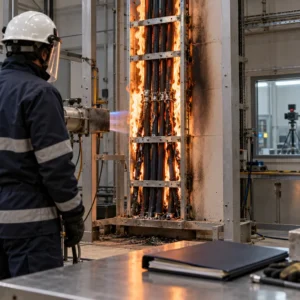
Match the fire performance of the shaft. The shaft is a vertical route that connects floors, and in many jurisdictions the cable in it is treated as part of the building’s fire performance. The requirement is normally a reaction-to-fire class, and where the lift is an evacuation or firefighting lift, circuit integrity on the circuits that have to keep working. Those are two different purchases.
Be replaceable in a planned window. Nobody replaces a traveling cable as an emergency. It is changed during a planned shutdown, which means the delivery date and the pre-termination arrangement matter as much as the product.
Traveling Cable Options by Duty
| Option | Duty | What to Specify | Evidence to Demand | Cost and Lead-Time Driver | How It Fails |
|---|---|---|---|---|---|
| Standard round traveling cable | Power, control and intercom in a conventional shaft, moderate rise and trip count | Flexible conductor class, bend test basis, hanging length, fire class for the shaft, car end termination arrangement | Bend cycle test report at a stated radius and load, dimensional records, class declaration | Conductor class and jacket compound; made-to-length items add lead time | Conductor fatigue in the loop, appearing as intermittent control faults before a total failure |
| Flat traveling cable | Tight shaft space, arrangements where the loop must fold rather than hang round | Flat profile with the correct bend axis, strain relief at both ends, defined minimum bending radius in the flat plane | Bend cycle test report for the flat orientation, termination and strain relief detail | The flat tooling; long runs of a fixed profile usually mean a minimum order quantity | Bending across the wrong axis, which fails far earlier than the test figure suggests |
| Composite with video and data | Car video, destination control, remote diagnostics and intercom in one loop | Composite construction with the signal elements individually screened, a stated separation between power and signal, and the correct impedance for the data pair | Impedance and screen continuity test data, cross-talk or separation declaration, dimensional records | Composite manufacture and lead time; the loom usually has to be made as one order | Picture interference or data loss from a power and signal pair sharing a jacket without separation |
| High rise and high speed duty | Long travel, high trip count, heavy loop, possibly compensation arrangements | Conductor and support detail sized for the hanging length, reinforcement where required, all test evidence at the actual duty rather than a reduced one | Bend cycle and tensile test data at the project duty, loop weight calculation, support detail | The test programme and the made-to-length manufacture, both of which set the lead time | A loop that stretches in service and chafes on the shaft furniture or the car |
| Escalator and moving walk control | Fixed installation with a short moving section, exposed to public use and cleaning | Flexible construction at the moving point, sheath that resists cleaning chemicals, ingress protection at the machine pit | Flex test data for the moving section, sheath resistance data, ingress rating at the terminations | Small metreage but frequently a bespoke length per unit | Sheath degradation from cleaning products, or water in the pit termination |
Bend Cycles, Test Evidence and the Claim Nobody Checks
Bend cycle claims are the most commonly unverified item in an elevator cable purchase. Three things make a claim meaningful.
The test basis. A cycle count without the bend radius, the load applied and the orientation is not comparable with anything. Ask for the radius, the load, whether the test was on a straight loop or over a sheave, and whether the test was continued to failure or stopped at a target. Our note on cable flex testing methods sets out how those tests are normally run and what a report should contain.
The conductor construction. Bending life comes mostly from the conductor. A flexible class of finely stranded conductor is close to mandatory, and a construction with a shorter lay on the strands survives longer than one strung for ease of manufacture. Our notes on flexible conductor classes and on cable bending cycles cover how the construction translates into life.
The radius in the actual installation. The test radius is not the installation radius. Where the loop is tighter than the tested figure, or where the cable is bent over a fixing or a shaft bracket, the life falls faster than the cycle count suggests. Our note on cable minimum bend radius gives the way it is normally expressed, and the shaft survey should record the tightest point rather than assuming the drawing is right.
Where the cable runs over a small sheave or a diverter. Some designs route the traveling cable over a pulley to manage the loop, which changes the duty from a hanging loop to a repeated over-sheave bend. That is a different test condition and has to be specified as such rather than assumed to be covered by a general bend figure.
Length, Tolerance and Delivery
Traveling cable is bought to length, and length is where most of the avoidable cost sits.
Hanging length comes from the site, not from a catalogue. The required length depends on travel, the height of the machine position and the arrangement of the loop, so the shaft has to be measured or taken from the approved lift layout. Our note on cable length tolerance covers how tolerance is normally expressed: a small under-length is unusable and a large over-length is wasted and harder to manage in the loop.
Pre-termination. Where the car end is terminated in a plug or a box at the factory, the termination becomes part of the approved assembly and the lift contractor needs the mating arrangement defined. Agreeing it after manufacture is the usual cause of a re-termination on site, which is exactly the work the pre-termination was meant to avoid.
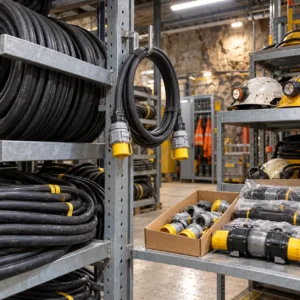
Batching and drum arrangement. A multi-lift project should be bought with the lengths grouped by shaft and delivered in one lot where possible, so the installation team can match cable to shaft without opening several drums. Where the cable is supplied coiled rather than on a drum, the coil and the packaging have to survive transport without a kink; our note on cable drum packaging covers the handling and identification requirements.
Documentation per length. Each length should arrive identified with the shaft or lift number it was made for, with its test report and, where a class declaration is required, a declaration that names the exact construction supplied. On a project with several lifts, a mismatch at goods-in is far cheaper to fix than one found during installation.
What to Freeze Before the Order
| Decision | What to State | Evidence to Attach | Cost of Leaving It Open |
|---|---|---|---|
| Functions in the loop | Which functions the cable must carry now, and which may be added later | A function schedule with the spare elements listed | A second cable hung beside the first, or a re-manufactured loom |
| Bend test basis | The cycle count required, at a stated radius, load and orientation | A bend cycle test report matching that basis | A claim nobody can verify, and a replacement within the warranty period |
| Hanging length | Length per shaft, derived from the approved layout and the measured site condition | A length schedule with tolerance stated | A cable that is short, or an over-length loop that chafes |
| Termination arrangement | Where the cable is terminated and whether it is pre-terminated at the factory | A termination drawing agreed with the lift contractor | Re-termination on site, in a shaft, during a planned shutdown |
| Fire performance in the shaft | The required class, and circuit integrity where the lift is an evacuation or firefighting lift | Class declaration for the exact construction, plus survival evidence where required | A class that cannot be evidenced at handover, or a lift that fails its evacuation duty |
| Signal separation | Screen arrangement and separation between power and video or data elements | Impedance and screen continuity test data, separation declared | Picture and data faults that appear after commissioning and are hard to diagnose |
| Identification and spares | Labelling per shaft, plus spare or agreed replacement availability | A marking and documentation schedule | A replacement ordered from first principles months after the first lift fails |
When a Composite Traveling Cable Is Not the Answer
When the composite is being bought for flexibility the lift does not have. A small goods lift with fixed functions does not need video and fibre in its loop. A composite costs more per metre, and the extra elements add weight to a loop that has to hang in a shaft.
When the bend claim is being trusted without the test basis. A cycle figure without radius, load and orientation cannot be compared. Two suppliers can quote the same number and deliver very different lives, which is why the report matters more than the headline.
When the length is being ordered from the contract drawing alone. Shafts change during construction. Measure before manufacture, or accept the cost of a made-to-length item that is wrong.
When the class requirement is being assumed rather than confirmed. The shaft is part of the building’s fire performance in many jurisdictions, and the local lift standard and the building regulation do not always say the same thing. Confirm which one governs the acceptance before the order rather than at handover.
RFQ Checklist
- Function schedule for the loop, with spare elements for later additions
- Bend cycle test report at a stated radius, load and orientation
- Conductor class and stranding construction stated on the datasheet
- Hanging length per shaft, from the approved layout and a site check
- Loop geometry, the tightest bend point and the support arrangement
- Termination arrangement, including whether factory pre-termination is required
- Reaction-to-fire class and, where relevant, circuit integrity grade for the shaft
- Screen arrangement, impedance and separation between power and signal elements
- Jacket compound for the cleaning regime where the installation is public
- Tolerance, marking per shaft and the documentation that ships with each length
- Delivery dates matched to the lift installation and commissioning programme
Conclusion
An elevator traveling cable is bought on mechanical life and on the functions it has to carry, not on current. Ask for the bend test basis and match it to the tightest point in the actual shaft, buy the conductor class that the cycle count requires, put the video and data elements into one well-designed composite rather than hanging three cables, and measure the shaft before manufacture rather than after. Then confirm which fire requirement governs the shaft in the destination market, because that is the item that holds up handover.
Kexingyu Cable Group (KXYE) has manufactured cable in Quanzhou since 1996, supplying flexible lift and hoist control cable, flat composite constructions and the network elements that modern car equipment needs, with the test reports and declarations that lift inspectors ask for. Send us the lift schedule, the shaft lengths and the function list, and we will come back with the constructions, the test evidence and a length schedule per shaft. A request for quotation is the fastest route.