Fire Safety Certificates for Cable in Kazakhstan and Kyrgyzstan
Quick Answer: A fire certificate for cable is a separate document from the conformity certificate, and in Kazakhstan and Kyrgyzstan it usually sits in the construction fire safety system rather than the electrical one. What it certifies is a class, and a class combines flame propagation, smoke and halogen behaviour in one designation. That combination is why the certificate is only useful with the test methods named beside it: a class letter without a method cannot be checked, and a method without a duration says nothing about a circuit that has to keep working.
Introduction
Cable is the item that runs through every compartment of a building, so it is the item that fire authorities ask about first and understand last. A buyer receives a certificate with a class printed on it, files it with the conformity documents, and discovers during commissioning that the class covers a different construction, or that the circuit integrity requirement was never tested at all.
This guide separates the fire file from the electrical file, explains what a class actually combines, names the circuits that trigger the requirement, and sets out how the document is obtained in the two countries. It is for EPC buyers and MEP contractors working on Kazakh and Kyrgyz projects. The electrical conformity route is in our note on power cable certification checklist.
Why Fire Evidence Is a Separate File
Electrical conformity asks whether the cable is safe to energise. Fire requirements ask what the cable does when something else is already burning. The two questions are answered by different bodies, under different regulations, with different tests, and a document that answers one says nothing about the other.
The separation is visible in the paperwork. A conformity certificate lists a standard and a product scope. A fire document lists a class, a test method and, where circuit integrity is claimed, a duration. Filing them together is fine; treating them as one document is where projects get caught.
There is a commercial reason to keep them apart as well. Fire-rated constructions cost more, and the premium is paid at order stage on the strength of a class that nobody will test again. Getting the class right is the cheapest risk reduction available in the whole cable package.
What the Class Letters Combine
A fire class for cable is not one property. It bundles flame propagation along a bundle of cables, smoke generation, and the acid gas or halogen content of the combustion products, and the designation records the combination rather than the individual results.
That bundling is convenient for a specification and awkward for a buyer. Two cables can carry similar class designations and behave differently on smoke, because the class records that a threshold was met rather than how far below it the product sits. For an escape route or a data hall, the margin is what matters.
The tests behind the class come from separate documents: a bunched flame test, a smoke density test and an acid gas test. Our notes on IEC 60332 categories and on halogen and smoke testing set out what each one measures.
Circuit integrity is a fourth property and it does not belong in the same bundle. A cable that must keep working during a fire is tested for a duration under fire conditions, and that duration is the number the fire strategy is written around. It sits on a report, not in a class letter. Our note on flame rating declaration and testing covers how the claims are structured.
Five Pieces of Fire Evidence in a Cable Bid
The table sets out what each document proves, what it leaves out, and what a buyer pays when the gap is discovered late.
| Document | Question It Answers | Field Usually Missing | Where It Is Checked | Cost of the Gap |
|---|---|---|---|---|
| Fire safety certificate | This product may be used where the fire rules apply | Scope narrower than the schedule | Construction approval and handover | Replacement cable after installation |
| Bunched flame test report | Flame does not travel along the bundle | Test category and mounting method | Technical evaluation | Class claimed on a single-cable test |
| Smoke density report | Light transmission stays above a threshold | Test method named | Escape route design | Smoke figure asserted, never measured |
| Acid gas report | Combustion products are low in halogen acid | Conductivity and pH values | Equipment protection review | Corrosive damage to switchgear |
| Circuit integrity report | The cable works for a stated time under fire | The duration and the test regime | Fire strategy sign-off | Life safety system runs on untested cable |
Which Circuits Trigger the Requirement
The requirement follows the route, not the cable. Circuits that serve life safety systems, run through escape routes, or pass between compartments are the ones the fire rules reach, and the same cable type used in a plant room may need no fire evidence at all.
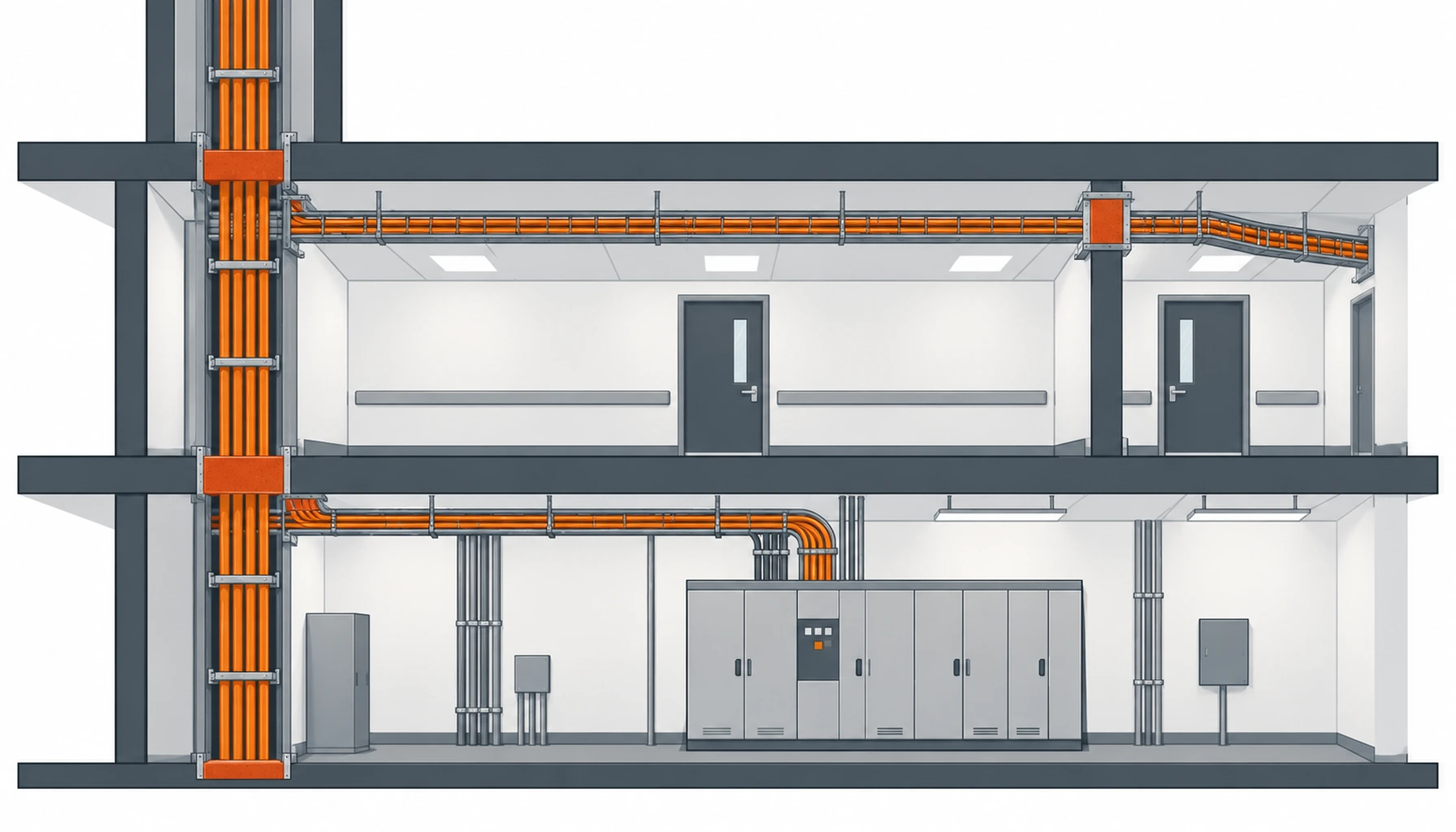
Three groups come up in almost every project. Emergency lighting and alarm circuits, because they have to work during the event. Pressurisation and smoke extraction, because they are part of the designed response. And anything running in a shaft, a riser or a shared corridor, because that is where a fire spreads between floors.
Marking the schedule by route rather than by cable type is the single most useful thing a buyer can do before the enquiry. It turns a question about class letters into a question about where each drum goes, and the second question has an answer that can be checked on a drawing.
Occupancy decides how hard the requirement bites. A warehouse and a hospital can carry the same cable schedule and be assessed very differently, because one has a defend-in-place strategy and the other does not. Read the fire strategy summary before pricing the fire-rated lines, since it is the document that turns a class into a quantity.
Kazakhstan: Where the Requirement Sits
Kazakhstan handles fire safety for construction products inside its own fire safety regulation rather than inside the electrical conformity system, so the document a buyer needs comes from a different institution and a different assessment. The electrical certificate and the fire document are separate files that both have to be present.
The practical consequence is a sequencing one. The electrical route is planned around the import, and the fire document is planned around the construction approval, which follows the building programme rather than the shipment. A project that starts the fire file when the drums arrive is starting it a phase too late.
Local practice also matters. Approvals in the regions are handled by territorial bodies, and what one accepts another may query, particularly where the class letter comes from a foreign report. Ask the local designer or the fire consultant which document they expect to see at handover, and get that in writing before the order. Our Kazakhstan supplier guide covers how that conversation usually runs.
Language is part of the file, not an afterthought. A fire document in English with a technical annex in Russian and a drum label in neither is a file that will be queried at the point where there is no time to fix it. Have the class designation, the method and the duration described the same way in all three places.
Kyrgyzstan and the Neighbours
Kyrgyzstan is a member of the customs union, so the electrical route for low voltage cable follows the union regulation, while fire safety for construction is a national matter. The split is the same as in Kazakhstan and the institutions are different, which is why a document prepared for one country rarely transfers unchanged.
For both countries, the useful question is not which certificate exists but which document the fire inspector will ask for at handover. That question is answered by the local design institute more reliably than by a supplier, and it is worth an email before the specification is frozen.
Uzbekistan and Tajikistan sit outside the union and handle both questions nationally. A buyer running a multi-country package should expect four sets of fire paperwork and plan the programme around the slowest of them, not around the fastest. Our note on cable import certification by country maps the differences.
The Scope Problem: Class Against Construction
A fire document names a product family and a class. The schedule names line items. Between those two statements sits the same gap that troubles every conformity document, and it is worse here because the class is what the fire strategy depends on.
Two specific mismatches recur. The first is a class tested on a single cable and quoted for a bunched installation, which are different tests and different results. The second is a class tested on one construction, offered for a family that includes an armoured variant with a different sheath compound.
Ask for the construction the report was issued on, in the same words as the drum label, and compare the two before the order. Where they differ, the honest options are a new test on the actual construction or a change to the specification, and both are cheaper before production than after. The fields that have to align are in our note on cable marking and traceability.
One more mismatch is worth naming: the class a supplier holds may come from a construction he no longer makes. Compounds change, a sheath supplier is replaced, and the certificate stays valid for a build that has quietly moved. Ask when the sample was made, not only what was tested.
Fire File Freeze List
These are the fields to settle before the order, in the order a handover review usually raises them.
| Item to Freeze | How to Write It Into the Order | Evidence to Attach | Cost of Leaving It Blank |
|---|---|---|---|
| Circuits in scope | Life safety, escape route and riser circuits marked on the schedule | Marked-up schedule or single line diagram | Fire evidence bought for the wrong lines |
| Class and method | Class designation with the test method beside it | Report naming both | A class nobody can check |
| Bunched or single | Test configuration stated as it will be installed | Report page with the mounting description | Single-cable result quoted for a tray |
| Circuit integrity duration | Minutes required, with the test regime | Report naming duration and regime | Life safety circuit untested |
| Construction match | Construction and sheath compound as printed on the drum | Report sample line against label artwork | Class valid for a different build |
| Country document | The document the local fire authority expects at handover | Written confirmation from the designer | A file refused at commissioning |
| Smoke and acid gas | Threshold figures, not adjectives | Test results with method named | Low smoke claimed, never measured |
When a Fire Certificate Is Not the Answer
When the route is the problem, not the cable. No class protects a cable run through a compartment without a sealed penetration. The fire stopping is a separate scope, usually let to another contractor, and the interface is where handover failures start.
When the strategy is performance based. A performance design asks for a calculation, and the calculation asks for a test method and a duration. A class letter cannot be entered into it, however official the certificate looks.
When the buyer is specifying by adjective. Flame retardant, low smoke and halogen free are descriptions, not requirements. Each one has a test and a threshold behind it, and a specification written in adjectives gets offers that cannot be compared. Our note on fire rated circuits in practice shows how the requirements are written when they have to be enforced.
When one country’s document is reused for another. Fire safety for construction is national, and a file prepared for Almaty does not become a Bishkek file by changing the address. Budget the second assessment, or buy cable that already carries both.
RFQ Checklist
- Life safety and escape route circuits marked on the schedule
- Fire class designation with the test method named beside it
- Bunched or single cable test configuration stated as installed
- Circuit integrity duration in minutes, with the test regime
- Smoke density and acid gas figures as numbers, not adjectives
- Construction and sheath compound matched to the drum label
- Country document confirmed with the local designer in writing
- Fire stopping and penetration sealing scoped separately
- Test reports per construction, not per catalogue page
- Lead time for the fire file built into the handover programme
Conclusion
Fire evidence is the part of the cable file that gets assembled last and checked hardest, because it is the part a building inspector, an insurer and a fire engineer all read. The work is not difficult; it is just different from the electrical route, and it has to start earlier than most programmes allow. A class that matches the route, the method and the drum is the whole objective.
Kexingyu Cable Group (KXYE) supplies flame retardant, low smoke and fire resistant constructions with test reports naming the class, the method and the duration, and states in the quotation which document each destination expects. Send the schedule with the fire circuits marked. A request for quotation is the fastest start, the field list is in our industrial cable RFQ checklist, and the regional picture is in the Central Asian cable buying hub.