Converting GOST Specs to IEC Orders: Voltage Class, Insulation and Testing
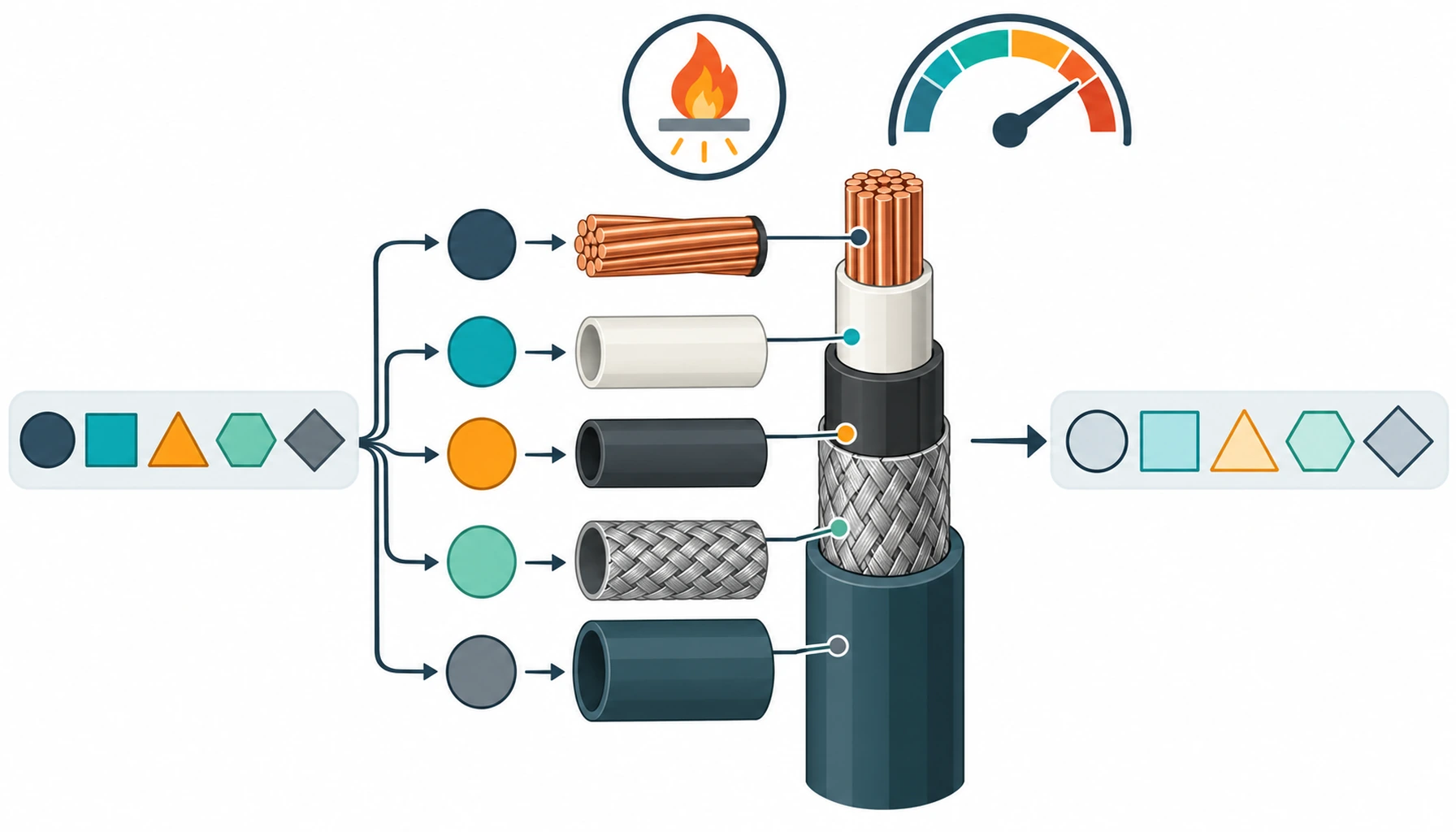
Quick Answer: Converting a GOST cable specification into an IEC order is not a translation job, it is a rebuild. Work through six steps: fix the voltage string with the earthing arrangement, rebuild the construction from the letter string, map the conductor class, convert the fire suffixes into named tests, translate the test clauses, and write the whole thing into a conversion sheet with a deviation column. Wherever the two systems genuinely disagree, the sheet records the disagreement instead of hiding it in the word “equivalent”.
Introduction
The request arrives as a scanned schedule in Russian: AVBbShv, APvP, KVVG, columns of cross-sections, a line at the bottom naming GOST numbers. The factory that will build the cable works to IEC tables and has no Cyrillic on site. Between the two sits the buyer, and the job is not to translate words but to rebuild one specification inside the other system without losing a field.
This page gives the working method step by step, for EPC procurement engineers and exporters quoting Central Asian schedules. The overview of how the two systems relate is a separate job, set out in our Central Asian cable buying hub and our crosswalk note; here we stay with the order itself. Work the steps in order, because each one feeds the next and a voltage string fixed late forces the construction to be rebuilt.
Step One: Fix the Voltage String Before Anything Else
GOST names a nominal system voltage: 1 kV, 6 kV, 10 kV, 20 kV, 35 kV. IEC names U0/U, a pair of figures that depend on how the network is earthed. The same 10 kV network can call for 6/10 or 8.7/15, and the insulation thickness behind the two strings differs. This is the one conversion that cannot be done from the document in front of you.
So ask the network owner one question and get the answer in writing: solidly earthed, or earthed through an impedance, and what is the single-phase-to-earth clearing time. With that, the string converts directly. Without it, any supplier will quote the cheaper class and half of them will be right by accident. The selection logic across IEC, GB and BS practice is in our note on medium voltage cable standards.
At low voltage the gap is cosmetic but real. A GOST 0.66/1 kV cable and an IEC 0.6/1 kV cable are bought for the same duty. Write the IEC string into the IEC order, keep the GOST string for the documents the local inspector will read, and say in the conversion sheet that both describe the same duty. That sentence costs nothing now and closes an argument later.
Step Two: Rebuild the Construction From the Letter String
The Russian designation is a layer list, not a type reference. Walk it position by position and write the layers out in words: conductor material, insulation compound, screen if present, bedding or its absence, armour type, inner sheath, outer cover. The suffixes come off the end and get parked for step four. What you now hold is construction-neutral, and construction is the only thing both systems can describe.
Mark the two positions where habit diverges most. Steel tape armour without a bedding is the CIS default; IEC schedules more often ask for steel wire with a bedding. Polyethylene outer sheaths are common on Russian medium voltage strings and are chosen for moisture rather than flame behaviour. Neither habit is wrong, but both have to be declared rather than assumed, because the offered construction will follow the supplier’s habit unless the order says otherwise.
The output of this step is a two-column page: the original string on the left, the layer list on the right, one row per position. If a layer cannot be mapped, write “unmapped” rather than choosing the nearest IEC word. An honest unmapped row gets resolved by the factory in a day; a wrong word survives into the drum label.
Step Three: Map the Conductor
Conductor is the field where the systems nearly meet, and nearly is the operative word. GOST 22483-2012 and IEC 60228 both sort conductors into classes by flexibility, both set resistance tables, both allow shaped conductors at larger sections. The class numbering does not run in parallel for every construction, and the minimum wire count for a flexible class differs between the two tables.
Convert by restating the property, not the class number. “Class 2 stranded copper” becomes a sentence: stranded, round or shaped, minimum wire count stated, maximum resistance at 20 °C. If the GOST schedule says sector-shaped aluminium, keep it; sector aluminium is normal in the region and a purely IEC worded order quietly excludes every plant that makes it. The class tables are set out in our note on IEC 60228 conductor classes.
Step Four: Convert the Fire Suffixes Into Named Tests
This is where a word-for-word conversion fails outright, because the Russian suffixes name behaviours and IEC names tests. ng claims the cable does not propagate flame in a bundle; the IEC side of that claim is a bunched flame spread test per IEC 60332-3 with a stated category. LS claims low smoke and points to a smoke density measurement. HF claims halogen free and points to an acid gas test. FR claims circuit integrity and always needs a duration.
Write each suffix into the order as a test method plus a pass figure, and leave the suffix out of the IEC order text entirely. An order line reading “IEC 60332-3 Cat. C, smoke density per IEC 61034, halogen content per IEC 60754” is checkable; “low smoke equivalent” is an opinion. The test families and their reporting are described in our note on IEC 60754 and 61034 testing, and how to get the claim into a signed declaration is in flame rating declaration and testing.
One caution belongs in the sheet: a GOST fire class and an IEC category are not declared equal by anyone. The construction either passes the named test or it does not, and the protocol decides. Write the conversion so the test report can answer it without a standards debate.
Step Five: Translate the Test Clauses
The GOST specification folds its test requirements into the construction standard: routine, acceptance and type tests live in the same document’s tables. IEC practice spreads them across documents and across a factory’s own routines, so the conversion has to restate who tests what and how often. Conductor resistance and voltage withstand per drum; sample tests against the material tables; type tests per construction, with the report naming the exact construction tested.
The mechanical and material test methods themselves differ between the systems, and a result obtained under one method does not automatically satisfy the other’s figure. Where the tender demands IEC methods, name IEC 60811 for the insulation and sheath mechanicals rather than accepting GOST annex results, and say so in the conversion sheet. The methods and their figures are in our note on IEC 60811 mechanical testing.
State the reporting rhythm too: one routine report per drum, one protocol per batch, type test report per construction, and the witness scope if the lender wants an engineer at the routine tests. The structure of a factory test regime is in our note on cable factory testing.
Step Six: Write the Conversion Sheet and Freeze It
The deliverable of the whole exercise is one sheet, and it goes into the order as an annex. Columns: the GOST field as written, the IEC order wording, the source of the IEC wording, and a deviation column that either says “none” or states the difference in one line. Both sides sign it. From that moment, “equivalent” has a definition and the definition is the sheet.
The sheet also disciplines the factory’s offer. When two suppliers quote the same converted line, the deviation columns tell you where their builds genuinely differ, which is information the price column alone hides. Our note on comparing cable quotations for Central Asia shows how to score offers once the sheets are in.
Six Steps at a Glance
The table compresses the method into the fields that actually appear in a Central Asian schedule, with the verification each step needs.
| Field | What the GOST Spec Gives | What Goes Into the IEC Order | What to Verify |
|---|---|---|---|
| Voltage string | Nominal voltage: 1, 6, 10, 20 or 35 kV | U0/U figure chosen from the earthing arrangement | Written earthing answer from the network owner |
| Construction | Letter string naming materials and layers | Layer list in words, one row per position | No row left unmapped; deviations listed |
| Conductor | GOST class and material | Material, stranded or solid, wire count, resistance limit | Sector aluminium preserved where scheduled |
| Fire behaviour | Suffixes ng, LS, HF, FR | Test methods with categories and pass figures | Duration stated for circuit integrity claims |
| Test regime | Routine, acceptance and type tables in one document | Named methods, per-drum and per-batch reporting rhythm | Type report naming the exact construction |
What Must Not Be Converted
Three things should never be smoothed over by the sheet. Wall thicknesses: the GOST tables and the IEC tables set different minimums, and where they differ the thicker wall governs if the buyer wants both documents satisfied. Declare the table reference, do not paraphrase it.
Screen section: GOST medium voltage standards carry indicative screen sections by voltage, while IEC 60502-2 expects the screen to be sized against the prospective fault current and its duration. The IEC method is the safer one, and it needs a fault study the cable supplier cannot do alone. Write the fault data into the order rather than accepting a default screen.
Marking: the drum label must carry what each inspector expects to read. If the GOST string stays on the passport for the local inspector and the IEC construction list goes on the datasheet, say so in the order. Two documents describing one drum are only a discrepancy if nobody wrote down why. Our note on IEC 60502 covers the construction vocabulary for the datasheet side.
Conversion Freeze List
These are the fields to settle before the converted order is signed, in the order the arguments usually arrive.
| Item to Freeze | How to Write It Into the Order | Evidence to Attach | Cost of Leaving It Blank |
|---|---|---|---|
| Earthing arrangement | Network earthing and clearing time quoted, U0/U derived from it | Network owner's written answer | Wrong insulation class chosen and built |
| Conversion sheet | Signed annex with a deviation column | Sheet referenced from the order text | "Equivalent" litigated after delivery |
| Layer list | One row per construction position, unmapped rows named | Factory construction drawing | Armour or sheath changed by habit |
| Conductor restatement | Material, form, wire count, resistance limit in words | Class table row from IEC 60228 or GOST 22483 | Flexible core that will not take the site lugs |
| Fire tests | Methods, categories and figures replacing each suffix | Test protocol per named method | Suffix claimed, test never performed |
| Thickness tables | Table reference named, thicker wall declared governing | Dimensional check sheet per drum | Two suppliers at two walls under one string |
| Marking plan | What prints on the drum, passport and datasheet | Label proof approved before production | Inspector reads a string nobody ordered |
When Conversion Is Not the Answer
When the tender already names both systems with a precedence rule. Then there is nothing to convert; the governing document decides, and the buyer’s job is compliance, not translation. Converting anyway creates a third reading nobody asked for.
When the fire strategy is performance based. A suffix-to-test conversion cannot satisfy a fire engineering calculation that asks for a duration and a failure criterion. The calculation needs its own test programme, agreed before the order.
When the project is a rehabilitation onto GOST infrastructure. Old ducts, old terminations and a local inspector who reads nothing but GOST: the honest answer is a GOST build with an IEC datasheet attached, not an IEC build squeezed into a GOST string.
When the line item is control cable sold against a TU. The TU is the real specification, and converting it into an IEC family loses the core schedule and the wall thickness the TU carries. Ask for the TU document and convert line by line, or keep the TU as the governing text.
When nobody holds the original annexes. A conversion built on a translated summary produces confident rows and wrong figures. Get the source standard or specify the construction fresh; a half-documented conversion is worse than none, because it looks authoritative.
RFQ Checklist
- Earthing arrangement and clearing time obtained in writing before the U0/U is fixed
- Voltage string written as the IEC drum label will print it
- Layer list rebuilt from the GOST string, one row per position
- Unmapped positions named rather than silently approximated
- Conductor restated as material, form, wire count and resistance limit
- Fire suffixes replaced by test methods, categories and pass figures
- Circuit integrity claims carrying a duration
- Test regime restated: per drum, per batch, type per construction
- Thickness table references named, governing wall declared
- Screen section sized against stated fault current and duration
- Conversion sheet signed as an order annex with a deviation column
- Marking plan approved before production starts
Conclusion
Conversion done well is invisible. The factory builds to a clear layer list, the inspector reads documents that agree, and the only place the two systems ever meet in the file is a signed sheet with a deviation column. Conversion done badly looks the same until the drums arrive, which is why the six steps belong in the enquiry, not in the dispute.
Kexingyu Cable Group (KXYE) builds to both GOST and IEC constructions from Quanzhou, converts Central Asian schedules against the six steps above, and returns the conversion sheet with the offer. Send the original schedule intact. A request for quotation is the fastest start, and the field list we convert from is in our industrial cable RFQ checklist.