Mineral-Insulated Cable: Where It Still Pays and Where It Does Not
Quick Answer: Copper-sheathed mineral-insulated cable is bought for one reason: it has nothing organic in it to degrade, so it survives conditions that destroy polymer-insulated constructions. That makes it the strongest answer for a pump room, a lift shaft or a tunnel, and it also makes it stiff, heavy, slow to install and dependent on specialist terminations. Buy it where the circuit genuinely has to survive, price the installation with it, and use a flexible rated construction everywhere the requirement is lower.
Introduction
Mineral-insulated cable has an unusual position in the market: it is simultaneously the most robust fire-rated cable available and the one most often specified by habit rather than by requirement. The construction is simple and old. A copper conductor sits in a densely compacted mineral powder inside a seamless copper sheath, and there is no polymer anywhere in the core, so there is nothing to melt, char, smoke or release acid gas.
That property is worth a lot in the right place and worth nothing in the wrong one. This guide is about drawing the boundary: which circuits justify it, which variants within the family suit which condition, what the installation really costs, and where a flexible rated construction does the same job for less.
The Family, and What Actually Differs
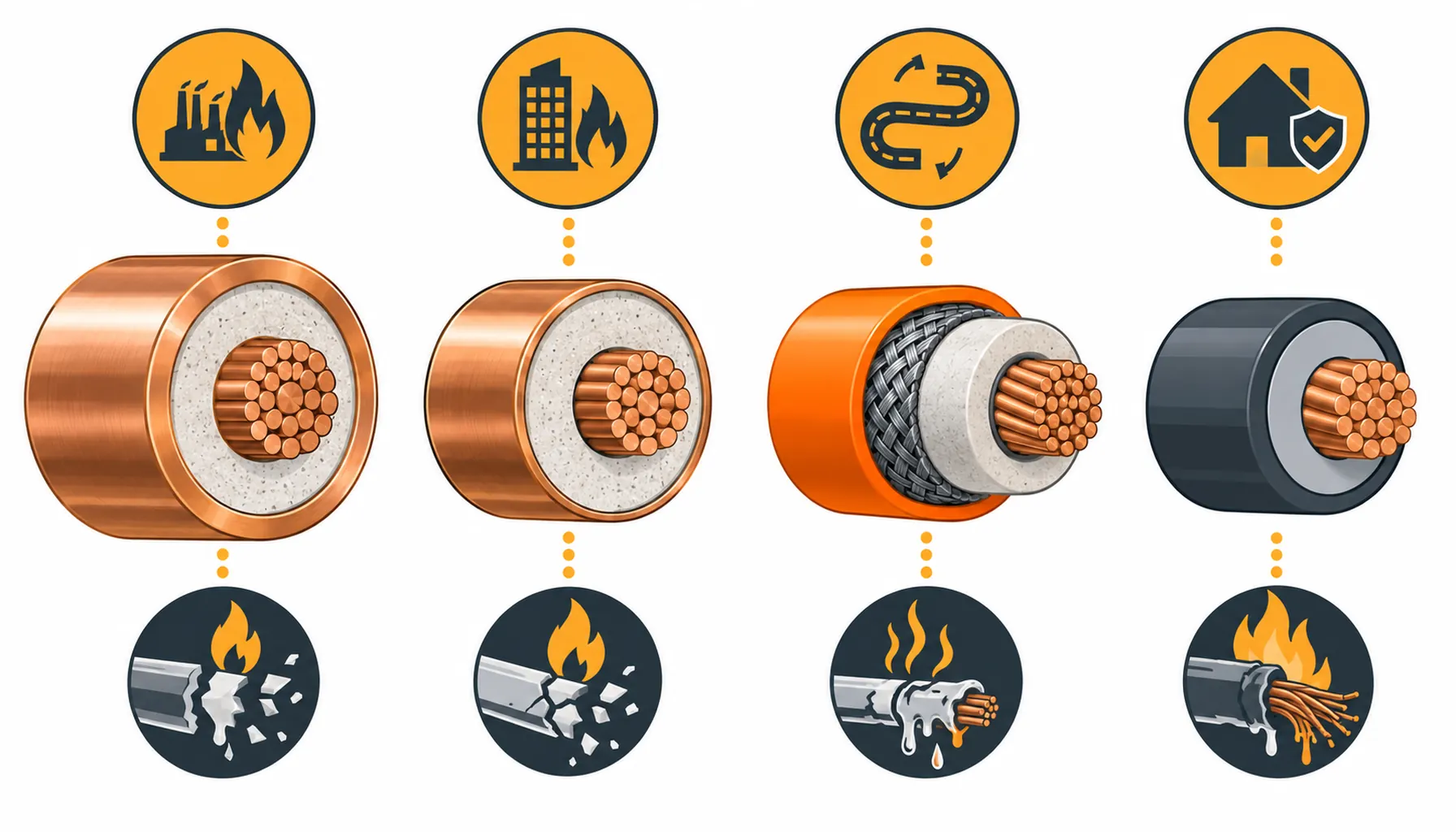
Heavy-sheath copper MI. The classic construction, with a thick seamless copper tube. It is the most mechanically robust option and the most difficult to work: it needs purpose-made tools for bending and stripping, and the terminations are made with a pot and sealant rather than a crimp. It is the right starting point for circuits in aggressive or wet environments where mechanical damage is credible.
Light-sheath copper MI. The same principle with a thinner copper wall, which makes it lighter, cheaper and easier to handle, at the cost of some mechanical robustness. For protected routes inside buildings this is usually the sensible variant, and the price difference between the two is significant enough that specifying heavy sheath by default is a common source of unnecessary cost.
Flexible rated constructions. Where the circuit has to bend repeatedly, or where the route turns in ways a rigid metal tube cannot follow, the answer is a flexible construction with a fire-rated barrier rather than a mineral core, such as the flexible fire resistant family. Different physics, different test evidence, much easier to install, and usually cheaper per circuit once the termination labour is counted.
The rigid family is not one product. Within copper-sheathed constructions there is a heavy-duty variant and a lighter one, and the difference between them is the sheath wall and what it will survive rather than the fire performance. The comparison is set out in our note on the two rigid mineral variants, and it is worth reading before a specification defaults to the heavier one on every circuit. Sheath wall thickness also drives the mass, the bend radius and the termination tooling, so choosing the variant wrongly costs money on the cable, the supports and the labour at the same time.
What they share. All of them are bought on survival test evidence at a stated grade and duration, and all of them need the accessories their approval names. The family difference matters for the installation and the environment, not for whether the circuit survives.
Where Mineral-Insulated Cable Earns Its Cost
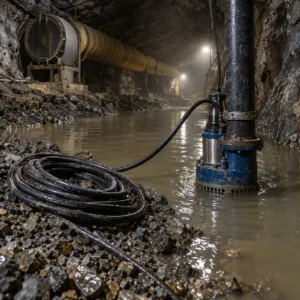
Immersion and washdown. Pump rooms, valve chambers, wet risers and any route that can be flooded. A mineral construction with properly potted ends tolerates water in a way that a polymer cable, however well sealed, ultimately does not.
High temperature and thermal shock. Routes near flues, boiler plant, kitchen extraction, foundry or process heat, where the ambient temperature alone would degrade a polymer sheath.
Mechanical damage in a rated route. A circuit that must survive both fire and impact, in a location where vehicles, tools or moving equipment can reach it, is exactly what the heavy-sheath version is for. The wider range available for each duty, including the screened and paired constructions for control circuits, is set out in the fire resistant cable range.
Very long service life with no maintenance access. In an embedded wall, a slab or a shaft nobody will open, a construction with no organic material has an advantage that shows up twenty years in rather than at commissioning.
Constructions Compared
| Construction | Best Duty | What to Specify | Evidence to Demand | Cost and Lead-Time Driver | How It Fails |
|---|---|---|---|---|---|
| Heavy-sheath copper MI | Immersion, high temperature, credible mechanical damage | Sheath wall thickness, conductor size, bend radius, termination type and potting compound, fixing method | Survival test at the grade, including water and impact where required; termination instructions and tooling list | Copper sheath dominates; terminations are labour-intensive and need specialist fitters | A poor pot seal letting moisture into the powder, or a bend tighter than the tooling allows |
| Light-sheath copper MI | Protected indoor routes with a genuine survival requirement | Sheath variant declared, since it is not interchangeable with heavy sheath, plus the same termination detail | Survival test and construction drawing naming the sheath variant | Lower material and handling cost than heavy sheath; still needs the specialist terminations | Substituted for heavy sheath where impact was actually a risk |
| Flexible fire rated construction | Circuits that bend, turn or move, or where access for specialist fitters is poor | Rated barrier construction, conductor class for flexibility, termination and gland system | Survival test report plus a system approval for glands and fixings | Cheaper to install than MI once labour is counted; material cost varies widely | Gland substitution that voids the approval, or a bend radius exceeded at a tight route |
| Fire rated control and data | Control, monitoring and alarm circuits that must keep signalling | Integrity grade, pair or core arrangement, screening and drain, loop or protocol limits | Integrity test evidence, screen continuity records, system compatibility | Small conductors; the grade and the screening drive cost rather than copper | A supply that survives with a control circuit that does not, so nothing starts |
| Ordinary LSZH construction | Everything not covered above | Reaction-to-fire class, smoke and acidity scores, dimensional requirements | Declaration of performance for the construction, dimensional records | Lowest material cost; the trap is using it where a survival grade was specified | A circuit that burns through in the incident it was expected to survive |
Installation Realities to Price In
The reason a mineral-insulated cable can look expensive in service is that its cost is not in the drum. It is in the labour that a rigid metal tube demands.
Bend radius and tooling. A copper-sheathed cable must be bent with the correct tool to a radius the manufacturer states, and a bend made by hand shortens the life of the sheath and can crack the powder compaction. Our note on cable minimum bend radius covers how that figure should be quoted, and on this family the difference between hand work and tooling is not a preference, it is a requirement.
Terminations. The ends are assembled with a pot, sealant and sometimes a specific sleeving arrangement, and they need a fitter who has done it before. On a project where the electrical contractor has no experience of the family, the first terminations are slow and the learning curve is on the client’s programme. Check the contractor’s history with the construction, or expect to pay for supervision.
Support and handling. The family is heavier than a polymer cable of the same current rating and it does not flex into place, so support spacing and the sequence of installation both change. Our note on firestop cable penetrations covers the crossing details, which for a rigid tube are usually simpler than for a tray full of cables, and that is one of the few places the rigid construction is easier.
Field changes. A design change late in the programme is expensive on this family because a tube cannot simply be re-routed, re-drummed and re-pulled. Where the design is still moving, a flexible rated construction is usually the better commercial bet even if the material costs more.
What to Freeze Before the Order
| Decision | What to State | Evidence to Attach | Cost of Leaving It Open |
|---|---|---|---|
| Construction per circuit | Heavy sheath, light sheath or flexible rated, circuit by circuit, with the reason | A schedule mapping circuits to constructions and environments | Heavy sheath bought by habit, or a rigid tube forced round an impossible route |
| Survival grade | Duration, plus whether water and impact are required | Survival test report at the grade, with the test conditions stated | A construction that passes flame and fails the water it will actually meet |
| Termination system | The pot, sealant, gland and tooling named as part of the system | Termination instructions and a list of tooling the site must hold | Ends assembled the wrong way on a circuit that must survive |
| Installer competence | Which crew installs and terminates, and their experience with the family | References or a sample termination inspected before the order | A programme absorbed by a learning curve on the critical circuit |
| Bend and support detail | Minimum bend radius, tooling required, support spacing and mass per metre | Installation drawing with the manufacturer's figures | Sheath damage that only appears in service |
| Design freeze point | The date after which the route is fixed and changes are priced | A marked-up route drawing accepted by all parties | Late re-routing on a construction that cannot be re-worked cheaply |
Cost, Lead Time and Where the Money Goes
On a mineral-insulated circuit the drum is rarely the largest line. Copper is the biggest material component, and the sheath is a solid copper tube rather than a thin foil, so the metal content per amp is high. But the line that surprises projects is the installation: bending, supporting, terminating and testing a rigid tube takes more hours per metre than any polymer cable, and those hours are on the electrical contract rather than the cable invoice.
The comparison that matters is cost per completed circuit, not cost per metre. That usually narrows the gap between the mineral family and a flexible rated construction, and on short runs with awkward terminations it sometimes reverses it. Where a project needs a defensible number, ask both suppliers to price the same circuit including terminations, and let the installation hours be part of the comparison.
Lead time follows the same logic. Heavy sheath and light sheath are standard products at many sizes, so the cable is often available quickly; the constraint is usually the terminations and the tooling, which are specialist items with their own lead time, and the fitter availability. Booking the terminations with the cable, rather than discovering them at the point of install, is the cheap discipline. Our note on cable factory testing covers the test evidence that should travel with each drum on this family, and the checks worth witnessing before delivery.
When Mineral-Insulated Cable Is Not the Answer
When the circuit does not have to survive. Standard distribution, lighting, small power and anything that the fire strategy does not require to keep working should not be bought on this family. Specifying it everywhere inflates the order and slows the installation for no benefit.
When the route moves late. A rigid tube is a poor choice for a design that is still changing. Where the layout is unsettled, a flexible rated construction or a protected route is the better commercial decision.
When the impact risk is really a route problem. If a cable is being damaged by vehicles, the answer is a barrier or a reroute, not a thicker sheath on an expensive construction.
When the contractor cannot terminate it. The strongest construction installed with the wrong terminations is worse than a compliant flexible one, because the failure is hidden until the incident.
RFQ Checklist
- Circuits listed with the environment, the survival requirement and the reason for the construction
- Sheath variant named explicitly, heavy or light, and not left to the supplier
- Duration and the inclusion of water and impact in the required test conditions
- Termination system with pot, sealant, gland and the tooling the site must hold
- Minimum bend radius, tooling for bending, support spacing and mass per metre
- Installer competence confirmed, with a sample termination inspected before award
- Permitted joint positions, or confirmation that the run is joint-free
- Firestop detail at each penetration, suited to the rigid construction
- Test records per drum and the checks to be witnessed
- Design freeze date, after which route changes are priced as variations
Conclusion
Mineral-insulated cable is the right purchase when a circuit genuinely has to survive water, heat and impact, and the wrong one when it is being specified to avoid thinking about the fire strategy. Draw the boundary per circuit, choose the sheath variant rather than defaulting to the heaviest, and price the terminations and the installation labour with the cable, because that is where this family’s true cost sits. Where the requirement is lower or the route is still moving, a flexible rated construction usually does the job for less.
Kexingyu Cable Group (KXYE) has manufactured cable in Quanzhou since 1996, supplying mineral-insulated, fire-rated and flexible rated constructions for building projects, with the terminations, glands and accessories their approvals depend on. Send us the circuits with their environments, the survival durations and the route conditions, and we will come back with the constructions, the installation implications and the evidence that applies to each. The fastest route is a request for quotation.