Mining Cable Inspection on Delivery: Building an Acceptance Test Plan
Quick Answer: Mining cable inspection works when it is a written plan with named tests, pass criteria and someone whose job it is to witness them. A visual check at the gate catches obvious transport damage and nothing else. The tests that actually protect a mine are dimensional, electrical and documentary, and most of them cost minutes rather than hours if they are planned before the drums arrive.
Introduction
Most mine cable disputes are decided by paperwork that either exists or does not. A drum arrives, it is unwrapped, it is installed, and three months later the run fails. At that point the mine needs a conductor measurement, an insulation resistance record and a certificate that matches the drum. Sites that took those three things on delivery settle the question in a day. Sites that did not settle it by negotiation.
Incoming inspection is also the last point at which the mine has leverage. After installation, a short length or a thin sheath is a shared problem. Before acceptance, it is the supplier’s. That is why the inspection plan belongs in the purchase order rather than in a stores procedure.
What Incoming Inspection Is For
It is not a substitute for the supplier’s factory testing, and it is not a route to finding out whether a cable will last ten years. Incoming inspection answers three narrower questions: is this the cable that was ordered, is it undamaged, and does its documentation match the drum in front of you.
Those three questions are worth asking because the common failures are mundane. A drum of the wrong conductor class. A length short by twenty metres. A sheath below the specified wall. A certificate that refers to a different construction. None of these need a laboratory, and all of them are much cheaper to find on the yard than underground.
The Five Groups of Tests Worth Witnessing
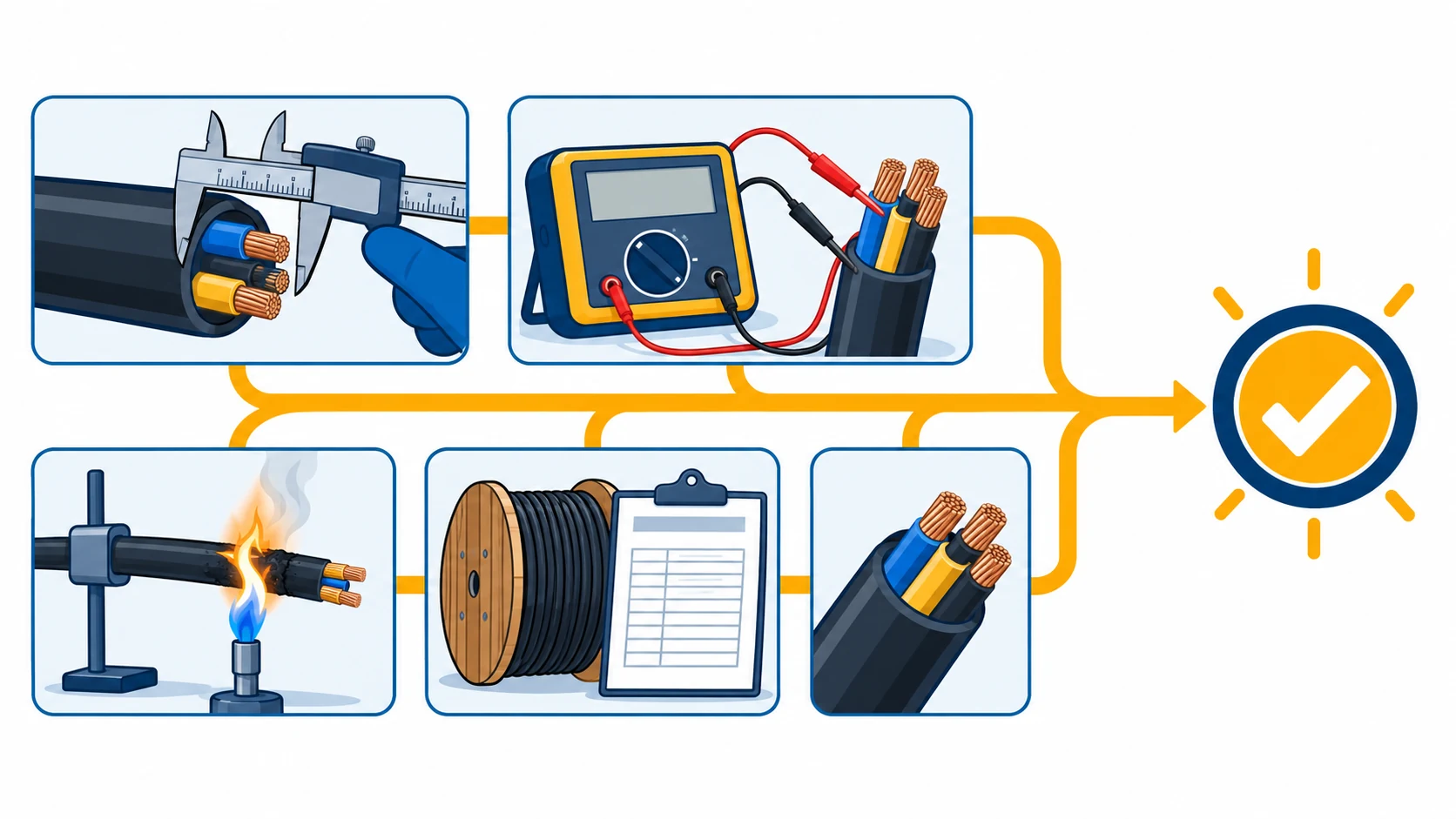
The table below groups the checks by what they prove, so a mine can decide which ones to witness and which to accept on documents.
| Group | What It Proves | How It Is Checked | Acceptance Criterion | Time and Cost | If It Is Skipped |
|---|---|---|---|---|---|
| Identity and length | The right construction, in the right quantity | Drum marking, packing list, measured length on a run | Marking and construction match the order line by line | Minutes per drum, no equipment | A wrong construction installed and discovered in service |
| Dimensional | Conductor area, sheath wall and overall diameter | Calipers on a cut sample, several points round the circumference | Minimum wall and nominal area within the stated tolerance | Under an hour with a sample cut | A thin sheath or a short conductor that nobody can prove later |
| Electrical | Continuity, insulation integrity and screen path | Conductor resistance, insulation resistance, screen continuity end to end | Values within the standard and above the minimum for the voltage class | Minutes to an hour per drum, simple instruments | A joint or a screen fault energised and a second outage |
| Mechanical and flame | The compound performs as claimed for the duty | Hardness, tear and any flame or antistatic requirement | Matches the approved sample and the test report | Sampled rather than every drum; may need a laboratory | A jacket that fails the mechanism it was bought for |
| Documentation | The drum is traceable to its test evidence | Certificate, test report and drum number matched | Report names the exact construction and the drum reference | Minutes if the paperwork arrives with the drums | No remedy at all when a failure is disputed |
Sampling: What to Test and What to Look At
Testing every drum is rarely necessary and never free. The useful split is between checks that are cheap enough to do on all drums and checks that are better sampled.
On every drum. Identity, drum marking, a visual check of the sheath and the ends, and a continuity check. These take minutes and catch the mistakes that actually happen, including a drum that was transposed with another order line in the yard.
On one drum per construction. Cut a sample and measure the conductor and the sheath. This is where the arguments get settled, and it is much better done with both parties present than later. Our note on conductor copper checks covers what a conductor measurement does and does not establish.
On sampled drums per batch. Mechanical and flame properties, checked against the approved sample. Where a compound claim is central to the purchase, agree the sampling rate and the method before award rather than after delivery. Our note on cable sample approval describes how approved samples should be kept so the comparison is meaningful.
On all drums, on paper. The certificate and test report, matched to the drum number. This is the cheapest check in the list and the one most often left until it is too late.
Building the Witness Plan
A witness plan says which tests are seen by the mine or its representative, before shipment rather than on arrival. For mining cable, three tests are worth witnessing where the volumes justify it.
Conductor and insulation tests on a finished drum. Where a mine buys in volume, seeing the routine tests at the factory removes most of the doubt before the freight is paid. Our note on factory testing explains which tests are routine and which are type tests.
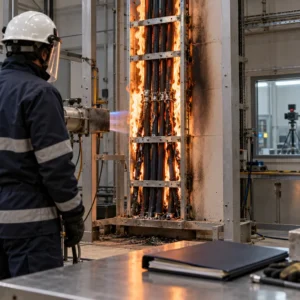
Flame and antistatic tests where a gassy roadway depends on them. These are the tests that determine whether the cable can legally be installed underground in some jurisdictions, and they are worth witnessing on first delivery or on a change of compound.
Mechanical tests where the compound is the reason for the purchase. If the mine paid a premium for tear or abrasion resistance, the test that supports that claim is the one to see. The IEC 60811 mechanical test series is where tensile and elongation data comes from.
Where the mine cannot attend, a third party witness is the alternative, and it is most worthwhile on the first delivery or on a new construction. Our note on third party cable inspection sets out how that is usually arranged. Where a factory test and a site test are both planned, the division of responsibility follows the logic described in our note on factory and site acceptance testing, and it should be written down rather than assumed.
What to Freeze Before the RFQ Goes Out
| Decision | What to State | Evidence to Attach | Cost of Leaving It Open |
|---|---|---|---|
| Tests to witness | Named tests, at the factory or on site, with dates | A witness plan with the test list and criteria | Tests done and not seen, and no right to re-run them |
| Acceptance criteria | Values, tolerances and the standard they are taken from | The standard reference and the agreed limits | An argument about whether a result passed |
| Sampling rate | How many drums are cut and tested per construction | A sampling plan agreed before award | Cutting drums that did not need it, or cutting none |
| Cut sample retention | Length kept, labelling and where it is stored | Stored samples referenced to drum numbers | No physical comparison when a claim is made |
| Documentation | Certificate and test report per drum, named construction | A document schedule with delivery | Drums that cannot be traced back to any test evidence |
| Nonconformance route | Who decides, in what time, and what the remedy is | A written clause naming the remedy and the clock | Disputed cable installed because the clock ran out |
Drum Records and Packaging
The inspection ends with a record, and the record is what makes the inspection worth doing. Keep, for every drum: the drum number, the construction, the length, the measured values, the certificate reference and a photograph of the drum marking. This file, kept with the cut sample, is what turns a failure investigation into a short conversation.
Packaging matters here too. A drum that arrives with a damaged outer wrap or a flange broken in transit has had its contents stressed in ways that will not show until the cable is installed. Note transit damage at the gate, with photographs, and record it against the delivery rather than discovering it later. Our note on cable drum packaging for export describes the protection that should be in place before the container is loaded.
Lead Time, Batch Size and Cost Structure
Inspection requirements change the lead time, and buyers who discover that late lose the advantage they gained by planning the tests in the first place.
Batch size sets the cost of testing. A cut sample destroys a few metres of cable, and a witness visit carries a fixed travel cost. On a large order those disappear into the price. On a short order of two or three drums they can be a visible fraction of the total. Where a mine buys small quantities repeatedly, it is usually cheaper to inspect fewer drums thoroughly and rely on the certificate for the rest, than to run a full programme on every small delivery. Our note on cable MOQ and lead time explains how minimum order quantities interact with the batch sizes a mine typically buys.
Witnessing adds a scheduling constraint rather than a long delay. A witnessed test has to be booked for a date the works can produce the drum, and that date has to line up with the shipping slot. Where a shutdown date is tight, book the witness date before the order is placed. On a first delivery of a new construction, that single booking is often what keeps the project on schedule.
The cost of inspection is small against the cost of a failed run. A day of sampling on the yard costs less than one shift of lost production on a conveyor or a hoist. The comparison is not inspection against nothing. It is inspection against the probability of a claim, and on mine duty that probability is not low.
Where a project fixes prices early, the inspection cost belongs in the quotation rather than in a side letter. Our note on cable price breakdown sets out the elements that make up a quotation, and testing and documentation should appear there explicitly so that two bids can be compared on the same basis.
When a Laboratory Test Is Not the Answer
When the cable is already installed. Incoming inspection is a gate, not a maintenance tool. Once a drum is on the machine, an insulation test tells you about the installation as much as the cable. Our note on in service cable testing belongs to that stage instead.
When the failure needs the mine to have kept evidence. A claim made without a cut sample and without drum records is a negotiation, not a test. The time to fix that is on the next order, not on this dispute.
When the incoming inspection is being used to avoid specifying properly. No amount of gate testing will correct a specification that never named the compound, the conductor class or the approval standard. Inspection confirms a specification. It does not replace one.
When the volume does not justify witnessing. On a short order of two drums, a full witness programme costs more than the risk. Sample the cut drum, insist on the documents and keep the sample. Reserve witnessed tests for volume orders and new constructions.
When the cheapest quotation is accepted on the understanding that inspection will catch problems. A supplier who expects to be inspected supplies a different product than one who expects to be trusted. Price that difference into the comparison rather than treating inspection as the safety net.
RFQ Checklist
- Named tests to be performed, and which of them will be witnessed
- Acceptance criteria with values, tolerances and the standard reference
- Sampling rate for cut samples, and which construction they cover
- Conductor area and sheath wall measurement method agreed
- Insulation resistance test voltage and minimum values per circuit class
- Screen and earth path continuity check on screened constructions
- Flame and antistatic test evidence where a gassy roadway applies
- Mechanical test evidence where the compound is the reason for the purchase
- Certificate and test report per drum, naming the exact construction
- Cut sample length, labelling and storage location
- Packaging and transit protection requirements, with damage reporting
- Nonconformance clause naming the remedy and the decision clock
- Third party witness arrangement if the mine cannot attend
Conclusion
Mining cable inspection protects a mine when it is planned, written down and evidenced. Decide which tests to witness, set the acceptance criteria from a named standard, cut one sample per construction, and keep the drum records and the sample together.
Kexingyu Cable Group (KXYE) has supplied electrical cable from Quanzhou since 1996, including the rubber-sheathed, screened and reeling-duty constructions used on mine duty, along with the routine and type test evidence that goes with them. Send the cable schedule and the inspection requirements, and we will come back with the test list that applies to each construction, the witness arrangements, the documentation pack per drum, and a delivery plan against your shutdown window. The fastest route is a request for quotation.