Buying Overhead Line Cable for Kazakhstan Grid Projects: ACSR, AAAC and Covered Options
Quick Answer: Overhead line conductor is bought against four published numbers: the stranding and nominal area, the rated tensile strength, the DC resistance at 20 degrees and the weight per kilometre. Add the galvanising class, the grease content where the conductor is greased, the drum lengths and the fittings the line design assumes. A quotation that lists those fields can be checked against a sag-tension calculation. One that offers a conductor name and a price per tonne cannot, and the difference surfaces at stringing, when the sag does not match the design.
Introduction
Kazakhstan’s transmission and distribution reinforcement work runs on overhead line, and most of the conductor is bought on a name rather than a specification. “ACSR 120” and “ACSR 150” travel through enquiries, offers and purchase orders without the stranding, the strength or the coating ever being written down. The line is then designed on assumed values, and the assumptions are tested for the first time when the stringing crew measures sag.
This guide is for EPC buyers, utility procurement teams and distributors sourcing overhead conductor for Kazakhstan. It covers the three families that come up in most enquiries, the data a supplier must publish for a line design to close, the fitting interfaces that decide whether the conductor survives vibration, and the tests to require at delivery. Distribution-level insulated overhead is a separate purchase and is covered in our note on grid expansion equipment.
What an Overhead Line Order Actually Specifies
The stranding is the identity of the conductor. Aluminium layers over a steel core, with the counts written as 54/7 or 30/7, define the conductor as much as the nominal area does. Two conductors both sold as 150 mm squared can carry different aluminium-to-steel ratios, and that ratio drives weight, strength, sag and the fittings that grip them.
Rated tensile strength is the number the line design uses. It is published in kilonewtons for the whole conductor, calculated from the wire strengths, and it sets the tension limit, the tower loading and the clamp slip requirement. An offer that gives a “breaking load” without saying whether it is calculated or measured is not usable in a sag-tension study.
Resistance and weight keep the offer honest. DC resistance at 20 degrees in ohms per kilometre and mass per kilometre are the two numbers that expose a conductor that is thinner than its name suggests. Ask for both, and compare them against the standard the enquiry cites rather than against the previous supplier’s sheet.
ACSR, AAAC and the Alloy Question
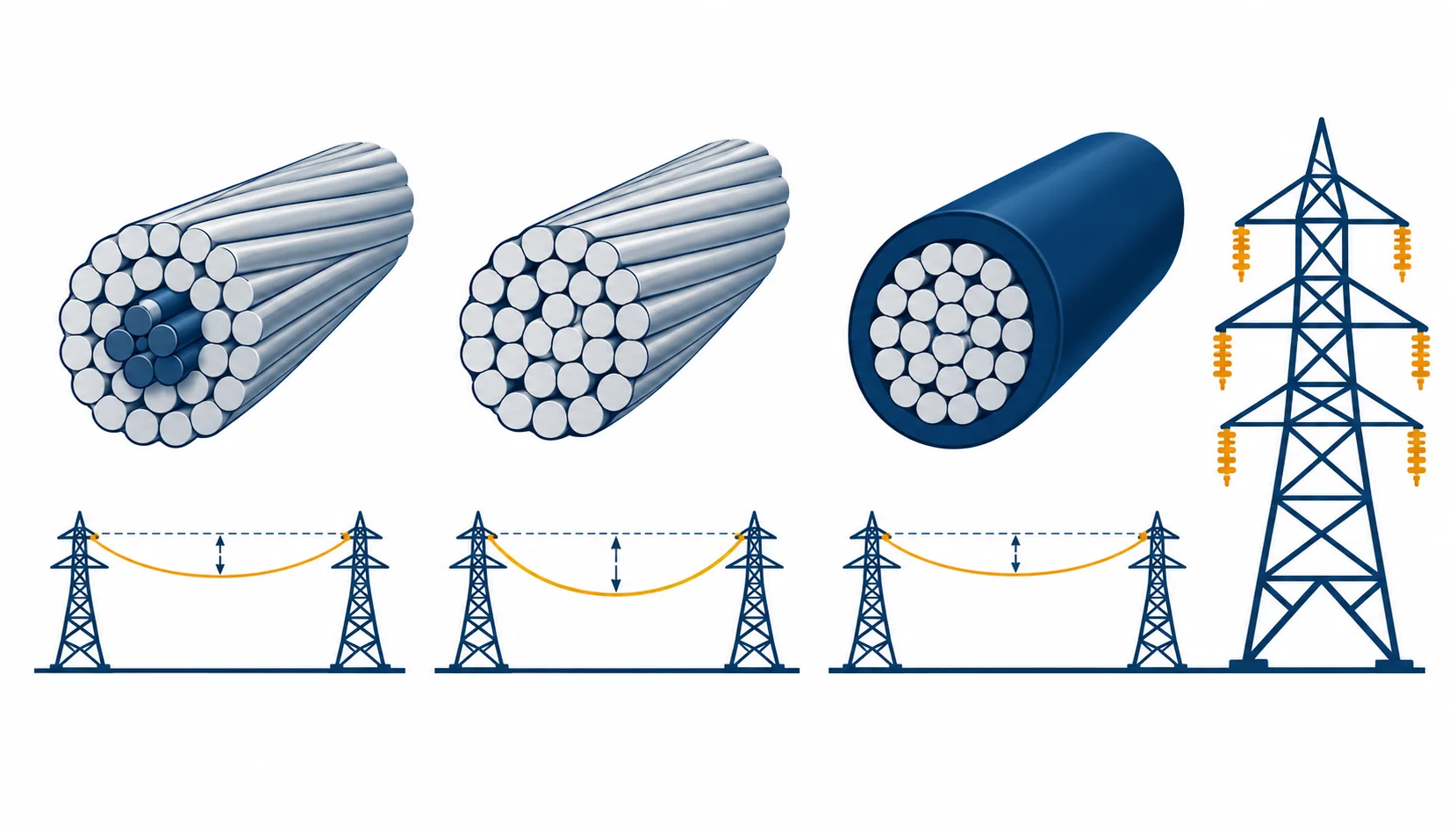
ACSR remains the default on long spans and high-tension towers. The steel core carries most of the tension and the aluminium carries the current, which is what allows longer spans and tighter tension on the same tower family. The trade-off is a bimetallic conductor whose sag behaviour changes with load history, and a core that needs galvanising or aluminium cladding to survive a steppe climate.
AAAC replaces the steel core with an aluminium alloy. A homogeneous conductor is simpler to joint, resists corrosion without a galvanised core, and behaves more predictably in sag because there is one thermal expansion curve instead of two. It is often chosen where the line runs through corrosive or coastal conditions and where spans are moderate.
The metal choice is a system decision, not a price decision. Conductor cost, tower cost, loss cost and the fittings inventory all move together. A buyer comparing ACSR and AAAC on price per tonne is comparing the smallest of those four numbers, and the comparison belongs in the line design, not in the procurement sheet. The same reasoning on conductor economics is set out in our note on aluminium versus copper conductors.
Bare, Covered and Insulated Overhead Options
Bare conductor is the cheapest per metre and the most demanding on clearances. It needs the right right-of-way, the right phase spacing and the right pollution creepage at insulators. Where any of those is constrained, the saving on conductor is spent on structures or on tree cutting instead.
Covered conductor buys clearance, not safety from contact. An XLPE or HDPE covering on a bare conductor allows reduced phase spacing and contact with vegetation, which is why it is used on rural distribution and in tree-prone corridors. It is not insulated cable in the sense of a service connection, and the fittings still have to be rated for the covered diameter.
Insulated overhead systems are a different purchase. Self-supporting insulated conductor bundles with a messenger are a distribution product with their own hardware family and their own span rules. Those are covered separately in our note on grid interconnection for large loads, and mixing the two families in one enquiry is the fastest way to an offer nobody can compare.
Overhead Conductor Options on a Kazakhstan Line
The table sets out the four options that appear on most Kazakhstan line enquiries, with what each one commits the buyer to and where it usually goes wrong.
| Option | What to Declare | Evidence to Ask For | Cost and Lead Time | Risk If Left Open |
|---|---|---|---|---|
| ACSR, galvanised steel core | Stranding, nominal area, RTS, resistance, grease content, zinc class | Wire test reports and a calculated strength sheet | Widest supply; long lengths on one drum | Core coating underspecified for the climate |
| ACSR with aluminium clad core | Cladding grade, strand counts, RTS, bimetal joint method | Cladding certificate plus conductor test sheet | Higher metal cost, fewer mills | Core corrosion at the first damaged span |
| AAAC, alloy conductor | Alloy temper, stranding, RTS, resistance, creep data | Alloy certificate and conductor test report | Competitive at moderate spans; fewer regional stockists | Sag assumed from an ACSR curve that does not apply |
| Covered conductor, XLPE or HDPE | Cover thickness, overall diameter, adhesion, tracking resistance | Cover thickness measurements and aged samples | Higher per metre; reduced clearance cost | Fittings sized to bare diameter will not grip |
| Bare copper or small aluminium for jumpers | Area, temper, termination method at the clamp | Conductor and lug compatibility confirmation | Small quantities, short slots | Bimetallic joint left without a transition plate |
Tension, Sag and the Data You Have to Publish
Every day tension and maximum tension are two different limits. The line design sets an everyday percentage of RTS to control vibration and a maximum percentage for the worst ice and wind case. The supplier needs both to confirm the conductor and the fittings, and the enquiry that gives only one gets a conductor that suits one condition.
Creep and load history change where the conductor ends up. Aluminium creeps under sustained tension, so the sag after two summers is not the sag at stringing. Ask whether the supplier publishes creep data or a sag-tension table for the construction, because a line built to initial sag ends up low over the road it crosses.
Climate inputs belong in the enquiry. Minimum temperature, maximum temperature, ice load, wind pressure and the pollution level along the route each move a decision: conductor diameter, creepage, and sometimes the choice between bare and covered. Kazakhstan routes span several of these zones in a single project, so state them per section rather than as a project average.
Thermal rating is where the conductor choice meets the load forecast. A line rated for a future load may need a larger conductor or a higher permissible temperature, and both change the sag at the worst case. Ask for the rating basis the design used, then check that the conductor offered was rated on the same basis; the derating logic is set out in our note on ampacity and field derating.
Fittings and the Interface Nobody Prices
Clamp slip strength is a number, not a habit. Suspension and tension clamps are qualified against a percentage of conductor RTS, and a clamp qualified on a different conductor is not qualified on yours. Ask for the slip strength with the fitting offer, and check it against the conductor actually ordered rather than the one in the drawing title block.
Vibration control follows span and terrain. Long spans across open steppe are the classic case for dampers and armour rods. Where the design calls for them, the fitting list is part of the conductor order, because retrofitting dampers on a live line costs several times what they cost in the drum package.
The joint between two drum lengths is a field operation. Compression or explosive joints are chosen on conductor type and tension, and the tooling has to match. Ask who supplies the jointing tools and whether the crew is qualified on that joint type, then set the drum lengths so the joint count stays inside the outage plan, as described in our note on drum length and jointing strategy.
Acceptance Tests on a Conductor Delivery
Wire tests before stranding and conductor tests after. The routine regime covers wire diameter and tensile strength, zinc coating mass, and the completed conductor’s DC resistance and diameter. Ask for the values per drum, not a certificate that says the batch conformed.
Grease and coating are the two most commonly skipped checks. Greased ACSR is specified by grease mass percentage, and galvanising by coating mass in grams per square metre. Both are cheap to test and expensive to discover missing after the conductor is in the air, where the only remedy is replacement.
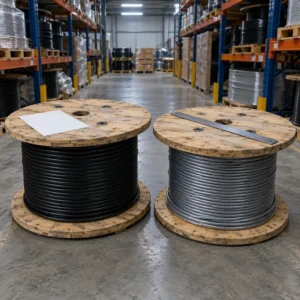
Packaging protects a product that is easy to damage. Conductor arrives on wooden or steel drums with the outer layers exposed to handling, and a crushed or abraded outer layer becomes scrap metres at the first pull. The packing standard is set out in our note on cable drum packaging for export, and the wider test regime in cable factory testing.
Overhead Line Order Freeze List
These are the fields to settle and write into the order before the purchase order goes out.
| Item to Freeze | How to Write It Into the Order | Evidence to Attach | Cost of Leaving It Blank |
|---|---|---|---|
| Stranding and nominal area | Layer counts written out, e.g. 54 aluminium over 7 steel | Construction drawing per line | Conductor identity lost, fittings and sag assumed |
| Rated tensile strength | Value in kilonewtons, calculated or measured stated | Strength calculation sheet | Tension limit unknown, tower loading unchecked |
| Resistance and mass | Ohms per kilometre at 20 degrees; kilograms per kilometre | Test values per drum | Undersized conductor accepted at face value |
| Core coating or alloy | Zinc mass per area, or alloy temper and grade | Coating or alloy certificate | Corrosion appears in the first wet season |
| Grease content | Mass percentage, test method named | Grease test result | Internal corrosion from the core outward |
| Drum lengths and tolerance | Length per drum, tolerance, drum type and marking | Drum schedule and packing standard | Waste at the end of every pull, extra joints |
| Fittings and interface | Clamp types, slip strength, dampers, joint method | Fitting test reports matched to the conductor | Clamps that slip or fittings that do not fit |
When Overhead Conductor Is Not the Answer
When the corridor is the constraint, not the conductor. A route through a town or a protected area usually costs more in wayleave and structures than an underground cable costs in materials. Buying conductor for a line that will not be permitted is the expensive version of the same decision.
When pollution is severe enough to drive creepage. Coastal and industrial corridors with heavy pollution need longer insulators and sometimes larger conductor spacing. A standard line design carried into that environment produces flashovers that no conductor upgrade fixes.
When the load is small and the distance is short. A short spur to one customer is often cheaper as cable in a trench, with no towers, no wayleave negotiation and no vegetation management programme to fund for the next thirty years.
When only the price per tonne is compared. Two conductors at the same nominal area can differ in strength, coating, grease and creep. If the evaluation cannot normalise those four fields, it is buying metal by weight and calling it a conductor.
RFQ Checklist
- Stranding and nominal area written out, per line
- Rated tensile strength in kilonewtons, with the basis stated
- DC resistance at 20 degrees and mass per kilometre required on the test sheet
- Core coating class, or alloy temper and grade, named explicitly
- Grease content and test method where the conductor is greased
- Cover thickness and adhesion where covered conductor is specified
- Clamp slip strength and fitting list quoted against the conductor ordered
- Vibration control items listed: dampers, armour rods, spiral fittings
- Drum lengths, tolerance, drum type and marking standard confirmed
- Climate inputs given per section: temperature range, ice, wind, pollution
- Routine test values per drum, plus the packing standard for the route
Conclusion
Overhead conductor is a small share of a line’s capital cost and a large share of its risk. The stranding, the strength, the coating and the grease are four lines in an enquiry that decide whether the sag matches the design and whether the conductor is still there in fifteen years. They cost nothing to write down at enquiry stage and a great deal to discover at stringing.
Kexingyu Cable Group (KXYE) supplies bare and covered overhead conductor from Quanzhou, quotes Kazakhstan line enquiries against stranding, strength and coating as written, and attaches the test values per drum with the packing standard for the route. Send your line schedule, the section climate inputs and the destination, or upload your bill of quantities. A request for quotation is the fastest route to start, and the wider sourcing picture is in the Kazakhstan supplier checklist.