Qatar and the Gulf: Data Center Buildout and Cable Requirements
Quick Answer: Qatar is converting a world-class connectivity position into a deliberate, state-backed buildout — smaller than its neighbors but exacting, rewarding the most documented suppliers rather than the largest.
Qatar enters the data center race from a position its neighbors can’t copy: one of the world’s densest fiber landing points, abundant energy, and a state that plans infrastructure in decades rather than quarters. The buildout is deliberate — national digital programs, AI initiatives, cloud regions landing in Doha — and it inherits a specification culture shaped by mega-event infrastructure and green certification frameworks. For cable suppliers, Qatar isn’t the Gulf’s biggest market, but it may be its most quality-selective: smaller volumes, larger files, and buyers who read the documentation before they read the price.
Introduction
The regional frame is a Gulf power market adding generation, grid and computing at once, with the sourcing landscape mapped in Middle East power equipment sourcing, and the global demand analysis in data center power demand growth places the Gulf among the fastest-growing computing regions in the world. Qatar’s slice of it is distinctive: a compact national market where a handful of programs carry most of the volume, each specified to international frameworks with a national utility layer on top. In a market of few, large, exacting buyers, the supplier list is short. Getting onto it is the whole game.
What Doha's Projects Demand From Cable
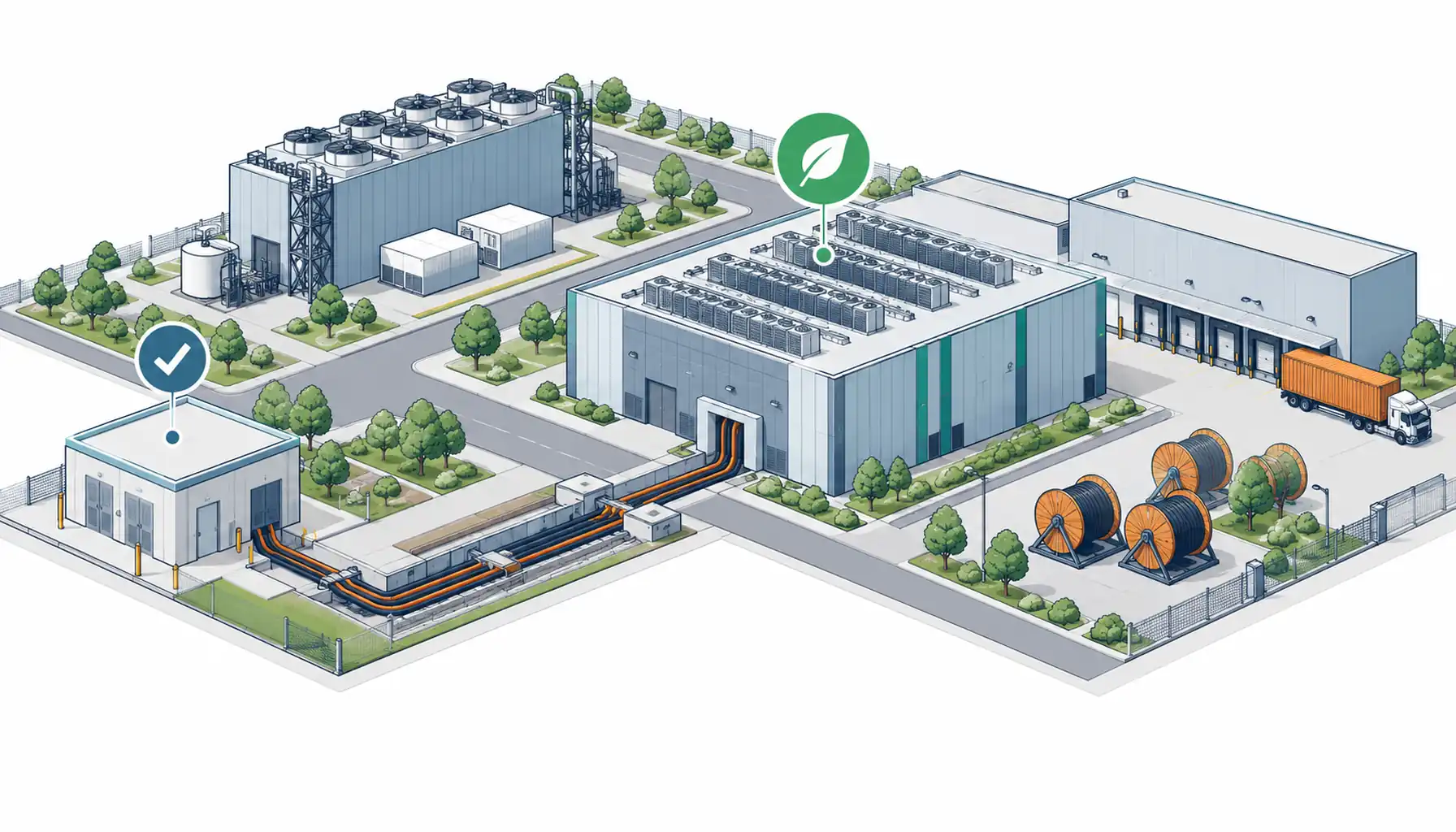
The electrical bill follows the hyperscale chain — MV feeders engineered to the standards framework in our MV and LV standards guide, LV distribution to UPS strings sized per UPS sizing for data centers, LSZH hall cabling, monitoring layers — with three Qatari signatures. Utility gatekeeping: the national utility’s standards govern the intake and substation layers, evidence is presented in the formats those standards define, and cable that has not cleared the utility file does not get connected regardless of consultant approval. Heat and environment: Gulf ambients drive derating on every run, and the compact geography of Doha’s campuses means routes are short but dense — engineering discipline matters more than route length. Green certification: sustainability frameworks score embodied materials, energy losses and fire performance, and cable parameters feed the scorecard. Low-loss constructions and documented compounds earn points that buyers count.
| Layer | Cable Family | Qatari Signature |
|---|---|---|
| Intake and substations | MV XLPE feeder cable, compact substation link | National utility standards gate the connection file |
| Distribution and UPS | LV power cable, parallel feeders | International uptime tiers; consultant-gated submittals |
| Halls and galleries | LSZH power and structured cabling | Fire performance scored inside green certification |
| Efficiency layer | Low-loss, documented constructions | Cable parameters feed the sustainability scorecard |
| Documentation | Type tests, certificates, batch traceability | Few buyers, large files, long institutional memory |
Who Buys, and What the Programs Look Like
The buyer map is compact enough to hold in one view. National digital and AI programs buy through state entities with master consultants attached, and their cable bills are the largest in the market — specified once, inherited by every phase. Carrier and connectivity operators buy for their own facility expansions, with procurement rhythms that follow bandwidth demand rather than construction seasons. Enterprise and colocation operators fill the base of the market through local integrators, on shorter cycles that reward suppliers already holding current files. Across all three buyer types runs the same thread: every project touches the national utility at the connection point, and every project reports into a certification culture that scores sustainability. A supplier entering Qatar therefore builds for reuse — one evidence architecture, three output formats — because the market is too small to justify a bespoke file per buyer and too exacting to forgive a generic one. The compactness is the strategy: in a market this size, being known by every buyer is achievable, and being unknown by any of them is fatal.
Qualifying in a Market of Few, Large Buyers
Qatar’s compact market changes the qualification strategy: with a handful of programs carrying the volume, a single shortlist position is worth more than in a broad market, and the path in is documentation depth rather than price aggression. The sequence: utility-format evidence first — the intake and substation file assembled to national utility standards before the tender, because connection-level review does not wait for stragglers; consultant submittals second — type tests and batch traceability aligned to the international frameworks the projects specify; then program posture — the coordination logic of one coordinated power equipment supplier, because Doha’s campuses energize as systems and the electrical families move on one calendar. The recurring failure catalog of international power equipment sourcing mistakes compresses into one line here: in a market of few buyers, every delivery is a reference, and every miss is remembered by everyone.
| Stage | Action | Classic Trap |
|---|---|---|
| Qualification | Utility-format and consultant files both assembled and current | Consultant file ready, utility file missing at connection review |
| Specification | Derating and low-loss parameters stated for the green scorecard | Efficiency parameters omitted from a sustainability-scored bid |
| Tender | Program-level schedule and coordination commitments submitted | Bidding as a one-off order in a market that builds programs |
| Delivery | Batch identity reconciled per consignment; references protected | One weak delivery in a market of few, well-connected buyers |
| Repeat | Record carried into the next national program | Treating the first project as the end of the relationship |
When a Small Market Is Not a Small Opportunity
Two cautions frame the outlook. Volume is not the only measure: Qatar’s compact, exacting market pays for documentation depth, and a qualified supplier carries the credential into the wider Gulf, which is the regional corridor logic that links Doha to Riyadh and Dubai. And selectivity cuts both ways: the same short buyer list that makes entry hard makes retention cheap. Suppliers who hold their file and their calendar keep their position for program after program, without re-earning it tender by tender. A third: the buyer map is small enough that reputation moves through it in weeks, in both directions. That’s precisely why the file and the calendar are kept current even between programs, because in Qatar the interval between orders is when the next buyer is checking references.
RFQ Checklist: Qatar Lines for the RFQ
Put the market’s questions in writing:
- Utility-format evidence for intake and substation layers, current and complete
- Constructions mapped to international frameworks with Gulf-ambient derating stated
- Low-loss and fire-performance parameters stated for the green certification scorecard
- Type-test reports from accredited laboratories, traceable to offered constructions
- Batch identity and marking commitments per consignment
- Program-level delivery schedule coordinated with the electrical families
- Framework terms for repeat programs across the national buildout
Conclusion
Qatar is the Gulf’s quality gate: a compact market where few, large, exacting buyers run deliberate programs, where utility standards and green certification shape the cable bill as much as the load does, and where documentation depth — not volume discounts — decides who is on the list. The opportunity is durable precisely because it is selective, and the credential travels across the region, into Saudi’s gigawatt programs and the UAE’s free zones and back, carrying Qatar’s exacting standard with it wherever the next file is opened.
Kexingyu Cable Group (KXYE) approaches Qatar the way the market demands: utility-format evidence assembled early, low-loss and fire parameters stated for the sustainability scorecard, and program-level calendars the factory keeps — supply built for markets that read the file first. In practice that means the file is never done: surveillance updates, batch reports and conformity renewals land between programs, and the suppliers who file them on time stay on the shortlist.