Winter Transit and Cable Packaging: Protecting Drums on Cold Routes
Quick Answer: Winter does not change what a cable is, it changes what happens to its packaging: wraps stiffen and tear at the edges, steel flanges become brittle under impact, condensation forms inside a tarpaulin at every temperature crossing, and a drum left in an open yard collects ice where the wrap has lifted. The specification that survives a cold route is written in four places: the drum build, the wrap, the lashing plan and the receiving instruction. A cable rated for cold weather does not arrive usable if the drum that carries it was packed for summer.
Introduction
This page covers the packaging and handling layer of winter transit on the Central Asian lanes: what low temperature does to drums and wraps, how a packing specification is written for a cold route, what changes in loading and yard practice, how the season window shapes the schedule, and what the receiving side must do before a frozen drum is moved or unwound. It is the winter supplement to the general export packing standard, not a replacement for it.
The regional buying context is in our Central Asian cable buying hub. What follows assumes the route and the delivery term are already chosen and asks what the cold months do to the goods while they travel.
Why Winter Is a Logistics Season, Not a Product Spec
Cable for cold climates is a product question: insulation and sheath compounds tested for installation at low temperature, flexibility retained in a frozen trench, and the evidence to prove both. Packaging for winter transit is a different question, asked by a different person, and answered with drum construction, wrap layers and handling rules rather than with a compound designation.
The two get confused because the failure looks the same. A sheath cracked at the drum edge in January can be blamed on the compound or on the wrap that let the edge freeze and take an impact. The distinction matters commercially, because one is a warranty matter and the other is a packing claim, and they are argued with different documents.
For buyers sourcing in Kazakhstan the product side is set out in our note on buying cold resistant cable for Kazakhstan. This page stays with the packaging layer, and the rule it keeps returning to is simple: the drum is the product’s winter coat, and the coat is specified per route, not per catalogue.
What Cold Does to Drums, Wraps and Sheaths
Steel loses impact toughness as temperature falls, and a flange that shrugs off a summer knock can crack under the same handling at minus twenty. Timber and plywood behave differently again, drying and splintering over repeated handling. The drum build, steel rim thickness, flange material and barrel strength, is the first thing a winter specification states.
Wraps are the second. Polymer wrap and tarpaulin stiffen in extreme cold and tear where they cross a sharp edge, and a tear that opens at the border stays open for the rest of the journey. Water that enters through a torn wrap sits against the cable, freezes, and opens the tear wider; the damage compounds at every transfer point.
The cable itself usually tolerates transport cold better than the packaging around it, but not always: a drum dropped hard in deep cold can crack a sheath at the point of impact, and the evidence of cause is in the damage pattern. Those patterns, and what they imply about handling rather than product, are catalogued in our note on cable damage and wear patterns.
The Packaging Specification for a Cold Route
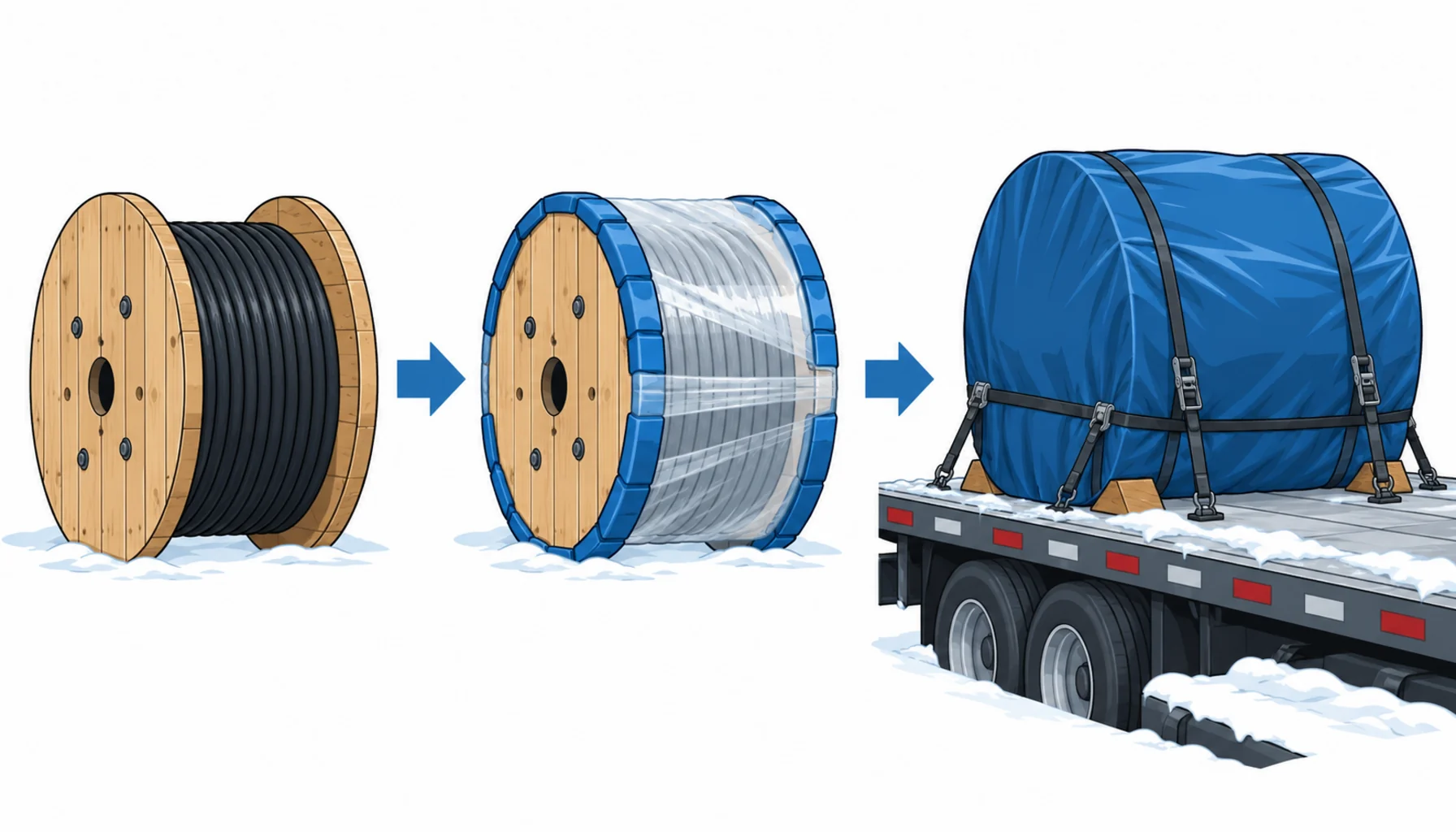
A winter packing specification adds four items to the standard export build. Edge protection under every wrap turn, so the wrap never bears directly on a flange edge. A wrap count and material rating stated for the lowest temperature the route will touch, not for the loading yard. Sealed cable ends, long enough to survive handling, because water that enters an end is the most expensive water in the consignment.
The fourth item is drainage and breathability. A wrap sealed perfectly against water traps condensation against the drum; a wrap open to the wind lets snow in. The workable answer is a layered build: an inner wrap that sheds water, an outer cover that handles weather, and a stated method for opening and re-closing at inspection. The full standard build is set out in our note on cable drum packaging for export.
Cost discipline matters here, because packaging is where a quote is quietly thinned. A specification that names the wrap layers, the edge protection and the end seals, and appears in the offer as a line item, survives negotiation. A phrase like export standard packing does not, and the difference shows up in February.
Loading, Lashing and the Winter Yard
Lashing practice changes with the season because the surfaces change. Icy flatbed decks and frozen yard ground alter how a drum can be chocked and how a crane can set it down, and the lashing plan should assume that at least one lift happens on iced surfaces with gloves on. Spare dunnage and a stated stacking rule belong in the loading instruction, not in the crew’s experience.
The winter yard is its own risk. Drums staged outdoors overnight collect ice between wrap and flange, and the first lift of the morning drops the ice into the consignment. Where staging is unavoidable, the instruction is to stage on dunnage, keep wraps closed, and limit the time between truck and covered storage to hours rather than days.
Most of this is preventable damage rather than transit damage, which is why the site side of it is covered in our note on site cable damage prevention. The same rules apply at every intermediate yard between the factory and the site, and the delivery annex should say so.
Season Windows and Winter Routing
The construction season shapes the calendar more than the weather does. Cable ordered for a spring installation is usually wanted at the border before the thaw, when transport is still reliable but the site is not yet working. Orders placed in autumn compete with the whole region’s push to close sites before winter, and slot prices on the rail lines move accordingly.
Routing also shifts. Mountain road passes that carry summer traffic close or slow in winter, which pushes more volume onto the rail crossings and lengthens the queue there. A schedule written in September with a road assumption can be a rail schedule by January, and the transit window inside the price has to carry that possibility.
The practical move is to book the winter leg earlier and to state the season assumption in the delivery plan: which crossings, which fallback, and what happens to the price validity if the route changes. The sea-rail alternative is slower but weather-tolerant, and its place in the route set is described in our note on cable sea freight.
Receiving and Storing Cold Drums on Site
A drum that arrives frozen should not be rolled off a truck onto frozen ground and left. The receiving instruction covers where it is put, on dunnage clear of snow and standing water, how it is turned, and how long it rests before unwinding. Cold cable is stiffer and more fragile to bend, and the minutes after arrival are when most winter handling damage is done.
Allow the drum to reach a workable temperature before pulling, and do not force pay-off from a frozen drum in an attempt to save an afternoon. The flexibility figures a buyer needs for that decision sit in our note on cable for extreme cold sites, which pairs with the packaging rules on this page.
Receiving is also the moment the evidence is created. A condition note with photographs at the ramp, taken before the wrap is cut, is what turns a transit problem into a claim rather than an argument. The survey discipline is the same one an independent inspector applies, set out in our note on third-party cable inspection, applied here in worse light and colder hands.
Marking and Documents That Survive the Cold
Labels fail in winter before drums do. Adhesive loses grip on a frozen, damp surface, ink smears under condensation, and a drum number that was legible at loading is gone by the border. Marking for a winter consignment is mechanical as much as printed: engraved or stamped drum numbers, plus a tag wired to the flange rather than glued to the wrap.
The same number must appear in the same form in the packing list, on the declaration and in the certificate scope, which is the traceability discipline set out in our note on cable marking and traceability. When the marking survives and the papers agree, a winter inspection takes minutes instead of a day in the cold.
Drum-level length records belong in the same file, because winter receiving is when partial-drum questions come up: how much is on the drum, what was cut, and what remains for the next phase. The tolerance and record conventions are in our note on ordered length and drum tolerance.
The Winter Packaging Map
Table 1 sets out the five parts of a winter drum build and what each one is protecting against.
| Component | What It Protects Against | How to Specify | Failure Sign |
|---|---|---|---|
| Drum build | Brittle flanges and edge cracks under impact | Steel rim and flange rating for the route's low point | Flange crack at a lifted edge |
| Edge protection | Wrap tearing on sharp flange edges | Edge guard under every wrap turn | Tear starting at the flange line |
| Wrap layers | Tear, snow ingress and condensation cycling | Inner water-shedding layer plus rated outer cover | Ice between wrap and drum |
| End seals | Water entering the cable ends | Sealed ends with stated length and method | Moisture at the cable end |
| Marking set | Label loss on frozen, damp surfaces | Stamped drum numbers plus wired tags | Unnumbered drum at the border |
The Winter Freeze List
Table 2 is what to settle before a winter consignment is scheduled, because every line is cheaper on paper than at a border in January.
| Item to Freeze | How to Write It | Evidence to Attach | Cost of Leaving It Blank |
|---|---|---|---|
| Packing spec | Drum build, wrap layers and edge protection per route low point | Packing drawing and material ratings | Packing thinned at quotation |
| Lashing plan | Method stated for iced decks and winter yards | Loading instruction with photos | Improvised lashing at the first frost |
| Season window | Crossings and fallback named for the delivery month | Route plan with the season note | A road assumption meeting January |
| Yard rule | Staging on dunnage, wraps closed, hours not days | Site and transit yard instruction | Ice in every consignment phase |
| Receiving note | Dunnage, turning and rest time before unwinding | Receiving instruction to site | Handling damage on arrival day |
| Marking set | Stamped numbers and wired tags, list-matched | Marking sample and packing list | A drum no paper can identify |
| Condition record | Photo and note at every handover, wrap uncut | Condition log per consignment | A claim with no evidence of cause |
When Winter Packaging Is Not the Answer
When the cable itself is wrong for the installation. Packaging protects the journey; it does nothing at the trench. If the construction is not rated for the installation temperature, the packing spec is polishing the wrong object, and the product note on cold rated cable is where that conversation starts.
When the schedule, not the packaging, is the risk. A consignment that misses the season window arrives in perfect condition and sits unusable until spring. Buffer the calendar first; the wrap is the second line of defence, not the first.
When the yard is the enemy. No wrap survives a month in an open yard with lifts every second day. If drums must overwinter, cover them properly and stop the handling, or the packaging budget is spent defending against the storage plan.
When the marking fails. A perfectly protected drum with no legible number is a consignment that stalls at the border while someone matches drums to a list by length and guesswork. Mechanical marking is part of the packaging spec, not an afterthought.
When the wrap was cut at the first inspection. A condition record taken after the wrap was opened proves nothing about transit. The inspection discipline is: photograph first, open second, and re-close exactly as specified.
RFQ Checklist
- Packing specification naming drum build, wrap layers and edge protection
- Wrap and material ratings stated against the route’s lowest temperature
- Cable end seals with a stated method and length
- Lashing plan written for iced decks and winter yard handling
- Season window with named crossings and a fallback route
- Yard staging rule: dunnage, closed wraps, hours not days
- Receiving instruction with rest time before unwinding
- Marking set: stamped numbers and wired tags, list-matched
- Condition record with photographs at every handover
- Packing items carried as line items in the offer, not as a phrase
Conclusion
Winter transit rewards the specification that was written in summer: a drum build rated for the route’s cold point, wraps that shed water without trapping it, ends sealed, numbers stamped, and a receiving instruction that treats a frozen drum gently. None of it is expensive; all of it has to be asked for before the drums are built.
Kexingyu Cable Group (KXYE) packs to a winter specification as a standard option: rated drum builds, layered wraps, sealed ends and stamped marking, with a receiving note issued with the consignment. Send the route and the delivery month. A request for quotation is the fastest start.