End Effector Cable: Specifying the Highest-Wear Zone on a Robot
Quick Answer: The run from the wrist to the tool packs more motion into less space than any other cable on a robot. Every cycle bends it at the wrist, twists it at the flange and flexes it again at the gripper, and it does that thousands of times a day. Buy for the shortest bend radius in the chain rather than the average one, name a torsion rating if the wrist rolls, keep the bundle light because every gram there costs payload, and settle the dress pack or internal route question before the tool is designed.
Introduction
Ask a field engineer where robot cables fail and the answer is usually the same: at the wrist, or just behind the tool. The zone sees more motion per hour than any other part of the harness, it has the least space to work in, and it is the hardest place on the machine to inspect or replace.
The joint routing logic in our note on cable routing through robot joints sets out the motions a cable meets. This guide stays on the end of the arm: the five zones between the wrist and the tool, what each one asks of the cable, and what to write into the order so the most-stressed run on the machine is not also the least specified one.
Why the Wrist and End Effector Wear Fastest
Three things combine at the end of the arm. The motions are small and frequent, because a wrist makes many short moves for every long move of the arm itself, and small repeated bends use up a cable’s flex life faster than occasional large ones. The space is tight, so bend radii that would be rejected anywhere else are accepted here because nothing else fits. And every gram of cable on the tool reduces the payload the robot can carry, which pushes designers toward thinner constructions that have less margin.
Wear is also invisible until it matters. The bundle is often tucked behind the tool or inside a dress pack, so a jacket that has started to wear is not noticed until the screen fails and an axis drops out. Inspection and replacement are slow because the zone is crowded, which turns a modest repair into productive downtime.
The Five Zones from Wrist to Tool
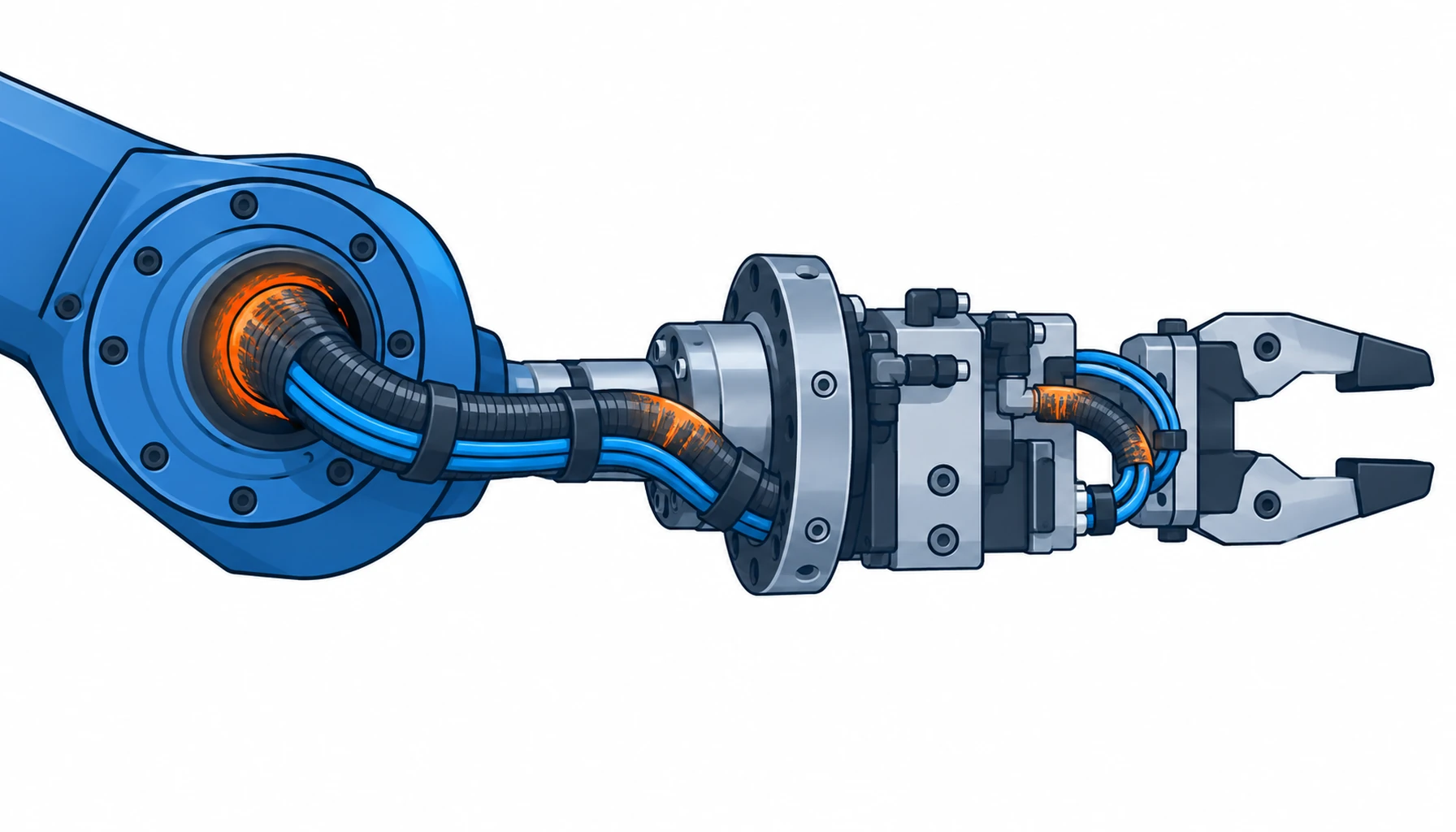
The run is not one cable duty but five, and each has its own dominant stress. Inside the wrist joint the cable bends around the pivot at the highest cycle rate on the machine. Between the wrist and the flange it may also twist, because the roll axis turns the bundle about its own length. From the flange to the tool changer the cable has to survive a short, tight bend at the interface and often a repeated mate and unmate. Inside the tool body it faces warmth from a motor or a process, and very little room. At the very end, sensor and vacuum lines have to keep a clean signal and an open passage while everything around them moves.
Buying one construction for all five zones is the most common mistake in this part of the arm, because the zone that needs a torsion rating is not the zone that needs heat resistance, and a compromise cable is mediocre at both.
The Decision Table: Five Zones and What Each One Needs
| Zone | Cable to Buy | What to Specify | Evidence to Demand | Where It Fails in Service |
|---|---|---|---|---|
| Inside the wrist joint | Small diameter continuous flex | Bend radius at the pivot and the cycle count per shift | A flex test at that radius and count | Jacket wear at the pivot, opening the screen |
| Wrist to flange | Torsion and flex rated | Torsion angle per metre if the roll axis turns the bundle | A torsion test at that angle | Screen opening and core migration at the twist |
| Flange to tool changer | High flex, tight radius rated | The bend at the interface and the mate and unmate count | A bend test at the interface radius | Jacket wear and contact damage at the changer face |
| Inside the tool body | Compact, temperature rated | Maximum temperature at the motor or process, and the space | A temperature rating valid at the duty, not a peak | Insulation ageing and a short near the motor |
| Tool end sensors and vacuum | Miniature, shielded, with a clear bore | Signal integrity after flex and an open vacuum passage | Continuity and signal checks after a flex cycle | Sensor dropouts and a blocked or kinked vacuum line |
Where the Motion Concentrates
The highest stress on the machine is usually a short section of bundle a few centimetres long, at the point where the wrist pivots and the cable has nowhere to go. Because the motion is small, the cable is often routed with a bend that is tighter than the general routing guideline, and because it repeats far more often than the arm’s own moves, the flex life is consumed quickly. The fix is to give the bundle a defined place to bend: clamp it on both sides so the bend happens where it was designed to happen, and keep the pivot bend radius inside the cable’s continuous flex rating rather than at its occasional flex limit.
Where the roll axis also turns the bundle, the same short section is bent and twisted at once, which wears it faster than either motion alone. Splitting the motions over a longer run, or paying for a torsion rated construction only in the section that twists, is usually better than one compromise cable for the whole end of the arm. The ways these motions wear a cable are set out in our notes on robot cable failure and on cable damage wear patterns.
Protection at the Tool
Protection that works at the wrist is protection that moves with the bundle instead of holding it. A spiral wrap or a braided sleeve that follows the bend keeps abrasion off the jacket without adding a bend of its own, and it is replaceable when it wears. A rigid conduit or a clip that fixes the bundle to the tool is often worse than nothing, because it stops the cable bending where it wants to and forces the movement into a shorter, tighter length.
Weight matters as much as protection here. Every gram added at the tool reduces payload, so a heavier sleeve has to earn its place by preventing a failure that a lighter one cannot. Where the cable has to pass a tool changer, the interface itself becomes a wear point, and the options for carrying power and signal across a quick change are set out in our note on gripper and tool changer cable. The jacket materials that survive this zone best are covered in our note on abrasion resistant cable jackets.
What to Freeze Before the Order
| Item | What to State | Evidence to Attach | Cost of Leaving It Open |
|---|---|---|---|
| Bend radius at the wrist | The radius at the pivot, measured on the built tool, not assumed | A drawing plus a flex test at that radius | The tightest bend on the machine decided by whoever built the first tool |
| Torsion rating | Whether the roll axis twists the bundle, and the angle per metre if it does | A torsion test at that angle | A flex cable on a twisting axis, failing at the screen |
| Cycle count | The wrist cycles per shift, not the robot's overall cycle count | A flex life figure at that count | A cable sized for the arm's motion and worn out by the wrist's |
| Weight budget | The maximum mass of the bundle and its protection at the tool | A measured assembly weight against the payload figure | Payload lost to cable, discovered at commissioning |
| Protection type | Whether the sleeve follows the bend and how it is replaced | A sample fitted on the actual route | A rigid guard that forces the movement into a tighter bend |
| Tool interface | How power, signal and air cross the changer, and the mate cycle count | A mating cycle test on the interface | Contact wear at the changer face, with intermittent faults |
| Sensor and vacuum lines | Signal and passage requirements after flex, plus a minimum bore | Continuity and flow checks after a flex cycle | Sensor dropouts and a kinked vacuum line that reads as a tool fault |
| Service method | How the bundle is replaced at the tool, and how long that takes | A written swap procedure with the parts list | The most-stressed cable on the machine with the slowest swap |
When a Lighter Cable Is Not the Answer
Where the payload margin is already thin. Removing a sleeve or a screen to save grams can cost more than it saves, because the failure it prevents is a full stop on the cell. Work out what the cable costs per gram saved over the life of the machine before cutting the construction down.
Where the shortest bend is at the tool. If the tightest radius in the whole route is at the tool flange, a lighter and more flexible cable does not help, because flexibility of the jacket says nothing about the strain limit of the conductors. The answer is a smaller bundle, a different route, or a larger radius, in that order.
Where the zone is inspected rarely. Any saving that depends on catching wear early is a saving that will not be realised on a tool that nobody looks at. If the bundle cannot be seen, specify it as though it has to last, and treat a lighter build as an option only where inspection is routine.
Where one cable is expected to serve the whole arm. The duty at the end of the arm is not the duty along it, and one construction rarely suits both. Where the harness is bought as a single line item, ask which zone it was designed for, because the answer is usually one of them, and the others are running on margin. The choice between running the bundle inside the arm and carrying it outside is set out in our note on internal wiring versus a dress pack.
RFQ Checklist
- Bend radius at the wrist pivot stated from the built tool, with a flex test at that radius
- Torsion rating named if the roll axis turns the bundle, with the angle per metre
- Wrist cycle count per shift stated separately from the robot cycle count
- Weight budget for the bundle and its protection, measured against the payload figure
- Protection that follows the bend, with a replacement part number for the sleeve
- Tool changer interface rated for the mate and unmate count the machine will see
- Sensor lines checked for continuity after flex, with a stated minimum vacuum bore
- Construction named per zone rather than one cable for the whole arm
- Service method written down, with the swap time and the parts needed
- Abrasion evidence for the jacket at the wrist, not just a general wear claim
Conclusion
The end effector is where a robot cable earns its place or loses it, because it takes more motion per hour than any other run and has the least room to do it in. Buy for the tightest radius in the chain, rate the twisting section for torsion rather than hoping a flex build will do, keep the mass at the tool in check, and make sure the zone can be inspected and swapped without taking the cell apart.
Kexingyu Cable Group (KXYE) supplies the cable that has to survive that zone: small diameter continuous flex and torsion rated constructions, including the robot composite cable, built to keep a defined bend and a light mass at the tool. Send us the wrist motion, the tool weight budget and the cycle count, and we will return constructions and sample lengths that fit; the fastest route is a request for quotation.