
How to Audit a Cable Factory Before You Award the Order
Quick Answer: A factory audit verifies, before you pay, that the plant behind the quotation can build your order — and the audit's real product is evidence, not impressions. Most buyers meet the factory twice: once as a slide deck, once as a container at the port. An audit replaces the slide deck with a walk through the plant, past the drawing benches and stranding machines and spark testers, while the order is still a decision rather than a commitment. Done properly, it's the cheapest quality tool you'll ever buy. One airfare against a shipment of undersized conductor is not a hard trade to justify. Done as a tourist visit, though, it buys you photographs and nothing else. This guide lays out the walk so that every hour on the floor produces a verdict you can defend later.
Introduction
Cable is a verification business. The product’s value hides inside the sheath: conductor purity, stranding quality, insulation thickness, the absence of voids. None of it can be confirmed at the receiving dock, which is why audits matter more for cable than for most purchased goods. The certificate on the drum is only as honest as the plant that issued it. A structured audit checks four layers: the paperwork that claims compliance, the machines that build the cable, the laboratory that tests it, and the people who hold the process together between shifts. The reference structure for any supplier evaluation is the power cable manufacturer checklist, and an audit is simply that checklist performed on the supplier’s own floor, where evasions are harder to hide. Auditing is also a core skill in the broader discipline covered in how to vet a Chinese electrical equipment manufacturer. Cable raises the stakes because its failure modes stay invisible until years later.
The Paper Audit: Certificates and Their Limits
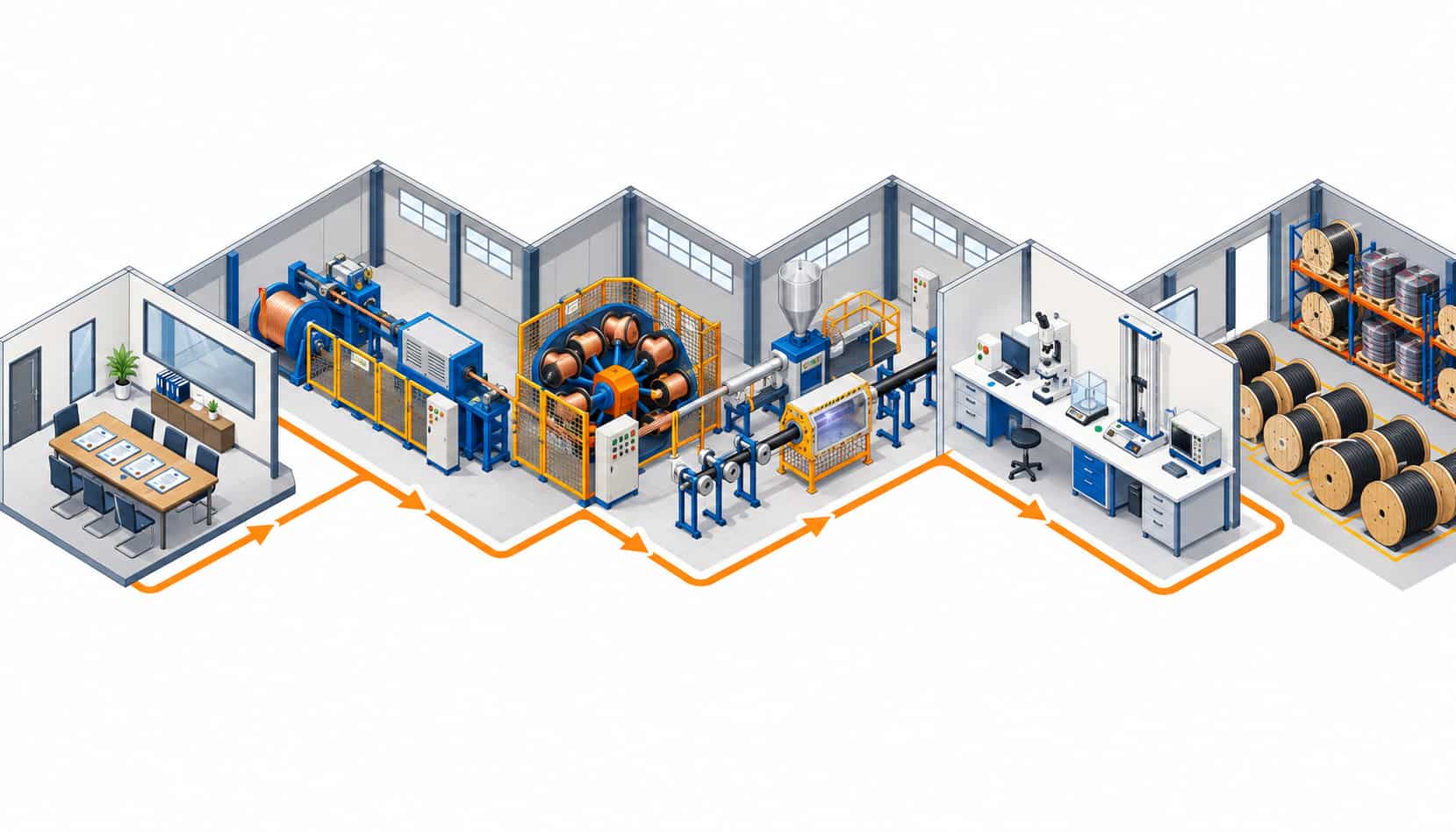
Start in the meeting room, but know what paper can and cannot prove. The licenses to verify are the business scope, the production license for the product categories you’re buying, and the test reports and type certificates that name the exact constructions in your inquiry. Family certificates for “similar products” don’t count. Ask to see the original type-test certificate from an accredited laboratory for the largest cross-section you intend to order, then check it line by line against the offered datasheet. Now consider what the paper cannot prove. A certificate qualifies a design, not every drum that leaves the line, and the gap between the two is exactly what the rest of the audit exists to close. A factory that’s proud of its paperwork produces originals on the spot; a factory that needs to “email them later” has already told you something. Paperwork discipline is also the axis covered by the China certification checklist, but it should take less than an hour of the visit. The floor is where the verdict forms.
The Production Floor: What the Machines Tell You
The drawing and stranding shop is where copper becomes a conductor, so it’s the first place to stand still. Watch the drawing benches for die wear practices and lubricant condition, because neglected drawing produces scratched, work-hardened wire. In stranding, count what you can see: whether bobbins are full and labeled, whether the lay and compaction look consistent, and whether the operator records what the machine produces. Then walk the extrusion lines and look for the instruments that matter. There should be a working spark tester on every insulation line, gauge sensors feeding a live thickness display, and printed meter marks on the finished cable. A plant that runs extruders without spark testing, or with the tester bypassed, is shipping insulation nobody watched, whatever its certificate says. The machines also tell you about capacity. A plant running three shifts with a full order book is a healthier supplier than one whose lines sit idle, even though the idle plant will swear it can deliver in four weeks. Capacity honesty is a recurring theme in cable sourcing delays and EPC timelines, and the floor is where you estimate it yourself.
| Audit Area | What to Verify | Evidence to Collect |
|---|---|---|
| Licenses and certificates | Business scope, production license, type tests for your exact constructions | Copies of originals, certificate numbers, laboratory accreditation |
| Raw material intake | Cathode supplier records, intake checks per heat, storage segregation | Intake inspection records for recent heats |
| Drawing and stranding | Die management, lubricant condition, bobbin traceability, lay consistency | Line records with drum IDs and operator sign-off |
| Extrusion lines | Spark testers on every line, live gauging, meter marking | Photos of instruments in service, spark test logs |
| Laboratory | Calibration stickers in date, resistance bridge, withstand set, sample records | Calibration certificates and a recent batch report |
| Quality system | Traceability from drum ID to heat number, nonconformance handling | A traced drum: report, heat, machine, operator, shift |
The Laboratory: Instruments and Calibration
The laboratory is the audit’s heartbeat, because every promise in the batch report originates here. Check each bench for a current calibration sticker: resistance bridge, high-voltage withstand set, tensile machine, thermal aging oven. Then ask to see the calibration certificates behind the stickers, issued by an accredited body. If the schedule allows, watch a test being run. How a technician cuts and measures a sample, or clamps a conductor into the resistance bridge, tells you more about habits than any procedure binder. Ask for a recent batch test report and read it in the room that produced it. You’re looking for drum IDs, values against the standard’s limits, stated conditions and a signature. The layers behind that report, from routine to sample and type testing, are explained in our MV and LV cable standards guide. The audit verifies that the report comes from the instruments in this room rather than a template in an office. A laboratory that can’t demonstrate a live test during your visit is showing you paperwork while withholding the process behind it.
People and Process: The Layer Paper Cannot Show
Between the machines and the reports sits the layer most audits skip: the people and the system that connects them. Talk to shift operators, not just managers. Ask a stranding operator how he knows a bobbin’s heat number, or an extrusion operator what she does when the spark tester alarms. Fluent answers point to training and real practice; hesitation means the procedure exists for auditors. Then test traceability live. Pick any finished drum in the warehouse and ask the factory to trace it backward to its heat number and forward to its test report, on the spot. A plant with a working quality system does this in minutes. A plant that has to “prepare it and send it tomorrow” is assembling the chain for your benefit. Close the layer with the nonconformance file. Real systems have real nonconformances, recorded and dispositioned. An empty nonconformance log at a plant of any size isn’t perfection; it’s a log nobody writes in.
| Red Flag | What It Usually Means | Risk If Ignored |
|---|---|---|
| Certificates "available by email" | Originals do not exist or do not match the offer | Datasheet compliance unverifiable |
| Spark tester bypassed or absent | Insulation shipped unwatched | Pinholes and thin spots in service |
| Calibration stickers expired | Batch report values are decoration | Undersized or faulty cable passes "tested" |
| Drum traceability takes days | No live quality system, chain built for audits | Warranty claims unprovable |
| Idle lines in a busy market | Capacity or quality rejected by other buyers | Late delivery after your deposit lands |
| Empty nonconformance log | Problems exist but are not recorded | Systematic defects repeat silently |
When an Audit Is Not the Answer
An audit is a snapshot of one day, and it has limits worth naming. It can’t verify the specific production run that will carry your order. That’s what pre-shipment inspection and factory acceptance testing are for, and the division of labor between factory and site verification is mapped in our FAT vs SAT guide. It can’t substitute for the evidence regime itself, either. Even the best-run plant proves each shipment with the batch report structure covered in our cable failure causes guide, where the audit-verified tests become the evidence chain. And it can’t be delegated entirely to a checklist template. The failure modes that matter to your project, from the copper economics behind the quotation to installation damage no factory controls, decide where your own hours should go. Audit the plant first, then hold it to the regime you verified.
RFQ Checklist: Turning the Audit into Contract Terms
An audit that changes nothing is a pleasant trip, so convert findings into the RFQ and the contract:
- Type-test certificate required for the exact offered constructions before award
- Batch test reports keyed to drum IDs with meter marks, per shipment
- Spark test and live gauging declared for every extrusion line used
- Calibration certificates for laboratory instruments available on request
- Traceability demonstrated: drum ID to heat number in the shipping file
- Named production lines and shifts disclosed for your order
- Nonconformance log summary available at each shipment milestone
- Pre-shipment inspection rights written into the contract
- Findings from the audit attached as agreed quality requirements
Conclusion
A cable factory audit earns its cost when it’s structured. Check the paperwork for originals, watch the machines in service, ask the laboratory to demonstrate what its reports claim, and test traceability on a random drum. Each layer either produces evidence or produces a red flag, and both outcomes are worth having before the order is awarded.
Kexingyu Cable Group (KXYE) welcomes customer audits as standard practice. We keep lines open, instruments accredited and drum-level traceability ready to demonstrate on the spot, because a supplier confident in its process treats the audit as the first step of the relationship rather than an intrusion to be managed.
Recent Posts

Power Cable Warranty Terms: What to Demand and What to Watch For
Power Cable Warranty Terms: What to Demand and What to Watch For Quick Answer: A usable warranty names its scope, duration, evidence standard, exclusions and
The Cable Sample Approval Process: What to Test Before Mass Production
The Cable Sample Approval Process: What to Test Before Mass Production Quick Answer: Sample approval tests the supplier’s claims while changes are still cheap —
Cable Drum Packaging for Export: Specs, Marking and Transit Protection
Cable Drum Packaging for Export: Specs, Marking and Transit Protection Quick Answer: Export packaging is a technical specification: drum size for weight and bend radius,