Indonesia Cable Imports: SNI Certification Explained
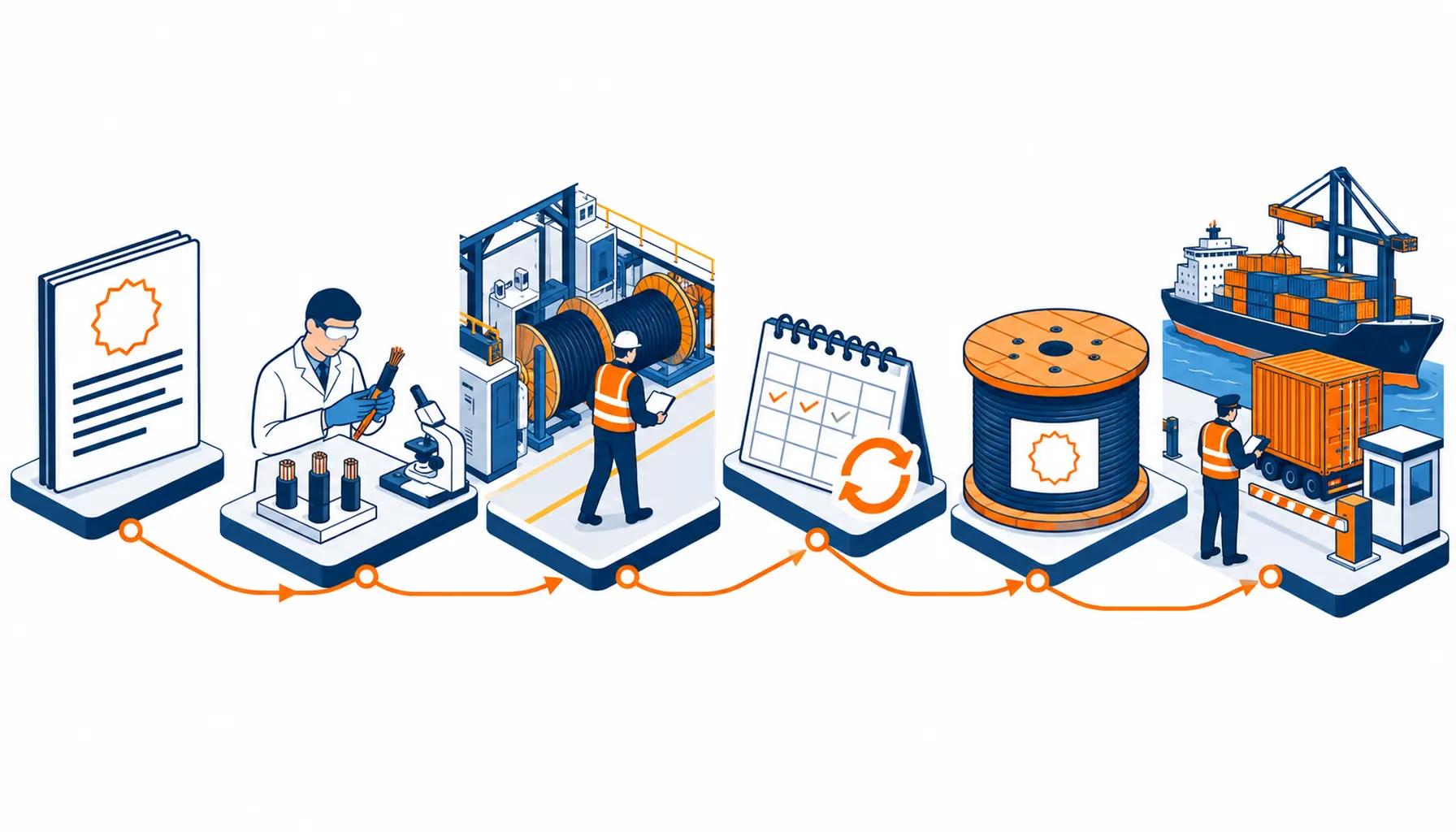
Quick Answer: Indonesia regulates cable through mandatory SNI certification — testing plus factory audit, kept alive by surveillance, marked on the product and matched to the certificate at the border.
Indonesia is Southeast Asia’s largest population and one of its fastest-electrifying economies, and it guards its cable market with a mandatory scheme in the BIS mold: the SNI mark, earned at the factory, tested against the national standard, and revisited by the certifier for as long as the license lives. For buyers, SNI is a heavy but legible gate. Like all heavy gates, it rewards the buyer who checks it before the delivery date is promised. This guide explains the scheme and the planning around it.
Introduction
SNI — Standar Nasional Indonesia — is Indonesia’s national standard, and SNI certification is the mandatory conformity regime through which regulated product families, wire and cable prominent among them, enter the market. The architecture repeats what this cluster has seen in the region’s heavier schemes: type testing proves the design against the SNI standard, a factory audit proves the plant can reproduce it, surveillance keeps the license current, and the SNI mark ties the physical product to the license. The demand context makes the effort rational. Indonesia’s grid extension, industrial estates and data infrastructure drive substantial cable imports, with the demand picture sketched in Southeast Asia data center power. The buyer’s task is the cluster’s standard sequence — map the construction to the scheme, verify the license, schedule reality into the delivery date — executed with Indonesian specifics.
How SNI Certification Works
The regime runs in four movements, familiar from its regional siblings. The standard: the applicable SNI standard defines the construction’s requirements. Indonesian standards for cable derive from the IEC family with national parameters, so IEC-tested factories start close. The testing: samples of the exact construction are tested at laboratories recognized for the scheme. The audit: assessors visit the manufacturing plant to verify the quality system and production consistency — the license is issued to the plant, by name. The surveillance: recurring visits and testing keep the license alive, and the SNI mark on the product ties each drum to the license. For foreign manufacturers, the scheme opens through the same door with an added logistics dimension: the audit and surveillance travel to the overseas plant, which lengthens the calendar and makes the certifier’s scheduling part of the project plan. The depth is the point. Like BIS and CCC, SNI certification is a state-recognized, recurring audit of the factory — among the strongest factory-credibility signals available, per the reasoning in supplier vetting.
What the License Covers — and the Verification Checks
The license names a plant, a standard and a scope, and all three boundaries bind. The verification is the cluster’s four checks, localized to SNI. Holder: the license names the manufacturing facility — match it to the plant that will build the order. Coverage: the standard and scope must cover the offered construction — sizes, voltage class, cable type as the license lists them. Currency: licenses live or lapse through surveillance, and the current status is verified through the certifier or the official registers. A photocopy is a starting point, never a conclusion. Marking: the SNI mark and the license identity appear on the product or its packaging, tying the drum to the license — the identity chain that anchors every mandatory scheme from CCC to BIS, and the one customs and market surveillance both check. The four checks are the same ones detailed in the power cable certifications checklist; SNI rewards them with high information content, because a current SNI license means the factory has been visited and revisited by the scheme.
| Movement | What It Proves | Buyer Check |
|---|---|---|
| SNI standard | The requirements the construction must meet | Standard and version named, IEC lineage understood |
| Product testing | The exact construction conforms at a recognized lab | Reports match the offered construction |
| Factory audit | The plant reproduces the design consistently | License holder is the building plant |
| Surveillance and mark | The license is current; the product is tied to it | Status verified in registers; SNI mark on product |
Lead Times and the Foreign Manufacturer Route
SNI is a months-scale gate when the license does not yet exist: application, testing, audit — with an overseas plant adding travel and scheduling to the audit window — then grant, then surveillance cycles for the license’s life. The planning consequences are the cluster’s standard three, with Indonesian weight. Verify before promising: the SNI status check belongs at RFQ and supplier selection, and a delivery date that assumes a future license is a wish, not a schedule — the lead-time reality that recurs in cable sourcing delays and EPC timelines. Project the license where needed: anchor milestones — application, test report, audit date, grant — in the contract, and tie the delivery schedule to the grant, the same milestone discipline as BIS. And choose the supplier first by the license. For Indonesia-bound programs, factories already holding SNI licenses for the needed constructions are worth a price premium measured against months of calendar — the panel-supplier logic that experienced regional buyers operate, and the market-by-market matrix from the cluster’s overview applied cell by cell.
The Import Workflow: From License to Clearance
The border procedure matches the shipment to the license, and it rewards the same one-source document discipline as every destination in this cluster. The importer of record registers the consignment; the documents — invoice, packing list, the SNI certificate identity, test reports — are generated from one source so descriptions agree; customs matches the goods to the file; and the drums, carrying the SNI mark, complete the identity chain on arrival. The ownership split — importer-side registration, exporter-side evidence — is the Gulf-and-Vietnam pattern again, allocated in the contract per the incoterms framing in FOB vs CIF for power equipment. The recurring failures are the recurring four: scope blur, holder blur, document drift, and importer surprise. Each is cheap to fix at RFQ and expensive at the port, as cataloged in international power equipment sourcing mistakes. The submittal dimension matters for project orders too: consultants review cable against the certification file, so the file assembles before design review rather than during it.
| Stage | Action | Classic Trap |
|---|---|---|
| RFQ | Map constructions to SNI scope; ask for held licenses | "Indonesian standards" treated as one generic line |
| Selection | Four-check verification; budget license projects where gaps exist | Delivery promised against a future license |
| Contract | License milestones, importer duties, cost bearing allocated | Audit scheduling discovered after contract award |
| Shipment | One document set; SNI-marked drums per the license | Invoice descriptions drifting from license scope |
| Arrival | Customs match; drum-to-document verification | Mixed loads with an unlicensed family |
When SNI Is Not the Answer
Two boundaries frame the scheme. It is a market gate, not an engineering verdict: the SNI mark proves the national standard’s minimums at a licensed plant, while the project’s ampacity, fire strategy and installation quality remain the specification’s work, verified through the per-drum batch evidence regime. And it is category-specific and evolving. Regulated scopes change, and the current status of a cable family is a register question at RFQ time, not a memory. Where a construction sits outside the regulated scope, absence of the mark isn’t a quality verdict — the engineering question is answered by type test reports and batch evidence under the IEC-derived framework mapped in our MV and LV standards guide.
RFQ Checklist: Indonesia Access Lines for the RFQ
Put the SNI questions in writing:
- Regulated-scope status confirmed for each offered construction, current at RFQ time
- SNI license held: holder plant, standard, scope and license numbers stated
- License currency verified through the official registers
- SNI mark and license identity on product or packaging where the license applies
- Test reports against the SNI standard from recognized laboratories
- License project milestones and cost bearing in the contract where gaps exist
- Importer of record and registration duties named on the customer side
- Document set and drum marking consistent with the license scope
Conclusion
SNI certifies cable the Indonesian way: against the national standard, at the factory, and repeatedly. The license names the plant, the mark names the license, and the border matches the shipment to both. Buyers who verify holder, scope and currency before promising dates find the gate legible. The planning moves are few, public, and identical in kind to the region’s other heavy gates — which is exactly why the market-access matrix earns its keep.
Kexingyu Cable Group (KXYE) supports Indonesia-bound orders with accurate SNI status disclosure, accredited test reports aligned to the SNI standards, and license-consistent drum marking. Factory-held credentials are matched to the constructions that ship.