Philippines Data Center and Grid Investments: A Cable Demand Outlook
Quick Answer: The Philippines is one of the few markets where grid modernization and data center growth pull cable demand at the same time — both rewarding documented, typhoon-resilient cable.
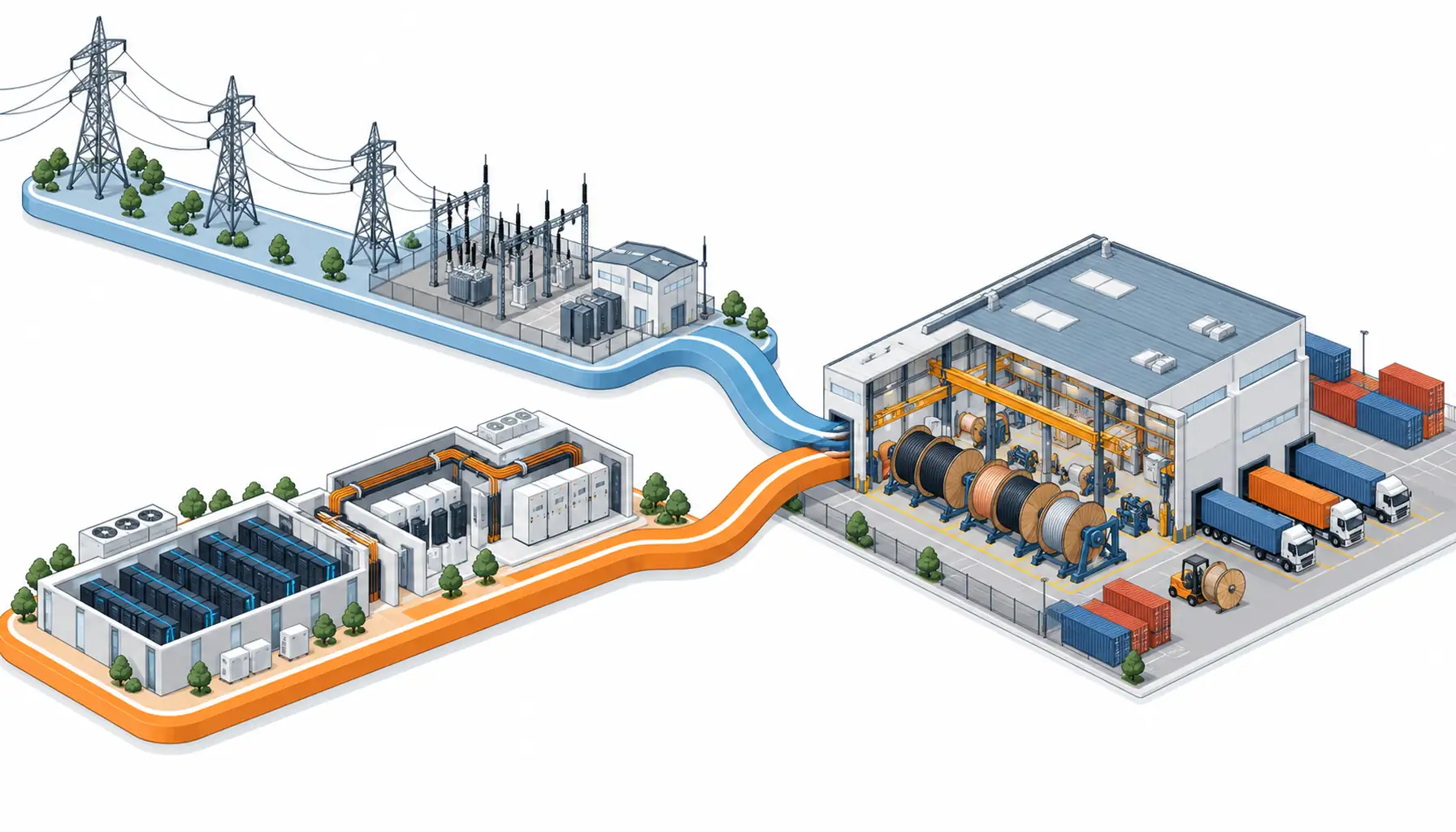
The Philippines used to be a cable demand story with one engine. Now it has two. On one side, the national grid operator is spending its way through a modernization backlog: new transmission lines, substation upgrades, and the interconnections that tie an island archipelago into one dependable system. On the other, Metro Manila and the provincial corridors — Clark, Cebu, the CALABARZON belt — are absorbing a data center buildout that international operators increasingly treat as a first-choice destination, not an afterthought. For cable suppliers, the twin tracks mean two very different buyers with one shared requirement: cable that arrives documented, on schedule, and engineered for an environment where typhoons are a design input rather than an anomaly.
Introduction
The regional frame is the fastest-growing data center corner of a global buildout, tracked in Southeast Asia data center power, and the Philippines is its demand sleeper: an English-speaking, time-zone-convenient workforce, a land-and-power cost profile its neighbors no longer offer, and an investment regime that opened the sector wide. The demand analysis in data center power demand growth puts the market in its global context; what the global numbers miss is how much of the Philippine story rides on the grid. Data halls are only as bankable as the feeders behind them, and the archipelago’s grid is being rebuilt to deliver them.
Track One: The Grid Modernization Program
The transmission and distribution program is the quiet giant of Philippine cable demand. New 500 kV and 230 kV backbones, substation upgrades in the load centers, and island interconnection projects all translate into MV cable, overhead conductor and substation wiring on multi-year schedules — the equipment families mapped in utility grid expansion equipment. The work is tender-driven, specification-heavy and unforgiving on documentation: utilities and their EPC contractors buy against named standards with type-test evidence, and a file missing one report is a bid scored down. The environment raises the bar further. Typhoon exposure pushes hard on mechanical strength, corrosion-resistant sheaths and installation practice. Cable specified for a calm grid fails a stormy one, and the Philippines is not a calm grid. Every one of those requirements ends up written, tested and traceable, because in this track the file is the product as much as the copper is.
| Demand Track | Leading Cable Families | Buying Behavior |
|---|---|---|
| Grid modernization | MV XLPE feeder cable, substation wiring, overhead conductor | Tender-driven; named standards with type-test evidence; multi-year schedules |
| Data centers — Manila core | MV intake feeders, LV distribution, UPS strings, LSZH hall cabling | Consultant-gated; submittal files before orders; uptime-driven redundancy |
| Data centers — provincial corridors | MV/LV distribution, campus backbone, structured cabling | Program-based; repeat builds as corridors scale; schedule discipline |
| Shared requirement | Documented, storm-resilient constructions across the bill | Traceable batch evidence; delivery calendars kept without exception |
Track Two: The Data Center Buildout
The Manila data hall electrical bill follows the standard chain — MV feeders engineered to the framework in our MV and LV standards guide, LV distribution to UPS strings sized per UPS sizing for data centers, LSZH hall cabling, monitoring layers — but the local context shapes it. Power quality in a developing grid makes backup depth a first-order design choice, and enclosed high-density halls make the fire case for halogen-free compounds. What distinguishes the Philippine program from its neighbors is the provincial spread: as operators look beyond Metro Manila for land, power and fiber, Clark and Cebu grow their own campuses, and each campus is a cable order that repeats. Building programs, not one-off orders, is how the corridor rewards its suppliers.
How Suppliers Actually Serve Both Tracks
The supply route into the Philippines rewards the same discipline this series documents everywhere: verification before volume. Certification evidence — product standards, type tests, batch traceability — assembled to the four-check discipline of the power cable certifications checklist; submittal files for the data center track and tender files for the utility track, each matched to its buyer’s format; and landed-cost honesty on the freight-heavy archipelago routes, where clearance ownership across a dozen island ports is written into the contract rather than assumed. The recurring failure patterns of international power equipment sourcing mistakes apply with force: suppliers who win Philippine orders are the ones whose paperwork survives the first inspection and whose calendar survives the first typhoon season, in that order.
| Stage | Action | Classic Trap |
|---|---|---|
| Qualification | Standards and type-test evidence assembled per buyer format | One generic file submitted to two different buying systems |
| Tender / submittal | Track-specific documentation: tender file vs consultant submittal | Treating the data center consultant like a utility engineer |
| Contract | Batch evidence, storm-resilient specs and schedule written in | Resilience assumed instead of specified |
| Delivery | Island-port clearance and documents reconciled per consignment | Underestimating archipelago logistics in the calendar |
| Repeat | Corridor programs tracked; evidence file maintained per build | Treating the first campus as the whole opportunity |
When a Twin-Track Market Is Not a Simple Market
Two cautions frame the outlook. Two tracks don’t mean one strategy: the utility buyer and the data center consultant reward different files, different rhythms and different relationships, and suppliers who blur them serve neither well. And demand growth doesn’t forgive supply gaps: a market adding grid kilometers and data halls simultaneously competes for global cable capacity, and the programs that land on time are the ones that ordered against realistic family calendars with copper-linked economics transparent.
RFQ Checklist: Philippine Lines for the RFQ
Put the market’s questions in writing:
- Constructions mapped to named standards with type-test evidence per cable family
- Storm-resilience parameters — sheath, mechanical strength, corrosion — stated, not assumed
- Track-specific documentation: tender format for utilities, submittal format for consultants
- Batch traceability and marking commitments for every consignment
- LSZH and fire-performance evidence for enclosed hall cabling
- Island-port delivery schedule with clearance ownership written into terms
- Repeat-build framework terms for provincial corridor programs
Conclusion
The Philippines is a twin-track cable market with a single deciding currency: documented reliability. The grid track buys MV feeder cable on multi-year tenders; the data center track buys a full electrical bill on consultant-gated schedules; both reward the supplier whose file, calendar and constructions survive scrutiny, and both punish the one who treats the archipelago as an easy market. The outlook is structural, not cyclical: electrification and digitalization are pulling in the same direction here for the first time, and the volume follows the verification.
Kexingyu Cable Group (KXYE) serves the Philippine tracks the way they are built: standards-mapped constructions with batch-traceable evidence, storm-resilient specifications written into the offer, and delivery calendars planned for island logistics — one supply chain, two buying systems, zero improvisation. For suppliers, that means two files maintained with one discipline: the tender-grade evidence for the grid and the submittal-grade file for the halls, kept equally current between orders.