US Data Center Cable Shortage: Tariffs, Onshoring and Alternative Sourcing
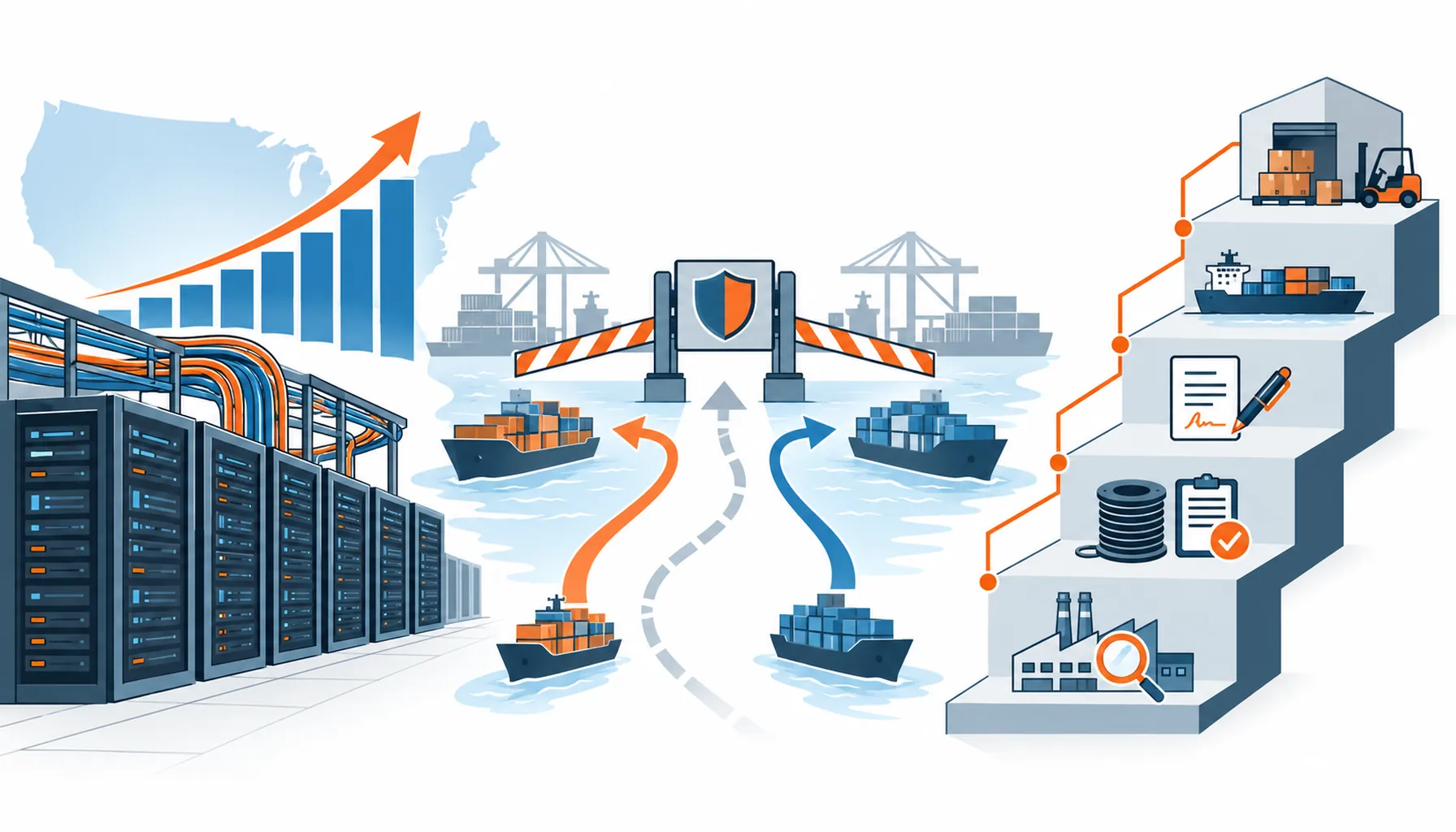
Quick Answer: US data center demand is outgrowing domestic cable capacity — imports cover roughly a quarter of supply, tariffs reshaped the trade map, and buyers respond with early ordering, dual sourcing and specification flexibility.
The United States is building data centers faster than it can build the cable that feeds them. Hyperscale campuses, AI training clusters and edge facilities are pulling power cable, control cable and specialty constructions at volumes the domestic industry never planned for, and imports bridge the gap: industry analysis has long put roughly a quarter of US wire and cable supply on the import side of the ledger. Section 232 tariffs then landed on top of that dependence, rewiring trade flows and repricing every landed meter. So the shortage now shows up less in headlines and more in schedules, as projects that ordered cable on normal assumptions meet the lead times and landed costs of a supply chain rearranged around policy. This guide covers what is driving the squeeze, what onshoring can and cannot fix, and the sourcing playbook that keeps a data center program supplied while the map is still moving.
Introduction
The demand frame comes first: the US sits at the center of the global surge tracked in data center power demand growth, with AI racks multiplying the cable content of every hall. The squeeze does not stop at cable. The same buildout has produced the equipment-side bottlenecks documented in our data center switchgear and transformer shortage analysis, and cable sits close behind, following the same demand curve through the same stretched factories. For a program buyer, the question is no longer “who makes this cable” but “who can supply it, at what landed cost, on whose calendar”. Getting that answer right is a large part of what separates projects that energize on time from ones that wait.
The Squeeze: Demand Up, Capacity Slow
Two curves crossed. Data center construction pushed demand up sharply — industry estimates put data centers at several percent of US metal cable demand and rising fast, with AI-driven density raising the cable content per hall — while domestic capacity barely moved, because a cable plant is a multi-year, capital-heavy proposition: continuous lines, curing tubes, test laboratories and, hardest of all, experienced operators. Imports filled the difference for decades, and a supply chain optimized around that flow does not turn quickly. The squeeze shows up first in the long-lead families: MV feeders, large parallel conductor runs for high-density racks, and fire-rated constructions for life-safety circuits, where qualified suppliers are fewest and substitution is hardest. Buyers who assumed cable was a commodity available off the shelf tend to find that out mid-project, when it starts behaving like the long-lead equipment around it.
Tariffs and the Rewired Trade Map
Then the policy layer landed on top of the demand layer. Section 232 tariffs raised the landed cost of imported cable and, just as importantly, rerouted it: flows that once ran through the cheapest export lanes were re-sourced, re-papered and re-priced, and buyers who budgeted on old landed costs found their numbers stale overnight. The effects stack up in day-to-day quoting. Tariffs pass through into prices, validity windows shorten because the input costs keep moving, and customs paperwork turns into a real schedule variable rather than a formality. The planning discipline the equipment side already learned from transformer lead times in 2026 and the calendar logic of switchgear lead-time planning now applies to cable too: order against policy as well as demand, and put landed cost, not ex-works price, in every comparison.
| Driver | What It Does | Buyer Response |
|---|---|---|
| AI demand surge | Raises cable content per hall and pulls long-lead families first | Order MV, parallel feeders and fire-rated circuits earliest |
| Slow domestic capacity | Qualified US supply covers only part of the volume | Treat cable as long-lead equipment in the master schedule |
| Import dependence | Roughly a quarter of supply historically imported | Build a qualified import lane before it is needed |
| Section 232 tariffs | Reprices landed cost and reroutes trade flows | Compare on landed cost with duty stated explicitly |
| Quote volatility | Shorter validity windows, surcharges repriced often | Fix copper and currency assumptions in the contract |
What Onshoring Can and Cannot Fix
Onshoring is real, and it is slow. New capacity announcements multiply, but a cable plant moves from groundbreaking to qualified output over years, and the constraint is not only machines: it is trained crews, certified test laboratories and the customer qualification cycles that make a factory’s output acceptable to consultants and utilities. Even at full speed, onshoring addresses the volume families first — building wire, commodity LV constructions — while the specialty constructions data centers concentrate on, from large-section MV feeders to mineral-insulated fire circuits, remain thinner on the domestic side. The realistic reading is that onshoring narrows the gap over time but doesn’t close it inside a project calendar. A 2026 program that plans around domestic-only supply is planning around capacity that doesn’t yet exist. The projects that hold their schedules are the ones that qualified an import lane early, not instead of domestic supply but alongside it.
Alternative Sourcing: The Buyer's Playbook
The playbook has five moves. First, order early: place cable on the master schedule beside the transformers and switchgear, not after them, with long-lead families first. Second, dual-source: qualify one domestic supplier for speed and one overseas supplier for volume, so a slip on either lane does not strand the program. Third, vet before the rush: apply the discipline of the power cable manufacturer checklist while there is still time to audit properly, because a factory audit done under deadline pressure usually has to be done again. Fourth, buy the lane, not just the cable: structure incoterms, duty responsibility and customs documentation as part of the award, the way sourcing power equipment from China for EPC projects treats logistics as part of the product. Fifth, coordinate: assemble cable with the equipment families it feeds through one-stop power equipment sourcing, so one schedule owns the interfaces and one file survives the audit. None of these moves is exotic, and all of them work better when applied a quarter earlier than feels necessary.
| Stage | Action | Classic Trap |
|---|---|---|
| Early ordering | Cable placed on the master schedule with long-lead families first | Ordering cable after equipment is contracted |
| Dual sourcing | Domestic lane for speed, import lane for volume, both qualified | Second source named but never audited |
| Factory vetting | Audit equipment, tests and traceability before award | Vetting under deadline pressure |
| Landed-cost award | Duty, freight and clearance priced into the comparison | Comparing ex-works quotes across tariff regimes |
| Coordinated families | Cable awarded with switchgear and transformers it feeds | Interfaces owned by no one's schedule |
When Waiting for Onshoring Is Not the Answer
Two cautions frame the strategy. The first is the domestic-only bet: waiting for US capacity that arrives too late for your program isn’t a sourcing policy, it just hands the schedule away. The projects that energized on time qualified two lanes and used both. The second is the tariff-frozen bet: treating tariffs as permanent and canceling every import option reprices the program against a policy that may shift faster than a cable plant does. The durable position is optionality — a domestic lane, an import lane, landed-cost comparisons that stay current, and a schedule that assumes the map moves again. Programs that built this optionality into 2026 mostly held their schedules; programs that waited are still waiting on capacity.
RFQ Checklist: US Shortage Lines for the RFQ
Put the market’s questions in writing:
- Long-lead families (MV, parallel feeders, fire-rated) quoted first with firm dates
- Landed cost stated with duty, freight and clearance as line items
- Quote validity window and copper assumptions fixed in the contract
- Domestic and import lanes qualified, with the import factory audited
- Customs documentation responsibility assigned per incoterms
- Batch test reports and traceability packaged for consultant review
- Delivery milestones aligned with the switchgear and transformer calendar
Conclusion
The US cable shortage is structural for the length of a project calendar: AI demand rising, domestic capacity arriving slowly, a quarter of supply historically imported, and a tariff regime that repriced and rerouted the flows that bridged the gap. Buyers who treat cable as long-lead equipment, compare on landed cost and hold two qualified lanes generally keep their schedules. Buyers who keep commodity assumptions keep the risk instead.
Kexingyu Cable Group (KXYE) serves US data center programs from the import side of the map: audited factory files, batch-tested constructions mapped to the specification, copper and currency assumptions fixed in the contract, and delivery planned against the equipment calendar the hall actually runs on — cable supply for a market where the schedule is largely decided before the order is placed.