Payment Terms for International Cable Orders: LC, TT and Escrow Compared
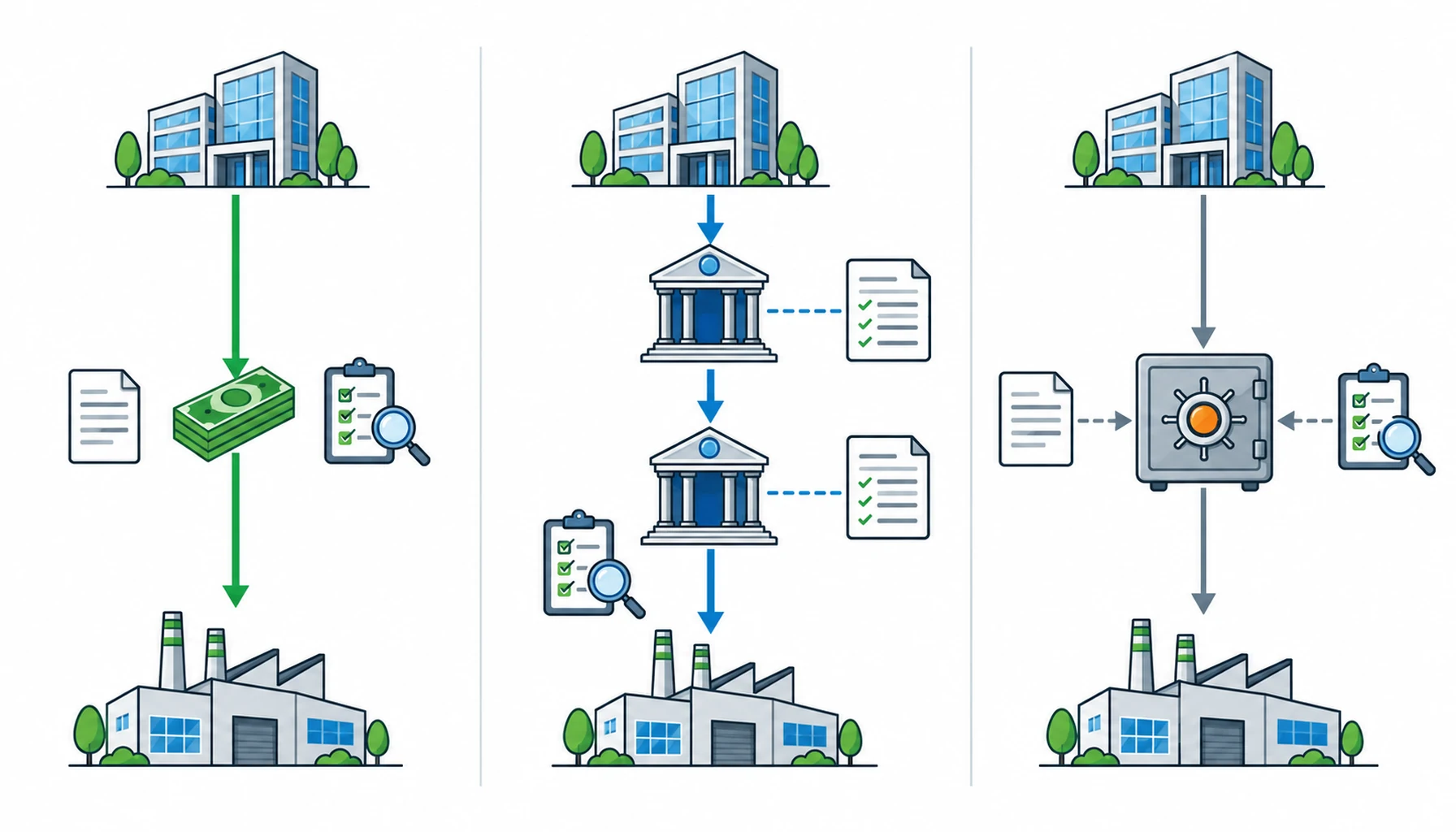
Quick Answer: Payment terms allocate the risk of paying before goods exist. TT is fast and trust-based, LC is documentary and bank-verified, escrow is platform-held — the right answer depends on order size and trust history.
Payment terms are the least discussed clause in cable procurement and the one that most directly answers a buyer’s private question: what happens to my money between the day I transfer it and the day the drums arrive. Every structure — telegraphic transfer, letter of credit, escrow, documents against payment — is a different answer to the same problem: production takes weeks, the goods exist on another continent, and neither side can verify the other’s intentions across the distance. The terms are not about generosity or suspicion; they are really a way of pricing trust, and they shift as the relationship earns it. This guide compares the three structures buyers actually use on international cable orders, shows how milestone-based splits and inspection rights combine with each, and maps which term fits which stage of a supplier relationship.
Introduction
The payment conversation lands differently depending on what surrounds it. A supplier with audited facilities, traceable test reports and a track record — the profile built in our manufacturer vetting guide — has already answered most of the trust question, and payment terms become administration. An unvetted supplier demanding full advance payment has effectively answered the trust question before it is even asked. That is why payment terms belong at the end of the vetting sequence, not the beginning: the checklist work in the power cable manufacturer checklist determines how conservative the terms need to be, and the terms themselves — including third-party inspection rights that give the money an anchor — are written into the contract per the EPC sourcing process. With that order of operations fixed, the three structures compare cleanly.
Telegraphic Transfer: Fast, Cheap, Trust-Weighted
TT — a direct bank transfer — is the workhorse of international cable trade because it is fast, costs little and fits the way production finance actually works: the deposit funds compound and copper procurement, the balance funds shipment release. The standard structure is a deposit, commonly around thirty percent, with the balance against shipping documents or a copy of the bill of lading. Its weakness is symmetrical and obvious: the buyer’s deposit is exposed until goods exist, and the supplier’s balance is exposed after goods ship. TT is therefore the right instrument when something else carries the trust — a vetted factory, a repeat relationship, or inspection rights that convert the balance payment into a verified event rather than a hope. The escalation for first orders is a milestone split: smaller deposits, a production-stage payment after witnessed batch tests, balance after pre-shipment inspection — each transfer tied to a document the buyer can verify before sending it. TT with milestones is not the cheapest structure to administer, but among the cheap ones it prices the trust most honestly.
Letter of Credit: Documentary, Bank-Verified, Document-Sensitive
A letter of credit replaces trust in the counterparty with trust in documents. The buyer’s bank promises payment against a defined document set — bill of lading, commercial invoice, packing list, certificate of origin, inspection certificate — presented within stated deadlines; the supplier ships against the promise, and the banks move the money when the documents comply. For the buyer, the LC’s value is real: the deposit is not exposed, payment happens only against evidence of shipment, and large first orders or politically distant markets justify the structure’s cost. The costs are equally real — bank fees on both sides, weeks of setup discipline, and the instrument’s defining quirk: banks pay against documents, not against goods, so a shipment of perfect cable with one inconsistent document can stall at the negotiation counter, while the LC’s protection never touches cable quality itself. An LC works best paired with an inspection certificate among its required documents — tying the payment trigger to a verification step — and with a document set rehearsed before shipment, because discrepancy disputes are usually decided in the preparation stage rather than in the argument afterward. For the full risk map from order to port, the sourcing mistakes guide covers where document friction usually starts.
| Structure | How It Works | Best Fit |
|---|---|---|
| TT with milestones | Direct transfers tied to verifiable stages | Vetted suppliers, repeat orders |
| Letter of credit | Bank pays against compliant documents | Large first orders, distant markets |
| Escrow | Platform holds funds, releases on confirmation | Small orders, unproven counterparties |
| Documents against payment | Bank releases documents on payment | Established trust, buyer-favorable balance |
| Full advance | Buyer pays everything up front | Almost never — only tiny spot buys |
Escrow and the Platform Middle Path
Escrow — typically through a trade platform that holds the buyer’s funds and releases them on confirmed receipt or agreed milestones — occupies the middle ground: cheaper and faster than an LC, safer than raw TT for a counterparty nobody has audited. Its fit on cable orders is specific: small and medium spot quantities, first contacts being tested before committing to vetting effort, and buyers whose procurement process cannot yet justify bank-level documentary machinery. Its limits are equally specific — platform fee structures, release conditions that rarely accommodate the milestone granularity a long production run wants, and coverage ceilings that small custom orders outgrow quickly. The realistic pattern: escrow to survive the first contact, TT with milestones once the factory has been audited, LC when order size makes the bank’s paperwork cheaper than the residual risk. What escrow cannot do is verify the cable — its release conditions confirm delivery, not construction — so the quality verification still runs through the inspection rights and test documents defined in the contract, the same discipline as FAT vs SAT verification stages applies to equipment.
When Full Advance Payment Is Not the Answer
One structure deserves its own warning, because it arrives dressed as simplicity: full payment up front. On a custom cable order it allocates the entire production risk to the buyer — the schedule risk, the quality risk, the counterparty risk — in exchange for nothing except the supplier’s comfort. The rare legitimate cases are tiny spot buys where the exposure is smaller than the administration of anything safer; everywhere else, full advance says more about the supplier than it does about the terms. The durable principle across all three structures: money should move against evidence — deposits against contracts and drawings, progress against witnessed tests, balance against inspection or documents — and the evidence ladder should tighten for new suppliers and relax as the track record earns it. Buyers ready to start that ladder with a real specification will find the milestone structure stated plainly at the RFQ page, because a supplier comfortable with evidence-based payment is telling you something about how the whole order will run.
| Stage | Typical Structure | Verification Anchor |
|---|---|---|
| First order, unvetted | Escrow or LC at sight | Platform release or document set |
| First order, vetted | Deposit + milestones + balance | Witnessed batch tests, pre-shipment inspection |
| Repeat orders | Deposit + balance on documents | Track record and batch reports |
| Framework releases | Scheduled payments per release | Rolling inspection rights |
RFQ Checklist: Payment Terms Lines for the RFQ
Put the market’s questions in writing:
- Payment structure stated per order size and relationship stage
- Milestone triggers defined as verifiable events, not dates
- Inspection rights written in before the payment schedule
- LC document set listed and rehearsed before shipment
- Currency, bank charges and responsibility split stated
- Claim and refund mechanics defined for failed inspection
- Terms progression agreed as the track record builds
Conclusion
Payment terms are a pricing of trust, and the three structures price it differently: TT moves money fast and leans on vetted relationships and milestone evidence, the LC replaces trust with documents at the cost of bank fees and paperwork discipline, and escrow holds the middle for small orders and unproven counterparties. The structure that fits is the one that moves money against evidence — tightened for first orders, relaxed by track record.
Kexingyu Cable Group (KXYE) states its milestone structure at quotation: deposits against contracts, progress against witnessed batch tests, balance against inspection or documents — payment terms built for buyers who verify, and earned terms for the relationships that come back.