China's 354,000-Robot Year: Inside the World's Largest Automation Market
Quick Answer: China installed about 354,000 industrial robots in 2025, 59 per cent of the global total, making it both the biggest cable customer in automation and its fastest-compounding one.
Every global automation statistic is now, to a remarkable degree, a China statistic. When IFR published World Robotics 2026 in September 2026, it recorded roughly 600,000 industrial robots installed worldwide in 2025, and 354,000 of them went into Chinese factories. That is not a market share; it is a majority, and it sits on top of an installed base that is itself the world’s largest. For anyone in the motion cable business, the arithmetic deserves a long look, because every one of those robots travels cable, and so does every one of the roughly 5 million robots already running across the world’s factories, a growing share of them in China.
Introduction
The scale took two decades to build. China went from a mid-table automation market to the majority of world installations by combining three forces: a manufacturing base vast enough to absorb robots across dozens of industries, wage growth and labour scarcity that made automation an economic necessity rather than a novelty, and industrial policy that treats robots as strategic equipment. World Robotics 2026’s 354,000 figure represents about 59 per cent of global installations for the year, and the operating stock in China has grown to a level no other country approaches.
Policy is now layered on economics. China’s current five-year planning cycle explicitly promotes AI and robotics as national strategic industries, which means incentives, procurement preferences and research funding all point the same direction as the commercial logic. For cable, that alignment matters: it sustains demand through economic soft patches, and it pushes local specifications upward as Chinese factories adopt the same quality expectations that mature markets hold. Suppliers weighing participation can start with the checklist for evaluating a Chinese cable manufacturer and the overview of Chinese equipment certification.
Where the 354,000 Robots Went
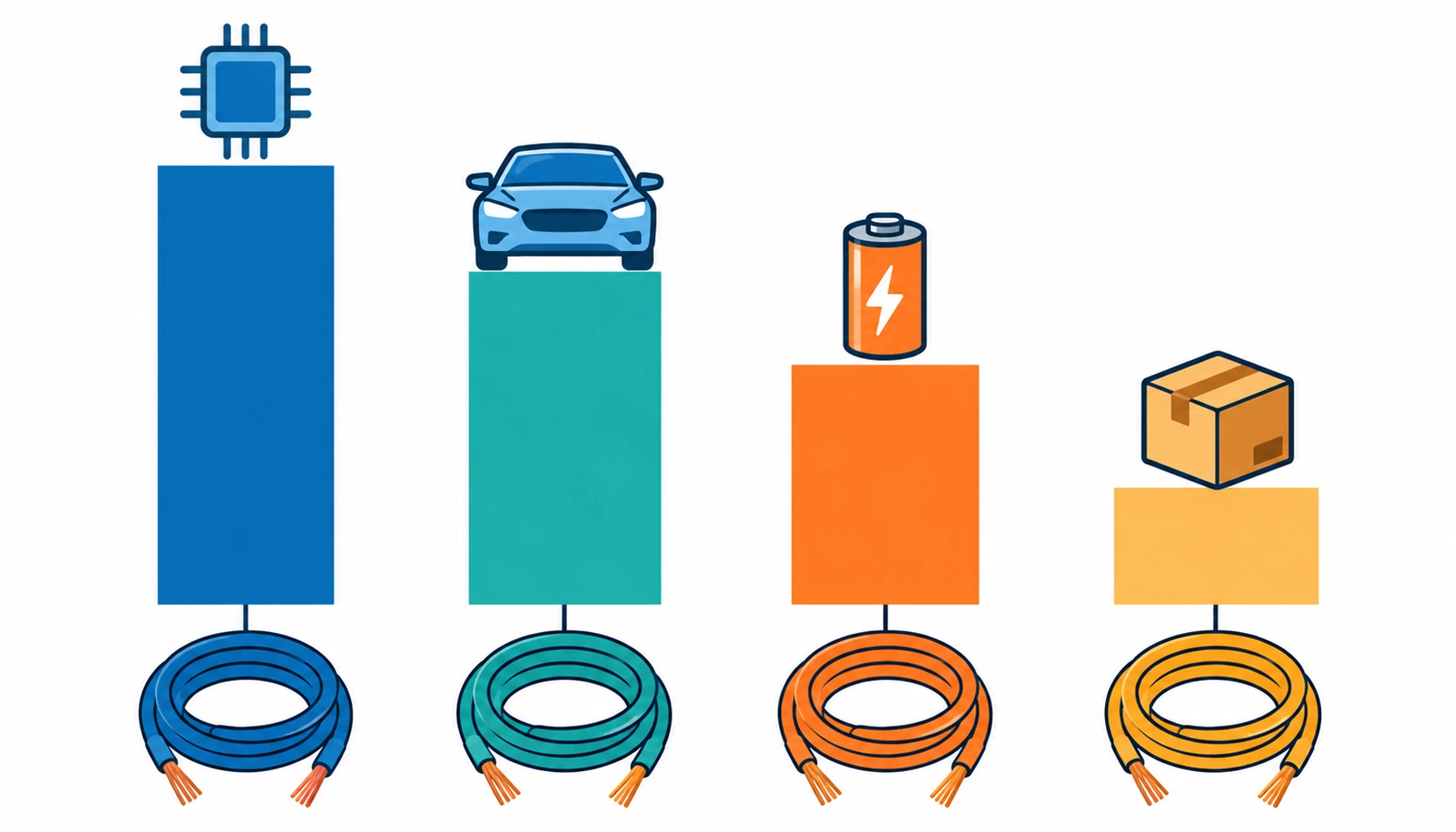
China’s installations are broad in a way no other market matches. Electronics remains the largest single consumer, spanning smartphone assembly, display production and the semiconductor supply chain, and it favours exactly the cable profile electronics everywhere demands: tight radii, high cycle counts, clean signals. Automotive is the second pillar, spanning domestic brands, joint ventures and the fast-growing EV segment, where body shops, battery plants and final assembly each carry their own cable duty. Around those two anchors, logistics, metalworking, food processing and chemicals automate at accelerating rates.
The breadth matters for cable because each industry stresses a different weakness. An EV battery plant punishes jackets with electrolyte and coolant; a press shop punishes them with chips and oil; a logistics hub punishes them with duty cycles that run around the clock. The common thread is volume: China does not automate one industry at a time, it automates all of them, so no single cable construction can capture the market and none is irrelevant to it.
The Cable Arithmetic Behind 59 Per Cent
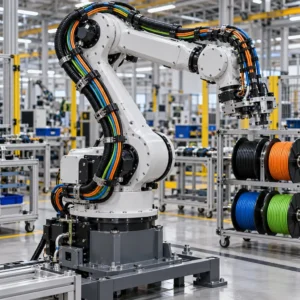
Turn the installation figure into cable terms and the picture sharpens. A typical articulated robot cell carries servo power, encoder feedback, brake control and often a dress pack of air, data and welding interfaces. Add the drag chains on the machine tools, conveyors and gantries around the robot, and a single automated production line consumes hundreds of metres of flex-rated cable. Multiply by 354,000 robots and their surrounding automation, and China’s new installations alone account for the majority of the world’s new motion cable demand before a single replacement drum is sold.
Replacement deepens the position. Cable wears faster than the machines it serves, and China’s fleet, while younger on average than Japan’s or Korea’s, is now large enough that early generations are entering refit age. Market research puts numbers on the resulting pool: QYResearch’s 2026 analysis sizes the global robot drag chain cable market at roughly USD 850 million for 2026, growing to about USD 1.24 billion by 2032, and projects that China alone will account for around 45 per cent of that market by 2032. Those are cable-specific figures; the wider automation equipment market grows alongside them.
| Industry | Demand driver | Cable duty profile | What buyers press on |
|---|---|---|---|
| Electronics and semiconductor | Display, phone and chip supply chain automation at national scale | Tight radii, very high cycle counts, clean encoder signals | Flex-life evidence and shield performance |
| Automotive and EV | Body shops, battery plants and final assembly across domestic and global brands | Heavy payloads, weld heat and spatter, oil and electrolyte exposure | Oil and heat resistance, torsion life at wrist axes |
| Battery and energy storage | Gigafactory construction at the world's fastest pace | Fast indexing gantries, chemical exposure, long continuous runs | Coolant and chemical resistance, batch consistency |
| Logistics and warehousing | E-commerce scale and labour cost growth | Round-the-clock duty, charging interfaces, high abrasion | Abrasion ratings and duty-cycle honesty |
From Buyer to Builder: China as Cable Origin
Reading the table, one pattern stands out: China’s demand is not concentrated in the premium segment the way Germany’s is, nor in replacement the way Japan’s is. It is concentrated in volume, across every duty class at once. That creates openings at every price point but also traps: the low end is brutally competitive, and the mid and high ends are rising in quality expectation each year as Chinese factory engineering matures. Suppliers who mistake the market for a dumping ground for surplus constructions misread it, and the failure analysis in the guide to common cable failure causes explains why those constructions return as warranty claims.
When the Headline Number Is Not the Answer
There is a second layer to the Chinese market that foreign observers often miss: China is simultaneously the largest cable customer and one of the largest cable origins. The factories that consume motion cable also produce it, and Chinese cable makers increasingly sell high-flex constructions into the same automation wave that buys their robots. For an international buyer, this cuts both ways. It means capable suppliers with modern stranding and extrusion equipment are abundant, and it means quality varies as widely as the market’s price points.
The practical defence is specification discipline, wherever you buy. Demand the flex-life test conditions, not just the cycle count; ask which jacket compound family is being offered and why; require batch traceability for repeat orders; and visit or audit the plant that will extrude your cable. The drive-side electrical environment these cables serve, from variable frequency drives to servo amplifiers, also shapes the specification, as the comparison in the guide to VFDs versus soft starters illustrates. Panel and inter-machine wiring follows the principles in the industrial power distribution checklist, and the control and signal layer is treated in the guide to control versus instrumentation cable.
| Decision | Why it matters here specifically | How to de-risk it |
|---|---|---|
| Price point positioning | The market spans every quality tier; the cheapest quote is rarely the honest duty match | Specify the duty first, then compare constructions, not prices |
| Equipment verification | High-flex performance depends on stranding lay and extrusion capability | Verify strand-lay equipment and flex test rigs exist at the plant |
| Batch consistency | Volume production tempts substitutions between orders | Require batch test records and written change control |
| Certification scope | Domestic and export grades differ; CCC covers domestic sale, export needs destination marks | Match certificates to the destination market before the order |
| Copper price exposure | Ultra-fine copper content makes quotes age quickly | Agree a price adjustment mechanism tied to the copper market |
RFQ Checklist: Motion Cable for a China-Based Automation Project
Three cautions. First, 354,000 installations describe the market, not your project; a cable order is won on the duty of one machine, and the macro chart only tells you the market exists. Second, the majority share does not mean every Chinese factory is automated; the density of Chinese manufacturing still has room to climb, which is precisely why the demand keeps compounding rather than saturating. Third, China as origin and China as customer are separate questions: sourcing cable from China requires the same supplier verification as anywhere, and the honest comparison framework in the OEM versus ODM guide applies to cable exactly as it does to switchgear.
Conclusion
Include these so quotes can be compared on engineering rather than price alone:
- Industry and cell type, with the cable duty per axis stated separately
- Actual bend radius, travel length and cycles per shift, three shifts noted where true
- Environmental exposure: coolant, electrolyte, oil, chips, washdown or cleanroom class
- Core schedule: servo power, encoder, brake and data cores, composite or separate
- Flex-life evidence requested at the application’s radius and speed
- Destination market, so export certificates ship with the cable
- Batch traceability and change-control expectations in writing
- Copper price adjustment mechanism, agreed before the order rather than argued after it